There’s no Google Search Console for AI visibility tracking. No dashboard Google hands you that says “here’s exactly how often ChatGPT mentioned you this month.” You’re on your own for that one.
That’s problem one. Problem two: there’s no single platform to check anymore. ChatGPT, Perplexity, Gemini, Google AI Overviews, the list keeps growing. And problem three, the one that catches people off guard: what gets you cited today might not get you cited next week. This is a moving target, not a one-time audit.
This article covers how to actually do AI visibility tracking right now, the challenges that make it harder than regular monitoring, and five tools that can help.
Key Takeaways:
- AI visibility tracking has no first-party source like Google Search Console, so you’re relying on third-party tools instead.
- There are way more places to track now: ChatGPT, Perplexity, Gemini, and Google AI Overviews, just to start.
- Citations change constantly. Getting cited once doesn’t mean you’ll stay cited.
- The right tool runs your actual target prompts and tells you whether you got mentioned, not just whether you theoretically could be.

Link building cheat sheet
Gain access to the 3-step strategy we use to earn over 86 high-quality backlinks each month.
How is AI Visibility Tracking Different From Organic Traffic?
You already know the biggest issue: there’s no Google Search Console equivalent for this. Google doesn’t hand over first-party data on how often an AI system mentions you.
Second, the number of places you’d need to check. ChatGPT, Perplexity, Gemini, Google AI Overview, Google AI Mode, and that list keeps growing.
Google Analytics was built for one platform. And currently, it bunches up all AI traffic under referral or direct traffic, with no attribution.
AI visibility tracking has to cover all of these ai search engines at once, because your buyers are split across every one of them, not concentrated on one.
Third, citations aren’t stable. Get cited today, and an AI system might pull from somewhere else next week, with nothing on your page having changed.
Put those together and you get something genuinely harder than a monthly traffic check: several sources, no native reporting from any of them, and results that shift on their own schedule.
So, How Does AI Visibility Tracking Work?
It comes down to running your target prompts through the answer engines you care about, then checking whether you got cited.
Say you track six prompts across ChatGPT, Perplexity, Gemini, Google AI Overview, Google AI Mode, and Copilot, and you show up in one of them.
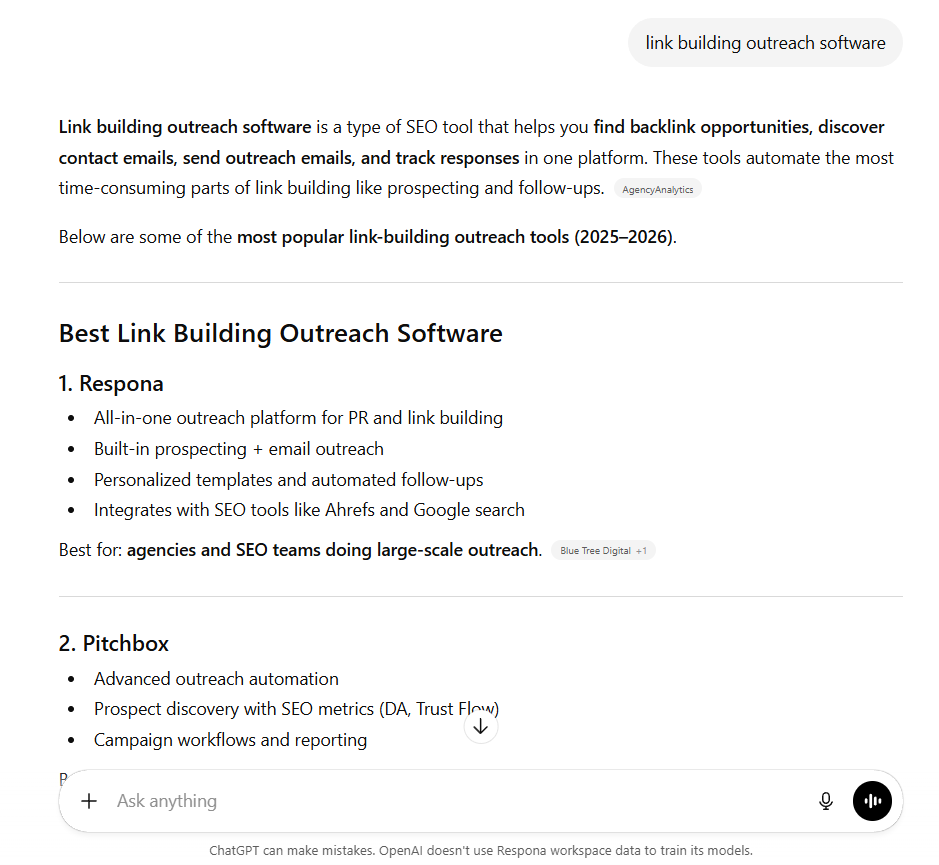
Your ai visibility is 20%. That’s the entire mechanic behind every ai visibility tracker on the market.
The catch is that number is relative, not absolute.
You’re only tracking a small set of prompts, and two people can ask the same question in wildly different ways.
Until Google Analytics officially treats answer engines as their own traffic source, you’re limited to the exact prompts you chose to track.
Pick the ones your actual buyers would ask, not the ones that sound impressive in a report.
That’s the whole model behind the AI visibility tools below: pick your prompts, run them, see what comes back.
Respona
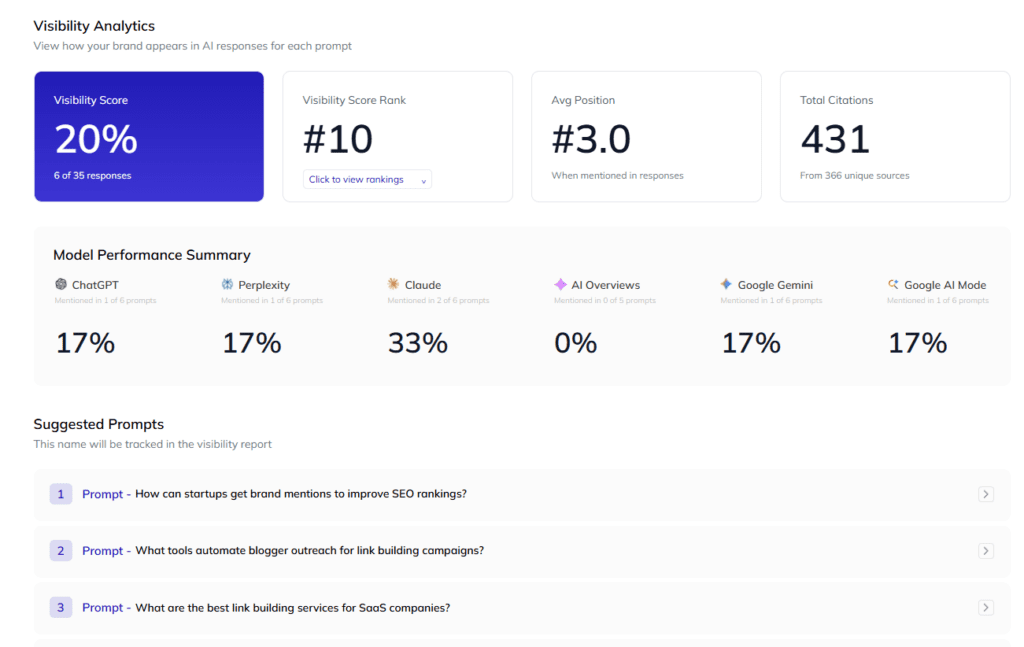
Respona’s ai visibility tracker checks how you’re showing up across six answer engines: ChatGPT, Perplexity, Google AI Overviews, Gemini, Claude, and Google AI Mode.
You hand over the prompts and pages you actually want cited for, and it reports back ai visibility metrics on each one: whether you got mentioned, whether a competitor got the citation instead, and how that visibility data has moved since your last check.
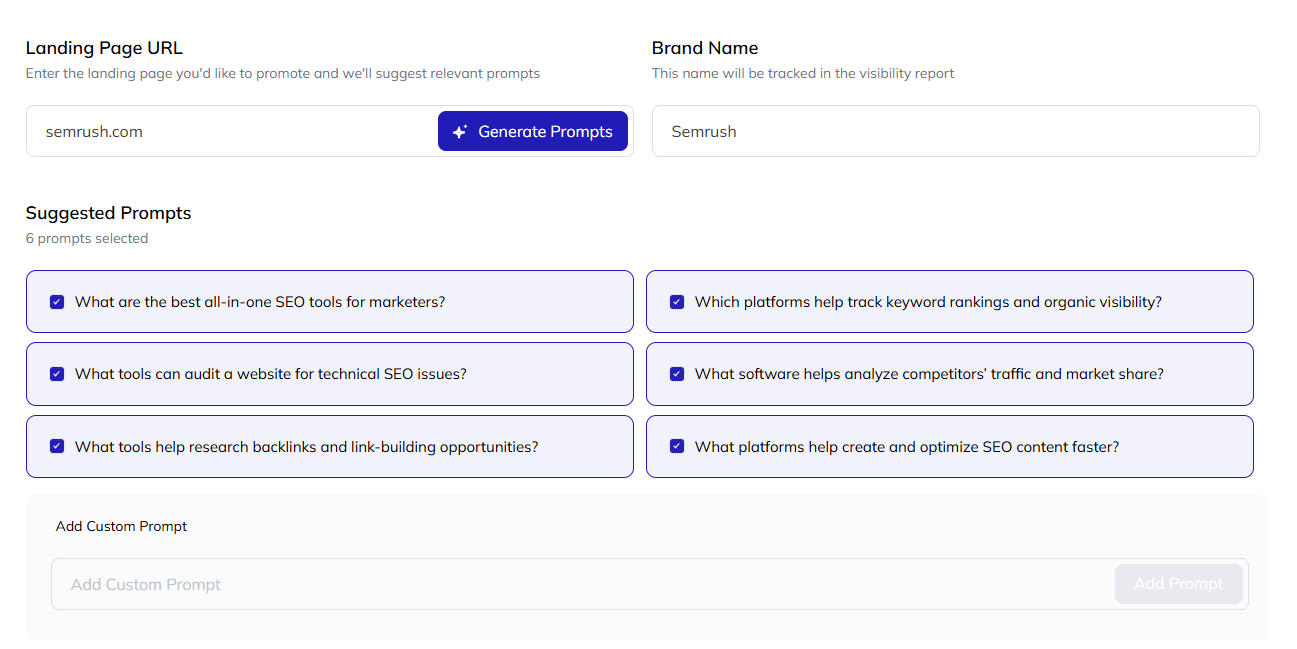
That’s the ai monitoring half. Most tools on this list stop there.
Respona goes further and connects ai visibility findings to an actual action plan: the specific third-party articles already earning citations for your target prompts, plus similar sites worth pitching next.
Instead of just telling you there are visibility gaps, this tool tells you exactly which pages could close them, which is where ai visibility tracking actually turns into results.
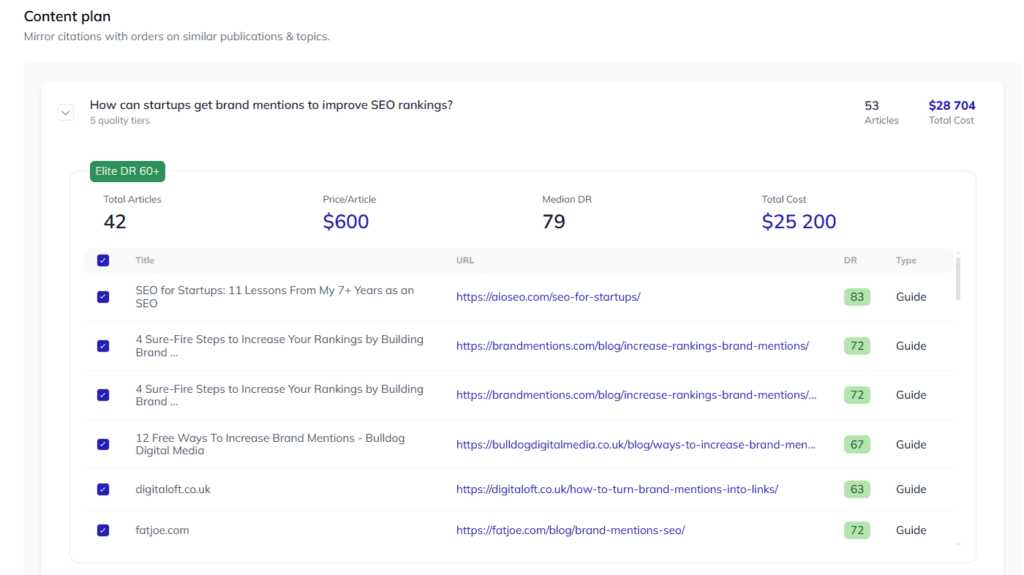
The outreach itself is handled by Respona’s own team, not an automated sequence.
They track down whoever actually runs each target site, make the case for a real collaboration, and stay on it until the placement happens.
What you get back is a genuine editorial mention on a page the ai systems behind these engines already treat as trustworthy, rather than a listing on some directory platform nobody reads.
There’s no retainer here.
You pay per placement, generally somewhere between $100 and $500 depending on the site, and a self-serve tier exists too, though it’s currently limited to AppSumo.
Most of the meaningful work still happens through the managed service.
Profound
Profound is the enterprise pick. It tracks real user prompts, not made-up keyword lists, across ChatGPT, Perplexity, Gemini, Claude, and Google AI Overviews, then layers on competitive benchmarking and prompt-demand data most tools don’t offer.
The catch is pricing: the $99 Starter tier only covers ChatGPT, and the tier that actually opens up multi-platform tracking runs $399/month, with anything beyond that requiring a custom enterprise quote.
It’s built for brands treating AI search visibility as a board-level reporting line, not a side project.
Otterly.ai
Otterly.ai is the budget entry point into this space, and a genuinely usable one. Even the $29 Lite plan tracks four core engines (ChatGPT, Google AI Overviews, Perplexity, Copilot) with unlimited team members and country-level tracking across 50-plus markets.
Gemini and Google AI Mode cost extra as add-ons, so factor that in before comparing prices directly.
It’s a solid fit for solo operators and small teams that just want a clean, shared view of where they stand.
Athena
Athena, more commonly known as AthenaHQ, goes past simple monitoring with its Action Center, which uses automated agents to suggest and help create content that closes specific visibility gaps instead of just flagging them.
It tracks brand mentions and sentiment across eight AI platforms and connects to GA4 and Shopify for teams that want AI citations tied to actual revenue.
Built by former Google Search and DeepMind engineers, it’s aimed at brands with an established content operation already in place, not beginners.
Brandwatch
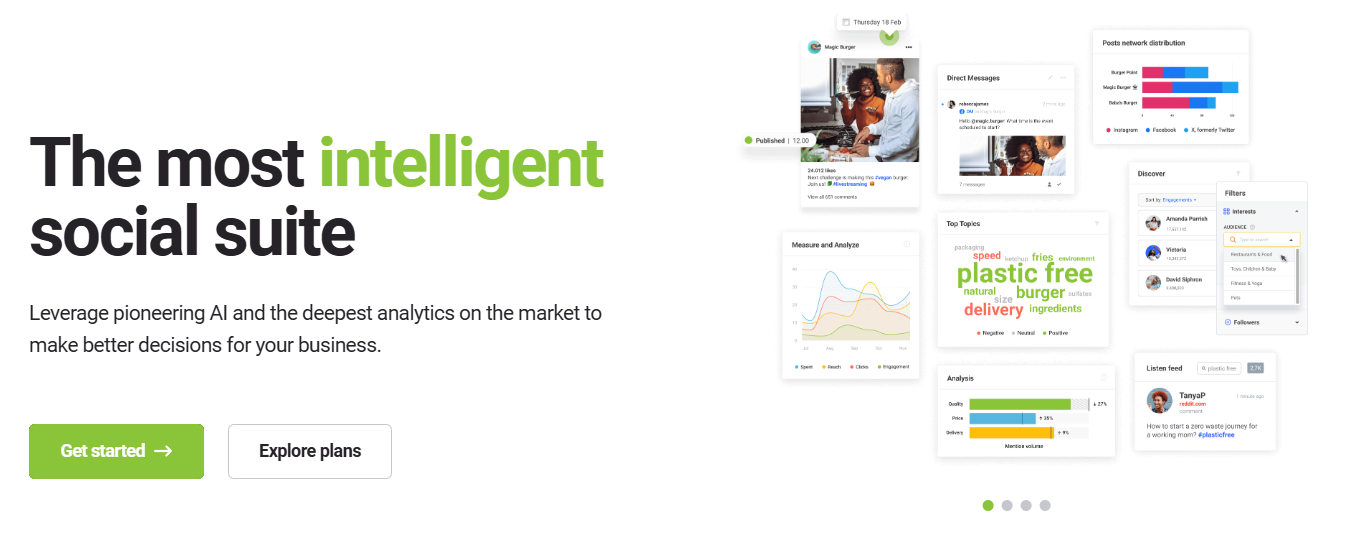
Brandwatch isn’t built specifically for AI visibility, and it’s worth knowing that going in.
It’s a broader social listening and brand intelligence platform that large teams sometimes repurpose to infer AI exposure, using its NLP-driven mention analysis across the wider web.
It won’t show you a ChatGPT citation directly the way a dedicated tracker will, but if a brand is already leaning on Brandwatch for reputation monitoring, it can offer an indirect read on how often the sources AI models cite are talking about them.
Link building cheat sheet
Gain access to the 3-step strategy we use to earn over 86 high-quality backlinks each month.
Now Over to You
Five tools, one shared job: telling you whether ai search is actually mentioning you. Most stop at monitoring and reporting back.
Respona is the one that also goes and does something about what it finds.
Whether you land on Otterly AI for a light monitoring setup or something heavier, the monitoring itself is only half the job.
Pick a tool, run your real prompts through it, and start treating ai search the same way you treat any other channel: checked regularly, not audited once and forgotten.
Frequently Asked Questions (FAQ)
What counts as a good AI visibility score?
There’s no universal benchmark, since every platform in this category defines its own scoring differently, and your score depends entirely on which prompts you chose to track.
A more useful question is whether your number is moving in the right direction against your own baseline and against competitors on the same platform.
How is this different from Scrunch AI or SE Ranking?
Scrunch AI leans enterprise, built for teams tracking large prompt sets and running deeper competitive analysis across every major ai search platform.
SE Ranking folds AI visibility monitoring into an existing SEO suite, so if you’re already using SE Ranking for rankings and audits, it’s a lower-friction add-on rather than a separate platform.
Both Scrunch AI and SE Ranking are solid options for ai search monitoring, they just fit different starting points than a dedicated ai visibility tracker would.
Is Ahrefs Brand Radar worth using alongside a dedicated tracker?
Ahrefs Brand Radar is a reasonable first look if you’re already inside the Ahrefs ecosystem, similar to how Brand Radar functions as a bonus rather than a primary tool for most teams.
It won’t replace a dedicated tracking platform, but it’s a fine way to get an initial read before committing to one.
Does this connect to other reporting tools?
Some tools do.
A handful export visibility data into Looker Studio or tie back to your existing analytics stack so you can see whether a citation actually drove traffic, not just whether it happened.
It’s worth checking before you buy if reporting alongside your existing dashboards matters to you.
What about Surfer’s AI Tracker or Knowatoa?
Surfer AI Tracker and Knowatoa AI are both worth a look if you’re already using either platform for other work.
Neither changes the underlying mechanic though: you’re still running target prompts and checking whether you got cited, the same model every tool on this list follows.
Do I still need a separate rank tracking tool?
Yes, for now.
Rank tracking and AI visibility tracking measure two different things, one covers where you sit on a traditional search engine, the other covers whether an AI system mentions you at all. Most teams run both until rank tracking tools fully absorb this into the same report.
What’s the difference between an AI visibility tool and an AI visibility tracking tool?
Not much in practice, people use the terms interchangeably.
An ai tool in this category typically means anything touching AI search visibility, while an ai visibility tracking tool is usually the more specific term for something that actively runs prompts and logs results over time, rather than just auditing you once.
Does tracking work the same across every AI model?
Not exactly.
Each ai model generates its own ai answer differently, some lean harder on live web results, others lean more on training data, so the same prompt can return different ai responses depending on the platform.
Google’s AI Overview, for instance, tends to lean on your existing organic ranking more than a standalone ai platform like Perplexity does. That’s also why llm visibility across different ai search engines rarely moves in lockstep.
How do I know if I have a real visibility problem or just a small sample?
Track ai activity across enough prompts and enough time before drawing conclusions. A single missed citation isn’t a brand visibility problem, it’s one data point.
Give it a few weeks of ai generated answers and ai generated responses across your tracked prompts before deciding whether there’s an actual gap in your ai presence or ai discoverability, not just noise. That’s also when track ai visibility efforts start to show a real pattern instead of a snapshot.