When it comes to event management, you know that choosing the wrong platform doesn’t just slow you down — it shows up on event day, in registration bottlenecks, disconnected tools, and reporting gaps you don’t catch until it’s too late. But the right one handles everything end-to-end, so your team isn’t firefighting when it matters most.
To help you find the best event management platform, I evaluated 25+ software solutions by analyzing thousands of verified G2 reviews, satisfaction scores, and feature ratings. My goal was to identify tools that actually keep everything working together, from registrations, attendee management, and engagement to post-event reporting.
I also paid close attention to the limitations users mentioned, because the best platform isn’t necessarily the one with the most features; it’s the one your team can rely on when event day arrives. Based on my evaluation, the six platforms that earned a spot on this list are Webex Events & Webinars, Eventbrite, Cvent Event Marketing & Management, vFairs, Whova, and Bizzabo.
Whether you’re an event planner, a marketer, or just someone trying to pull off a seamless experience, this list is for you.
6 best event management software for 2026: My top picks
- Webex Events & Webinars: Best for hybrid conferences and multi-track webinars
Offers customizable registration pages, interactive sessions (Q&A, polls, chat), strong hybrid performance. ($14.50 per user, per month) - Eventbrite: Best for quick event setup and public-facing ticketing
Enables fast event creation, built-in social promotion, HubSpot integration, and mobile check-in. (3.7% + $1.79 service fee per paid ticket and 2.9% payment processing fee per order) - Cvent Event Marketing & Management: Best for enterprise-scale event management
Includes advanced attendee management, detailed reporting, and 24/7 support. (Custom pricing) - vFairs: Best for immersive virtual and hybrid event experiences
Manages 3D exhibit halls, virtual auditoriums, networking lounges, and dedicated project managers. (Custom pricing) - Whova: Best for attendee networking and event engagement
Includes an event app with agendas, attendee profiles, direct messaging, gamified leaderboards, and photo contests. (Custom pricing) - Bizzabo: Best for end-to-end corporate event management
Provides multi-track agenda builder, speaker portal, Klik SmartBadge networking, and Salesforce integration. ($499/user/month)
*These event management software tools are top-rated in their category, according to the latest G2 Summer 2026 Grid Report. I’ve added their standout features and starting price wherever available for easy comparison.
6 best event management platforms I’d recommend in 2026
When you’re managing multiple stakeholders, tight deadlines, and high expectations, the platform you choose becomes the backbone of your entire operation — not just a convenience.
That’s why I focused on tools that go beyond basic task management. The reviews from event professionals I evaluated indicated a need for platforms that could handle event creation, ticket sales, registrations, agenda building, attendee engagement, and post-event reporting, all without requiring a different tool for each job. I also weighed how each platform performed under pressure, because a great onboarding experience means little if the system buckles on event day.
The market reflects this shift in expectations. The global event management software market is projected to reach $17.33 billion by 2030, growing at a 13.2% CAGR, and the platforms driving that growth are those that have moved beyond registration and ticketing into full-cycle event intelligence. Industry confidence backs this up: the American Express survey found that 85% of respondents are optimistic about the year ahead, with AI and analytics topping their investment plans.
For buyers evaluating platforms right now, that context matters. The tools on this list aren’t just well-reviewed; they’re built for where event management is heading.
How did I find and evaluate these event management platforms?
I started by analyzing the latest 2026 G2 Grid Report to identify event management platforms with strong scores across satisfaction, market presence, and feature ratings. That gave me a data-backed foundation of tools that real event professionals consistently rate highly.
From there, I used AI to surface patterns across thousands of verified G2 reviews, identifying recurring themes around ease of use, quality of support, onsite performance, and likelihood to recommend. I prioritized reviews that spoke to real-world usage: how platforms held up during live events, not just in setup. I also looked closely at what users disliked, because friction points at scale tell you more about a platform’s reliability than its feature list does.
Every product on this list was evaluated against the same criteria: registration and ticketing capability, attendee engagement tools, onsite performance, post-event reporting, and integration depth. G2 Data scores, including feature-level ratings across registration, marketing and communications, event operations, and attendee engagement, were used to validate and compare platforms at a granular level.
The screenshots throughout this article are of publicly available material and verified visuals sourced from vendor G2 profiles.
What makes the best event management platforms worth it: My perspective
Here’s what I looked for when deciding whether an event management platform is worth the time, money, and long-term commitment.
- Event website and landing page builder: The event page is where the attendee journey begins. I looked for platforms with drag-and-drop builders, built-in templates, and branding controls that didn’t require a developer to customize. A professional-looking page that matches your brand shouldn’t take three days to build.
- Registration and ticketing management: Manual registration management creates bottlenecks before the event even starts. I prioritized platforms that support multiple ticket types, such as free, paid, and early-bird, along with automated confirmations, waitlist management, and integrated payment gateways. The less your team has to touch manually, the better.
- Agenda and session planning: For multi-track or multi-day events, agenda management can make or break the attendee experience. I looked for platforms that made it easy to build complex schedules, assign speakers, and let attendees create personalized session plans.
- Attendee engagement tools: Engagement doesn’t happen by accident. I evaluated platforms on the strength of their built-in Q&A, live polling, surveys, chat, and push notification capabilities, features that keep attendees active participants rather than passive observers, whether in-person or virtual.
- Marketing and promotion features: I looked for platforms with email marketing, promo code support, social media integrations, and channel-level analytics so organizers can track what’s actually driving registrations, not just how many came in.
- Real-time analytics and post-event reporting: Every event should make the next one better. I prioritized platforms with dashboards that track registrations, attendance, engagement, and feedback in one place and make it easy to export and act on that data after the event wraps up.
- CRM and third-party integrations: Event data is only useful if it flows into the tools your team already uses. I weighted platforms that integrate cleanly with HubSpot, Salesforce, Mailchimp, and Zapier to reduce manual data entry and keep your stack connected.
- Mobile-friendly experience: Attendees live on their phones. I looked for platforms with mobile-optimized event pages and companion apps that give both organizers and attendees a seamless experience from registration through check-in.
The list below contains genuine user reviews from the event management software category. To be included in this category, a solution must:
- Enable the creation of a branded, event-specific landing page or event website
- Provide customizable forms for attendee registration and allow users to manage attendee lists
- Include or integrate with payment processing tools
- Offer event marketing features, such as email marketing, social media marketing, or other means of event promotion
- Include features for the planning and management of on-site events, such as on-site check-in, badge printing, lead retrieval, and floor plans
- Report on event metrics such as attendance, engagement, and ROI via built-in analytics or dashboards
*This data was pulled from G2 in 2026. Some reviews may have been edited for clarity.
1. Webex Events & Webinars: Best for hybrid conferences and multi-track webinars
As I evaluated user reviews for Webex Events & Webinars, the clearest signal across the board was reliability at scale. With a G2 satisfaction score of 91, the highest in this category, it’s the platform that enterprise and mid-market event teams keep coming back to when the stakes are high.
The first thing that stood out to me was how intuitive the platform feels. Many reviewers mentioned they could build event websites, configure registration, and manage sessions without spending weeks learning the platform. That aligns with its 92% Ease of Use score on G2, making it one of the easiest platforms in this category to adopt.
Registration and agenda management are other strengths. Webex scores 93% for Event Creation and 90% for the User Registration Process, and reviewers appreciated how quickly they could customize registration pages, organize multi-session agendas, and keep attendee information centralized throughout the event lifecycle.
For engagement, Webex packs in live Q&A, polling, chat, emoji reactions, and breakout sessions, all within a single interface. G2 reviewers running training programs and large-scale conferences noted that these tools made a measurable difference in keeping participants active rather than passive, with attendee engagement scores sitting at 88% in G2 Data.
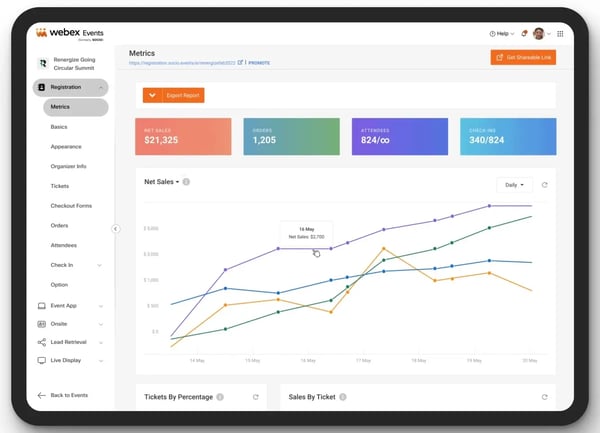
Session scheduling is where Webex particularly excels among the tools on this list, with a G2 Data score of 91%. For multi-track conferences where timing and session flow are critical, this is especially important.
Customer support was another recurring theme across reviews. Users frequently described the support team as responsive and knowledgeable, especially during event setup and live event execution. Combined with a 97% Quality of Support satisfaction score, it’s clear that buyers value having expert help available when timelines are tight.
Post-event, the reporting and recording features add lasting value. Reviewers noted being able to review full session recordings, track attendance, and assess engagement outcomes, giving teams the data needed to improve future events rather than just debriefing on what went wrong.
As some reviewers note, Webex’s comprehensive feature set does come with a learning curve. With so many configurations available, locating specific dashboard settings can take time for new users. That said, most emphasized that the interface becomes intuitive once you’ve run a few events through it, and the depth of features quickly becomes an advantage rather than a hurdle.
On the technical side, reviewers on limited bandwidth or older devices occasionally experienced slow load times and performance lag during live sessions. Webex is a feature-heavy platform, and it shows in its resource requirements. Reviewers were quick to note that these issues were the exception rather than the rule for well-equipped teams.
Webex Events & Webinars holds a 4.6/5 rating on G2, making it the top-rated platform in this category by G2 Score. For teams running large-scale hybrid conferences where reliability, engagement depth, and post-event analytics all matter, it’s the strongest all-around option on this list.
What I like about Webex Events & Webinars:
- The real-time sync between the backend, event website, and app means changes made mid-event propagate instantly: no manual updates across multiple surfaces during a live session.
- Built-in Q&A, polling, chat, and breakout sessions give organizers the tools to keep large audiences engaged without having to stitch together separate tools for each function.
What G2 users like about Webex Events & Webinars:
“Event logistics were easy to access and following our event we can still see attendee engagement and networking. Most found it easy to navigate through the different features and the performance of the app stood up to the entire day without any issues. We had almost 500 people registered to use this app for our one-day event. It’s nice not having to juggle between different platforms because everything is right within the app. The customer support was also very helpful.
– Webex Events & Webinars review, Maile C.
What I dislike about Webex Events & Webinars:
- The platform’s depth means first-time users often spend time hunting for specific settings. The learning curve is real, but most reviewers noted it flattens quickly. And once familiar, the same depth becomes an operational advantage.
- Participants with limited bandwidth or older hardware can experience lag during live sessions, which is worth factoring into pre-event tech checks for global audiences. That said, reviewers running well-equipped setups consistently described the platform as stable and reliable when it counts most.
What G2 users dislike about Webex Events & Webinars:
“Webex Events & Webinars is generally very reliable, but the platform can sometimes feel heavy, especially for participants on limited bandwidth or using older devices. Initial load times and required software updates can occasionally delay the start of a session, which disrupts the flow of training programs. A lighter client option, or stronger performance in the browser-based experience, would greatly improve usability overall, particularly for large-scale education and public training sessions.”
– Webex Events & Webinars review, Hidayatullah.
2. Eventbrite: Best for quick event setup and public-facing ticketing
If you’re looking for a solution that gets an event live fast, with a ticketing and registration experience that attendees already know and trust, Eventbrite is a good option.
Event creation is where Eventbrite is hard to beat. Reviewers described setting up a fully published event page in under two minutes, with step-by-step prompts, built-in templates, and no design experience required. For teams that run frequent events and can’t afford to spend hours in a page builder each time, that speed is a real operational advantage. Eventbrite’s G2 Data event creation score of 93% reflects how reliably this experience holds up across user types.
The event pages themselves are customizable enough to make a strong first impression without a designer in the loop. G2 reviewers highlighted the multi-purpose page layouts and built-in social sharing functionality as features that meaningfully reduced their promotion workload, enabling them to reach broader audiences without pulling in additional marketing resources.
Ticketing is Eventbrite’s core strength, and the numbers back it up. Some reviewers noted that nearly 30% of their ticket sales came through Eventbrite’s own marketplace, a built-in distribution channel that most event platforms simply don’t offer. For public-facing events where discoverability matters, that reach is a differentiator. G2 Data puts Eventbrite’s mobile check-in score at 92%, the highest among the platforms on this list.
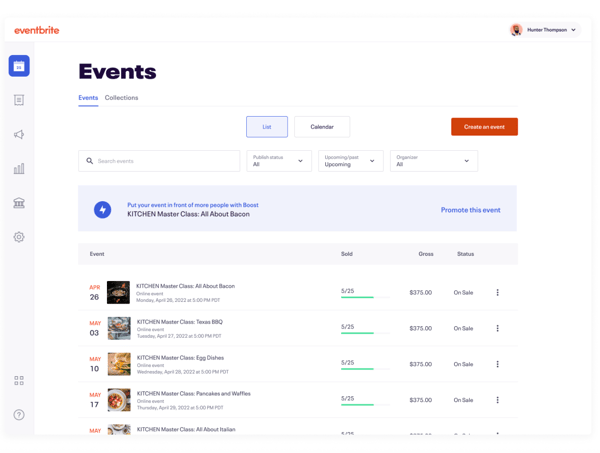
I was also impressed by its CRM integration. Reviewers specifically called out the HubSpot integration as seamless, where registration data flows directly into their CRM without any manual processing, keeping their pipeline clean and their team focused on follow-up rather than data entry. A full-featured API also allows teams to connect Eventbrite with internal systems and other third-party tools.
Attendee communication and analytics round out the core workflow. Reviewers praised the ability to manage registrations, ticketing, and attendee messaging from a single interface, with analytics and attendee insights that help teams understand engagement patterns and improve future event performance.
I also noticed consistent praise for the platform’s ease of use. Eventbrite holds a 91% Ease of Use satisfaction score on G2, and reviewers often described the interface as intuitive enough for first-time organizers while still offering the flexibility needed for recurring events. That shorter learning curve means teams can spend less time figuring out the software and more time planning the event itself.
That said, Eventbrite’s pricing structure is a recurring point of friction in G2 reviews, particularly for smaller organizations or teams running high-frequency events. Per-ticket service fees add up quickly, and some reviewers found the cost difficult to justify against tighter budgets. But many reviewers pointed to Eventbrite’s free tier for free events, which gives smaller teams a low-risk entry point before committing to paid plans.
Reporting is another area where G2 reviewers flagged limitations. Combining Eventbrite data with external analytics, especially when tickets are sold across multiple channels, can feel cumbersome, and the ads reporting was specifically called out as underdeveloped. For teams with straightforward single-channel reporting needs, this is rarely an issue; for those running complex multi-channel campaigns, it’s worth knowing upfront.
Overall, Eventbrite holds a 4.3/5 rating on G2. For event teams that prioritize fast setup, built-in audience reach, and a ticketing experience attendees already trust, it’s the most frictionless entry point on this list.
What I like about Eventbrite:
- The event creation flow is genuinely fast. Reviewers described going from a blank page to a published event in minutes, with no design or technical skills required.
- Eventbrite’s own marketplace drives real ticket sales. For some organizers, with nearly 30% of tickets sold through the platform’s discovery feed, the platform serves as both a management tool and a distribution channel.
What G2 users like about Eventbrite:
“I am interested in concerts and concert tours all across the USA, paying particular attention to Denver, CO, Baltimore, DC, Tampa Bay, and Charlotte, NC. Eventbrite is constantly sending me emails with news of the latest concert tours, bands, and artists. Getting these emails gives me a better chance of getting a good seat at a show I want to go to.”
– Eventbrite review, Robert M.
What I dislike about Eventbrite:
- Per-ticket service fees can add up quickly for teams running frequent or high-volume events. For organizations on tighter budgets, the free tier is a reasonable starting point, and for paid events with healthy margins, the trade-off against Eventbrite’s built-in reach often works in organizers’ favor.
- Combining Eventbrite’s reporting data with external analytics platforms takes more manual effort than it should, particularly for multi-channel ticket sales. For teams with straightforward reporting needs, the built-in analytics are sufficient, and the attendee insights dashboard gives organizers a solid post-event baseline to work from.
What G2 users dislike about Eventbrite:
“Eventbrite is an expensive service when one has to cover extensive and regular events within a strained budget since this company charges the fees rather rapidly. Event pages customization also tends to be rather restricted and it may then be challenging to make an entirely branded experience that would correspond to our organizational appearance.”
– Eventbrite review, Sabina K.
3. Cvent Event Marketing & Management: Best for enterprise-scale event management
Cvent Event Marketing & Management is purpose-built for organizations running complex event programs at scale. With a G2 Score of 89, Cvent is the default choice for enterprise event teams that need a single platform to manage the full event lifecycle without stitching together separate tools.
Based on my understanding, reviews like how Cvent handles event websites, registration, attendee communications, on-site logistics, and post-event reporting in one place. For organizations managing multiple simultaneous events across large teams, the ability to control data accuracy and branding consistency from a single account is an operational advantage.
Registration customization is where Cvent particularly excels. G2 reviewers described building custom registration paths with widgets, data tags, and custom contact fields to capture exactly the information needed from different attendee types. Automated email responses triggered by registration actions further reduce manual communication work. G2 Data puts Cvent’s user registration process score at 87%, reflecting how consistently this holds up across complex event configurations.
Attendee management is another standout capability. Users appreciated being able to organize thousands of attendees, process bulk uploads, update participant information in batches, and segment audiences for personalized communication. That centralized approach helps enterprise teams spend less time managing spreadsheets and more time delivering better event experiences.
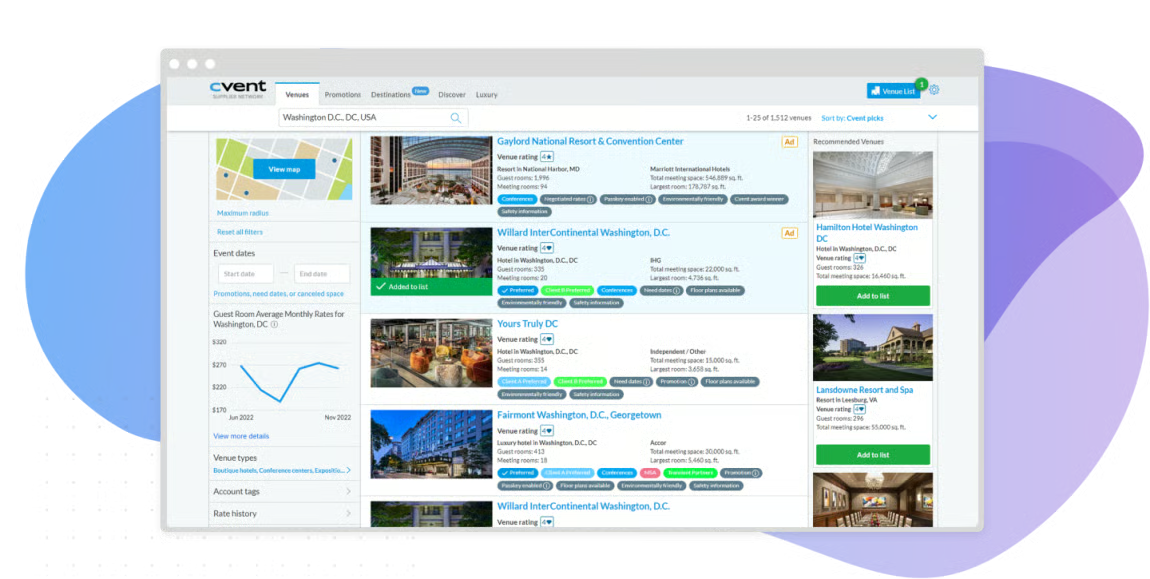
Many reviews appreciate Cvent’s reporting capabilities, which allow teams to generate detailed, segmented reports and share them via web portals with stakeholders who don’t have Cvent access, a practical feature when leadership needs updates without logging into a new system. Reviewers also called out CventIQ, the platform’s AI layer, for helping generate event content and session summaries that save planners meaningful time during build-out.
Support quality rounds out Cvent’s enterprise credentials. G2 reviewers consistently praised 24/7 availability across phone, chat, and case submission, with fast response times and support reps who could troubleshoot confidently even during live event escalations. G2 Data puts Cvent’s Quality of Support score at 89%.
Cvent’s depth comes with a learning curve that G2 reviewers were candid about. The volume of features, configuration layers, and backend settings can feel overwhelming for new users, and some advanced customizations require either technical assistance or dedicated product training. That said, reviewers were equally consistent that familiarity with the platform pays off once the initial ramp is behind them. Teams described the same depth as a competitive advantage for managing complex programs.
Some users also pointed out that certain legacy components, including badge design tools and parts of the website builder, could benefit from a more modern interface. Even so, reviewers generally agreed that these limitations have little impact on Cvent’s core strengths, especially for organizations prioritizing robust registration management and enterprise-scale event operations.
Overall, Cvent Event Marketing & Management earns 4.3/5 stars on G2 and remains one of the most comprehensive event management platforms available. Its highly configurable registration workflows, powerful attendee management, enterprise reporting, and dependable customer support make it an excellent choice for organizations managing large conferences, multi-event programs, and complex event portfolios.
What I like about Cvent Event Marketing & Management:
- The full-lifecycle coverage means teams managing complex events don’t have to context-switch between platforms, registration, communications, on-site logistics, and reporting, all live in one place.
- Session-level attendee communication is a differentiator. The ability to send tailored follow-ups based on which sessions individual attendees did or didn’t attend takes post-event engagement well beyond what most platforms support.
What G2 users like about Cvent Event Marketing & Management:
“Cvent Attendee Hub strikes a strong balance between ease of use and robust engagement capabilities. The platform feels intuitive for attendees, which reduces friction and limits the need for support, while still providing interactive tools such as live polling, Q&A, chat, and agenda personalization. It performs especially well in hybrid event settings by delivering a cohesive experience for both virtual and in-person audiences. In addition, the ability to send real-time updates and monitor engagement metrics offers useful insights that can help refine and improve future events.”
– Cvent Event Marketing & Management review, Kelly B.
What I dislike about Cvent Event Marketing & Management:
- The volume of features and configuration layers creates a real onboarding challenge for new users. The learning curve is steep, but reviewers who pushed through it consistently described the platform’s depth as a long-term advantage, particularly for teams managing multi-track or multi-event programs.
- Some reviewers felt the badge designer and parts of the website builder could be more modern. Even so, most agreed these were minor tradeoffs compared to Cvent’s powerful registration and event management capabilities.
What G2 users dislike about Cvent Event Marketing & Management:
“Cvent’s biggest downside is pricing. The platform is powerful, but the cost can feel excessive for what you actually get, especially once you factor in add-ons, limited integrations, and transaction fees. The pay-as-you-go model becomes expensive quickly, and charges like $3.95 plus 1.95% per ticket can add up fast on higher-volume events. It’s a capable platform, but the pricing structure makes it harder to justify for organizations trying to run events efficiently without getting nickel-and-dimed.”
– Cvent Event Marketing & Management review, Elsworth L.
4. vFairs: Best for immersive virtual and hybrid event experiences
If you’ve ever tried cobbling together webinars, booths, and networking tools from a bunch of platforms, you know how messy it gets. With vFairs, it’s all under one roof.
The virtual event experience is where vFairs shines. Reviewers frequently highlighted its customizable virtual lobbies, exhibit halls, auditoriums, and networking lounges that create a more engaging experience than standard webinar platforms. Rather than simply joining a video session, attendees can explore a fully branded event environment that feels closer to an in-person experience.
Setting up those experiences also seemed easier than I expected. Many users appreciated being able to build event websites, manage registrations, and configure sessions without extensive technical expertise. Combined with its 92% Ease of Use satisfaction score on G2, vFairs strikes a strong balance between flexibility and accessibility.
From what I read in reviews, the dedicated project manager support is what sets vFairs apart. Every reviewer who mentioned support described having a named project manager available throughout planning, build, and live event execution, who responded quickly, handled last-minute changes, and provided live troubleshooting on event day. G2 Data reflects this: vFairs holds the highest Quality of Support score in this category at 98%, and reviewers across the board described their project managers as a valuable factor in their event’s success.
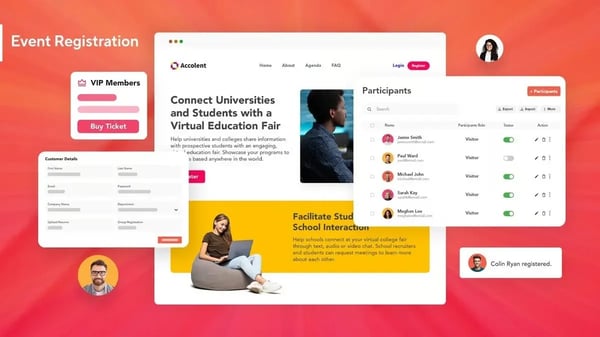
The event app and attendee experience tools are well executed on both desktop and mobile. Reviewers highlighted built-in agenda management, real-time updates, attendee connection features, and push notifications, all accessible through a single app interface that attendees could navigate without guidance. Many reviewers also liked attendee directories, one-on-one meeting scheduling, live chat, and discussion spaces that make it easier for participants to connect throughout the event.
Email communication and built-in survey tools drew consistent praise from organizers managing multi-touchpoint event programs. Reviewers appreciated the ease of building and sending targeted email communications within the platform, as well as the surveys and gamification features that kept attendees engaged before, during, and after the event.
Registration and analytics round out the core workflow. Reviewers called out the real-time analytics dashboard, specifically its ability to track registration numbers by registrant type, which gave teams an accurate picture of event momentum during the build-out phase. G2 Data puts vFairs’ online registration score at 89%.
Some G2 reviewers noted that booth setup and graphical templates can feel restrictive. Getting graphics to fit properly within template constraints occasionally requires back-and-forth with the vFairs team. The flip side is that the same team is highly responsive to those requests, and most reviewers described the collaborative customization process as smooth once the workflow was established.
A few reviewers also mentioned occasional technical hiccups during live events or felt the mobile experience wasn’t quite as polished as the desktop version. Even so, most emphasized that these issues were infrequent and quickly addressed by the support team, leaving their overall experience largely unaffected.
vFairs holds a 4.7/5 rating on G2. For organizations that want an immersive virtual or hybrid event environment and a support model that treats every event as a partnership, it’s the most service-forward platform on this list.
What I like about vFairs:
- The immersive environment, virtual auditoriums, 3D exhibit halls, and networking lounges create an attendee experience that stands apart from standard video conferencing, and reviewers consistently noted that attendees noticed the difference.
- The dedicated project manager model means teams aren’t navigating setup and live event execution alone. Having a named, responsive contact throughout the process is a genuine operational advantage, especially for first-time virtual event organizers.
What G2 users like about vFairs:
“What stood out most was the responsiveness of the team and how flexible the platform was throughout the planning and execution process. We were managing a fairly involved virtual event, and vFairs gave us the tools we needed while their team stayed engaged and solution-oriented the entire time.”
– vFairs review, Brian Z.
What I dislike about vFairs:
- Booth setup and graphical templates have constraints that can make custom branding fiddly. The vFairs team handles these adjustments responsively, and most reviewers found the iterative process straightforward once the working relationship was established.
- Some reviewers reported occasional technical glitches or a less polished mobile experience, but most agreed these were minor issues that didn’t affect the platform’s overall reliability.
What G2 users dislike about vFairs:
“We could get more notification when they were doing updates to their system. This was frustrating during the build. The size limitation on handouts is small for some of the presentations, and the system wasn’t designed to accommodate downloads. I think that should be a customizable feature. Sometimes the instructions were not updated timely in the help section.”
– vFairs review, Cynthia Z.
Want to keep attendees engaged on the go? Check out the best mobile event apps for a seamless event-day experience.
5. Whova: Best for attendee networking and event engagement
With a G2 Score of 84 and a satisfaction score of 94%, Whova earns its place on this list by doing something most event platforms treat as secondary — making the attendee experience genuinely intuitive and social, from agenda planning through post-event networking.
From everything I evaluated, Whova stands out for helping attendees get more value from the event itself. Across G2 reviews, users consistently praised the platform for making it easier to discover sessions, connect with other attendees, and stay engaged before, during, and after the event.
Clearly, attendee networking is Whova’s defining strength. The platform provides attendees with structured ways to find and connect with one another by browsing profiles, sending direct messages, scheduling one-on-one meetings, and joining community boards organized around shared interests. For conferences where peer connection is a core part of the value proposition, this matters. G2 Data puts Whova’s attendee networking score at 96%, the highest in this category.
Agenda management benefits both organizers and attendees. Reviewers described building personalized session schedules in advance, receiving real-time updates when rooms or times changed, and receiving reminders that kept them on track throughout multi-day events, without constantly checking the app.
Reviewers who attended events as speakers described logging in to the platform and landing directly in a Speaker Hub with their session front and center, registration numbers visible, and tools for polling the audience, reviewing submitted questions, and messaging fellow speakers, all on one screen. That kind of role-specific clarity reduces friction for speakers who don’t have time to learn a new platform the morning of their session.
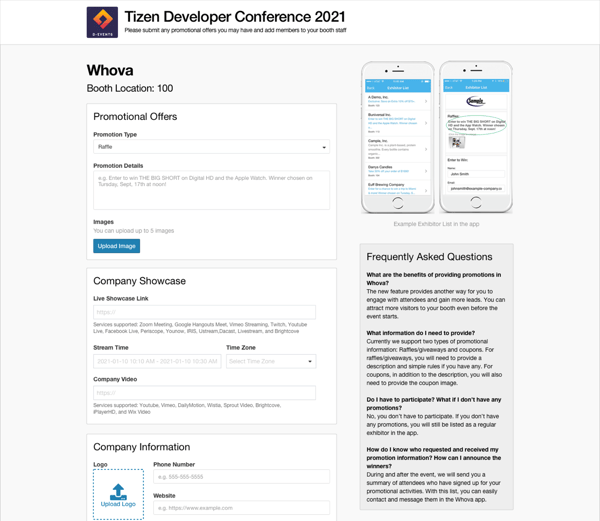
Engagement tools are built into the core product rather than bolted on. Live polling, Q&A, community boards, gamified leaderboards, and photo contests give organizers multiple ways to keep attendees active throughout the event, not just during sessions. Reviewers noted that these features led to measurably higher participation than at previous events without a dedicated engagement layer.
Information distribution is another consistent highlight. Reviewers managing fellowship programs, academic conferences, and multi-track professional events praised Whova’s ability to get the right information into attendees’ hands quickly, including schedules, vendor contacts, session materials, and post-event recordings, all accessible from one app. G2 Data puts Whova’s information distribution score at 93%.
That said, while the mobile app is well-optimized and central to the Whova experience, that dependency can create friction in low-connectivity environments. Reviewers noted that without reliable internet access, real-time updates didn’t sync. Though they were equally consistent, once connectivity was restored, the app caught up quickly and performed well.
Navigation within specific sections, particularly the attendee directory and community boards, could use better filtering and sorting controls. A few reviewers found tracking down specific notifications or browsing large attendee lists more click-heavy than necessary. That said, the overall navigation structure drew consistent praise for its common-sense layout, and most users described the app as easy to follow from the first time they opened it.
Whova has earned a 4.8/5 average rating on G2. For conference organizers who want attendees to walk away having made real connections, not just having sat through sessions, it’s the most engagement-focused platform on this list.
What I like about Whova:
- The attendee networking infrastructure, including profiles, direct messaging, meeting scheduling, and community boards, gives conferences a social layer that most platforms don’t prioritize. With a 96% G2 Data score for attendee networking, it’s the strongest in the category on this dimension.
- The agenda management experience is built for both organizers and attendees. Personalized schedules, real-time session updates, and reminders work together to keep multi-day conference navigation stress-free.
What G2 users like about Whova:
“Ease of use – it is super clear what to do and where to find the information you need. I was a speaker at a recent event and when logging in it opened right to the Speaker Hub which had my session front and center and I could see how many people registered for the session, and click through to see who they were.”
– Whova review, Donna K.
What I dislike about Whova:
- The app’s real-time sync depends on a stable internet connection. In low-connectivity environments, updates don’t come through until connectivity is restored. For most indoor conference venues, this rarely becomes an issue, and reviewers noted the app recovered quickly once back online.
- Filtering and sorting within the attendee directory and community boards require more clicks than are necessary for large events. It’s a navigational friction point rather than a functional gap, and reviewers consistently noted that the overall app layout remains intuitive once the initial orientation is complete.
What G2 users dislike about Whova:
“I disliked that whenever I went into specifics about an agenda item, it would take me back to the full agenda instead of my agenda (if I have that right). I really wish there was a way to bookmark meet-ups instead of just adding them to my agenda to track/RSVP, and I really wish there was a searchable way to find a meet-up I saw previously. I spent a lot of time scrolling to find meetups I remembered I was interested in. Also, would like a way to disable notifications for select meet-ups. If I made one comment, I kept getting notifications on meetups I simply said hi in versus those I really wanted to track. It became overwhelming at times.”
– Whova review, Michelle M.
Mid-sized companies have a distinct set of priorities when it comes to event registration. Here’s how G2’s mid-market segment data identifies the best event registration software across satisfaction, support, and ease of use.
6. Bizzabo: Best for end-to-end corporate event management
The biggest strength I found with Bizzabo wasn’t a single feature; it was how smoothly the platform connects every stage of the event lifecycle. G2 reviewers highlighted its ability to unify registration, marketing, attendee engagement, and analytics, providing event teams with a single place to manage corporate events from start to finish.
The multitrack agenda builder is a standout capability for organizations running parallel-session conferences. Reviewers managing events with four simultaneous rooms described attendees building personalized schedules from the full program, receiving session reminders, and adjusting plans in real time, a functionality that previously required a custom-built app. For standard single-track events, the setup is straightforward enough that most team members can configure it without dedicated training. G2 Data puts Bizzabo’s multitrack agenda score at 89%.
The speaker portal is one of the most practically useful features reviewers highlighted. Rather than chasing speakers via email for headshots, bios, and session details, the portal gives each speaker their own login to upload materials and manage their session information directly. Deadline reminders are automated, eliminating the manual follow-up cycle that consumes hours of event coordinator time per event cycle.
Onsite check-in and badge printing are executed with the operational precision corporate events demand. Reviewers described the on-demand kiosk and batch printing modules that link directly to on-site wireless printers, enabling attendees to scan their confirmation QR code and print their badge in seconds. This eliminates entrance queues and the registration bottlenecks that derail event-day momentum.
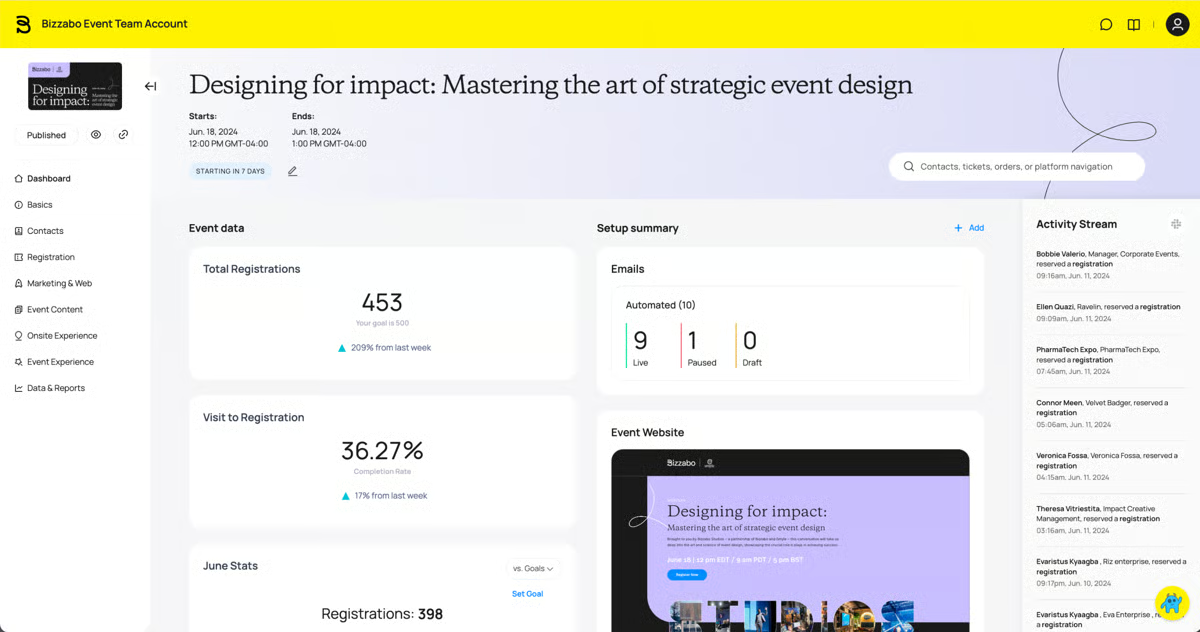
Many reviewers specifically mentioned the Klik SmartBadge wearable networking system. With this feature, attendees can exchange contact information by tapping badges together — no phone scanning, no app fumbling — resulting in more networking interactions that organizers can track. The AI-powered networking matchmaker complements this by automatically connecting attendees with shared interests, driving engagement without requiring manual facilitation.
I also noticed how frequently Salesforce integration is praised for its directness and ease of implementation. Reviewers described mapping ticket sales, attendee check-in status, and participation data directly to lead records without custom webhook code or data-mapping scripts, and a clean field-matching interface that keeps the sales pipeline current without manual intervention.
However, there are some limitations. Reviewers noted that the website and email builders are template-driven, which makes the platform restrictive for design teams wanting custom CSS overrides or layouts beyond the preset blocks. The email editor specifically drew criticism for feeling dated. Multicolumn HTML layouts frequently broke alignment on mobile, and the canvas engine lacks the flexibility of modern dedicated email tools. That said, for teams whose branding needs fit within Bizzabo’s template framework, the out-of-the-box design quality is polished and professionally credible without additional customization.
Cross-event analytics reporting requires more manual work than it should for teams managing large event programs. Comparing performance metrics across multiple events currently means exporting separate CSV files and merging them externally, a workflow gap that reviewers flagged as a friction point for reporting to leadership. The individual event dashboards are well-constructed and centralized, making single-event performance analysis straightforward.
Bizzabo holds a 4.3/5 rating on G2. For corporate event teams running multi-track conferences, large hybrid programs, or high-volume onsite events where the registration-to-pipeline connection matters, it’s the most operationally complete platform on this list.
What I like about Bizzabo:
- The speaker portal removes the most time-consuming manual coordination task in pre-event planning. Automated deadline reminders and direct upload access for speakers alone save event teams hours per event cycle.
- The Klik SmartBadge networking system turns badge scanning into a measurable engagement metric. Reviewers reported an increase in networking interactions at events where Klik was deployed, and the data feeds directly into post-event reporting.
What G2 users like about Bizzabo:
“I like the API flexibility of Bizzabo. Our development team specifically wanted to know about this before we committed, and it has delivered on what was promised. We can pull event data into our website to display upcoming events, synchronize registrations with our CRM in real-time, and build custom integrations with internal tools faster than expected. The API is well-documented and works as it says, which separates Bizzabo from other tools that look similar but lock you into their own ecosystem. Also, the platform is accessible enough for the marketing team to customize event page colors and basic elements without developer involvement, which is convenient for us.”
– Bizzabo review, Hudyakova I.
What I dislike about Bizzabo:
- The website and email builders are template-constrained, which frustrates design teams trying to implement precise custom branding. For organizations whose visual identity fits within Bizzabo’s preset frameworks, the out-of-the-box polish is strong — and the platform’s operational depth far outweighs the design flexibility trade-off for most corporate event use cases.
- Comparing performance metrics across multiple events requires manually exporting and merging data, which adds friction for teams reporting across a full event program. The individual event dashboards are well-built and provide organizers with a solid single-event baseline, and the Salesforce integration ensures pipeline-level event data stays current without manual intervention.
What G2 users dislike about Bizzabo:
“I think Bizzabo needs improvement with its built-in event website builder and agenda layout tools. Both tools can feel incredibly clunky. The basic templates work fine for simple landing pages, but when trying to design a highly customized multi-track agenda view with specific multi-zone branding, the layout editor becomes very fiddly. Elements of a draft appear awkwardly on mobile screens and it requires a lot of trial and error tweaking to get things looking clean. There needs to be an update to the website editor with a more fluid and intuitive drag-and-drop grid system.”
– Bizzabo review, Aslam H.
Frequently asked questions (FAQs) about the best event management platforms
Have more questions? Find more answers below.
Q: Which event management platforms offer reliable support and predictable product roadmaps without disrupting existing workflows?
vFairs and Webex Events & Webinars are the best options here. vFairs assigns a dedicated project manager to every account, providing teams with a consistent point of contact throughout planning and live execution. Webex benefits from Cisco’s enterprise infrastructure and integrates cleanly into existing workflows without requiring teams to restructure their operations.
Q: Which event management platform solutions avoid vendor lock-in and implementation complexity without disrupting existing workflows?
Eventbrite and Whova are the lowest-friction options on this list. Both platforms are self-serve from setup through post-event reporting, with standard integrations that connect to existing tools without custom development. Neither requires dedicated vendor implementation support to get started.
Q: Which event management platforms have strong adoption rates and minimal learning curve while meeting enterprise security requirements?
Whova and Bizzabo are good options. Whova’s interface is frequently described by G2 reviewers as intuitive from the first time it’s opened. Bizzabo supports SAML single sign-on, allowing enterprise teams to onboard staff using existing corporate credentials, keeping security compliance and fast adoption in sync rather than at odds.
Q: Which event management platform solutions integrate with existing tools without custom development?
Bizzabo and Cvent lead here. Bizzabo’s Salesforce integration maps attendee and ticketing data to lead records through a clean field-matching interface without API scripting. Cvent connects with Salesforce, Swapcard, and a broad range of enterprise tools out of the box. Eventbrite’s HubSpot integration is also worth noting for marketing-focused teams.
Q: Which event management platforms are most reliable for event managers at event services companies based on reviews?
Cvent and vFairs are the most consistently cited by event services professionals. Cvent’s depth of features supports complex, multi-event programs, while vFairs’ dedicated project manager model is particularly valued by teams coordinating events on behalf of clients where live execution support directly affects outcomes.
Q: Which event management platforms ease onboarding for non-technical team members?
Eventbrite and Whova are the most accessible for non-technical users. Eventbrite’s step-by-step creation flow gets new users to a published event page in minutes. Whova’s organizer interface uses clear navigation that most team members can manage without formal training or IT involvement.
Q: What are the top event management platform solutions for teams of 11–50 employees needing quick team adoption and measurable ROI?
Eventbrite and Whova are the strongest fits for smaller teams. Eventbrite’s built-in marketplace drives organic ticket discovery, delivering measurable ROI without additional marketing spend. Whova’s engagement tools deliver outsized attendee engagement for smaller teams without requiring a large operations staff to manage them.
Q: What are the best event management platforms for event managers with limited implementation time and budget?
Eventbrite and Whova are the most implementation-friendly options here. Eventbrite can take an event from a blank page to published in under two minutes. Whova is fully self-serve from setup through reporting, with a free tier available for qualifying events.
Q: Which event management platforms are most trusted by event managers at companies with 11–50 employees based on user reviews?
According to G2 reviews, Eventbrite, Webex Events & Webinars, and Whova earn high satisfaction from smaller event teams thanks to their ease of use, dependable performance, and ability to support professional events without excessive administrative overhead. They offer a strong balance of functionality and usability for growing organizations.
Q. Which are the highest-rated event management platforms for event managers meeting tight deployment deadlines?
Webex Events & Webinars and Eventbrite are the best options when time is tight. Webex supports rapid setup with customizable registration templates that experienced event managers can move through quickly. Eventbrite’s sub-two-minute event creation makes it the fastest from zero to live on this list.
Find the event management platform that works as hard as you do
The six platforms on this list aren’t here because they have the longest feature lists — they’re here because G2 reviewers who’ve used them under real event conditions said they held up. That’s the filter that matters at the decision stage.
Before you commit, request a demo using your actual event specifications, not a generic walkthrough. Bring your actual attendee numbers, integration requirements, and on-site setup. That’s when the platform either proves itself or shows its gaps.
Don’t finalize any tool until you’ve stress-tested the check-in flow, confirmed your CRM integration works without custom development, and verified that support is reachable during live event hours, not just during business hours.
Locked in your platform? To make sure the rest of your stack is just as solid, start with our guide to the best event planning software to close any gaps before your next event.