Key takeaways:
- ESG reporting software development cost in Australia ranges from roughly AUD 70,000 for a basic MVP to AUD 700,000 or more for an AI-powered enterprise platform.
- Regulatory timing under AASB S1 and S2 means Group 2 and Group 3 entities should architect for the full phased rollout now to avoid a costly rebuild later.
- Hidden costs, particularly data cleansing, supplier data collection, and assurance preparation, frequently exceed the original software budget.
- Modular, API-first architecture allows enterprises to sequence investment against actual compliance deadlines rather than over-building on day one.
The corporate sustainability landscape in Australia has shifted permanently from voluntary, marketing-driven disclosures to strict, legally binding compliance. With the introduction of the Australian Sustainability Reporting Standards (ASRS), overseen by the Australian Accounting Standards Board (AASB), enterprise leadership teams face an immediate challenge. Legacy enterprise resource planning (ERP) frameworks and manual spreadsheets cannot handle the granular data capture required for modern compliance.
For CFOs and CIOs, this shift has turned ESG (Environmental, Social and Governance) reporting from a communications exercise into an engineering problem. Off-the-shelf software regularly falls short for Australian companies because it cannot easily adapt to local National Greenhouse and Energy Reporting (NGER) requirements, complex regional supply chains, and rigid domestic data systems.
For large organisations in Australia, building custom infrastructure is becoming the standard approach to guarantee data ownership, long-term system flexibility, and audit readiness. However, when considering to build custom ESG reporting software, businesses first wonder how much would it cost to build ESG reporting software in Australia.
On average, ESG reporting software development cost in Australia typically ranges between AUD 70,000 and AUD 700,000 or more. But it is not a fixed number. The actual cost varies, depending on the number of frameworks supported, the depth of Scope 3 tracking, integration complexity, and how much of the assurance and audit trail work is automated versus manual.
This blog breaks down what drives that range, where budgets quietly blow out after go-live, and what questions should shape a build decision before a single line of code is written.
Understand Your ESG Software Investment Before You Build
Every ESG initiative has different reporting obligations, integration needs, and compliance timelines. Share your vision with us to estimate the right budget.

How Much Does ESG Reporting Software Development Cost in Australia?
Every enterprise has different baseline needs, shifting the overall software development cost in Australia based on organisational complexity, data endpoints, and audit requirements. A basic platform designed for mid-market compliance costs less than an AI-driven system built for a global supply chain.
The table below breaks down the estimated budgets and delivery timelines for custom ESG reporting software development cost in Australia:
| Software Type | Estimated Cost (AUD) | Timeline |
|---|---|---|
| Basic ESG Reporting MVP | 70,000 – 150,000 | 4–6 months |
| Mid-Market ESG Platform | 150,000 – 300,000 | 6–9 months |
| Enterprise ESG Reporting Solution | 300,000 – 550,000 | 9–14 months |
| AI-Powered Enterprise ESG Platform | 550,000 – 700,000+ | 12–18 months |
A basic MVP generally covers Scope 1 and 2 tracking, a single framework, and manual data entry with light validation. It suits Group 3 entities preparing for their 2027 obligations with a narrow initial scope. At the enterprise end, the build includes multi-framework mapping, Scope 3 supplier data collection portals, immutable audit logging, and integration with ERP, HRIS, and procurement systems.
These cost figures match custom software development benchmarks across Australia, taking into account specialised engineering talent, local data privacy requirements, and the complex data logic needed for institutional compliance.
ESG Budget Allocation by Software Development Life Cycle (SDLC) Phases
Breaking down costs by development stages allows enterprise financial controllers to set clear funding milestones, manage cash flow efficiently, and ensure engineering quality checks are passed before releasing the next round of capital.
The table below outlines the percentage and typical budget allocation across the ESG reporting software development process for a standard mid-to-enterprise level solution:
| Development Stage | Percentage Allocation | Cost Range for a Core MVP (AUD) | Cost Range for a Deep Enterprise Solution (AUD) | Deliverables & Focus |
|---|---|---|---|---|
| Discovery & Architecture Design | 15% | AUD 10,500 – AUD 22,500 | AUD 52,500 – AUD 105,000 | Functional specifications, AASB data mapping models, UI/UX prototypes, and cloud infrastructure planning. |
| Core Code & Backend Engineering | 45% | AUD 31,500 – AUD 67,500 | AUD 157,500 – AUD 315,000 | Database construction, custom NGER emission calculation engines, API integrations, and supplier portal development. |
| Quality Assurance & Regulatory Audit | 20% | AUD 14,000 – AUD 30,000 | AUD 70,000 – AUD 140,000 | Automated testing pipelines, data security vulnerability assessments, and calculation logic validation against official standards. |
| Deployment & Enterprise Integration | 10% | AUD 7,000 – AUD 15,000 | AUD 35,000 – AUD 70,000 | Cloud production environment setup, data sovereignty compliance validation, and initial legacy system data migration. |
| Post-Launch Handover & Team Training | 10% | AUD 7,000 – AUD 15,000 | AUD 35,000 – AUD 70,000 | Executive user onboarding, change management documentation, technical training for compliance teams, and early system optimizations. |
| Total Cumulative Build Cost | 100% | AUD 70,000 | AUD 700,000 | Fully functional custom ESG platform tailored to Australian enterprise compliance parameters. |
Regulatory Drivers: Why Australian Enterprises Are Building Custom ESG Systems
Evolving federal regulations mean corporate boards face legal risks if their data collection lacks clear proof, making custom systems a necessity rather than an optional project.
The Phased Rollout of AASB S1 and S2
Australia’s mandatory climate reporting framework requires large companies to disclose climate risks and energy metrics under standards aligned with the International Sustainability Standards Board (ISSB). The rollout impacts organisations based on specific revenue, asset, and employee thresholds. Group 1 entities must report first, followed quickly by Group 2 and Group 3 companies.
Because these requirements expand over time, rigid off-the-shelf software often struggles to keep up. Custom systems give companies full control over their reporting logic, allowing them to adjust rules as regional compliance details shift.
The Scope 3 Trap
Tracking indirect value chain emissions is a primary challenge for ASX-listed entities. Scope 3 compliance requires gathering data from external suppliers, distributors, and logistics partners who often lack sophisticated carbon tracking tools.
Off-the-shelf platforms usually rely on rigid application programming interfaces (APIs) that small suppliers cannot use. Building custom ESG reporting software in Australia allows businesses to design simple supplier portals and secure data upload forms, ensuring reliable data collection without complicating supply chain relationships.
Audit-Readiness and Anti-Greenwashing
The Australian Competition and Consumer Commission (ACCC) continuously monitors corporate sustainability claims, penalising organisations that publish unverified data. To protect against greenwashing risks, enterprises need an unchangeable audit trail.
Custom platforms allow engineering teams to build time-stamped, highly secure data logging directly into the core system architecture. Every piece of carbon data, waste calculation, or labor safety record can be tracked directly back to its source document, ensuring compliance during external third-party audits.
What Are the Key Factors Affecting ESG Reporting Software Development Costs?
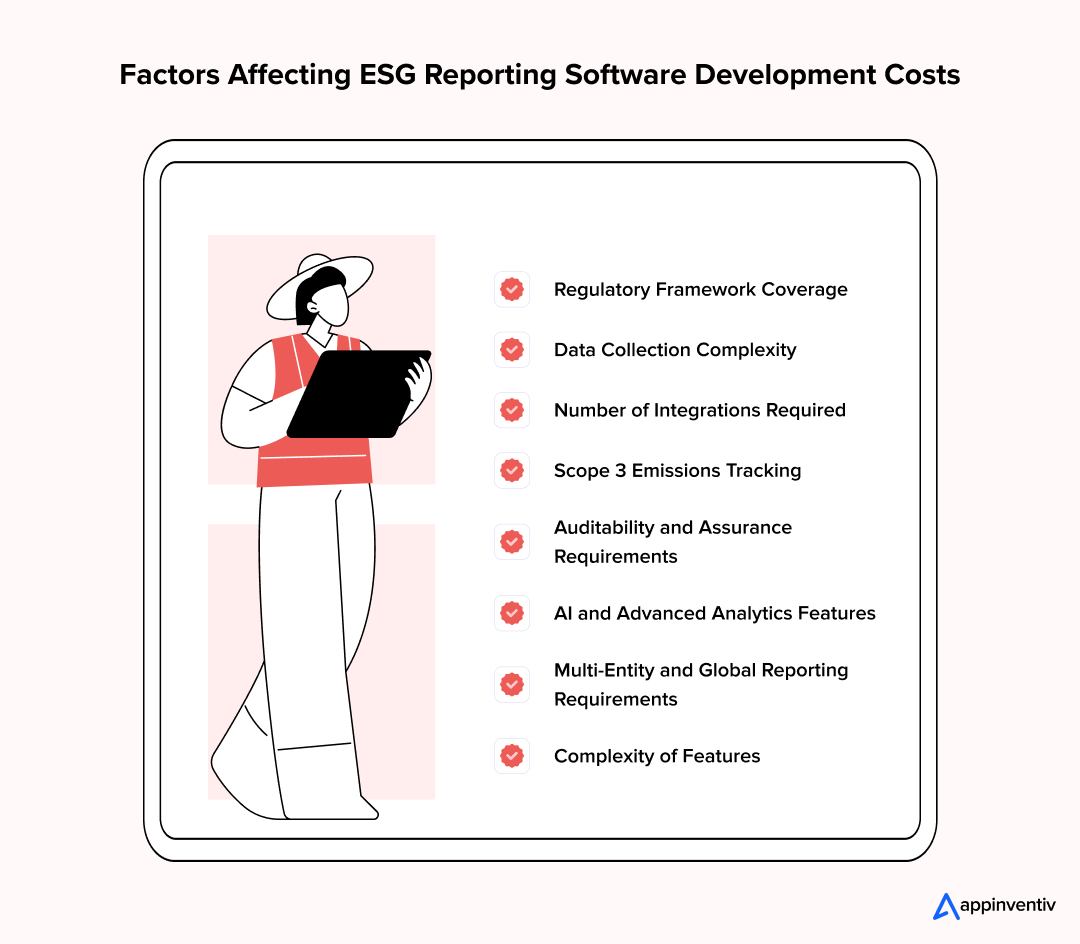
ESG reporting software development cost in Australia is rarely driven by a single decision. It compounds across framework coverage, data complexity, and the degree of automation an organisation wants around assurance. Each variable below shifts the estimate independently, which is why two enterprises in the same industry can receive quotes that differ by hundreds of thousands of dollars.
Regulatory Framework Coverage
Supporting a single framework such as AASB S2 keeps the mapping engine relatively contained. Costs climb sharply once a platform must reconcile disclosure requirements across ASRS, ISSB, GRI, SASB, CDP, TCFD, CSRD, and the EU Taxonomy simultaneously, since each framework defines materiality, boundaries, and metrics differently.
Data Collection Complexity
Systems that rely on manual data uploads cost less initially but require more internal labor over time. Conversely, automating data collection through direct connections to utility APIs, smart building IoT sensors, and fuel tracking systems increases upfront software development expenses. However, this automation reduces human error and provides real-time visibility into operational footprints.
Number of Integrations Required
Enterprise data lives in separate systems, including SAP or Oracle ERPs, HR tools like Workday, and specialized supply chain applications. The cost to build ESG reporting software in Australia scales with the number of these secure data connections.
Scope 3 Emissions Tracking
Beyond the supplier portal itself, Scope 3 tracking requires emission factor libraries, category classification logic across all fifteen GHG Protocol categories, and reconciliation workflows for incomplete supplier responses. This single capability can represent a quarter or more of total build cost on enterprise-tier platforms.
Auditability and Assurance Requirements
Enterprise systems must be audit-ready. This means adding strict role-based access controls, detailed activity logs, and encrypted document storage. Building these security and compliance features directly into the database architecture requires highly skilled backend engineering, which increases the initial development cost.
AI and Advanced Analytics Features
Integrating machine learning models to spot data anomalies, forecast future carbon footprints, or automate disclosure drafting changes the complexity of a project. While AI features lower operational costs over time, they require specialised data science workflows and model training during the initial build phase.
Multi-Entity and Global Reporting Requirements
Large enterprises often operate through multiple subsidiaries across different legal jurisdictions. The system architecture must consolidate data across separate legal entities, manage different regional currencies, and support localised reporting rules, which adds to the overall structural complexity and cost.
Complexity of ESG Reporting Platform Features
Every additional feature, such as a real-time executive dashboard or automated custom report builders, adds to development time and cost. Product leaders must balance the desire for advanced functionality against core operational needs to keep the project within budget.
Feature-Wise Cost Breakdown of ESG Reporting Standards in Australia
| Feature Module | Estimated Cost Contribution (AUD) |
|---|---|
| User Management & RBAC | AUD 2,000–5,000 |
| ESG Data Collection Engine | AUD 8,000–15,000 |
| Carbon Accounting Module | AUD 10,000–18,000 |
| Reporting Framework Mapping | AUD 7,000–14,000 |
| Dashboard & Analytics | AUD 5,000–10,000 |
| Workflow Automation | AUD 4,000–9,000 |
| AI Insights Engine | AUD 12,000–20,000 |
| Third-Party Integrations | AUD 6,000–18,000 |
| Security & Compliance Features | AUD 4,000–10,000 |
What Are the Hidden ESG Development Costs Enterprises Often Underestimate
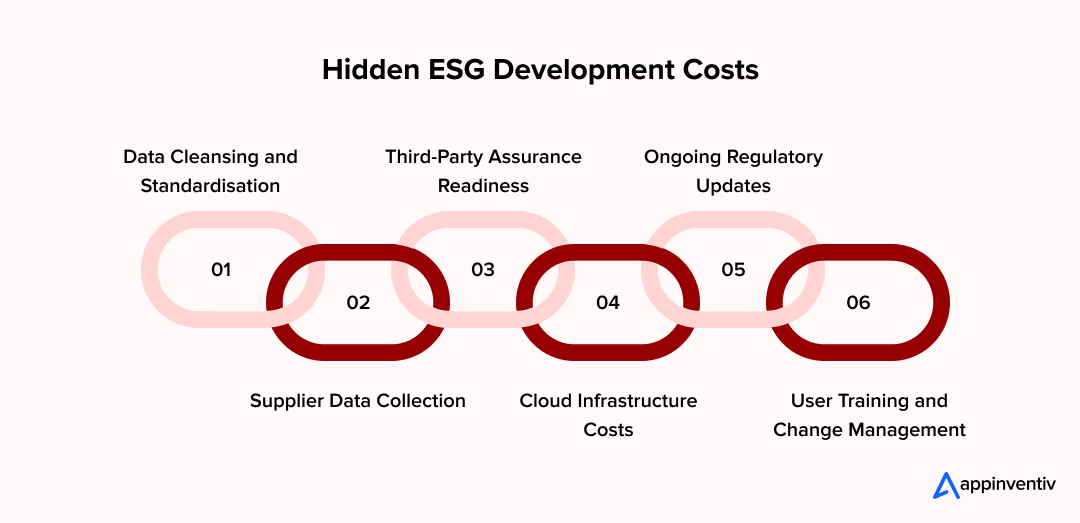
Initial development quotes rarely capture the full cost of ownership. Deloitte’s Sustainability Action Report found that more than half (57%) of respondents cite data quality as their top ESG challenge, with 88% ranking it among their top three concerns overall, which signals where budgets typically get tested after go-live.
Data Cleansing and Standardisation
Legacy data sitting across spreadsheets, disconnected systems, and inconsistent units almost always needs normalisation before it can feed a reporting engine. This work is frequently excluded from initial vendor quotes and discovered only during implementation.
Supplier Data Collection
Chasing hundreds of suppliers for consistent, timely data is an ongoing operational cost, not a one-off build expense. Organisations that underestimate this often find their Scope 3 numbers arrive too late for the reporting deadline.
Third-Party Assurance Readiness
Preparing documentation, calculation evidence, and methodology notes for an external auditor takes considerably longer the first time an organisation goes through it. Budgeting only for software and not for this preparation cycle is a common miscalculation.
Cloud Infrastructure Costs
Storage and processing costs scale with the volume of supporting documentation, especially where audit trails require long-term retention of source files. These costs are ongoing rather than fixed at build time.
Ongoing Regulatory Updates
Frameworks are still evolving. The AASB has already issued amendments clarifying NGER measurement relief, and further changes are expected as Group 2 and Group 3 thresholds are reviewed. Platforms need a maintenance budget to keep pace with these shifts.
User Training and Change Management
A platform is only as good as the discipline of the people entering data into it. Training across finance, procurement, and operations teams, along with change management to shift reporting from an annual scramble to a continuous discipline, is frequently the largest non-technical cost enterprises overlook.
Emerging Trends That Impact ESG Software Costs in Australia
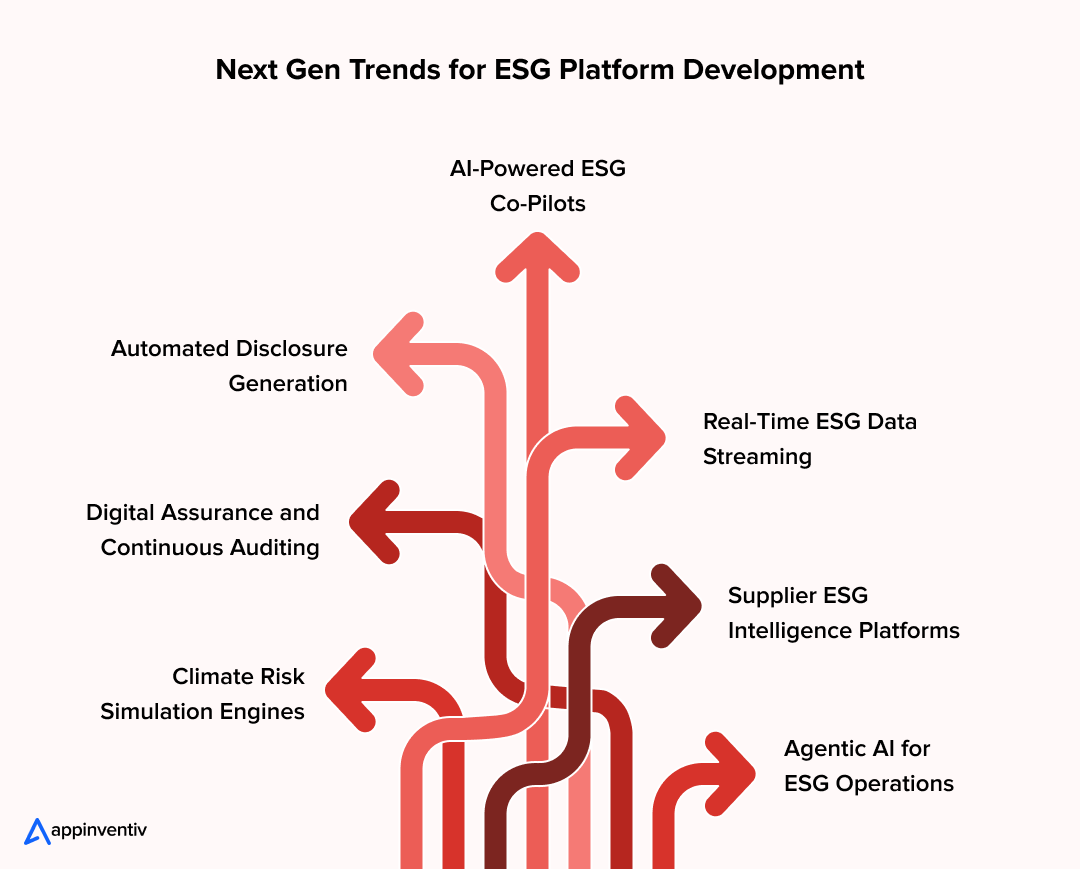
Technology choices made today will shape both cost and capability over the next reporting cycle. Enterprises building now should factor these trends into architecture decisions even where the near-term use case seems narrow.
AI-Powered ESG Co-Pilots
Natural language assistants that help sustainability teams query emissions data, draft disclosure narratives, and flag inconsistencies are moving from novelty to expected feature, particularly for organisations managing multiple frameworks simultaneously.
Automated Disclosure Generation
Platforms increasingly auto-populate narrative sections from structured data, reducing the manual drafting burden that consumes weeks ahead of reporting deadlines.
Real-Time ESG Data Streaming
Rather than batch uploads at quarter-end, IoT-connected facilities and fleets are beginning to stream emissions and energy data continuously, giving finance teams a live view rather than a retrospective one.
Digital Assurance and Continuous Auditing
As assurance requirements tighten toward reasonable assurance by 2030, platforms that support continuous, system-level audit checks rather than annual point-in-time reviews will carry a cost premium but reduce assurance friction significantly.
Climate Risk Simulation Engines
Scenario modelling against 1.5°C and higher warming pathways, mandated under AASB S2, is increasingly built directly into reporting platforms rather than handled through separate consulting engagements.
Supplier ESG Intelligence Platforms
Dedicated modules that score and monitor supplier ESG maturity are emerging as a category of their own, particularly for enterprises with complex, multi-tier supply chains.
Agentic AI for ESG Operations
Research increasingly points toward autonomous ESG workflows powered by AI agents rather than static annual reporting systems, with agents handling data validation, anomaly flagging, and disclosure drafting with limited human intervention. This shift, still early, is likely to influence platform architecture decisions being made today, since retrofitting agentic capability into a rigid, form-based system is considerably harder than designing for it from the outset.
How Businesses Can Reduce ESG Software Development Costs Without Sacrificing Compliance
A phased development approach lowers initial financial requirements while delivering essential compliance tools from day one.
- Prioritise high-risk disclosures first: Focus engineering efforts on mandatory Scope 1 and 2 metrics before expanding to broader sustainability goals.
- Adopt modular architecture: Build the system using flexible components so new features or frameworks can be added later without rewriting core code.
- Build an MVP around mandatory reporting requirements: Launch a minimum viable product in Australia that handles immediate regulatory demands, then refine the user experience over time.
- Use API-first integration strategies: Build clean, standardised connection points to easily link existing enterprise databases without custom coding for each tool.
- Leverage cloud-native infrastructure: Use established cloud tools for data processing and storage to reduce custom infrastructure work.
- Introduce AI selectively where ROI is measurable: Deploy machine learning features only where they directly cut labor costs or fix major data accuracy issues.
Reduce ESG Development Costs Without Sacrificing Compliance
Build only what your organisation needs today while creating an architecture that supports future regulatory changes and business growth.

Key Questions to Ask Before Building ESG Reporting Software in Australia
Before any development conversation begins, enterprise leaders should have working answers to a short set of questions.
- Which specific local and international reporting frameworks must the platform support from day one?
- Which internal databases, ERPs, and external utility systems currently house the necessary sustainability data?
- What level of audit tracking and data encryption is required by the board and regulatory bodies?
- How frequently must sustainability reports and executive dashboards be updated?
- Will external third-party assurance partners need direct, restricted access to the system’s data logs?
- Is the software design flexible enough to handle future business expansion into new international markets?
How Appinventiv Can Help Build ESG Reporting Software in Australia
Building a custom ESG solution is ultimately an investment in long-term governance and risk mitigation. For Australian enterprises navigating this complex transition, partner selection determines whether a platform succeeds or becomes stuck in technical debt.
We at Appinventiv bring more than a decade of technical execution experience across the APAC region, positioning our custom software development services in Australia as a reliable choice for organisations prioritising high-integrity development.
Having deployed over 3,000 digital assets across 35 distinct industries, we focus on architecting highly available ESG platforms that blend seamlessly with existing systems while keeping operational disruption to a minimum.
Our engineering framework is built on a foundation of sovereign-grade security. We maintain ISO 27001, ISO 9001, and SOC2 certifications alongside a 99.5% security compliance SLA, ensuring that sensitive enterprise data remains strongly protected and fully aligned with local regulations.
Approved on major procurement panels, including the Queensland Government ICTSS and Local Buy LGA arrangements, we offer the structural transparency that corporate boards require. This balanced approach has helped us maintain a 90% client retention rate while helping Australian enterprises automate data pipelines to achieve operational efficiency gains of up to 35%.
If your organisation is ready to move away from fragmented spreadsheets and build an immutable, audit-ready data infrastructure that meets upcoming AASB mandates, contact our tech experts today to scope your functional roadmap.
FAQS
Q. How much does it cost to build ESG reporting software in Australia?
A. ESG reporting software development costs in Australia generally range between AUD 70,000 and AUD 700,000 or more, depending on the number of frameworks supported, integration complexity, and how much of the audit and assurance workflow is automated.
Q. How long does it take to develop ESG reporting software in Australia?
A. The timeline to build ESG reporting software in Australia ranges from four to six months for a basic MVP to twelve to eighteen months for an AI-powered enterprise platform, depending on scope and the number of integrations required.
Q. What is the ROI of implementing automated ESG reporting software?
A. Enterprises typically see returns through reduced manual reporting labour, faster audit cycles, and lower risk exposure from greenwashing enforcement, with some Australian implementations reporting efficiency gains of up to 35% in reporting cycle time.
Q. What ESG reporting requirements apply to Australian businesses?
A. Large entities face mandatory climate disclosure under AASB S2, phased across three groups from 2025 to 2027, alongside consumer law obligations under ACCC guidance around environmental claims and, where relevant, ASIC’s greenwashing enforcement priorities.
Q. How is AI used in AI-powered ESG reporting software?
A. AI is applied to anomaly detection in supplier data, automated disclosure drafting, predictive emissions forecasting, and increasingly, agentic workflows that handle data validation and reporting tasks with limited manual oversight.