Summary
Cross-channel marketing automation is most effective when unified customer data, real-time decisioning, and journey orchestration work together. Responding to customer behavior across every channel, not scheduled campaigns, creates more relevant experiences and more accurate marketing measurement.
There is a specific frustration that comes up again and again in marketing operations reviews: “We have email, push, and SMS all running, the data exists somewhere, but nothing talks to anything else.” The team is not short on tools. They are short on a framework that connects them. Each channel was bought to solve a discrete problem, and now the stack is four vendors deep with a spreadsheet holding the logic together.
A cross-channel marketing automation framework is not a collection of platforms that happen to share a customer’s email address; it is a coordinated system where data flows in one direction, decisions happen in one place, and every channel execution is an output of the same underlying logic.
This article walks through how to build that system, where common stacks break down, and what it takes to close the gaps while keeping data, decisioning, execution, and measurement in one operating model.
What a cross-channel marketing automation framework actually requires
The four non-negotiable layers
Every functional cross-channel framework rests on four layers, and they are sequential: unified data foundation, real-time audience decisioning, channel-agnostic journey orchestration, and closed-loop measurement. The reason they are non-negotiable is that each layer is an input to the next. Without unified data, audience decisioning is guesswork.
Without accurate decisioning, orchestration fires at the wrong people. Without orchestration, measurement has nothing consistent to evaluate. The failure mode in many stacks is not that all four layers are absent; it is that one is weak and the others compensate badly.
Teams patch a missing data layer by building manual list exports, compensate for weak orchestration by adding more channels, and reduce measurement to channel-level dashboards that cannot explain what actually drove a conversion. The fix is not more tools. It is building the layers in order inside one platform that unifies customer data, audience segmentation, personalization, journeys, recommendations, analytics, and marketer execution. That matters in evaluation scenarios because buyers are not only comparing channels; they are comparing whether one operating layer can keep data, decisioning, execution, and reporting aligned without adding more operational complexity.
Why point-solution stacks create compounding friction
A multi-tool stack, with one platform for email, another for push, a third for on-site, and an external customer data platform (CDP) feeding all of them, looks functional on an architecture diagram.
In practice, it creates three categories of compounding friction, and understanding each one clarifies what a unified framework needs to solve.
The first friction is the latency where every data movement between systems adds delay, and a behavioral trigger that should fire within seconds of a cart abandonment can take hours when the signal has to pass through an external pipeline before reaching the execution tool.
It also introduces attribution gaps, where each platform claims credit using its own model and the numbers never reconcile.
Another common friction is on engineering dependency, where every new journey, segment, and data connection requires a developer touchpoint, slowing marketers to the pace of a sprint backlog rather than a campaign calendar.
Building the data foundation: unified profiles before any automation fires
Why built-in CDP architecture changes the trigger equation
The distinction between a built-in CDP and an external one passed into an execution tool is not semantic; it is operational. When the CDP is native to the platform, identity resolution happens inside the system that fires the automation.
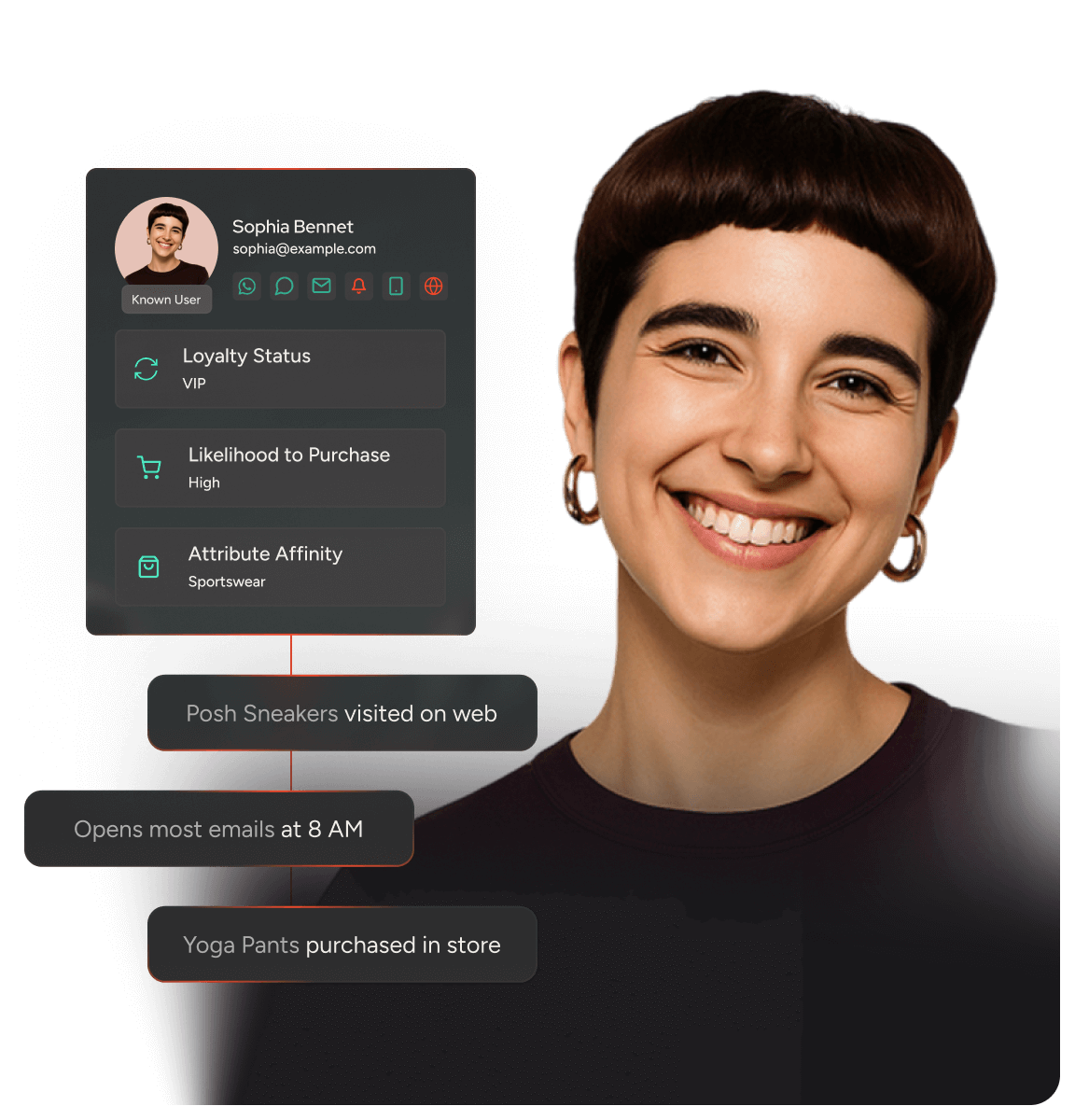
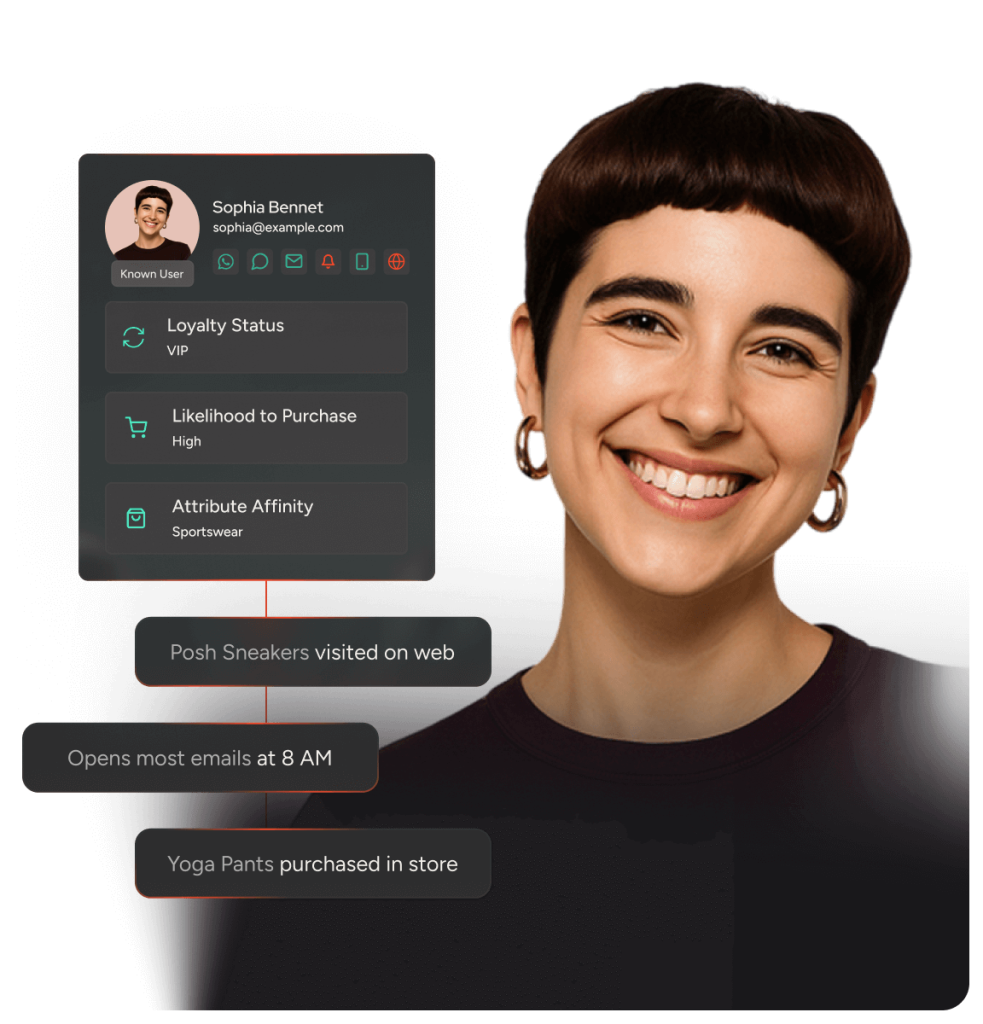
A customer who browses on mobile, purchases on desktop, and contacts support via chat is recognized as one person, and every automation decision draws from that complete profile without a data transfer in the middle.
When the CDP is external, that recognition still happens, but the enriched profile has to travel across an API before the execution layer can use it.
For time-sensitive triggers such as price drop alerts, back-in-stock notifications, and real-time abandon sequences, that latency can determine whether a message reaches the customer while the intent window is still open or after it has narrowed.
Insider One addresses this gap through its AI-powered Growth Management Platform, where the CDP connects unified customer profiles with audience segmentation, personalization, recommendations, cross-channel journeys, and analytics in one operating layer.
The data inputs that matter most for behavioral automation
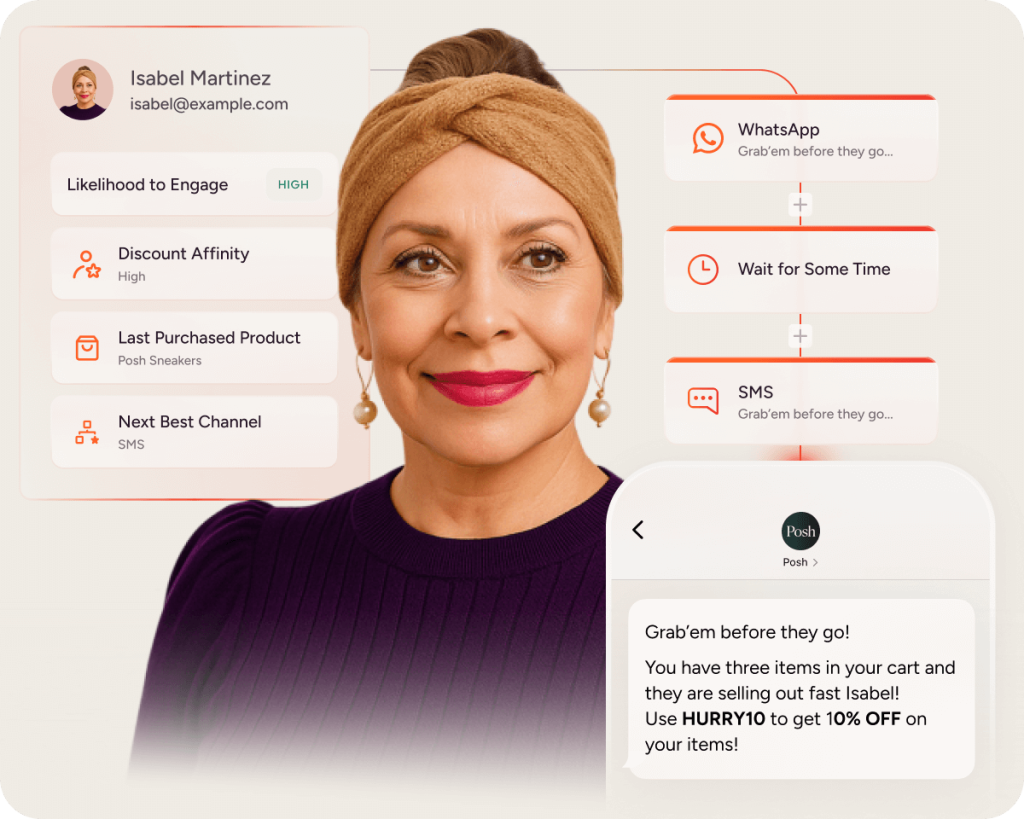
Unified profiles are only as useful as the data they contain. The inputs that generate the highest-value automation signals are purchase history (recency, frequency, and category preference), channel reachability (which channels a user has opted into and at what frequency), browsing behavior (product affinity, session depth, and search terms used), and event-level actions captured across web, app, and API touchpoints.
When these inputs live in a single profile, audience segmentation becomes a function of real behavior rather than manually maintained lists.
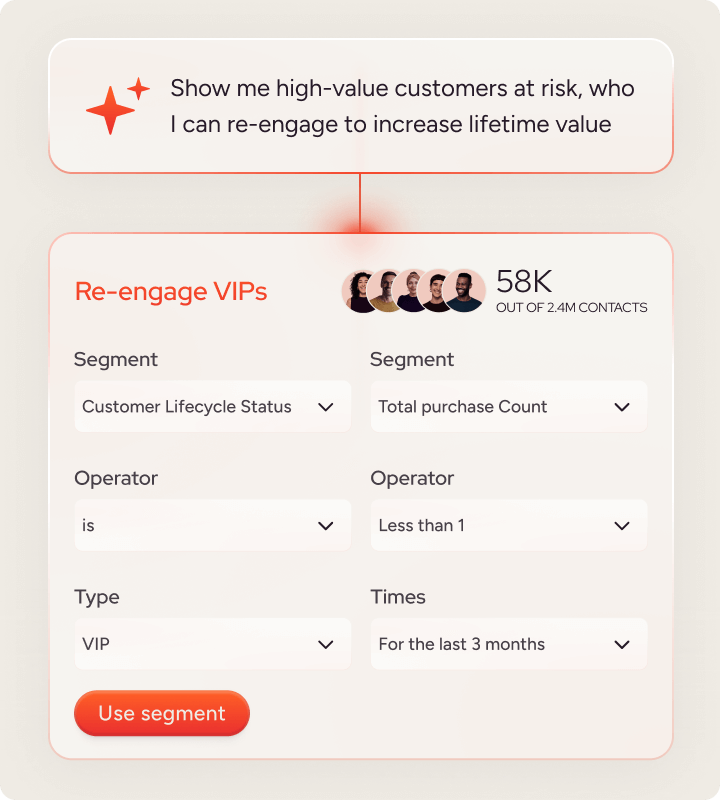
In Insider One, marketers can use InOne to build and update segments from current behavior through a marketer-friendly interface with structured navigation and ready-to-use templates, so automation runs on latest actions without requiring constant developer or data team intervention.
Journey orchestration: designing flows that respond, not just send
Schedule-based sending vs. behavior-triggered orchestration
Schedule-based automation sends a message at a predefined time. Behavior-triggered orchestration decides in real time whether to send, which channel to use, and what content to show, based on what the user just did or failed to do.
A mature orchestration layer includes branching logic that routes users based on real-time behavior, suppression rules that pause messaging when a user is already converting, and frequency caps that prevent the same customer from receiving multiple messages across several channels inside a short window.
These controls are not optional refinements. Without them, cross-channel automation becomes cross-channel noise, and unsubscribe rates climb regardless of how good the content is.
AI-assisted decisioning as the adaptive layer
Rule-based orchestration handles known scenarios well. It does not handle edge cases: the user who always opens push but suddenly stops, the shopper who buys in-store but browses online, or the subscriber whose preferred send time shifts seasonally.
AI-assisted next-best-action and send-time optimization close this gap by moving orchestration from a static ruleset to an adaptive model that updates based on individual behavior patterns.
This is where Insider One extends beyond a standard automation builder.
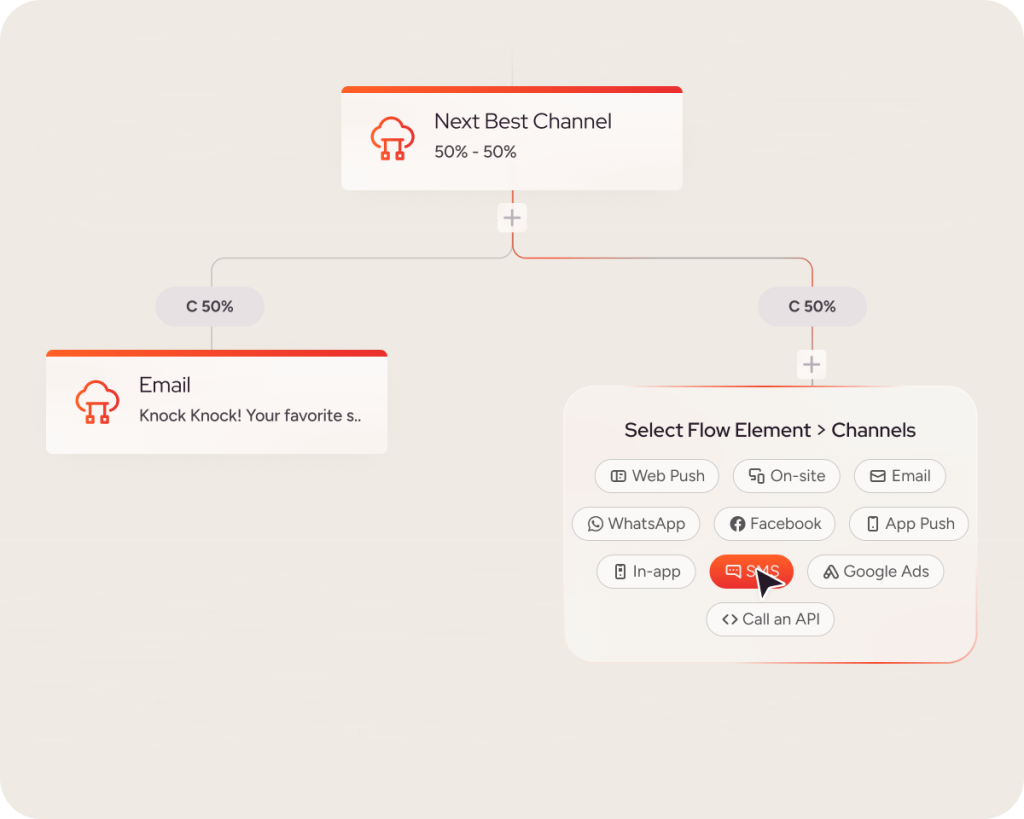
Through AI powered features such as Smart Journey Creator and channel-specific AI text generation, marketers can speed up journey creation, refine messaging, and apply AI assistance to journey design and message preparation while keeping the guardrails in marketer control.
The result is a more adaptive orchestration model that can reduce manual rule upkeep as behavior patterns change. Our guide to omnichannel marketing automation covers what this looks like in practice.
Channel coverage and on-site personalization: the gap many platforms ignore
The highest-intent moment is on-site, not in the inbox
Email, SMS, and push are outbound channels. They reach a customer when that person is not actively engaged with your brand and try to pull them back. While on-site personalization works the opposite way as it engages a customer who is already there, already browsing, already high-intent.
Investing heavily in outbound while ignoring on-site experience creates a counterproductive dynamic where automation spends to acquire attention that the website then fails to convert.
The gap is particularly visible at key decision points like homepage banners that do not reflect a user’s category affinity, app experiences that ignore recent behavior, web push prompts that do not match current intent, search results that surface generic inventory instead of behaviorally ranked products, and product pages that miss upsell and cross-sell signals entirely. These are not content team problems; they are unified-data and decisioning problems.
The behavioral profile exists, but no system is reading it to shape what the user sees. Philips achieved a 40.1% conversion rate increase by connecting Smart Recommender to their on-site experience, directly applying behavioral data to what each visitor saw.
Wiring on-site into the same journey logic as outbound channels
The architectural fix is treating on-site personalization as a channel inside the journey engine, not a parallel system. When a cart abandonment trigger fires, the first check should be whether the user is currently on-site.
If yes, the framework can prioritize a contextually relevant on-site banner or product recommendation before escalating to outbound follow-up. If the user leaves without converting, the outbound sequence can then pick up.
This is what cross-channel journey orchestration looks like when the on-site layer is wired into the same decisioning engine as email, SMS, and push.
Platforms that treat web personalization as a separate product or bolt-on integration struggle to execute this logic cleanly, because the signals that should suppress a notification or escalate a recovery sequence live in a different system.
Adidas achieved a 259% increase in average order value and a 13% lift in conversion rate in a single month by unifying on-site and outbound channel logic through one platform, a result that requires the channels to share the same behavioral data in real time.
Measuring framework performance: attribution models that hold up to scrutiny
Why last-click attribution breaks cross-channel reporting
Last-click attribution assigns full conversion credit to the final touchpoint before purchase. In a single-channel world, that is a reasonable simplification. In a cross-channel framework, it systematically undercounts every channel that influenced the decision before the final click.
The email that drove the initial visit, the push notification that recovered the abandoned session, and the on-site recommendation that surfaced the right product all go unrecognized, and budget decisions get made on a distorted picture.
Multi-touch attribution distributes credit across the touchpoints that contributed to conversion, weighted by their position and influence in the journey. This is not only a modeling question; it is also a data availability requirement.
Unified in-platform tracking makes multi-touch attribution more reliable and operationally simpler, because when each channel lives in a separate platform, stitching the journey together after the fact becomes slower, less consistent, and harder to trust.
The key performance indicator hierarchy for a mature framework
Mature cross-channel frameworks organize key performance indicators (KPIs) into three tiers. Channel-level metrics such as open rates, click-through rates, and opt-out rates tell you whether individual touchpoints are working.
Journey-level metrics such as conversion rate by journey, revenue influenced per active user, and cart recovery rate tell you whether the orchestration logic is sound. Customer-level metrics such as lifetime value, purchase frequency, and reactivation rate tell you whether the framework is building durable revenue or simply pulling forward short-term conversions.
The reason this hierarchy matters is organizational as much as analytical. Channel metrics are owned by the channel manager. Journey metrics belong to the growth or automation team.
Customer metrics are the ones the chief marketing officer and finance will act on.
A framework that cannot report at all three tiers cannot make the case for its own investment. Reporting built on a unified data layer, where every touchpoint is captured in one place, also gives teams access to Behavior Analytics, Funnel Analytics, Flow Analytics, Event Analytics, and retention reporting across web, app, and API touchpoints without stitching together disconnected dashboards manually.
If you want to see how Insider One combines a Unified Customer Database, audience segmentation, Insider One AI, and cross-channel analytics to turn live customer data into coordinated experiences, book a personalized demo to see the exact use cases, decision logic, and marketer workflows most relevant to your team.
Frequently asked questions
Implementation timelines vary significantly based on stack complexity and data readiness. A platform with a Unified Customer Database and marketer-friendly workflow tools can shorten the path to live behavioral automation, but the timeline still depends on integration scope and data quality. The longest phase is typically data consolidation, not channel setup. Platforms that require custom data pipelines before any automation fires will usually extend this timeline.
Not necessarily. A phased migration is common, particularly when existing tools have long contract terms. The practical approach is to identify the layer causing the most friction, usually the data layer, and prioritize replacing that first. Running a unified platform alongside legacy point solutions temporarily is workable as long as the new system is the single source of truth for audience decisioning.
A multichannel platform gives you the ability to send on multiple channels. A cross-channel platform coordinates those channels so they share data, suppress redundant messages, and respond to behavior across the full journey as a unified system. The functional difference shows up in outcomes: multichannel stacks generate channel-level metrics, while cross-channel frameworks generate journey-level and customer-level results.
AI moves orchestration from a static ruleset to a more adaptive model. Instead of a marketer writing rules for every scenario, AI assistance can help teams generate journey drafts, accelerate content creation, and inform next-best-action decisions based on behavioral history. The marketer sets the guardrails, including goals, frequency caps, and suppression rules, and tools such as insider One AI support execution within them. This reduces the manual maintenance burden and helps teams scale cross-channel execution as more behavioral data accumulates over time.