Key takeaways:
- Connected software updates entire banking pipelines from start to finish. This technology cuts manual labor. It sharpens compliance, stops fraud, and pleases clients.
- AI, RPA, and document tools build scalable bank operations. They integrate directly with your core platform rather than replacing existing infrastructure.
- Project success requires deep process redesign and API connections. Leaders must focus on AI governance and phased launches rather than rapid installations.
- Track progress through clear operational metrics and financial returns. Measure final client satisfaction and regulatory compliance precision to confirm total value.
- Advanced systems combine agentic AI, hyperautomation, and live event data. Tightly managed governance rules protect your operations as technology updates.
Banks have automated repetitive tasks for years. Yet core banking still relies on manual reviews. Disconnected systems and heavy document workflows slow down operations.
Staff move data across multiple platforms to open accounts. They check loan applications manually. They screen transactions for financial crime. They prepare regulatory reports by hand. These steps delay final decisions. This delay increases costs. It creates human errors.
Intelligent automation in banking fixes these problems. It does not just fix isolated tasks. It connects artificial intelligence (AI) and robotic process automation (RPA). It combines intelligent document processing (IDP) with machine learning.
It uses business rules engines and workflow orchestration. This technology automates the complete process from intake to decision. Banks process documents faster. Systems detect fraud in real time. Straight-through processing (STP) rates rise. Human reviewers focus on high-risk cases instead of routine work.
Today, 94% of business leaders consider AI core to their business operations. This guide covers enterprise use cases, implementation best practices, enabling technologies, and the governance needed to scale intelligent automation across banking operations.
40% Higher Operational Efficiency Starts Here
Banks modernizing automation today improve processing speed, compliance, and customer experience before competitive gaps become harder to close.
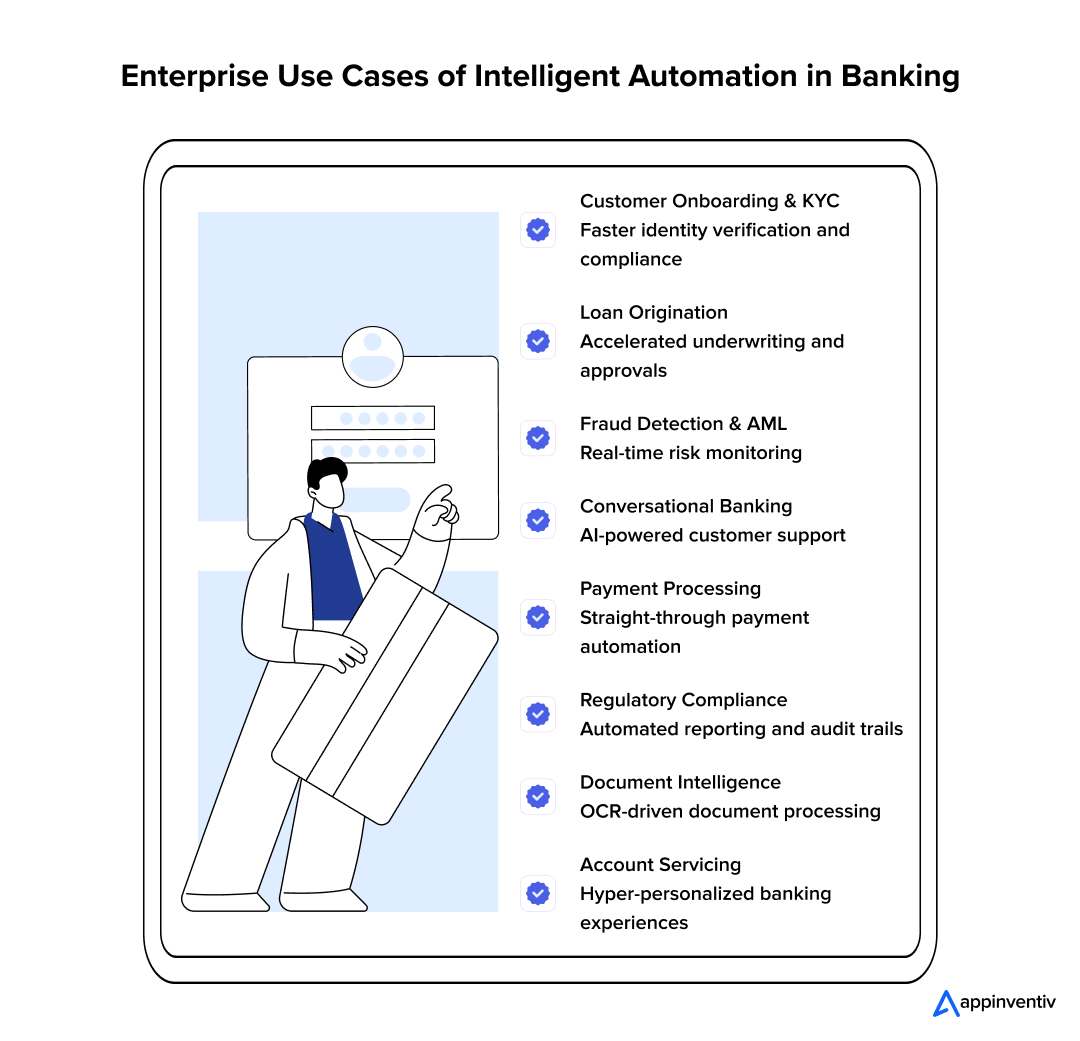
8 Enterprise Use Cases of Intelligent Automation in Banking
Banks do not change every operation at once. Leadership teams usually target the slowest tasks first. They pick workflows with heavy manual labor or strict regulatory oversight.
Onboarding, lending, fraud tracking, and compliance are common starting points for banking intelligent automation use cases. These areas have high transaction volumes and clear financial costs. These examples of intelligent automation in banking show how automated tools reshape daily banking operations.
Customer Onboarding, KYC, and Identity Verification
Opening accounts requires many steps. Workers collect identity cards, check customer data, perform Know Your Customer (KYC) steps, screen lists for sanctions, and complete Anti-Money Laundering (AML) checks. These tasks require logging into multiple systems. Moving data manually takes days and creates data entry errors.
How Intelligent Automation Solves It
The software reads customer documents using OCR and Intelligent Document Processing (IDP). It extracts fields like name and history. The system verifies identities through biometric data and automatically screens customers against AML watchlists. Workflow tools route complex files to compliance specialists while clean applications finish automatically.
Business Impact
Banks cut onboarding times from days to minutes. Compliance accuracy rises across the network, fewer customers drop out, and compliance teams focus on complex files.
Technologies Used
OCR, IDP, biometric verification, AI, AML screening, sanctions screening, workflow orchestration.
Loan Origination, Credit Underwriting, and Mortgage Processing
Approving loans demands deep financial checks. Underwriters examine financial statements, check income records, value property collateral, and match credit rules. Manual document review slows down lending choices, creating backlogs.
How Intelligent Automation Solves It
Document intelligence software reads text from financial statements and tax returns without manual entry. Machine learning models check borrower risk using data from past loans, while decision engines apply lending rules instantly. The system routes complex applications to underwriters.
Business Impact
Banks approve loans faster with digital lending technology, and underwriting teams deliver uniform decisions. Processing costs drop, allowing analysts to focus on complex deals.
Technologies Used
IDP, AI credit scoring, machine learning, decision engines, workflow automation.
Fraud Detection, AML Monitoring, and Financial Crime Prevention
Banks process millions of transactions daily. This is also where AI delivers the greatest business value, with 49% of business leaders identifying KYC, AML, and fraud detection as its highest-impact use case. Old tracking software relies on fixed rules that generate thousands of false alarms.
Fraud investigators spend hours checking harmless transactions, slowing down the team and allowing actual criminals to steal funds.
How Intelligent Automation Solves It
Machine learning in banking constantly checks customer behavior to spot unusual spending patterns and flag fraud in real time. AI scores alerts based on risk instead of basic matches. Automated AML tracking checks transactions against risk models, sending serious threats to investigators.
Business Impact
Banks reduce false alarms, and fraud tracking accuracy improves immediately. Investigation times shrink, allowing teams to stop financial crime without hiring more staff.
Technologies Used
Machine learning, behavioral analytics, AI, AML monitoring, real-time risk monitoring, decision engines.
AI-Powered Customer Service and Conversational Banking
Customers expect immediate help across apps, websites, text tools, and call centers. About 53% of business leaders already report customer experience and support as AI’s biggest area of business impact. Managing these service volumes with human workers raises operating costs and leaves buyers waiting on hold for answers.
How Intelligent Automation Solves It
Virtual assistants and AI-powered chatbots in banking use Natural Language Processing (NLP) to read requests, answer questions, and show balances. Agent Assist tools check live conversations to recommend answers and pull helpful articles for human staff to speed up response times.
Business Impact
Banks answer questions faster, and first-contact resolution rates increase. Contact center workloads go down, and customers receive the same level of service on every channel.
Technologies Used
NLP, conversational AI, virtual assistants, Agent Assist, omnichannel banking.
Also Read: How Voicebots Are Reshaping Banking Customer Service
Payment Processing and Reconciliation
Payment teams must check transactions, match records across banking systems, and fix errors for transfers. Doing this work by hand delays settlement times and adds to operations costs.
How Intelligent Automation Solves It
RPA software validates payments automatically and matches transaction data across platforms. It handles reconciliation tasks, while AI spots strange payment patterns to highlight exceptions. Straight-through processing (STP) manages transfers, and workflow orchestration guides difficult files.
Business Impact
Banks settle payments faster, and reconciliation requires less manual work. Transaction accuracy increases, and straight-through processing rates rise.
Technologies Used
RPA, AI, STP, workflow orchestration, ISO 20022, exception handling.
Also Read: How Blockchain Is Transforming Banking Payments
Regulatory Compliance and Audit Automation
Banks must satisfy strict regulatory rules that demand accurate reports, clear history trails, and continuous monitoring. Pulling data by hand from separate software takes too much time and increases compliance risks.
How Intelligent Automation Solves It
Intelligent automation gathers operational details and transaction records automatically. The software validates data against company policies, builds regulatory reports, and logs every action within the workflow. Automated policy enforcement creates a clean history that regulators view easily.
Business Impact
Reporting accuracy improves while compliance tasks take less effort. The bank stays ready for audits, and the risk of regulatory fines drops.
Technologies Used
Business rules engines, compliance monitoring, regulatory reporting automation, audit logging, workflow automation.
Intelligent Document Processing and Contract Automation
Banks manage millions of paper and digital files like loan agreements, customer contracts, and financial reports. Manual document review slows down approvals and introduces data mistakes across different business units.
How Intelligent Automation Solves It
Intelligent Document Processing uses OCR, NLP, and AI to read files and identify incoming forms automatically. It extracts text from tables and unstructured files, validates numbers, and sends data to core banking systems. Automated indexing makes files easy to find.
Business Impact
Document processing takes less time, and data accuracy increases. Manual data entry drops, allowing lending workflows to move faster.
Technologies Used
OCR, NLP, IDP, AI, document classification.
Customer Account Servicing and Hyper-Personalization
Customers make many routine updates like changing addresses, replacing lost cards, and asking for account help. Forcing buyers to switch between apps and call lines raises service costs and creates a broken experience.
How Intelligent Automation Solves It
Intelligent automation synchronizes data between CRM banking tools and core banking platforms to complete routine service updates automatically. The software checks customer actions to plan the next best action, while AI engines build personal offers for self-service portals.
Business Impact
Customer satisfaction scores rise and product sales increase. Total servicing costs drop, allowing banks to provide personal banking experiences.
Technologies Used
CRM integration, AI recommendations, next-best-action models, self-service banking, workflow automation.
AI delivers clear metrics when teams build it into daily banking routines. Do not isolate the technology within single-customer channels. Appinventiv built an AI banking platform using this exact strategy. We connected automated tools with digital support assistants. This platform removes manual steps and creates smarter banking applications for your users.
→ Explore the complete AI Banking case study
Types of Intelligent Automation Solutions in Banking
Banks rarely change every aspect of intelligent automation in banking at once. In fact, 87% of organizations are actively rolling out new AI-driven technologies across their operations. Instead, leadership teams start with simple, rule-based tasks.
They add artificial intelligence (AI), document tools, and workflow systems as needs grow. Each new step builds on old choices. This pattern lets financial institutions automate large parts of their daily work. It allows them to maintain strict compliance and human oversight.
Robotic Process Automation (RPA)
Robotic Process Automation in banking forms the baseline for bank automation. Software bots handle repetitive, rule-based tasks. They input data, reconcile accounts, and validate payments. They update customer records and complete regulatory reporting. This technology cuts manual labor and increases accuracy. It lets operations teams focus on work that requires human judgment.
AI-Powered Automation
Artificial intelligence expands automation past fixed rules. It introduces smart decision choices and predictive analytics. AI models check customer behavior and evaluate credit scores. They spot fraudulent transactions and recommend business actions. They use historical records and real-time data. This method lets banks automate choices that once required manual analysis.
Intelligent Document Processing (IDP)
Banks process thousands of files every single day. They handle loan applications, corporate financial statements, KYC records, and identity cards. Intelligent Document Processing combines OCR, Natural Language Processing (NLP), and computer vision in finance & banking. It uses large language models (LLMs) to sort files, extract information, and validate data. This tool speeds up lending and compliance.
Enterprise Workflow Orchestration
Automation delivers full value when separate tools work together. Enterprise workflow orchestration coordinates software bots, AI models, banking applications, APIs, and human reviewers inside one path. The software manages task routing, handles errors, and tracks approval paths. It connects directly with core banking platforms. Human-in-the-loop controls let low-risk tasks finish automatically. The system routes complex decisions to specialists, giving executives operational control.
Also Read: How Enterprises Can Get Started With Intelligent Automation
Core Components of an Intelligent Banking Automation Platform
Large banks connect multiple technologies for intelligent process automation of financial services inside a single architecture. Each layer handles a distinct job. The structure moves data from customer requests down to backend systems. This blueprint lets executives track and control automated workflows.
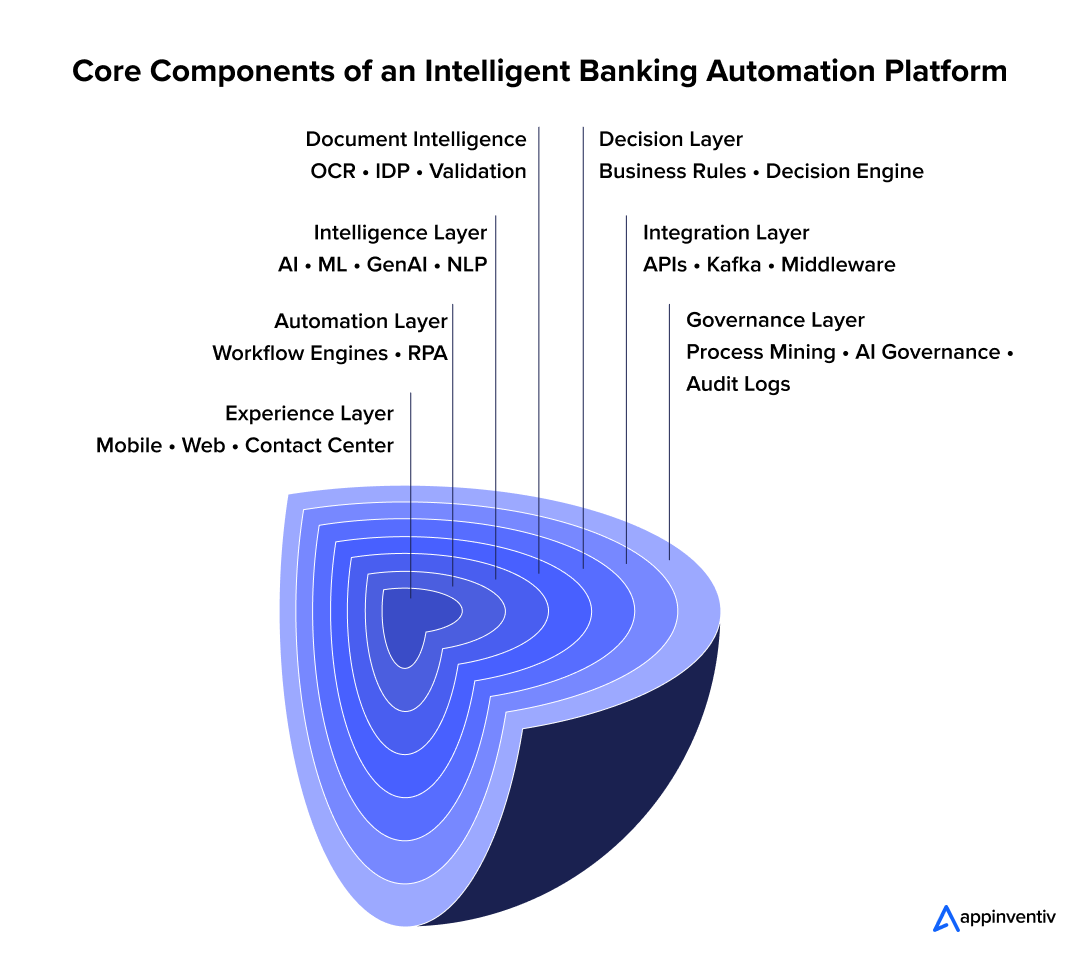
The Experience Layer
This layer acts as the entry point for clients and employees. It includes mobile banking apps, web portals, contact center tools, and staff dashboards. Every account update, loan application, and service request begins here.
Also Read: How AR Is Changing the Digital Banking Experience
The Automation Layer
This layer handles repetitive tasks using workflow engines and Robotic Process Automation (RPA). It processes onboarding documents, moves payments, and reconciles balances. The software handles standard workflows automatically and sends exceptions to human teams.
The Intelligence Layer
This layer adds deep analysis and reasoning to bank operations. Artificial Intelligence (AI), Machine Learning (ML), Generative AI, and Natural Language Processing (NLP) study customer behavior. They flag fraud and check credit risks. The software reads raw data and refines its choices over time.
The Document Intelligence Layer
Banks process massive piles of paper and digital records daily. This layer uses Optical Character Recognition (OCR) and Intelligent Document Processing (IDP). It reads tax forms, loan applications, and identity cards. The system extracts text, verifies the math, and routes clean data.
The Decision Layer
This layer applies bank policies and risk limits automatically. Decision engines check credit rules, eligibility metrics, and compliance mandates. The software decides if a transaction can proceed, needs extra verification, or requires manager approval.
The Integration Layer
This layer connects modern automation tools with old mainframes. It uses fintech APIs, middleware, and Apache Kafka event streaming. Data moves between core banking systems, payment gateways, and CRM software. Information flows across systems without human data entry.
The Monitoring and Governance Layer
This layer tracks performance and protects data. It uses process mining to map workflows and records every digital action in an audit log. The software monitors AI models for accuracy drops. It gives compliance teams full visibility while keeping human oversight for high-risk choices.
Enterprise Technology Stack
The following reference stack illustrates how these architectural layers match up with enterprise tools.
| Layer | Representative Enterprise Technologies |
|---|---|
| Channels | Mobile Banking, Web Banking, Contact Center |
| Automation | UiPath, Automation Anywhere, Microsoft Power Automate |
| AI | Azure AI, Vertex AI, OpenAI |
| Document Intelligence | ABBYY, Google Document AI |
| Business Process Management | Camunda, Appian, Pega |
| Integration | Apache Kafka, MuleSoft, REST APIs |
| Data | Snowflake, Databricks |
| Security | Identity and Access Management (IAM), Zero Trust, SIEM |
| Monitoring | Grafana, Celonis |
This layered model lets banks modernize their operations step by step. Executives can upgrade parts of the system without replacing core infrastructure. Each layer connects smoothly with legacy mainframes to support complete automation.
Banking Automation Technologies and How an Intelligent Banking Process Works
Large banks do not rely on a single technology for automation. They connect multiple tools into a single working pipeline. These tools trade information instantly and apply business rules to make choices. Intelligent automation links core banking networks together instead of replacing them. It uses APIs, workflow engines, and AI services to handle a customer request from start to finish.
Tech Stack Components
Different tools manage separate stages of a single banking pipeline.
| Technology | Role in the Process |
|---|---|
| Robotic Process Automation (RPA) | Bots handle repetitive tasks like data entry, balance matching, and transaction logs across platforms. |
| Artificial Intelligence (AI) | Software checks customer profiles, spots fraud patterns, and guides choices based on operational data. |
| Machine Learning (ML) | Models study historical data to predict credit risks, scan fraud trends, and group customer habits. |
| Intelligent Document Processing (IDP) | Systems read paper and digital files to sort, extract, and validate data fields automatically. |
| Optical Character Recognition (OCR) | Software turns image scans, tax forms, and identity cards into text for backend systems. |
| Natural Language Processing (NLP) | Systems read customer messages, interpret text intent, and power chat assistants. |
| Business Rules Engines | Software enforces lending rules, compliance limits, and transaction thresholds uniformly. |
| Process Mining | Tools trace workflow records to find operation lags and identify tasks for automation. |
| API Integration | Code links automation platforms with core banking systems, payment gateways, and CRM networks. |
| Event Streaming | Software enables live communication between separate programs so transactions can be processed without lag. |
How an Intelligent Banking Process Works
Most automated banking processes follow a uniform sequence of steps.
- Customer Request: A client sends a request through a mobile app, web page, or branch terminal.
- Document Capture: The system collects digital files like identity proofs, tax reports, or application forms.
- OCR and IDP: OCR scans the images into text. Then IDP identifies the file types, extracts fields, and validates numbers.
- AI Validation: AI reviews the customer files, flags missing data, and cross-checks internal and external databases.
- Fraud and Risk Check: Machine learning models analyze history and real-time habits to flag suspicious actions early.
- Business Rules: Decision engines apply credit parameters, compliance laws, and transaction limits to decide the next action.
- Workflow Orchestration: The main engine coordinates bots, APIs, and banking programs. Clean files proceed, and errors divert to staff.
- Human Review: Staff step in for high-value transfers, complex compliance alerts, or uncertain AI findings.
- Core System Update: The system logs approved deals on the core platform and syncs CRM and compliance databases.
- Customer Notification: The client receives a message through their preferred app, and the system saves a clean audit trail.
Operations Impact
Banks use these tools to increase straight-through processing (STP) rates. Low-risk transactions move through the system without a human touch. Error-handling tools catch incomplete forms, policy breaches, or missing files. They route these bad files to human teams without halting the entire system.
Human-in-the-loop controls protect the bank from operational blind spots. Automation processes routine files quickly, but experienced bankers keep final control. Professionals approve high-risk loans, investigate financial crimes, and fix complex errors. This balance helps banks cut operational friction while keeping strict regulatory compliance and customer trust.
Automation Fails Without Strong Architecture
Reduce deployment risk with API-first integration, enterprise governance, and intelligent workflow orchestration designed for regulated banking environments.

Challenges of Implementing Intelligent Automation in Banking
Automated tools change how banks run. Yet deployment requires more than dropping AI models or software bots into your workflow. Executives face technical, operational, and legal friction that stalls projects. Fixing these blocks early protects your budget. It allows your automation network to scale safely as the business grows.
| Challenge | Why It Matters | Recommended Fix |
|---|---|---|
| Legacy Core Banking Systems | Old core platforms cannot handle real-time data or smart automated tools. Direct connections cause system crashes and mismatched data. | Use an API-first architecture with middleware tools. This design lets new automation platforms talk to old mainframes without replacing core infrastructure, supporting long-term legacy banking modernization. |
| Data Silos and Messy Data | Customer profiles sit trapped inside separate databases, CRM logs, and loan software. Messy records cause software to make bad choices. | Create central data rules. Standardize your master file records. Use data-linking programs to build a single view of all corporate information. |
| Fragmented Business Processes | Workflows grow messy over time from manual approvals and repetitive steps. Automating a broken workflow just accelerates bad operations. | Map your workflows using process mining tools. Cut out redundant tasks. Standardize decision steps before you write any automation code. |
| Regulatory Compliance Laws | Regulators demand complete tracking for KYC, AML, and data privacy. Automated choices must leave clear history trails for outside auditors. | Embed compliance logic directly into your code. Keep full audit logs and clear AI logic. Add human sign-off blocks for high-risk transactions. |
| AI Governance Blocks | Regulators reject automated choices if risk teams cannot explain how the AI works. Closed models create legal liabilities during audits. | Use explainable AI tools. Track code versions and monitor live models. Document the logic behind every automated decision. |
| Banking Cybersecurity Risks | Automated systems handle private balance data and link deep into core networks. A single security breach exposes critical financial files. | Apply Zero Trust security rules across your network. Encrypt all files. Limit database access via IAM tools, and watch environments using SIEM software. |
| Workforce Adoption Fears | Employees often fear that software bots will replace them. This friction causes resistance and kills the value of your tech budget. | Bring branch teams into the project early. Define new jobs and provide clear training. Show that bots take over boring tasks so humans can do higher-value work. |
| Vendor Lock-In | Buying closed, proprietary software limits your options later. Moving off these systems costs millions when corporate requirements change. | Select modular architectures built on open API standards. This plan lets you plug in new AI tools or cloud features without rewriting code. |
Expert Perspective
Many intelligent automation projects in banking fail for one simple reason. Banks automate messy workflows instead of fixing them first. You must redesign the process before you deploy code. Once teams standardize the workflow, automated tools speed up execution. They deliver tight governance and clear operational savings without creating tech confusion.
Enterprise Roadmap for Implementing Intelligent Automation in Banks
Implementing Intelligent Automation in Financial Services is not a single project. It is part of a broader banking digital transformation journey. It requires a phased plan that mixes process updates, system connections, and continuous oversight. Banks that set clear financial targets and scale in stages succeed. They avoid the trap of launching massive, unmanageable programs on day one.
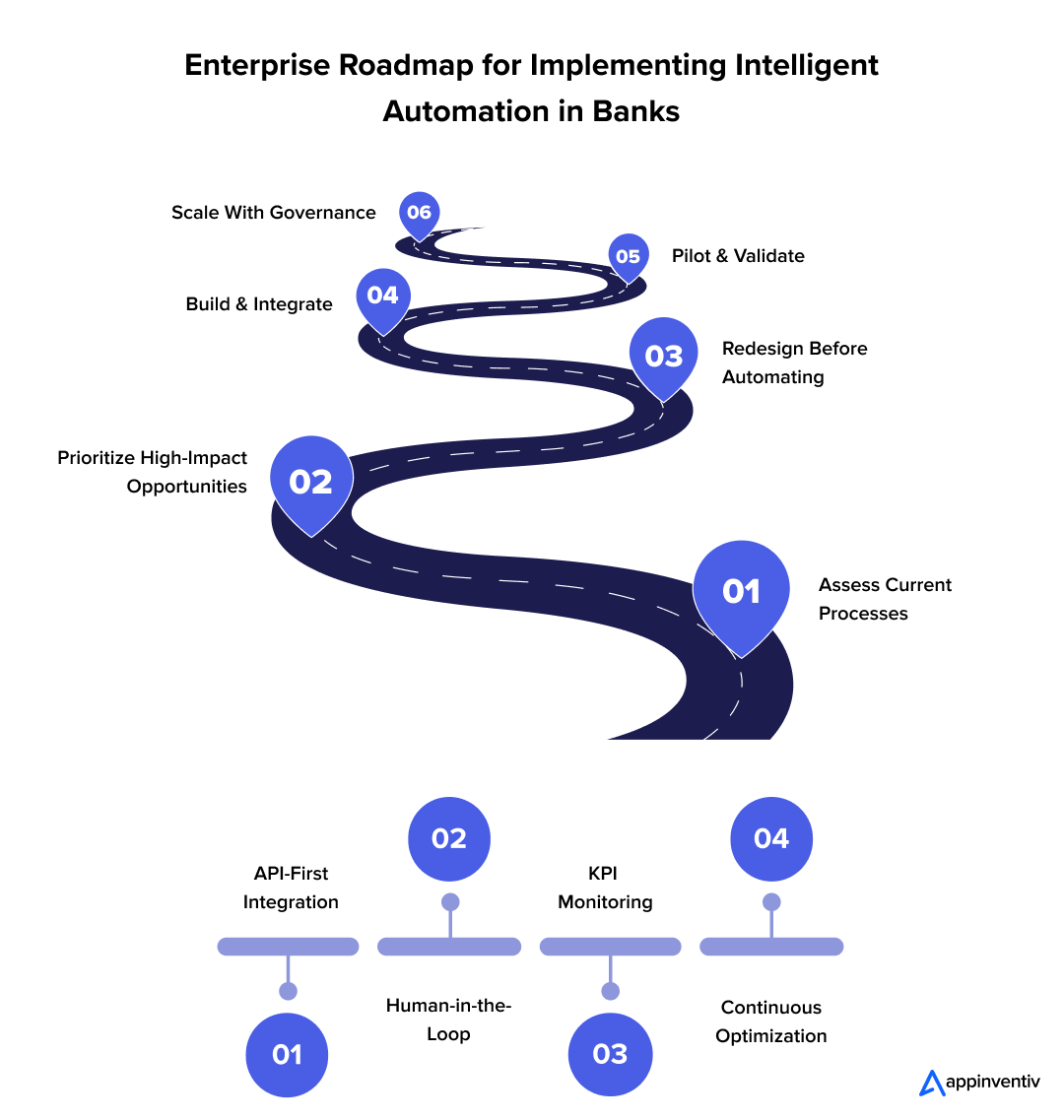
Step 1 – Assess Current Workflows
Start by tracking your existing workflows to spot repetitive, slow, and paper-heavy steps. Measure completion times, manual labor hours, error rates, and software dependencies. Process mining tools help map operational blocks. They pinpoint the exact tasks that consume the most corporate resources.
Also Read: The Ultimate Guide to Robotic Process Automation
Step 2 – Pick High-Value Target Areas
Do not automate everything at once. Focus on workflows with high transaction counts, fixed rules, and strict compliance needs. Onboarding, loan processing, fraud tracking, and payment reconciliation offer the fastest financial return for intelligent process automation in banking. They combine heavy volume with clear, measurable improvements.
Step 3 – Fix the Process Before Deploying Code
Software must fix a workflow, not protect outdated habits. Remove redundant approvals, simplify decision trees, and cut duplicate tasks before writing any code. Why is this necessary? Tighter workflows are easier to automate and manage across the firm.
Also Read: Business Process Automation, Benefits and Use Cases
Step 4 – Connect Your Core Technology Platforms
Build paths that link AI, software bots, and document tools into a single operating plan. Use APIs to connect this automated system with legacy mainframes, CRM databases, and payment hubs. This setup prevents operational friction during the launch.
Step 5 – Run Limited Tests to Verify Results
Launch the technology in one small business unit before scaling across the enterprise. Check data accuracy, security compliance, and staff adoption rates. Track processing speeds, data accuracy, and client satisfaction to prove financial value before moving forward.
Step 6 – Scale Tightly Under Corporate Control
Expand the platform step by step into other departments while keeping central oversight. Keep human controls for high-risk choices like credit approvals and fraud cases. Review metrics using dashboards and audit logs. Update your rules when laws or client habits shift.
Measuring the ROI of Intelligent Automation in Banking
Clear business outcomes prove intelligent automation in banking project success. Do not just count the number of software tools you deploy across departments.
Executives require precise metrics from banking data analytics that demonstrate real operational gains, financial returns, improved client satisfaction, and tighter compliance.
These data points highlight the benefits of using intelligent automation in banking, helping leaders defend budgets, spot workflow bottlenecks, and expand software systems with complete confidence.
| Category | Key Performance Indicators (KPIs) |
|---|---|
| Operational Tasks | Straight-through processing (STP), average turnaround time, exception rates and workforce productivity |
| Financial Gains | Cost per transaction, operational cost cuts, return on automation investment (ROAI) |
| Customer Experience | Customer satisfaction scores (CSAT), first-contact resolution, and digital onboarding completion rate |
| Risk Compliance | Fraud detection accuracy, false-positive rates, audit readiness and regulatory reporting precision |
Also Read: How Gamification Is Boosting Customer Engagement in Banking
Key Factors That Influence the Cost of Intelligent Automation in Banking
Project scope determines your total budget for intelligent process automation in banking. Small projects in a single department cost around $50K. Large programs that connect AI tools across multiple legacy systems can exceed $500K.
Several elements drive these implementation expenses. You must account for the following costs:
- The number of workflows you connect.
- Connections to old core banking platforms.
- AI model training and testing.
- Compliance laws and cybersecurity protection.
- Cloud computing services in banking and software licensing.
- Staff training programs.
Tools that handle live choices or regulatory reports require extra integration work. This increases the necessary development hours.
A phased launch plan keeps your budget under control. It lowers deployment risks. It lets you expand your software system as financial returns grow.
Future Trends Shaping Intelligent Automation in Banking
Future systems for intelligent automation in banking will move past simple task automation. Banks will build smart operating systems that adapt to changes in real time. That direction is already clear, with 85% of organizations planning to use AI to drive future innovation.
Agentic AI
Agentic AI in banking goes beyond basic chat assistants to run tasks on its own. These smart tools do more than just answer questions. They complete multi-step workflows. They check customer data, collect missing forms, start credit checks, and coordinate team approvals within strict company rules.
Hyperautomation
Hyperautomation unites AI, RPA, and document software on a single platform. It blends process tracking with workflow management. This change lets banks automate entire operations instead of separate, isolated steps.
Responsible AI
Responsible AI is now a regular boardroom topic. Banks buy tools that explain how AI makes choices. They track live models, add human checkpoints, and build digital audit trails to satisfy banking regulators. These steps build corporate trust in automated choices.
Live Networks and APIs
Live networks will change payment logs, fraud tracking, and loan processing. Banks can integrate streaming software such as Apache Kafka with open banking APIs. This setup helps core systems react instantly to fresh data. It eliminates old, slow batch processing entirely.
Also Read: IoT in Banking and Finance, Use Cases and Benefits
These shifts deliver an automated network that runs on its own. The technology keeps data clear and links all enterprise software together.
Your Competitors Won’t Wait Either
Modernize banking operations with intelligent automation before legacy systems become your biggest competitive disadvantage.
Why Appinventiv Is the Right Enterprise Partner for Intelligent Automation in Banking
Scaling your intelligent automation in financial services systems requires more than buying software bots or AI models. Banks need a technology consulting partner to redesign workflows and connect legacy core platforms. You must build secure systems, tighten internal controls, and comply with regulatory requirements at every stage.
Appinventiv provides these skills, including digital banking development services, through a unified delivery model. We help teams update corporate operations from initial planning to daily performance tracking.
Our team completed over 300 bank modernization projects across 30 countries. We bring 10 years of industry experience and hold a 97% client satisfaction score. We managed over 100 million secure transactions.
Our deployments maintain a 99.90% uptime rate for core bank networks. These tools help clients achieve up to a 40% drop in manual labor time. Our financial technology record includes 200 delivered products.
We achieve 98% fraud-detection accuracy and support a 99.50% transaction-security rating. This work cuts operating expenses by up to 30%.
Appinventiv builds secure, scalable platforms that deliver clear corporate results. We update customer onboarding, lending paths, payment logs, compliance tasks, and fraud tracking systems, which are the core of enterprise intelligent automation in banking
Let’s connect and build secure intelligent banking platforms that scale with growth.
Frequently Asked Questions
Q. What is intelligent automation in banking & financial services?
A. Intelligent automation in banking & financial services links AI, RPA, and document software to run complete workflows from start to finish. This technology manages onboarding, loan applications, compliance reviews, and fraud tracking across banking and insurance networks. It cuts operational expenses, accelerates customer response times, and processes unstructured data. Human teams handle high-risk exceptions.
Q. How do banks successfully implement intelligent automation?
A. Success starts when teams pick tasks with high transaction volumes, clear rules, and heavy paperwork. Leaders must redesign messy workflows before writing any software code. The team links the new tools to core banking systems using APIs. They set clear AI rules and roll out the software in stages. Tracking metrics like straight-through processing (STP), processing speed, and costs confirms financial gains before the system expands across the firm.
Q. What is the difference between traditional RPA and intelligent automation in banking?
A. Traditional RPA manages repetitive tasks by following fixed rules and structured data paths. Intelligent process automation in banking links RPA with AI, machine learning, document tools, and decision engines. This combination lets the software read text files, make data-driven choices, and track full operations. RPA handles isolated data steps. Intelligent automation runs complete processes from start to finish and keeps human checks for major choices.
Q. How long does it take to implement intelligent automation in a bank?
A. Timelines for intelligent process automation financial services projects depend on project scope and system connections. Small projects in a single department take three to six months. Large programs span multiple business units, require AI tools, and link with old mainframes. These wide operations take 9 to 18 months to finish. Most bank executives use a phased rollout plan. This strategy lowers deployment risk and shows financial value quickly.
Q. What ROI can banks expect from intelligent automation?
A. Leaders measure returns through operational gains, faster speeds, fewer mistakes, and better client satisfaction. They avoid looking at a single financial number. Clear indicators include higher straight-through processing (STP) rates and lower costs per transaction. Teams spend less time on manual entries. Loan approvals and customer onboarding finish much faster. Fraud tracking improves, and compliance errors drop. High-volume systems deliver measurable returns within the first year.