Reading Time: 7 minutes
Most marketing teams will tell you their stack is fragmented. Ask them what they’re doing about it, and you’ll hear: “We’re evaluating platforms” or “We’re waiting for IT to sign off.” But evaluation isn’t the bottleneck. Alignment is. And buying another platform rarely fixes what misalignment broke.
We spoke to Ana Mourão, a Global Customer Data Senior Manager with 15 years of martech experience across numerous Fortune 500 Companies, who has navigated consolidation from within some of the world’s most complex organizations, and Alexandra Gallus, Senior Director of Growth at Fueled, a digital growth consultancy, who sees the same patterns repeating across industries from the outside. Here is what they had to say.
More Tools, More Problems
The instinct when something isn’t working is to look at the tools. That instinct is almost always wrong.
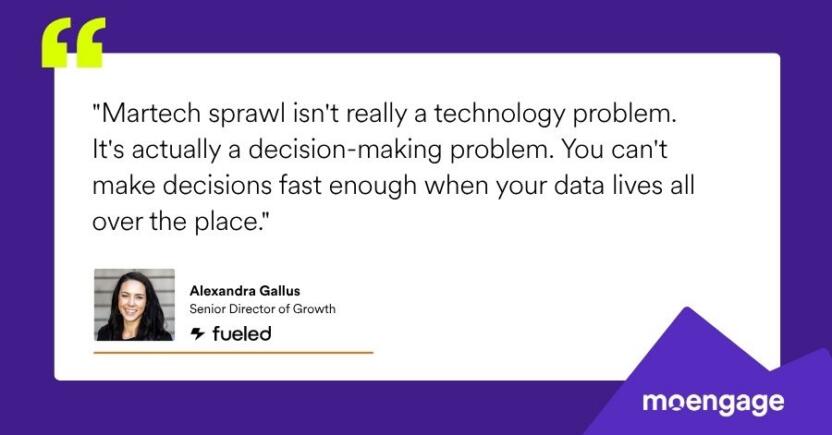
Alex’s team runs martech audits across industries and finds the same pattern everywhere. Teams buy platforms to solve individual problems, but nobody evaluates how the ecosystem works together. The result, as Alex describes it, is organizations running more than 15 marketing and analytics tools simultaneously, with three separate reporting environments all producing slightly different versions of the same metric.
In retail, vendors keep promising better attribution or churn prediction, making it easy to keep buying without ever stepping back to assess what you already have. In financial services, GDPR compliance forces data into separate silos by design, making a unified customer view structurally difficult before any tool decision is even made.
Across all of it, Alex consistently finds that only 30 to 40 percent of a platform’s capabilities are actively being used. The rest sits idle while teams evaluate what to buy next.
The Problem Runs Deeper Than the Platform
Where Alex sees these patterns from the outside, Ana has lived them from within. And from that vantage point, the biggest failure point isn’t the platform selection. It’s what comes before it.
“It’s not really about technology. The processes are siloed, the data that should be empowering those platforms is siloed, and there’s no one there to help break those silos. That coordination and architecting of processes is what is most challenging for marketers and companies.” — Ana Mourão, Global Customer Data Senior Manager
A fragmented stack doesn’t just reflect broken processes. It entrenches them. When data flows through disconnected platforms with no shared governance, each team builds its own source of truth, and what looked like a technology problem turns out to be a coordination problem that a new platform was never going to solve.
Ana describes the most overlooked root cause as the absence of governance around how customer data is collected and used for activation. Not the absence of data or tools, but the absence of shared rules for what the data means and who is responsible for it. Getting that foundation right, she says, has to come before any vendor conversation begins.
When the Tipping Point Arrives
Ana also defines the two north stars that tend to crystallize the decision to consolidate. The first is the unified customer view: when data is scattered across platforms, a coherent picture of customer behavior across channels becomes impossible to build. The second is operational efficiency: faster time to market, fewer handoffs, less time reconciling data across tools.
These operational gains are also what unlock buy-in from teams that marketing needs to bring along. Ana frames the argument differently for each stakeholder: for IT, it’s reduced dependency; for legal, it’s easier compliance with data deletion requests and audit requirements; for finance, it’s reduced agency spend. The business case for consolidation is rarely one story. It’s several, told to the right people.
What those gains look like in practice varies, but Ana points to a blind spot that most teams share: marketers tend to measure the customer-facing outcomes and overlook the operational ones. Campaign speed, segment-creation time, reduced agency dependency, and compliance efficiency are just as valid as conversion rates, and often more persuasive when making the internal case for investment. Once that alignment is in place, the next question becomes what the stack itself should actually look like.
The Stack Your Team Can Actually Operate
The debate between best-of-breed versus unified platform never really goes away. But the operational cost of governing a fragmented ecosystem has grown significantly as data privacy requirements, AI initiatives, and customer expectations have all accelerated at once.
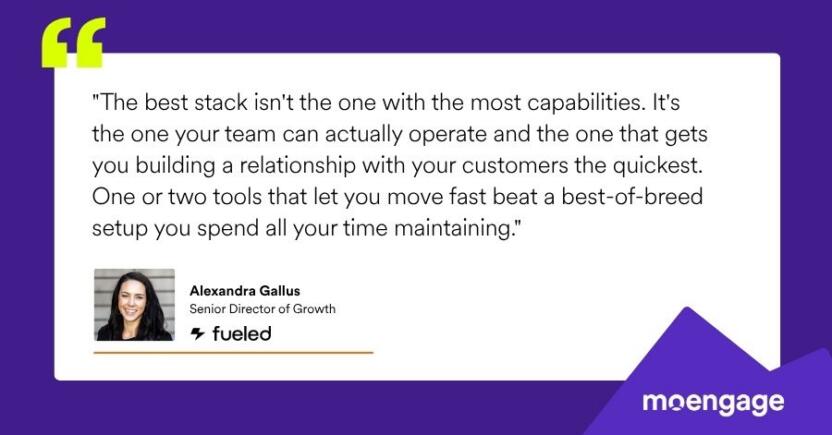
Alex has seen best-of-breed work, but only at organizations with a dedicated team whose sole job is to maintain integrations and govern the stack. Most teams don’t have that capacity, and building it just to maintain a stack isn’t a realistic investment.
Customers Don’t Experience Your Org Chart
The cost of fragmentation doesn’t show up first in your dashboards. It shows up in what your customers feel.
“Customers don’t want to experience your organizational chart. They want to experience your brand. They’re no longer comparing you to competitors in your industry. They’re comparing you to the brand that got it right this morning.” — Alexandra Gallus, Senior Director of Growth, Fueled
Fragmentation shows up as a welcome email to someone who has been a customer for years, a promotion for a product they already own, or a push notification for an action they already took. These are small moments, but each one signals the same thing: this brand doesn’t really know me.
Alex’s team worked with a wellness retailer, whose customer data was spread across an ecommerce platform, loyalty program, email tool, mobile app, and SMS platform. Each system captured part of the story, but because data lagged by 12 hours or more, the team couldn’t act on intent signals in time. After unifying those systems, product recommendations became behavior-driven rather than generic, and the team could message in real time. Within 30 days, cart conversion rates improved by 15 percent, loyalty program participation rose by 5 percent, and retention strengthened across the board.
The same held true for an insurance client where app activity, website behavior, and CRM data were completely disconnected. Once unified, customers were no longer treated as strangers across their own channels, and communications shifted from audience-driven to behavior-driven.
The technology and the industry differed. The underlying problem, and the payoff from solving it, did not.
“The difference between a unified and fragmented organization is speed. Both may have the same customer signals. The unified organization can act on them while the customer is still engaged.” — Alexandra Gallus, Senior Director of Growth, Fueled
The Hardest Integration Is Always Human
Both Ana and Alex agree that most consolidation projects don’t fail at the technical layer. They fail at the organizational one.
Each department comes in with its own goal. As Alex puts it, marketing wants personalization, technology wants simplification, finance wants cost reduction, and product wants audience growth. Getting those stakeholders aligned around a shared business outcome before any platform discussion starts is what determines whether the project moves.
Alex’s approach is to make the cost of fragmentation concrete. Once teams see how much time goes into reconciling reports, maintaining broken integrations, and debating which metric is correct, the case makes itself.
“Most consolidation projects don’t fail because of integrations alone. They fail because stakeholders aren’t aligned. You can’t consolidate your technology if the organization itself is still fragmented.” — Alexandra Gallus, Senior Director of Growth, Fueled
On the execution side, Ana’s advice is to resist the urge to migrate everything at once.
“Start small, prove value, then start migrating everything else. No shock and awe. Go in parts so that you can do it together and gain confidence as a larger team.” — Ana Mourão, Global Customer Data Senior Manager
Getting aligned is the first hurdle. But even once teams are on the same page, the execution phase has its own learning curve. Year one will be harder than most teams expect. Companies tend to assume the project ends when the technology launches. But that’s usually when the real work begins, because adoption, governance, and process redesign all follow the go-live, not precede it.
“Companies often underestimate the human side of transformation and overestimate the technology side of implementation in the first year.” — Alexandra Gallus, Senior Director of Growth, Fueled
From Operators to Architects
As AI becomes embedded across more platforms, Ana and Alex see the marketer’s role shifting in the same direction: away from tool execution and toward a much broader view of the stack.
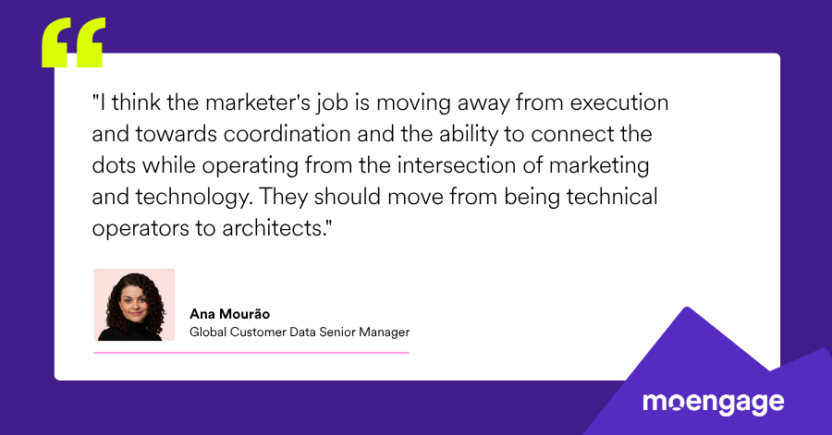
That shift doesn’t require technical expertise. What it requires is a systemic understanding of how data moves through the entire stack, where it goes for activation, and where it can break.
AI accelerates this dynamic, but not equally for everyone, as Alex observes. Organizations that invested in data quality and governance early are the ones moving fastest with it now. For everyone else, AI is exposing the foundational problems they didn’t know existed. As more execution becomes automated, the coordination layer (the human work of connecting teams, resolving ambiguity, and making governance calls) only becomes more critical, not less.
“Bad data plus AI helps you make mistakes faster.” — Alexandra Gallus, Senior Director of Growth, Fueled
Stop Adding, Start Connecting
Both practitioners see the martech sprawl issue from opposite ends. But their conclusion is the same.
Ana’s advice is to resist the pressure to chase what everyone else is doing and focus on what actually holds value.
“Go back to the basics. Make sure the processes make sense, make sure you only have martech that you are actually using, and use AI in a thoughtful way.” — Ana Mourão, Global Customer Data Senior Manager
From the outside, Alex sees a clear divide between organizations that are adapting and those that are falling behind. The ones moving fastest are actively reducing complexity, concentrating on cleaner customer data, and consolidating around tools that help them act faster. The ones struggling are still caught comparing data between platforms and making decisions far too slowly.
“The biggest gap isn’t lack of technology. It’s whether you can adapt quickly and whether your technology supports that or keeps you behind. The value isn’t better reporting. The value is being able to meet your customer where they’re at while they’re still engaged with your brand.” — Alexandra Gallus, Senior Director of Growth, Fueled
Martech consolidation isn’t a technology decision. It never was.
The post The Cost of Martech Sprawl: Lessons from the Trenches appeared first on MoEngage.