Summary
The best platforms unify customer data into a single profile and activate segments across email and other channels without manual list exports. CDP-first platforms like Segment and Tealium unify data upstream but need a separate email service provider for activation. All-in-one platforms like Insider One, Braze, and Klaviyo combine unified profiles with native execution in one platform, though the channels each one executes on natively vary.
Marketing teams running segmented campaigns across several channels face a structural problem. Customer data lives in separate systems, segments refresh on different schedules, and activation requires manual exports between platforms.
The right approach connects data sources into a single customer profile, then activates segments directly, without list management overhead in between. Your choice of architecture determines whether an abandoned cart message arrives in minutes or hours, on the channel that customer actually responds to.
What to compare when evaluating these platforms
A segment refresh that runs nightly means your abandoned cart message fires long after the cart event. Before comparing features, it helps to understand how each platform handles identity resolution, activation latency, and which channels it can actually send on natively.
| Platform | Category | Identity resolution | Refresh cadence | Native channels beyond email | Consent handling |
| Insider One | All-in-one | Deterministic and probabilistic | Real-time | SMS, WhatsApp, web push, app push | Build-time |
| Braze | All-in-one | Deterministic | Real-time | SMS, push, in-app, WhatsApp | Send-time |
| Klaviyo | All-in-one | Deterministic | Real-time | SMS, RCS, WhatsApp, mobile push | Send-time |
| Segment | CDP | Deterministic | Real-time | None natively (Twilio Engage is a separate connected product) | Build-time |
| Tealium | CDP | Deterministic and probabilistic | Real-time | None (CDP only) | Build-time |
| Census | Warehouse-native | Relies on warehouse | Micro-batch | None (warehouse only) | Relies on warehouse |
Real-time here means updates that happen within moments. Micro-batch means updates occur in periodic intervals, typically minutes to hours rather than seconds.
This is the point where the “unified across email and marketing channels” framing actually gets tested. Segment and Tealium unify data well but send nothing themselves.
Klaviyo and Braze have both broadened well beyond email into SMS, push, and messaging apps.
Insider One and Braze execute natively across the widest set of channels among the all-in-one options, which matters if your unified profile needs to reach more than an inbox.
Which platforms unify customer data best for cross-channel activation
The platforms below fall into different architecture categories. If you already run a customer data platform (CDP), skip to that section. If you want a single platform for data and execution, start with the all-in-one options.
Insider One
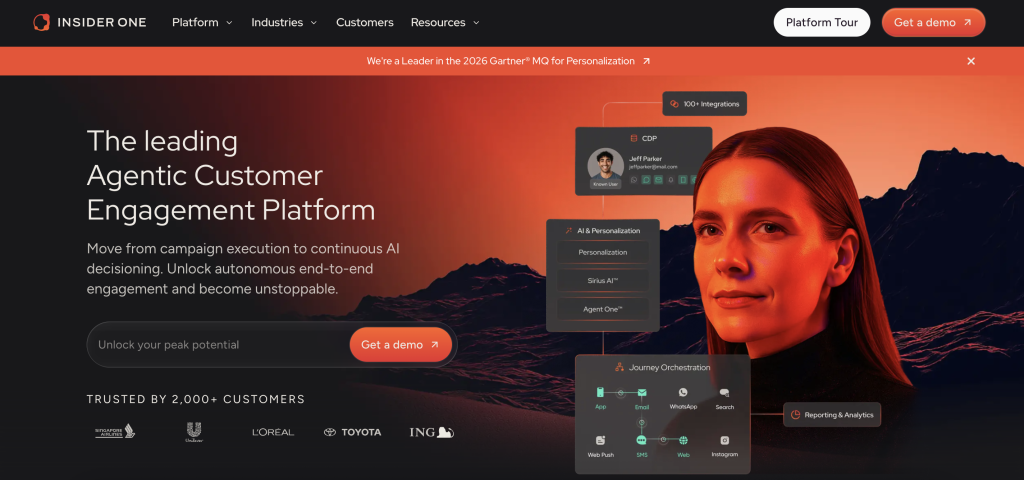
Marketing teams stitching together a CDP, an email platform, and a separate journey builder spend more time on integration than on campaigns. Insider One combines a unified customer database, AI-powered segmentation, and native execution across channels in a single platform.
Events from web, app, and API map to a single profile using configurable identity resolution. Segments update in real time as behaviour changes, and activation to email, SMS, WhatsApp, and web push happens from the same canvas without export.
Consider a concrete example: users who viewed a product page recently, haven’t purchased, and are predicted to have a high likelihood to purchase. This segment updates automatically and can trigger a multi-channel journey in Architect, Insider One’s customer journey orchestration solution, without manual list pulls.
- Unified customer database: unified profiles across web, app, and offline sources, managed through Customer Data Management
- Predictive segments: powered by Insider One AI™, Insider One’s set of AI capabilities, including likelihood to purchase, churn, and discount affinity
- Real-time computation: near-real-time segment refresh as behaviour changes
- Native activation: email, SMS, WhatsApp, web push, and app push from one canvas via Architect
- Integrations: connections to data warehouses, CRMs, and ad platforms
Pricing uses a monthly tracked user model, with no separate charges for data, storage, or duplicated events.
Klaviyo
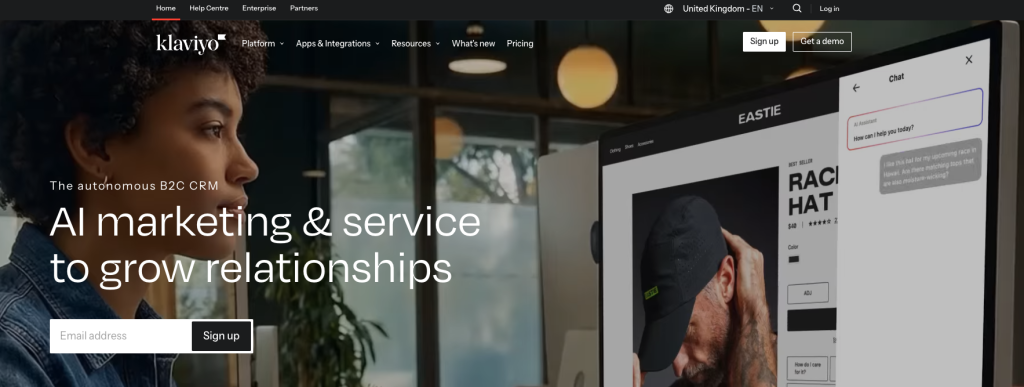
Klaviyo serves Shopify-native ecommerce brands that want deep transactional segmentation without a separate CDP. It pulls order, browse, and email engagement data directly from Shopify into a single profile.
Segments combine purchase history, predicted lifetime value, and email engagement. Klaviyo has expanded its native channel coverage over time and now positions itself around email, SMS, RCS, WhatsApp, and mobile push from one profile.
Segment example: customers who purchased recently, have high customer lifetime value, and haven’t opened an email lately. Teams with significant app or offline data should verify Klaviyo supports those sources before relying on it as the primary profile.
Pricing is based on active profiles, with a free tier available. Costs scale with list size.
Braze
Built for mobile-first brands, Braze delivers lifecycle engagement across app push, in-app messaging, WhatsApp, SMS, and email. It ingests events from SDKs, APIs, and partner integrations into user profiles.
Identity resolution uses a combination of user ID and device-level identifiers. Segments update in real time and can trigger campaigns based on in-session behaviour.
Segment example: users who completed onboarding, haven’t made a purchase, and opened the app recently. Teams that need warehouse-level data unification should confirm whether Braze alone meets that need, or whether an additional data layer is required.
Pricing is based on monthly active users and messaging volume, with a credit-based model for certain channels.
How unified customer profiles actually work behind a segment
A segment showing many users in your CDP but fewer in your email platform usually means some profiles failed identity resolution or a suppression list didn’t sync. Understanding the underlying process prevents these mismatches.
- Data collection: events and attributes flow in from web, app, API, and offline sources
- Identity resolution: anonymous and known identifiers get stitched into one profile using deterministic or probabilistic matching
- Schema normalisation: events map to a common taxonomy, so “add_to_cart” from web and “cart_add” from app mean the same thing
- Segment computation: rules or predictive models evaluate profiles against segment definitions
- Activation: segments sync out to email and other channels
Latency depends on the integration method. Native activation is typically fastest, since there’s no export step in between. API push adds delay, and reverse ETL from a warehouse, the approach platforms like Census specialise in, is typically slower still.
For abandoned cart messages or flash sales, that latency gap determines whether the message actually arrives in time to matter. If you want to see what real-time segment-to-send looks like in practice, the product demo hub walks through it by channel.
What to look for in a platform for unified customer profiles
A feature checklist rarely reveals whether a platform will actually work for your team. Evaluation criteria tied to how you’ll use it day to day are more useful.
- Identity resolution depth: does the platform support deterministic and probabilistic matching, and can you configure match rules?
- Segment refresh cadence: real-time, hourly, or daily? Abandoned cart needs real-time; a monthly newsletter doesn’t
- Attribute and event depth: how many attributes and events can segment definitions actually use, and are computed traits supported?
- Suppression and consent handling: can you exclude users by consent state at build time, or only at send time?
- Activation latency: native channel execution, API push, or reverse ETL, each adds a different amount of delay before a segment reaches its destination channel
- Pricing model: monthly tracked users, event-based, or contact-based, each drives cost differently as you scale
Ask any vendor about average segment sync latency to your specific channels, not just email. Real-time refresh increases compute cost, and relying entirely on native execution limits flexibility if you want to switch providers later.
What free and low-cost options exist for unifying customer data
“Free tier” often means free until you need the one feature that actually matters. Understanding the constraints upfront avoids a painful migration later.
- Mailchimp: free tier with limited segmentation depth
- HubSpot Free CRM: unlimited contacts, but minimal behavioural tracking
- Klaviyo: free tier with full segmentation features, now spanning email, SMS, and more
- Segment Connections: free tier with limited destinations; identity resolution is paid
- Customer.io: free tier for low-volume senders
Rough starting points by stage: solo or early-stage teams can manage with Mailchimp or Klaviyo’s free tier and manual list exports. Seed-stage SaaS teams often pair Customer.io with Segment’s free tier for event tracking. Growth-stage ecommerce teams tend to outgrow both and move to a paid tier or an all-in-one platform.
You’ll know it’s time to move on when you hit contact caps, need real-time segments, or need to activate across more than one or two channels natively.
Privacy, consent, and compliance in unified customer profiles
A segment that still includes users who unsubscribed last week is the kind of thing that gets your compliance team a call from legal. These patterns need to be built into segmentation from the start, not bolted on afterwards.
- Consent as a profile attribute: store consent state on the profile and check it in every segment definition, not just at send time
- Build-time versus send-time suppression: build-time suppression excludes users from the segment itself, which is safer but requires tighter data sync between systems
- Hashed identifiers for activation: when syncing to ad platforms, use hashed email or phone to avoid exposing personally identifiable information
- Audit trails: the platform should log segment membership changes for compliance audits
If consent management is fragmented across systems, it’s worth unifying consent data before trying to unify segments on top of it. Insider One’s Customer Data Management layer handles consent state as part of the unified profile itself, so build-time suppression doesn’t depend on a separate sync.
Segment design patterns worth using for lifecycle campaigns
“AI-powered segments” is a feature label, not a strategy on its own. A few concrete recipes are more useful as a starting point than the label itself:
- High-intent cart abandoners: viewed a product, added to cart, no purchase soon after, predicted high likelihood to purchase. Trigger a message quickly, on whichever channel that customer engages with most
- Lapsed loyal customers: purchased repeatedly over the past year, no purchase recently. Trigger a win-back campaign with a personalised offer
- New subscriber onboarding: subscribed recently, hasn’t completed a first purchase. Trigger a welcome series
- Churn risk intervention: predicted high churn probability, has engaged recently. Trigger a retention offer before the churn actually happens
Always use a holdout group to measure incremental lift rather than assuming a segment is working because it looks good on paper. Segments that are too small produce unreliable results, and overlapping segments cause duplicate sends unless mutual exclusivity rules are in place.
Insider One AI’s predictive segments build these recipes with built-in holdout testing rather than requiring a separate analytics step.
Segmentation mistakes that quietly hurt deliverability
A segment that refreshes daily while your suppression list syncs weekly means you’re emailing people who already unsubscribed. These operational gaps hit sender reputation directly.
- Segment drift: segments go stale when refresh cadence doesn’t match campaign frequency
- Over-segmentation: segments too small complicate deliverability warm-up and produce unreliable test results
- Segment overlap: users in multiple segments end up receiving duplicate campaigns
- Missing suppression sync: unsubscribes, bounces, and complaints need to sync back before the next segment computation
- Frequency cap blindness: segmentation without frequency capping means high-value users get over-messaged and disengage
A basic governance workflow, who owns segment definitions, how changes get reviewed, how conflicts get resolved, prevents most of this before it becomes a deliverability problem.
How to start unifying customer profiles with Insider One
Insider One combines unified customer data, AI-powered segmentation, and native activation across email, SMS, WhatsApp, web push, and app push in a single platform. Teams typically go live quickly, with predictable pricing and no hidden charges for data or events.
If exports, sync schedules, and “close enough” segments are the current state of play, book a demo to see how unified profiles and native activation change the speed and accuracy of every send.
Frequently asked questions
It means combining customer data from multiple sources, web, app, offline, into a single profile, then using that profile to build segments that activate across email and other channels without manual list exports between systems.
Email service providers handle segmentation within email. CDPs like Segment and Tealium unify data across channels but need a separate email provider for activation. All-in-one platforms like Insider One combine both in one system.
Klaviyo offers a free tier with full segmentation. Mailchimp offers basic segmentation with a free tier. HubSpot’s Free CRM allows unlimited contacts but includes limited behavioural tracking.
Teams with clean data and clear segment definitions can launch quickly. Missing tracking, unclear identity resolution, and pending consent reviews are the most common blockers, more often than the platform itself.
It means segment membership updates shortly after the triggering behaviour happens. Batch segmentation updates on a schedule instead, which delays time-sensitive campaigns like abandoned cart messages.