Key takeaways:
- AI introduces attack surfaces that traditional application security programmes were not designed to manage.
- Many enterprise AI risks emerge during data preparation, model training, deployment, and monitoring rather than after release.
- Secure AI SDLC in UK environments helps reduce operational, regulatory, and reputational exposure.
- The UK’s evolving AI governance landscape is making security-by-design a board-level concern.
- Organisations that adopt secure AI SDLC practices are better positioned to scale AI while maintaining trust and audit readiness.
UK enterprises are deploying AI at a pace that has fundamentally outrun the security frameworks governing it. Across financial services, healthcare, insurance, manufacturing, and the public sector, AI now touches customer-facing decisions, back-office operations, and regulated data flows. Yet the majority of organisations still rely on development processes architected for conventional software, not probabilistic, data-dependent AI systems.
According to McKinsey’s State of AI 2025, 88% of organisations now use AI in at least one business function, highlighting how quickly AI is becoming part of mainstream business operations.
At the same time, the UK Government’s Cyber Security Breaches Survey 2025 found that 43% of businesses experienced a cyber security breach or attack during the previous year, reinforcing that cyber resilience remains a board-level priority.
The gap between AI adoption and AI security is not a technical oversight. It is a governance failure, and one that regulators, boards, and enterprise risk committees are increasingly unwilling to overlook.
AI models can be manipulated through adversarial inputs, poisoned during training, and exploited after deployment, even when the surrounding application infrastructure appears technically sound. Traditional DevSecOps catches code vulnerabilities. It does not catch model drift, prompt injection, or training data leakage. That is precisely where AI security in the UK now demands a different discipline: a Secure AI Software Development Lifecycle (SDLC).
This article examines the real business costs of ignoring AI security, maps the UK’s regulatory landscape, and outlines what a mature, secure AI SDLC looks like in practice for enterprise decision-makers.
Secure AI Starts Long Before Deployment
Building AI securely begins with the right development approach. Appinventiv helps UK businesses integrate security, governance, and compliance into every stage of the AI lifecycle.

Decoding the 2026 UK AI Regulatory Landscape
The UK is shaping AI governance through existing regulators instead of introducing a single AI law. This approach places greater responsibility on businesses to demonstrate secure development, responsible deployment, and effective governance throughout the AI lifecycle.
Sector-Led Enforcement
The Financial Conduct Authority (FCA), the Information Commissioner’s Office (ICO), and Ofcom are all enforcing AI-related obligations in the UK within their existing mandates. For financial services firms, the FCA’s Consumer Duty and Operational Resilience frameworks already capture AI-driven customer decisions and third-party model dependencies. Ofcom’s approach to algorithmic accountability is shaping expectations in media and communications. The regulatory environment is not waiting for dedicated AI legislation.
The ICO’s Position on AI and Data
The ICO has published detailed guidance on the use of generative AI and the obligations it creates under UK GDPR. AI systems that process personal data for automated decision-making are already subject to lawfulness, fairness, and transparency requirements. The ICO has signalled that organisations using AI without adequate data protection impact assessments face formal enforcement action, not just guidance letters.
ETSI EN 304 223 and the UK AI Safety Institute
The ETSI EN 304 223 standard for AI cybersecurity, introduced in 2025, provides a technical baseline for AI security controls that UK enterprises operating in regulated and critical infrastructure sectors are expected to align with. The UK AI Safety Institute continues to shape compliance requirements through testing and evaluation frameworks, particularly for high-capability frontier models deployed in sensitive environments. For enterprise architects and security leads, these standards are not optional frameworks to be reviewed later. They are shaping what audit-ready AI deployment looks like now.
Why AI Changes the Enterprise Security Landscape
AI security in the UK requires a fundamentally different lens from traditional application security. The attack surface is broader, the failure modes are less predictable, and the consequences of getting it wrong extend well beyond a standard data breach.
Traditional Software Risks vs AI-Specific Risks
| Traditional Applications | AI Systems |
|---|---|
| Code vulnerabilities | Prompt injection |
| API attacks | Model poisoning |
| Authentication flaws | Training data leakage |
| SQL injection | Model inversion attacks |
| Malware | Adversarial input attacks |
| Data theft | Hallucination exploitation |
Why Existing DevSecOps Alone Isn’t Enough
DevSecOps was built to secure deterministic systems where the same input reliably produces the same output. AI systems are probabilistic by nature. They retrain continuously, respond to dynamic prompts, and depend on third-party foundation models whose security posture enterprises rarely control directly.
The data supply chains feeding AI models introduce risks that sit entirely outside the scope of conventional security testing. Model governance gaps, inadequately documented training datasets, and the absence of prompt security controls create vulnerabilities that standard penetration testing and code review processes simply are not designed to detect.
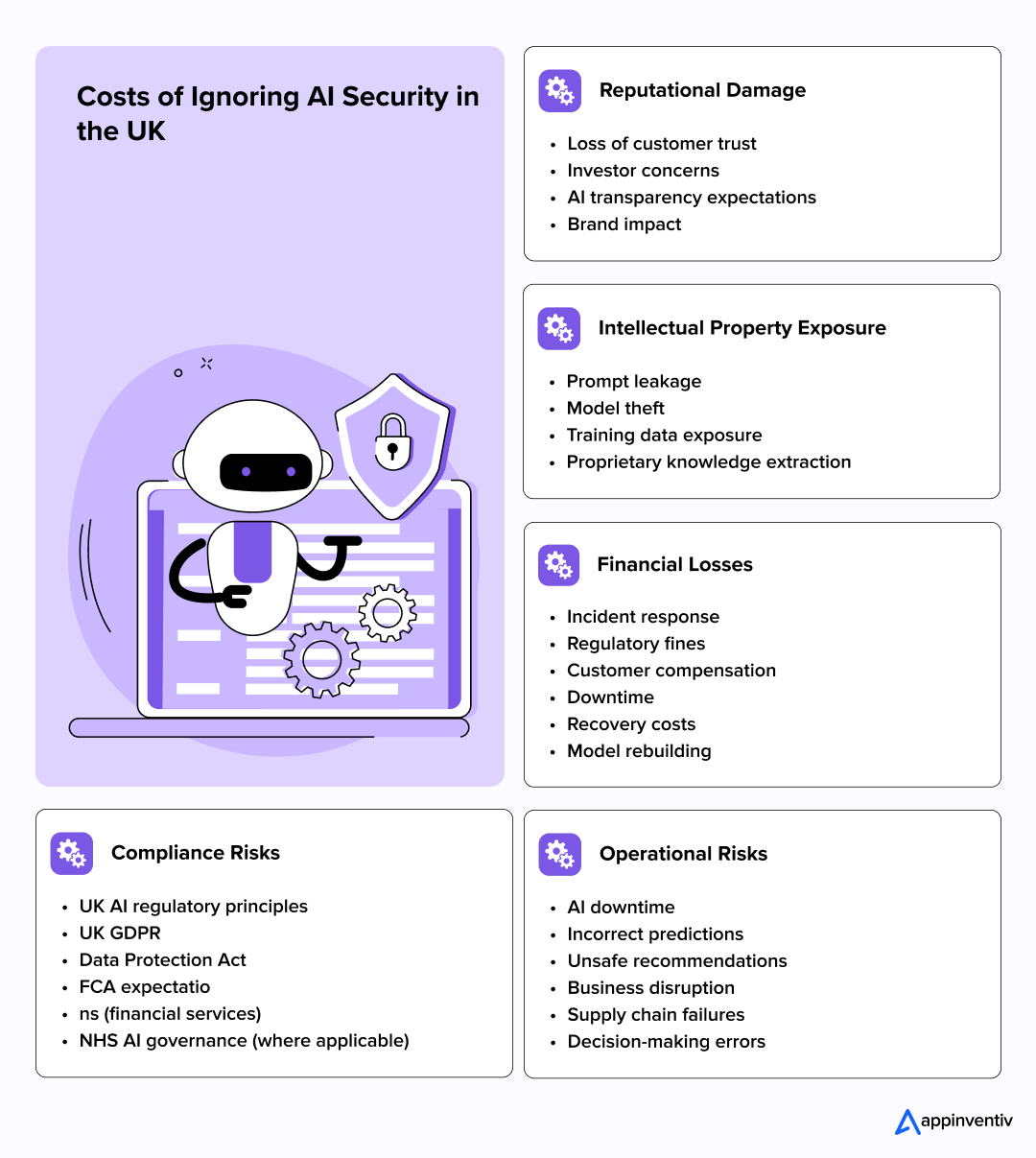
What Are The Hidden Costs of Ignoring AI Security in the UK?
The business case for secure AI development is not primarily about compliance. It is about avoiding costs that accumulate across financial, reputational, operational, and legal dimensions simultaneously when AI security is treated as an afterthought.
Financial Losses
A single AI security incident carries costs that extend well beyond immediate incident response. Regulatory fines under UK GDPR can reach nearly 4% of global annual turnover. Customer compensation, legal exposure, model rebuilding, and the business downtime associated with taking compromised AI systems offline all compound quickly. Addressing these issues after deployment is often significantly more expensive than embedding security during development.
Reputational Damage
AI failures are not contained within IT departments. When an AI model produces biased outputs, leaks customer data, or is manipulated to generate harmful recommendations, the reputational consequences reach the board, investors, and the press. In an environment where AI transparency is becoming an explicit expectation from institutional investors and enterprise customers alike, a visible AI security failure can restructure how the market perceives a company’s technology governance entirely.
Compliance Risks
UK GDPR, the Data Protection Act 2018, FCA operational resilience requirements, and NHS AI governance frameworks are all in active force. AI systems that process regulated data without demonstrable security controls and data lineage documentation are exposed to enforcement from multiple regulators simultaneously. Enterprise AI security guidelines in the UK are evolving toward mandatory audit trails, not optional best-practice documentation.
Operational Risks
AI downtime, model drift leading to incorrect predictions, and unsafe automated recommendations generate operational disruption that is difficult to quantify until it happens. In supply chain, financial services, and healthcare environments, AI-driven decision errors carry real liability which can quickly affect business continuity.
Intellectual Property Exposure
Prompt leakage, model theft, and the extraction of proprietary knowledge through carefully constructed queries represent an underappreciated category of AI risk. Enterprises embedding competitive knowledge, client data, or proprietary methodologies into AI systems without adequate access controls and prompt security testing are effectively exposing that intellectual property to extraction. This is not a theoretical risk. It is already occurring at scale across industries, deploying large language models without security controls.
Build Security Into Every AI Release
A secure AI product begins with a secure development lifecycle. Appinventiv helps organisations implement secure AI SDLC that reduces risk while supporting faster AI adoption.
What Is Secure AI SDLC?
Secure AI SDLC extends conventional software security principles across every stage of an AI system’s lifecycle, from data sourcing and model training through to production deployment and continuous monitoring. It treats models, data, and prompts as security-critical artefacts, not just the application code wrapping them.
How Secure AI SDLC Differs from Traditional SDLC
Understanding the specific differences between these methodologies clarifies why a specialised approach is necessary.
| Traditional SDLC | Secure AI SDLC |
|---|---|
| Focus on code security | Focus on code, models, and data pipelines |
| Security testing near deployment | Security integrated throughout the lifecycle |
| Static application behaviour | Continuously evolving model behaviour |
| Conventional threat modelling | AI-specific threat modelling (MITRE ATLAS, OWASP LLM Top 10) |
| Code review | Data, prompt, and model review |
How Secure AI SDLC Protects the Business
Implementing this specialised framework offers direct commercial and operational protection by targeting risks at their source:
- Safeguards Intellectual Property: Blocks model inversion and prompt extraction techniques designed to steal core data assets and proprietary algorithms.
- Ensures Regulatory Compliance: Insulates the enterprise from catastrophic UK GDPR failures by maintaining fully traceable data lineage and preventing poisoned inputs.
- Mitigates Financial Risk: Proactively catches vulnerabilities during the training phase, avoiding the severe liabilities associated with post-deployment model rollbacks, operational downtime, and regulatory fines.
Building Secure AI Into Enterprise Delivery
Implementing secure AI SDLC in UK organisations requires coordinated effort across multiple business units.
- First, you must mandate cross-functional governance, ensuring legal, security operations, and data science teams collaborate from project inception.
- Second, invest in AI-specific security tools designed for continuous model observability and anomaly detection.
- Third, conduct regular internal audits against emerging NCSC standards and actively train your engineering staff on AI-specific threat vectors.
- Finally, partner with an AI development company in the UK that understands how to bake governance into the architecture natively.
AI Security Risks Across Every Stage of the AI Lifecycle
AI security cannot rely on a single control point. Every development phase introduces different risks, making continuous validation essential for maintaining secure and trustworthy AI systems.
| AI Lifecycle Stage | Common Risks | Security Controls |
|---|---|---|
| Data Collection | Data poisoning, biased sources | Input validation, source verification |
| Data Preparation | Sensitive data exposure | Data classification, anonymisation |
| Model Training | Model poisoning, backdoors | Secure pipelines, integrity checks |
| Fine-Tuning | Prompt leakage, overfitting | Access controls, prompt auditing |
| Deployment | API abuse, unauthorised access | Authentication, rate limiting |
| Production | Model drift, adversarial inputs | Runtime monitoring, anomaly detection |
| Continuous Learning | Unauthorised retraining | Governance controls, versioning |
What Are The Most Critical AI Security Threats UK Enterprises Should Prepare for in 2026?
AI security challenges in the UK in 2026 extend well beyond conventional cyber threats. Enterprise risk teams need a working knowledge of these attack vectors to make informed investment and architecture decisions.
Prompt Injection
Malicious inputs override an AI system’s intended instructions, forcing outputs that serve the attacker’s objectives rather than the application’s design.
Indirect Prompt Injection
Threat actors embed malicious instructions inside external content, such as documents or web pages, that an AI agent retrieves and processes autonomously.
Data Poisoning
Training datasets are corrupted at source, causing models to learn from manipulated data and produce systematically skewed or malicious outputs.
Model Poisoning
Attackers inject malicious patterns directly into the training or fine-tuning process, embedding backdoors that activate under specific trigger conditions.
Model Inversion
Query patterns are exploited to reconstruct sensitive training data, potentially exposing personally identifiable information or proprietary datasets.
Membership Inference
Attackers determine whether specific data records were used to train a model, creating privacy and compliance exposure for regulated datasets.
Adversarial Attacks
Carefully crafted inputs, often imperceptible to humans, cause AI systems to misclassify data or produce incorrect outputs with high confidence.
Sensitive Data Leakage
AI systems inadvertently reproduce confidential information from training data within generated outputs, bypassing conventional data loss prevention controls.
Shadow AI
Staff deploy unapproved AI tools outside governance frameworks, creating unmanaged data exposure and compliance liability. IBM’s 2025 UK findings show that only 31% of UK organisations have governance policies in place to manage shadow AI.
Supply Chain Risks from Open Models
Third-party open-source foundation models may carry pre-existing vulnerabilities, biased training data, or backdoors that propagate into enterprise AI products.
Agentic AI Security Risks
AI agents with tool-calling capabilities and autonomous decision-making authority amplify the potential blast radius of a security failure significantly.
Multi-Agent AI Risks
Complex multi-agent systems create trust boundary challenges where a compromised agent can manipulate other agents within an orchestrated workflow.
Secure Every Stage of Your AI Lifecycle
Whether you are building GenAI apps, AI copilots or intelligent automation platforms, we help organisations embed security throughout the AI lifecycle to reduce risk and strengthen long-term resilience.
UK AI Security Regulations and Standards, Businesses Should Know
Compliance across AI security best practices in the UK draws on a layered set of frameworks. Understanding which apply, and how they interact with existing information security obligations, is foundational to building an audit-ready AI governance posture.
| Framework | Why It Matters for UK Enterprises |
|---|---|
| UK GDPR | Governs personal data processing within AI systems, including automated decision-making |
| Data Protection Act 2018 | UK-specific privacy obligations applicable to AI-processed personal data |
| NCSC AI Security Guidance | Practical security best practices for AI system design and deployment |
| ISO/IEC 42001 | AI management system standard covering governance, risk, and lifecycle controls |
| ISO 27001 | Information security management; foundational baseline for AI security programmes |
| ISO 23894 | AI risk management standard guiding enterprise risk assessment for AI systems |
| OWASP Top 10 for LLM Applications | Application-level AI security vulnerabilities, widely referenced by security teams |
| NIST AI Risk Management Framework | Structured approach to identifying, measuring, and managing AI risk |
| MITRE ATLAS | Adversarial threat modelling framework specific to AI and machine learning systems |
| ETSI EN 304 223 | Technical standard for AI cybersecurity controls, relevant to regulated sectors |
Build vs Retrofit: Why Embedding Security Early Costs Less Than Fixing AI Later
Retrofitting security controls onto a deployed AI system is significantly more expensive and disruptive than embedding them at the architecture stage. The cost differential is not marginal; it reshapes the total cost of ownership of an AI programme.
| Dimension | Secure by Design | Retrofitted After Deployment |
|---|---|---|
| Development cost | Higher upfront investment | Lower initial spend, higher remediation cost |
| Compliance readiness | Audit trails built in from the start | Delayed audits, documentation gaps |
| Incident frequency | Reduced through proactive controls | Elevated exposure until controls are added |
| Scalability | Security architecture scales with the model | Retrofit controls create technical debt |
| Customer trust | Demonstrable governance from launch | Reputational risk during remediation period |
The secure AI powered software development lifecycle in the UK is increasingly being treated as a cost reduction strategy, not merely a compliance requirement. Organisations that embed AI governance, threat modelling, and security controls from the architecture phase reduce long-term remediation expenditure and compress the path to regulatory compliance.
UK Enterprises AI Security Readiness Checklist
Before scaling any AI programme, leadership teams benefit from an honest assessment of where security controls currently sit. The following checklist reflects the baseline expectations of a mature, audit-ready, secure AI SDLC program for the UK environment.
- AI governance framework formally adopted and documented
- AI asset inventory is maintained with model versions and dependencies
- Data lineage tracking in place for all AI training datasets
- Secure training pipelines with integrity verification controls
- Prompt security testing is conducted regularly and documented
- AI red teaming exercises are scheduled and results are acted upon
- Runtime monitoring is active across all production AI systems
- Model version control with rollback capability in place
- Incident response plan covering AI-specific failure scenarios
- Regulatory documentation aligned to UK GDPR, NCSC guidance, and relevant sector standards
Why Businesses in the UK Choose Appinventiv for Secure AI Development
Security-capable AI development requires more than good intentions at project kick-off. It requires an engineering culture and delivery methodology where secure AI SDLC is not a phase to be completed but a continuous discipline embedded across every sprint, architecture review, and deployment decision.
Appinventiv brings a secure-by-design engineering approach to every AI programme. Our enterprise architecture consulting services integrate AI threat modelling, data governance, and prompt security controls right from the initial design session.
This rigorous approach allows us to successfully deliver end-to-end AI product engineering for innovative platforms like Vyrb, MyExec, Reel Media and so on. Our delivery model seamlessly combines MLOps and DevSecOps practices, ensuring that model retraining, continuous monitoring, and strict governance function as active, ongoing obligations rather than one-time project tasks. By conducting AI risk assessments at regular intervals, we catch vulnerabilities early, ensuring your system remains completely secure as your user base scales.
Furthermore, we embed regulatory-aware development directly into our core engineering practice. We structure our every engagement to explicitly align with UK GDPR, NCSC AI guidance, and ISO/IEC 42001, alongside sector-specific frameworks like FCA operational resilience requirements and NHS AI governance standards. The UK AI governance framework shaping enterprise expectations in 2026 acts as a foundational design input for our technical teams, rather than an external constraint we must navigate around during deployment.
Our commitment to these rigorous standards translates directly into quantifiable business impact for organisations seeking AI development services in the UK. In our 11+ years of experience, we have successfully deployed more than 3000+ digital assets across 35 different industries. This deep, cross-sector experience helps us drive documented efficiency gains of up to 45% for our UK clients.
For enterprise leaders evaluating delivery partners, the question is not whether AI security in the UK should exist within your programme. The real question is whether your technical partner possesses the engineering depth and regional market experience to make that security a practical, operational reality.
Connect with Appinventiv’s AI experts to create secure, scalable, and future-ready AI solutions tailored to your business.
FAQs
Q. Why is AI security important for UK businesses?
A. Enterprise AI security in the UK matters because AI systems introduce entirely new attack surfaces, such as data poisoning and prompt injection. Unsecured systems expose enterprises to massive data breaches, severe regulatory fines under UK GDPR, and catastrophic loss of intellectual property, making proactive defence essential for business survival.
Q. How can UK companies comply with AI security requirements?
A. UK companies should align with UK GDPR obligations for automated processing, NCSC AI security guidance, ISO/IEC 42001 for AI management systems, and relevant sector-specific frameworks such as FCA operational resilience requirements. Practical compliance requires AI asset inventories, data lineage documentation, prompt security testing, and regular audits against established standards.
Q. How do you build secure AI applications in the UK?
A. AI security best practices in the UK involve embedding security controls at the architecture stage rather than retrofitting them. This includes secure data pipelines, AI-specific threat modelling using frameworks such as MITRE ATLAS and OWASP LLM Top 10, prompt security testing, runtime monitoring, and model version control. Engaging a trusted AI partner with demonstrated experience of secure AI SDLC capability shortens the path to both functional and compliance-ready deployment.
Q. How does a Secure SDLC support compliance and auditability in the UK?
A. A secure software development lifecycle in the UK produces the documentation, audit trails, and governance artefacts that regulators require. Data lineage records, model integrity logs, incident response documentation, and access control records are all outputs of a mature, secure AI SDLC process. These artefacts are increasingly required by the ICO, FCA, and NHS governance frameworks as evidence of responsible AI deployment.
Q. What are the biggest AI security challenges for enterprises?
A. The most significant AI security challenges for UK enterprises include shadow AI proliferation, the absence of AI-specific governance frameworks, supply chain risks from third-party foundation models, and the failure to apply security controls across the full AI lifecycle.
The UK AI governance framework is evolving rapidly, and organisations that have not yet formalised their AI risk management approach are carrying material regulatory and operational exposure.