[ad_1]
New Deloitte data reveals why corporate affairs leaders are prioritizing change management, employee belief, AI upskilling, political acumen and business impact.
Politics and measurement are in. Media relations and purpose are out.
Those are some of the findings from Deloitte’s 2026 Corporate Affairs Report, which was based on 42 interviews with corporate affairs leaders, largely drawn from FTSE 100 companies and, reflecting a UK bent.
But the data reveals insights that can be of use around the world to those working in this discipline, which focuses on reputation, communications, and government and stakeholder relations.
These are some of the insights — and what they mean for your own corporate affairs practice.
- The biggest threat is change.
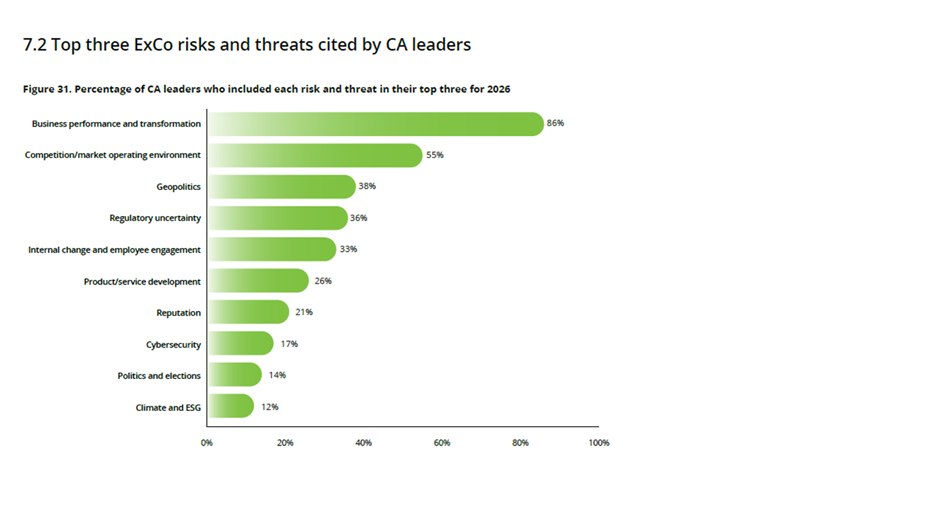
According to the data, 86% of respondents said that the greatest threat to their organization is business performance and change.
Now, that’s a huge category that can include everything from businesses evolving due to AI to stock prices tanking due to the unexpected closure of the Strait of Hormuz. But it demonstrates that uncertainty and a world that’s changing faster than humans can keep up pose a deep concern to those charged with protecting an organization’s reputation from the unknown.
Crisis playbooks, contingency plans and a willingness to move quickly can all help. But no one can plan for every future crisis.
The next largest concerns were competition/market operating environment and geopolitics, but both ranked far below change.
- Reputation matters — but so do internal stakeholders.
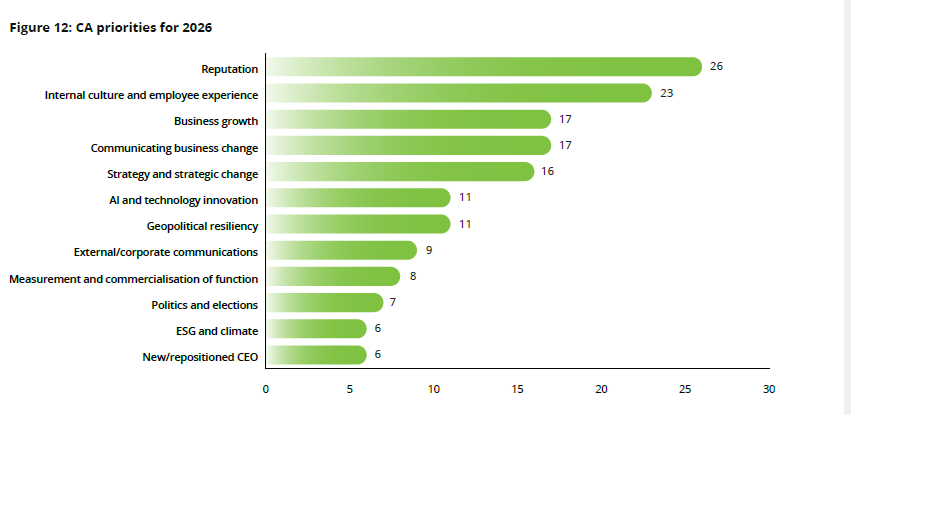
Perhaps not surprisingly, 26% of respondents said reputation was their biggest priority in 2026, more than any other answer. The discipline, after all, is defined by its focus on reputation. However, more surprisingly was the No. 2 response: internal culture and employee experience. In a time of economic upheaval and higher unemployment, organizations still see their people as a vital resource and a main area of focus for their corporate affairs function.
“Organisations increasingly view employee belief as a delivery multiplier,” the report said. “During restructures and transformation, CA leaders emphasised the risk of change fatigue and reduction in productivity, which can slow execution and create second order reputation and customer impacts if not managed effectively.”
- AI is more and less important than you’d think
Only 11% of respondents placed AI among their top 2026 priorities. Perhaps that’s why only 26% said they had a formal AI policy — a startlingly low number nearly four years into the AI revolution.
“The prevalence of the words ‘experimenting’ (referenced five times in interviews) and ‘playing’ suggests a lack of maturity,” the report notes.
That’s likely why the top priority for corporate affairs pros over the next 12 months, when it comes to AI, is upskilling, with 95% listing it as a major focus. The next answer, AI governance, had only a 49% response rate.
- Political acumen is more important — purpose is less
The report compared the last three years of the report to see which skills and focus areas have increased or decreased in importance. Following a worldwide trend, the report found that ESG, purpose and social issues campaigning had decreased in value. On the other hand, geopolitical experience, AI and measurement rigor are more important than ever.
Interestingly, while media relations has decreased in importance — a stark contrast to what we’ve seen in other areas of comms, where GEO pressures have triggered a media relations renaissance — owned media and podcasts have increased. Is this particular to the corporate affairs function, or will we see this trend spread across all of comms?
- CEOs expect impact
The survey found that 64% of corporate affairs heads sit on the executive committee. That access to leadership makes some aspects of the job easier, but it also engenders high expectations from CEOs.
“Good counsel is expected. Proving impact is the differentiator,” one CEO said. “The ability to interpret complexity and distill it for the leadership team is where CA earns its seat,” said another.
6. Bringing it all together
The throughline is that corporate affairs is becoming broader, more strategic and more accountable. The function is still responsible for reputation, but reputation can no longer be managed through messaging alone. It is now tied to business performance, employee belief, political risk, AI readiness and the ability to prove impact in terms that executives recognize.
The fundamentals still matter, but they are no longer enough on their own.
The organizations that get this right will not treat corporate affairs as a reactive support function. They will use it as an early-warning system, a source of strategic counsel and a bridge between reputation and business results in a world where change is the biggest threat.
Allison Carter is editorial director of PR Daily and Ragan.com. Follow her on LinkedIn.
The post These are the most important aspects of corporate affairs today appeared first on PR Daily.
[ad_2]
Source_link