[ad_1]
What if the biggest revenue opportunity in your business has been hiding inside customer emotions you’ve never measured and the stories you’ve never told?
That question crackled through the room at the CX Leadership Breakfast during Charlotte Fintech Week, a peer gathering at the Charlotte Convention Center that turned into one of the most candid conversations about customer experience, trust, and business impact I’ve attended lately.
But before I get into what happened in that room, I need to share a moment that made the morning even more meaningful for me personally.
Sixteen years ago, in June 2010, the Social Media Club Chicago team presented TN2020: Social Media for Social Good with the British Council. It was one of those events that felt significant in the moment, a room full of people who believed social media could do something bigger than go viral. Among the speakers we welcomed from around the world was Chris Johnston from Northern Ireland, who presented on “Doing well, by doing good through integrated communication.”
Fast forward to June 2026. I walked into a breakfast in Charlotte, and there was Chris, now CEO of Adoreboard, co-hosting an event about turning customer emotion into revenue impact. Thanks to Chris for inviting me via LinkedIn and for giving me a piece of the Blarney Stone. My heritage mix includes ancestors from Ireland, and I feel so lucky to have a bit of Irish luck on my desk. I didn’t expect to see anyone from that night 16 years later, and yet there we were, closer in purpose than we had ever been back then.
If you’ve ever wondered whether social media has a life beyond a post, a comment, or a reel, the answer is yes. Go back and scroll through your contacts from another era. You never know how a connection made in one chapter becomes a collaborator in the next.
That reunion set the tone for everything that followed — because the whole morning was really about what happens when human connection, emotional intelligence, and measurable business outcomes converge.
For marketers and PR professionals, this event wasn’t just about banking data or NPS dashboards. It was a reminder that a superpower can be how to translate human emotion into business outcomes. If you work in marketing, communications, brand strategy, or public relations, the ideas from this breakfast belong in your toolkit and in your next strategy conversation with your CX colleagues.
Why This Topic Landed for Me
Charlotte is the right city for this conversation. It’s a growing banking powerhouse, yes, but it is also a relationship city, a hospitality city, and increasingly a city where customer experience is becoming a strategic differentiator. The breakfast, held at the Charlotte Convention Center, brought together senior leaders in CX, loyalty, operations, consulting, and community leadership to talk about something many organizations still struggle to prove: how experience connects to the bottom line.
I’ve also spent enough time in Charlotte venues to appreciate what great experiences feel like when they are done right. I love events at the Convention Center and the NASCAR Hall of Fame, which is where I gave a keynote presentation on PR for the National Speakers Association Carolinas chapter. The best events do more than deliver information. They create emotional texture. They make people feel seen, welcomed, engaged, and energized.
Charlotte’s CX community has also welcomed me as a speaker to present on storytelling for CXPA Charlotte, exploring how data translates into emotion and stories. Walking into this breakfast felt like a continuation of a conversation already in progress.
Another reason this theme resonated with me is my family’s long history with the YMCA. During the panel discussion, YMCA of Greater Charlotte leader Christine Mulder talked about the role of belonging, loneliness, and welcome in customer experience. I immediately thought of our family’s Y story, which stretches back to our B.R. Ryall YMCA in Glen Ellyn days: our youngest learned to sing in Y daycare and went on to perform in a touring children’s choir, our boys went to skateboard camp there. One later became a skate camp counselor, and my husband learned to rock climb and went on climbing trips with the Y. Me? I loved reading while riding recumbent bikes and taking classes, which is where I met a connection that led me to a project to create social media guidelines for hospital communicators.
More recently, at the Keith Family Y in Charlotte, I enjoy watching greeters go out of their way to warmly connect with everyone who walks in. More than a routine hello transaction, it’s a trust-building moment with recognition. It also perfectly illustrates the event’s biggest idea: emotion shapes outcomes. Maybe that Y greeter will be the friendliest person you’ll see today.
WIIFM: What’s In It for Marketers, PR Pros — and CX Teams?
Before diving into the session recap, let’s establish why this conversation belongs to everyone in marketing, communications, brand strategy, PR and why it reinforces what great CX professionals already know.
CX professionals are among the most data-rich, customer-obsessed practitioners in any organization. What creates the biggest opportunity is pairing that rich customer intelligence with compelling narrative that travels up the org chart, out to the public, and across campaign channels. That’s where marketing and PR come in as collaborators. This is about companion disciplines working toward the same goal from different directions to meet in the middle.
Here’s what’s in it for everyone at that intersection:
- You’re already in the emotion business. Every campaign, press release, brand story, and customer touchpoint either builds trust or erodes it and CX data tells you exactly which one is happening.
- You speak the same language as CX teams: emotion, trust, and audience insight and together you can build a business case no CFO can ignore.
- Customer experience IS your brand reputation. In a world where 80% of decisions are driven by emotion, a bad customer experience is a PR crisis waiting to happen and a great one is your best earned media.
- The metrics CX teams use are the same metrics that measure your campaigns. NPS, sentiment, trust scores, and churn data all touch the same customer whose attention you’re trying to reach.
Now let’s get into what happened in the room.
The Event at a Glance
The CX Leadership Breakfast: From NPS to Customer Revenue Impact was hosted on Thursday morning, June 11, at the Charlotte Convention Center. The session was co-hosted by Chris Johnston, CEO of Adoreboard, and Debra Rhino, Director of Customer Experience for the Charlotte Regional Visitors Authority. The format was intentionally intimate and practical: an opening keynote, a research-backed presentation, and two panels featuring leaders from financial services, consulting, hospitality, residential, and nonprofit sectors.
That mix of voices made the discussion stronger. This was a room full of people trying to answer hard questions, like: How do you persuade a CFO to invest in customer experience? How do you measure emotion without drifting into fluff? How do you use AI without creating more friction? And how do you build trust internally so employees can actually deliver trust externally?
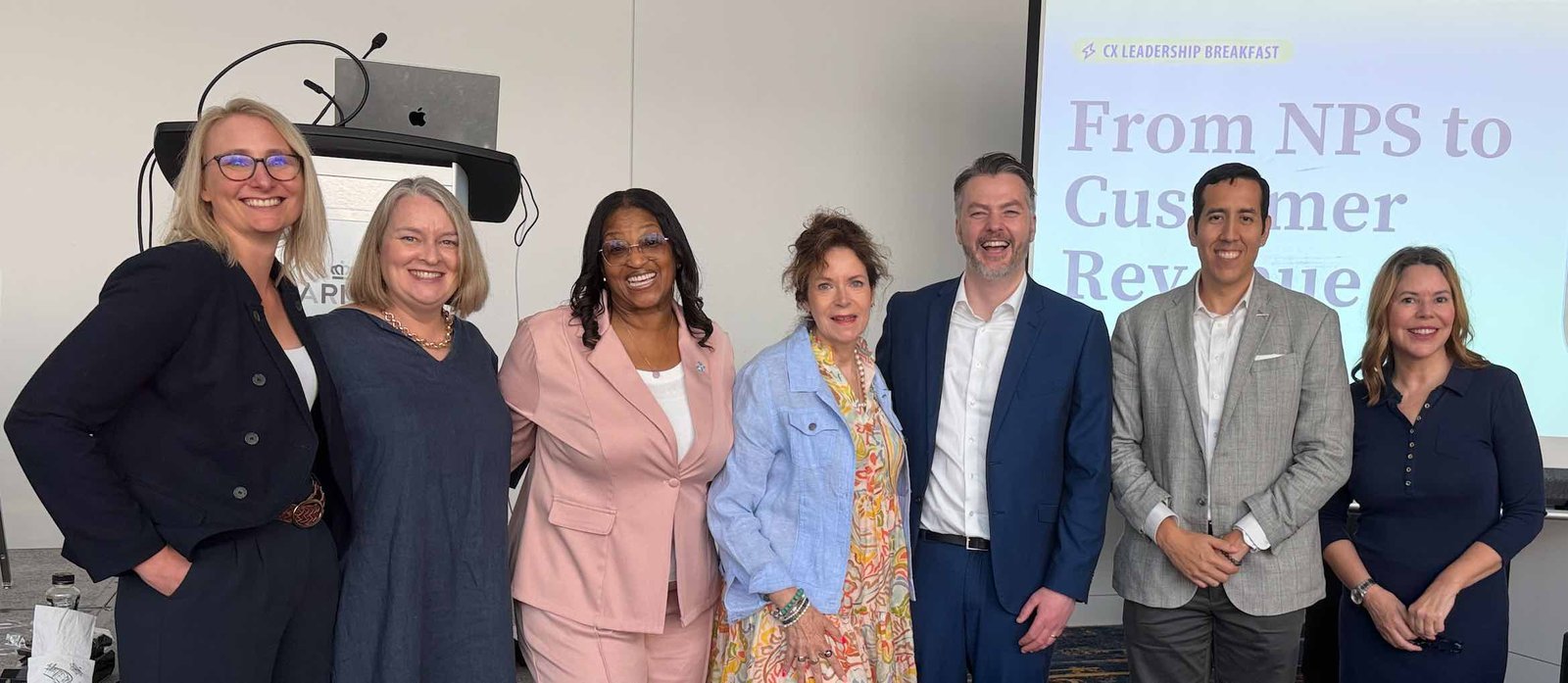
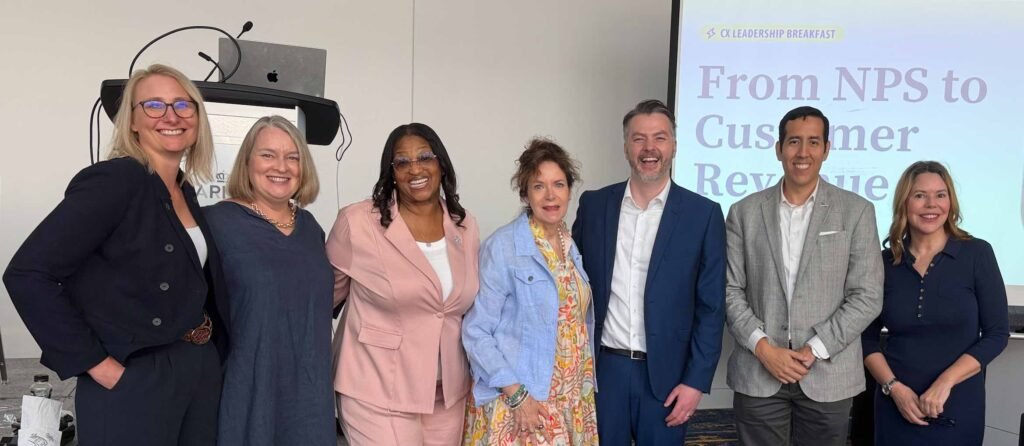
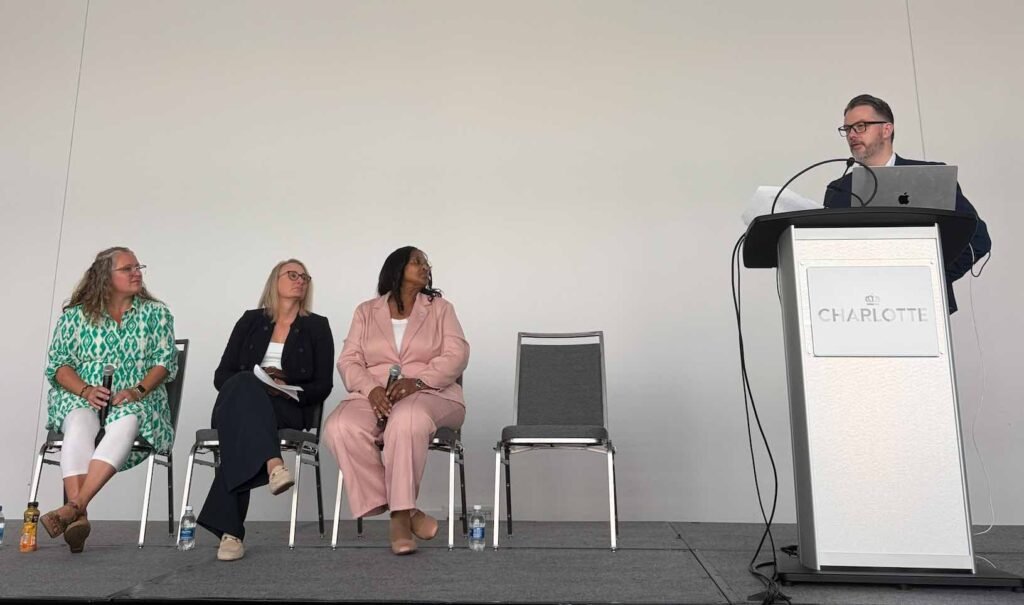
The photos from the event tell that story well too: a professional but warm room, a compact stage, a group of leaders who looked like they had both data and conviction, and slides that pushed the conversation beyond “track the score” into “predict the impact.” One of the strongest visual messages on screen all morning was simple and provocative: Turn NPS into revenue impact.
Connect with the Speakers
If the ideas from this session resonated with you, connect directly with the leaders who shaped the conversation:
Chris Johnston, Debra Rhino, James Muñoz, Rob Lentz, Valerie Peck, Geriel Thornburg May, Carolynn Bruce, Christine Mulder
Keynote: “A Bank Doesn’t Sell Financial Products. It Sells Trust.”
James Muñoz, Director of Brand & Employee Experience at Elsevier, opened the morning with one of the most memorable lines of the event. He shared that years ago, while working in cybersecurity at Bank of America in Charlotte, a senior executive told him: “A bank doesn’t sell financial products. It sells trust.” James said that statement never left him, and it shaped the entire premise of his keynote.
He pushed the room to think differently about what organizations are actually measuring. One slide cited a striking stat: 80% of decisions are driven by emotion, not logic. His point was that many organizations still measure the aftermath of an experience rather than the emotional drivers inside it. NPS, in that framing, is not useless. It is simply incomplete. It captures the residue of satisfaction after an interaction has already happened. As James put it, it is a lagging echo, not a leading signal.
That distinction matters. If people form expectations before they interact with your brand, then evaluate what actually happened, the real force inside satisfaction is the emotional gap between expectation and experience. James walked through that dynamic using expectation confirmation theory, describing how expectations plus perceived performance create a feeling, and that feeling shapes whether satisfaction, trust, advocacy, or disengagement follows. In other words, the score is downstream. Emotion is upstream.
He also offered one of the most useful frameworks of the morning: a North Star model for experience strategy. It connected vision, mission, a three-year customer ambition, emotional needs, rational needs, customer principles, behaviors, and metrics into a practical structure for leaders trying to move beyond tactical surveys. I especially liked his emphasis on a “three-year customer ambition.” The phrase itself is more alive than a standard strategic plan. Ambition suggests movement, hope, and aspiration.
James then shared what he described as a metrics menu for emotional CX, encouraging organizations to expand beyond NPS and include tools like emotional sentiment, expectation gap measures, relationship depth, effort and friction, and listening signals. His metaphor was memorable: NPS is one instrument in the orchestra, not the whole symphony. And, I loved how he gave a shoutout to one of my most-loved local arts organizations, Charlotte Symphony Orchestra.
Chris Johnston’s Case: From Customer Feedback to Revenue Impact
If James gave the room a philosophical and strategic foundation, Chris Johnston gave it a financial model. His presentation focused on how Adoreboard combines experience data and revenue data to quantify what he called customer revenue impact. He shared findings from an Adoreboard AI study that analyzed nearly 60,000 consumer reviews across 14 U.S. banks to identify where trust is built, where it is eroded, and what that means financially.
His central argument was blunt: this isn’t a moment for CX leaders to defend their existence with vague language about delight. This is a moment to quantify what customer friction costs and what better experiences can return. Adoreboard’s research framed the challenge in terms of what it calls the experience revenue gap: the distance between what customers feel and what organizations financially realize when that feeling turns into loyalty, churn, referral, or loss.
The banking examples were powerful because they translated familiar frustrations into measurable business impact. Chris described a split between trust builders and trust eroders. Trust builders were tied to an estimated $108 billion opportunity if banks improve areas such as mobile app experience, loan and credit access, and overdraft protection or emergency cash support. Trust eroders, by contrast, were linked to roughly $500 billion at risk through poor, fragmented, emotionally tone-deaf experiences.
One of the sharpest examples involved what he called the doom loop. A customer experiences a failed payment, fraud flag, or urgent account problem. They try to resolve it through AI chat and get stuck. They call and wait on hold for 30 to 50 minutes. When they finally reach a person, they feel dismissed. They leave angry, vulnerable, and open to further harm. Chris noted that in some cases, frustrated customers go to social channels for help, where scammers can identify and target them. That detail landed hard because it showed how a bad service design problem can become a trust and safety problem very quickly.
He also showed specific banking themes tied to opportunity. Mobile app experience, seamless loan and credit access, and overdraft protection or emergency cash access all appeared as high-trust categories with associated revenue upside and projected NPS gains. That combination, emotion, theme detection, financial risk, and predicted business lift, is exactly why this conversation matters now. It moves CX out of the “nice to have” category and into the realm of business intelligence.
The most useful line from Chris’s presentation may have been the simplest: stop reporting scores; start predicting revenue impact.
Panel Insights: Trust Is Built in Moments, Not Slogans
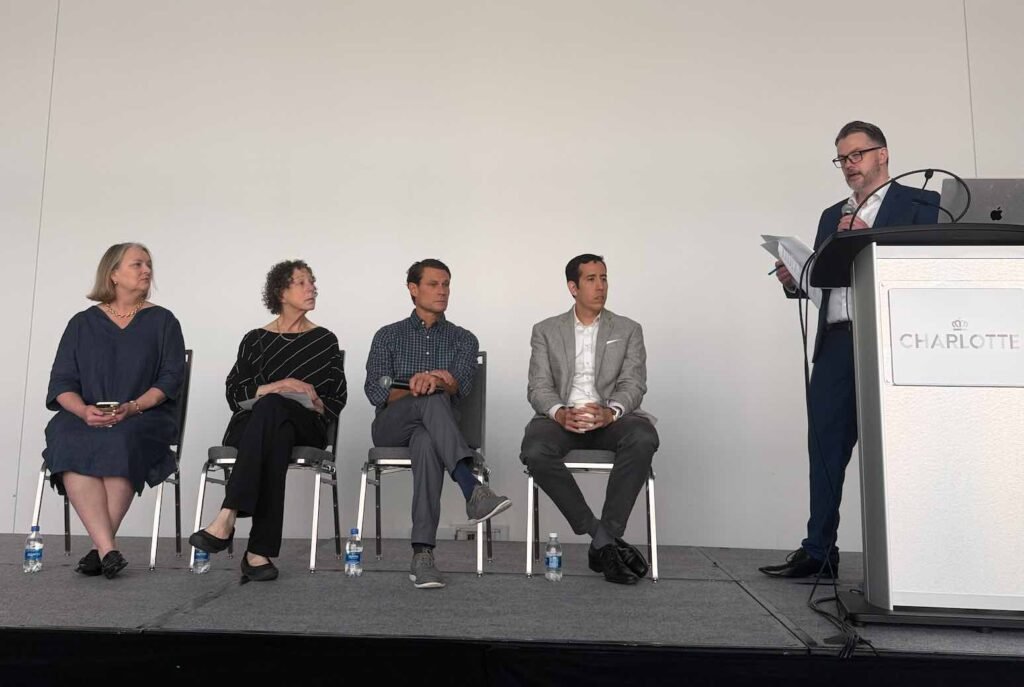
The first panel explored how leaders actually make the business case for CX investment. Rob Lentz, Valerie Peck, Geriel Thornburg May, and James Muñoz discussed the realities of selling experience improvements inside organizations that may say they value customers but still reward short-term efficiency metrics. Their comments were refreshingly direct.
Rob emphasized that strong business cases often start with cost savings or risk reduction before expanding into revenue. Geriel shared a vivid story about getting executives to fund a broken password reset fix by making them watch the experience fail in real time. James made an equally important point: even if NPS is imperfect, it can be the cost of entry to the conversation. If leaders care about it, CX teams can use that fact as a bridge into broader and better metrics around trust, retention, and emotional drivers. Valerie’s provocation was spot on: stop asking customers how much they love you and start doing customer intelligence.
The second panel shifted from financial persuasion to cultural delivery. Debra Rhino, Carolynn Bruce, and Christine Mulder discussed how employee behaviors, hospitality, and psychological safety shape what customers feel. Debra shared that CRVA uses white gloves in training as a physical reminder that service should feel intentional and special. Christine explained that with roughly 157 people moving to Charlotte each day, the YMCA recognized loneliness as a real customer problem and realized the emotional significance of something as simple as a greeting at the door. Carolynn underscored the role of psychological safety, reminding everyone that employees cannot build trust outwardly if they do not experience trust internally.
What Marketers, Brand Leaders, and CX Teams Should Take Away
For wiredPRworks readers, especially CMOs, founders, consultants, speakers, strategists, and brand builders, this event offered more than a financial services case study. It offered a strategic lens you can apply almost anywhere.
First, emotion is not soft. It’s measurable, predictive, and commercially relevant. When leaders dismiss emotional language as vague or fluffy, they often miss the fact that emotion is what moves behavior. Trust affects retention. Friction affects churn. Belonging affects loyalty. Dismissiveness affects defection. Those are business outcomes, not branding abstractions.
Second, NPS is not the enemy; incompleteness is. The better question is not whether you should abandon NPS. It is whether you are willing to admit that a single score cannot carry the full complexity of experience, expectation, and trust. The event made a compelling case for adding richer layers of insight, from sentiment and friction to listening signals and predictive modeling.
Third, your organization already has emotional experience data. It is in your reviews, support transcripts, event feedback, sales conversations, community interactions, and hallway comments. The challenge is not a lack of signals. The challenge is distilling those signals, organizing them, and connecting them to action.
Fourth, the best stories unlock budgets. Data matters, but human stories turn data into urgency. That was clear from the panels, and it is true in marketing and PR as well. If you want leadership to act, help them feel the consequences of the current experience. Make friction visible. Make the opportunity vivid. Make the risk undeniable.
Finally, trust is built by systems and by people. AI, automation, analytics, and dashboards all matter. But so do greeters, presenters, hosts, customer service agents, volunteers, and managers. A brand promise becomes real only when someone delivers it in a moment that matters. That truth connects banking, hospitality, nonprofits, PR, events, and community leadership more tightly than many people realize.
Five CX Moves to Make Now
- Audit your current metrics and identify which are lagging echoes versus leading signals of trust and emotion.
- Define a three-year customer ambition that focuses on what you want people to feel, not just what you want them to do.
- Identify one vivid story of customer friction that leadership can see, hear, or experience directly.
- Map which moments in your customer journey should be AI-assisted and which absolutely require a human touch.
- Look for the places where your brand promise is either being reinforced or quietly broken by everyday behavior.
Why This Conversation Matters Now
The larger significance of this breakfast is that it signals a shift in how business leaders talk about experience. For years, CX has often been framed as a service function, a survey function, or a loyalty function. What this room made clear is that CX is becoming a revenue, trust, and strategic transformation function.
That matters to every organization trying to grow in an AI-shaped marketplace. We are entering a period where generic content is easier to produce, automated interactions are more common, and customer patience is thinner. In that environment, brands that understand human emotion, and can connect it to measurable business outcomes will have a major advantage.
That is also why this story belongs on wiredPRworks. PR has always been about perception, trust, relationship, and story. Visibility without trust is fleeting and shallow. Metrics without meaning are weak. And customer experience without emotional intelligence is expensive.
The leaders who can connect customer emotion to revenue impact are no longer “just” CX professionals. They are becoming some of the most important strategic voices in the room. And after spending the morning at Charlotte Fintech Week listening to leaders from Adoreboard, Elsevier, CRVA, the YMCA, consulting, and financial services, I left with one clear takeaway: trust may be emotional, but its impact is measurable.
That’s a message worth carrying into every brand meeting, boardroom, keynote, and customer conversation.
About Barbara Rozgonyi
Barbara Rozgonyi is an AI + PR visibility strategist, keynote speaker, fractional CMO, and founder of CoryWest Media. She has published WiredPRWorks since 2006, covering visibility, trust, leadership, media, and digital brand strategy. She works with organizations and leaders who want to grow their presence with more clarity, credibility, and momentum. Connect with Barbara Rozgonyi on LinkedIn.
This post reflects Barbara Rozgonyi’s firsthand attendance at the CX Leadership Breakfast, Charlotte Fintech Week, June 11, 2026. AI writing tools assisted with drafting and editing. All quotes, insights, and experiences are original.
[ad_2]
Source_link