Key takeaways:
- AI security now covers models, prompts, data pipelines, agents, APIs, retrieval systems, and outputs.
- Prompt injection, data leakage, model theft, poisoned data, and unsafe agents are major enterprise risks.
- Secure AI starts early with threat modeling, access control, guardrails, vendor checks, and monitoring.
- RAG systems need permission-aware retrieval, so sensitive documents do not surface through normal queries.
- AI can scale safely only when security, governance, compliance, and auditability are built in from day one.
AI has moved far beyond experiments and isolated pilots. It now sits inside enterprise workflows, customer experiences, software products, decision systems, and automation layers. That shift has made security for AI a real business priority, not just a technical concern.
The risk is also changing fast. Attackers are no longer targeting only apps, networks, and databases. They are now looking at AI models, prompts, training data, vector databases, APIs, agents, and the enterprise systems connected to them.
IBM’s Securing Generative AI report highlights this gap clearly. While 82% of executives say secure and trustworthy AI is essential to business success, only 24% of current generative AI projects are being secured. Nearly 70% also say innovation is taking priority over security, which shows how quickly enterprise risk can build when AI scales without the right controls.
This is why enterprises need to rethink their approach. AI can support cybersecurity, but that is only one side of the story. The next priority is securing AI itself, so innovation can scale without exposing business data, intellectual property, users, or critical operations.
Secure Your AI Before It Scales
AI is already moving into your workflows, decisions, and customer-facing systems. Make sure it is protected before risk becomes expensive to fix.
What Is Security for AI and Why Does It Matter?
Security for AI means protecting AI systems, models, prompts, data pipelines, APIs, outputs, and connected workflows from misuse, manipulation, leakage, and attack. It brings traditional cybersecurity controls together with AI-specific safeguards built for LLM apps, copilots, AI agents, recommendation engines, predictive models, RAG systems, and generative AI tools.
The reason for this is because AI is not on the sidelines of the business anymore. It’s linked to customer journeys, internal systems, decision-making workflows, sensitive data, in finance, healthcare, retail, logistics, HR, customer service and cybersecurity.
A compromised AI system can expose customer records, leak intellectual property, manipulate decisions, trigger compliance issues, or damage user trust. The risk becomes even harder to control when employees use unapproved AI tools and sensitive business data moves outside governed environments.
That is why AI security has become a boardroom priority. It now directly affects business continuity, regulatory readiness, reputation, and customer confidence.
How AI Changes the Enterprise Attack Surface
AI does not just add another application to the enterprise stack. It creates a new execution layer where prompts, AI models, data, tools, APIs, and user permissions interact in real time. That is why the security of AI has to cover the full workflow, not only the app interface.
Traditional software follows predefined logic. AI systems work through probabilistic responses, retrieved context, embeddings, prompt instructions, model orchestration, and tool calls. So the attack surface expands beyond code and infrastructure into how the system interprets intent, retrieves data, generates outputs, and acts on connected systems.
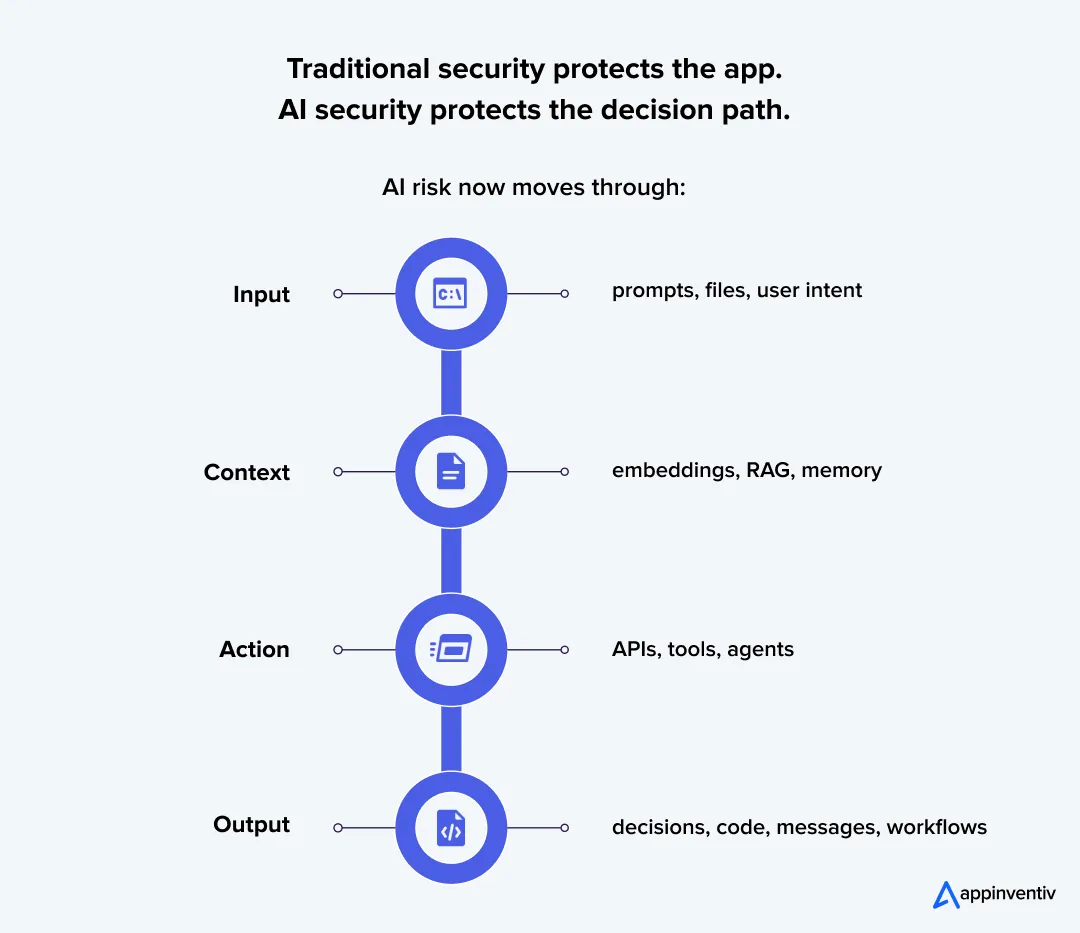
The real risk appears across layers such as:
- Prompt layer: malicious instructions, jailbreaks, hidden commands, and indirect prompt injection through documents or web content
- Data layer: poisoned training data, exposed embeddings, weak vector database access, and sensitive data leakage through retrieval flows
- Model layer: model extraction, unsafe responses, hallucinated outputs, and behavior drift after fine-tuning
- Orchestration layer: insecure plugins, weak API scopes, broken tool permissions, and unvalidated agent actions
- Application layer: poor session isolation, over-permissive access, insecure logging, and weak output handling
The challenge becomes sharper with AI agents’ security. A chatbot may answer a question, but an agent can call APIs, update CRM records, trigger workflows, search internal files, create tickets, approve requests, or interact with third-party systems. If those actions are not scoped, validated, and logged, one manipulated input can move across multiple enterprise systems.
That is why cybersecurity for AI needs a different operating model. Every connected system, from ERP and CRM platforms to data warehouses, cloud storage, identity providers, and internal knowledge bases, becomes part of the AI risk surface.
The Most Critical AI Security Risks Enterprises Must Address
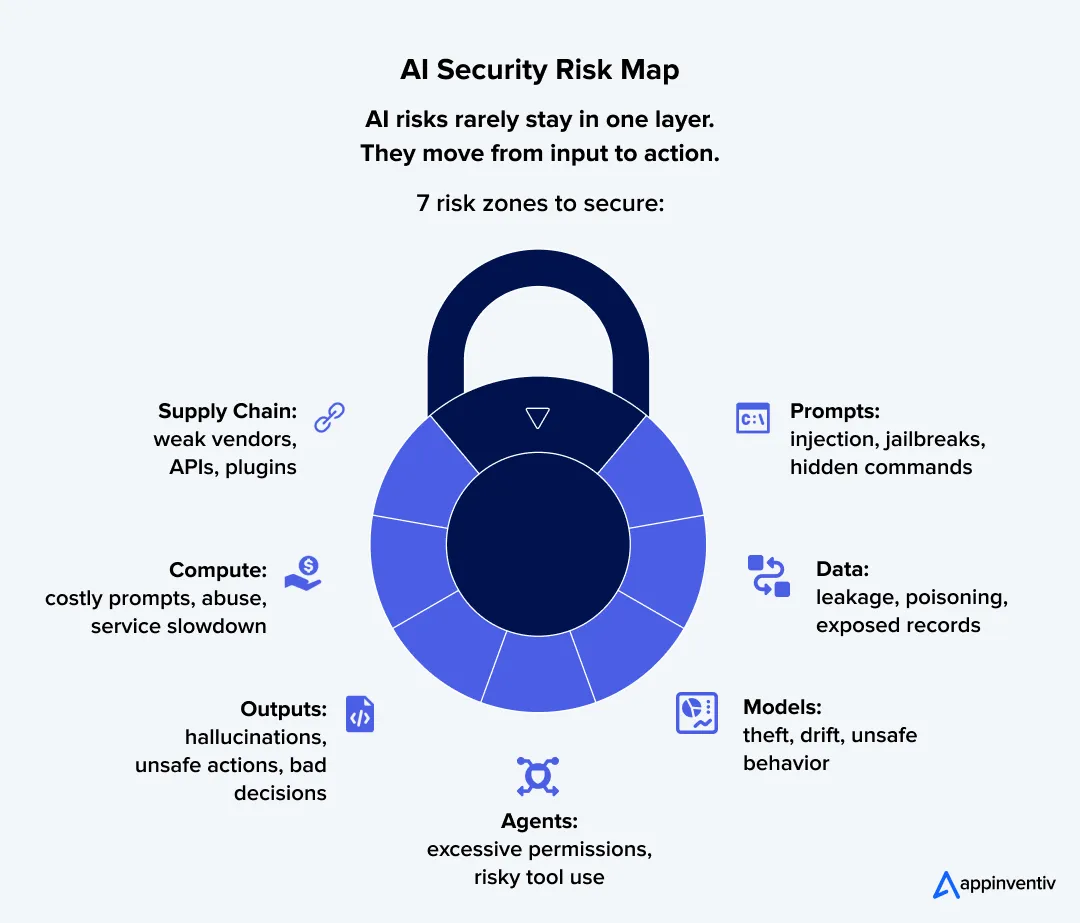
Major Risks to AI Systems do not sit in one place. It moves across models, prompts, APIs, datasets, users, agents, logs, and downstream systems.
OWASP’s LLM risk guidance also places issues like prompt injection, insecure output handling, training data poisoning, model denial of service, supply chain vulnerabilities, excessive agency, and model theft among the most important risks for LLM-based applications.
1. Prompt Injection
Prompt injection turns normal user input into an attack path.
In a traditional app, user input is usually processed against fixed rules. In an AI system, input can influence how the model behaves, what it retrieves, and what it says next. A malicious user may try to override system instructions, bypass safety rules, extract hidden prompts, or force the model to reveal restricted information.
The risk increases when the AI is connected to enterprise tools, databases, or customer workflows. For example, a support AI connected to account records could be tricked into ignoring its original instructions and revealing private customer data.
An internal copilot could be manipulated through a document that contains hidden instructions. An AI agent could be pushed into calling the wrong API or sharing information outside the intended workflow.
Enterprises need controls such as:
- Strict separation between system prompts, user inputs, and retrieved content
- Prompt injection testing across direct and indirect inputs
- Input filtering for malicious patterns and hidden instructions
- Tool-use restrictions based on user role and business context
- Runtime monitoring for abnormal prompt behavior
- Output checks before sensitive responses are shown or actions are triggered
2. Data Leakage and Privacy Exposure
AI systems can expose sensitive data even when the core model is not breached.
Confidential files, customer records, contracts and financial data, health data, HR documents, source code, product roadmaps and internal policies are examples of enterprise files in which AI systems can be processed. Typically, this data is linked to AI without robust access restrictions, masking, encryption, or retrieval mechanisms.
RAG models in Gen AI make this risk more complex. If a vector database indexes restricted documents without permission-aware retrieval, a user may receive information they should never have accessed. The leak may happen through a prompt, model response, conversation history, training dataset, telemetry log, evaluation set, or support transcript.
For regulated businesses, this is not just a privacy issue. It can create exposure under frameworks such as GDPR, HIPAA, PCI DSS, SOC 2, or regional data protection laws.
The practical controls include:
- Document-level and field-level access control in RAG pipelines
- Data classification before indexing or fine-tuning
- PII, PHI, PCI, and secrets detection across prompts and outputs
- Redaction and masking for sensitive data
- Encryption for data at rest, in transit, and inside storage layers
- Secure retention policies for prompts, logs, and conversation history
- Retrieval audit trails showing what data was accessed, by whom, and why
3. Training Data Poisoning
If attackers can influence the data, they can influence the model.
Training data poisoning happens when manipulated, biased, false, or malicious data enters the model lifecycle. This can affect pre-training, LLM fine-tuning, RAG knowledge bases, embeddings, synthetic data pipelines, feedback loops, or reinforcement learning workflows.
The result can be subtle. The model may start favoring incorrect answers, producing unsafe recommendations, ignoring certain rules, leaking planted content, or behaving normally until a specific trigger appears. In enterprise use cases, this can affect fraud decisions, clinical summaries, product recommendations, credit scoring, customer segmentation, or compliance workflows.
This risk is especially important when teams use third-party datasets, public web data, user-generated content, vendor-provided data, or automated feedback loops.
Enterprises should focus on:
- Dataset provenance and source verification
- Data validation before training, fine-tuning, or indexing
- Anomaly detection in training and evaluation data
- Separate approval flows for high-impact datasets
- Continuous model evaluation after updates
- Version control for datasets, embeddings, and model artifacts
- Red-team testing to identify backdoors, trigger patterns, and manipulated outputs
4. Model Theft and IP Exposure
AI models, prompts, datasets, and workflows are now enterprise intellectual property.
For many companies, the value is not only in the model. It also sits in proprietary prompts, fine-tuning datasets, evaluation methods, orchestration logic, AI guardrails, agent workflows, embedding strategies, and business-specific decision rules. If attackers extract these assets, they can replicate product behavior, expose trade secrets, or weaken competitive advantage.
Model theft may happen through API abuse, repeated query patterns, exposed endpoints, weak authentication, insecure model storage, leaked system prompts, or poorly governed access to model artifacts.
In some cases, attackers may not need to steal the full model. They may only need to infer enough behavior to clone key capabilities.
Protecting AI IP requires:
- Strong identity and access management for model endpoints
- Rate limits and abuse detection for model APIs
- Watermarking or output fingerprinting where relevant
- Secure storage for model weights, prompts, and datasets
- Segmented access for data science, engineering, QA, and business users
- Monitoring for model extraction patterns and repeated probing
- Clear ownership over prompts, fine-tuned models, and generated assets
5. AI Supply Chain Vulnerabilities
AI products are only as secure as the models, datasets, tools, and services they depend on.
Modern AI systems are built on third-party models, open source libraries, vector databases, APIs, plugins, data connectors, orchestration frameworks, cloud services, evaluation tools, and external datasets. Any weakness in any aspect of the AI workflow could hinder the rest.
The risk could be from a vulnerable open source package, a compromised model, an unverified data set, an insecure plugin, a compromised API or a vendor platform lacking controls.
As AI tech stack becomes more modular, vendor and component risk assessment becomes part of cybersecurity for AI, not a separate procurement exercise.
Enterprises should build a secure AI supply chain through:
- Model, dataset, plugin, and vendor due diligence
- Software bills of materials for AI dependencies
- Model bills of materials where applicable
- Dependency scanning and vulnerability management
- Signed artifacts and verified model sources
- Security reviews for AI APIs and third-party connectors
- Contractual controls for data usage, retention, and training rights
- Clear rollback plans when a model, dataset, or vendor component is compromised
6. Model Denial of Service
AI systems can be disrupted by cost-heavy prompts, repeated requests, or resource abuse.
Model denial of service happens when attackers overload AI systems with expensive prompts, long context inputs, repeated queries, recursive tasks, or high-volume API calls. The result may be slower responses, failed workflows, degraded customer experience, inflated inference costs, or service disruption.
This is different from traditional denial-of-service attacks because the cost is often tied to tokens, context length, model size, retrieval calls, tool usage, and compute consumption. A single poorly controlled workflow can burn resources across the model layer, vector database, orchestration engine, and downstream APIs.
Controls should include:
- Rate limiting by user, tenant, endpoint, and workflow
- Token and context-window limits
- Budget controls for inference usage
- Abuse detection for repeated or abnormal prompts
- Queue management for high-volume workloads
- Caching for safe repeat queries
- Fail-safe responses when usage crosses defined thresholds
- Monitoring for compute spikes across models, vector stores, and tools
7. Insecure Outputs and Hallucination-Driven Risk
AI outputs become risky when enterprises treat them as verified truth or executable instructions.
AI systems can generate inaccurate, unsafe, biased, non-compliant, or manipulated outputs. In low-risk use cases, this may only create a poor user experience. In enterprise workflows, the impact can be much larger, especially when outputs influence lending decisions, medical summaries, legal reviews, financial analysis, code generation, procurement, fraud alerts, or customer communication.
The risk grows when AI output is passed directly into another system. For example, generated SQL, code snippets, workflow instructions, customer messages, or policy recommendations can create downstream security and compliance problems if they are not validated.
OWASP identifies insecure output handling as a key LLM application risk because unvalidated outputs can expose downstream systems to issues such as code execution or data exposure.
Enterprises need a clear validation layer before AI outputs are trusted or executed. That includes:
- Output sanitization before responses reach users or systems
- Source grounding for factual answers
- Confidence scoring and uncertainty handling
- Business-rule validation for recommendations
- Human review for regulated or high-impact decisions
- Safe templates for customer-facing responses
- Code scanning for AI-generated code
- Clear escalation when the model lacks enough context
Together, these risks show why security for AI cannot be limited to network controls or basic application testing. Enterprises need a security model that protects the model, data, prompts, retrieval layer, tools, outputs, and business workflows as one connected system.
Strengthen the Security Layer Behind Your AI Systems
Build stronger controls around AI models, data flows, APIs, and agent workflows before security gaps turn into business risk.
What Happens When AI Security Is Ignored?
When AI security is ignored, the impact usually reaches far beyond the model. A weak control in prompts, data access, agent permissions, or output validation can expose customer information, leak IP, disrupt operations, or push teams into decisions they cannot fully trust.
| Business Risk | What It Can Lead To |
|---|---|
| Customer data exposure | Sensitive records, financial details, health data, or account information reaching unauthorized users |
| IP loss | Proprietary prompts, model logic, datasets, product workflows, or source code being extracted or copied |
| Compliance penalties | Audit failures, regulatory action, breach reporting, and penalties under data protection or industry-specific laws |
| Biased or manipulated decisions | AI outputs influencing hiring, lending, pricing, healthcare, fraud, or customer decisions incorrectly |
| Operational disruption | AI agents triggering wrong workflows, overloading systems, or slowing business-critical processes |
| Loss of customer trust | Users questioning whether the business can protect their data or use AI responsibly |
| Higher remediation costs | More spending on incident response, audits, legal review, retraining, and system redesign |
| Failed AI adoption | Teams losing confidence in AI tools because outputs feel unsafe, inaccurate, or hard to govern |
This is why security for AI needs to be treated as an operating requirement, not a final review step. Once AI is connected to core systems, every gap becomes harder and more expensive to fix later.
Core Principles of Secure AI System Design
Secure AI starts in architecture, not during pre-launch testing. The model, data pipelines, retrieval layer, APIs, agent permissions, logs, and fallback paths need to be designed as one controlled system. For enterprises, securing AI is not a policy exercise alone. It is applied engineering. Following a responsible AI security checklist can help to build secure AI systems from the start.
Security by Design
Define the control points before the AI workflow goes live. Map data movement, model access, retrieval logic, tool permissions, API scopes, and failure paths early, especially when the system connects with CRMs, ERPs, customer records, cloud storage, or internal knowledge bases.
Zero Trust for AI Workflows
Treat every prompt, output, retrieved document, tool call, and agent action as untrusted until verified. A document can carry hidden instructions. A user prompt can try to override the system prompt. A model response can sound confident and still be unsafe. Identity, context, access rights, and allowed actions should be checked at every step.
Data Minimization
Do not give the model more data than the task needs. PHI, PCI data, credentials, source code, customer records, financial documents, and internal strategy files should be masked, encrypted, excluded, or tightly scoped before they enter prompts, embeddings, logs, or fine-tuning datasets.
Permission-Aware Retrieval
RAG systems need access control inside the retrieval layer. A vector database should not return content only because it matches a query. It should first check user role, tenant boundary, department, geography, document rights, and business context before sending chunks to the model.
Human-in-the-Loop Controls
AI outputs that affect money, care, compliance, customer communication, or system changes need review before execution. If the AI can approve a refund, update a record, flag fraud, support clinical decisions, or trigger a workflow, approval rules should sit directly inside the orchestration layer.
Continuous Monitoring
AI behavior changes as prompts, users, models, datasets, and agent tools evolve. Production monitoring should cover prompt patterns, retrieval behavior, tool calls, failed guardrails, unsafe outputs, latency spikes, token usage, cost anomalies, and abnormal user activity.
Auditability and Explainability
When something breaks, teams need a clear trail: user, prompt, retrieved source, model version, tool call, approval step, output, and final action. That traceability makes the security of AI easier to investigate, prove, and improve.
How to Build a Secure AI Architecture
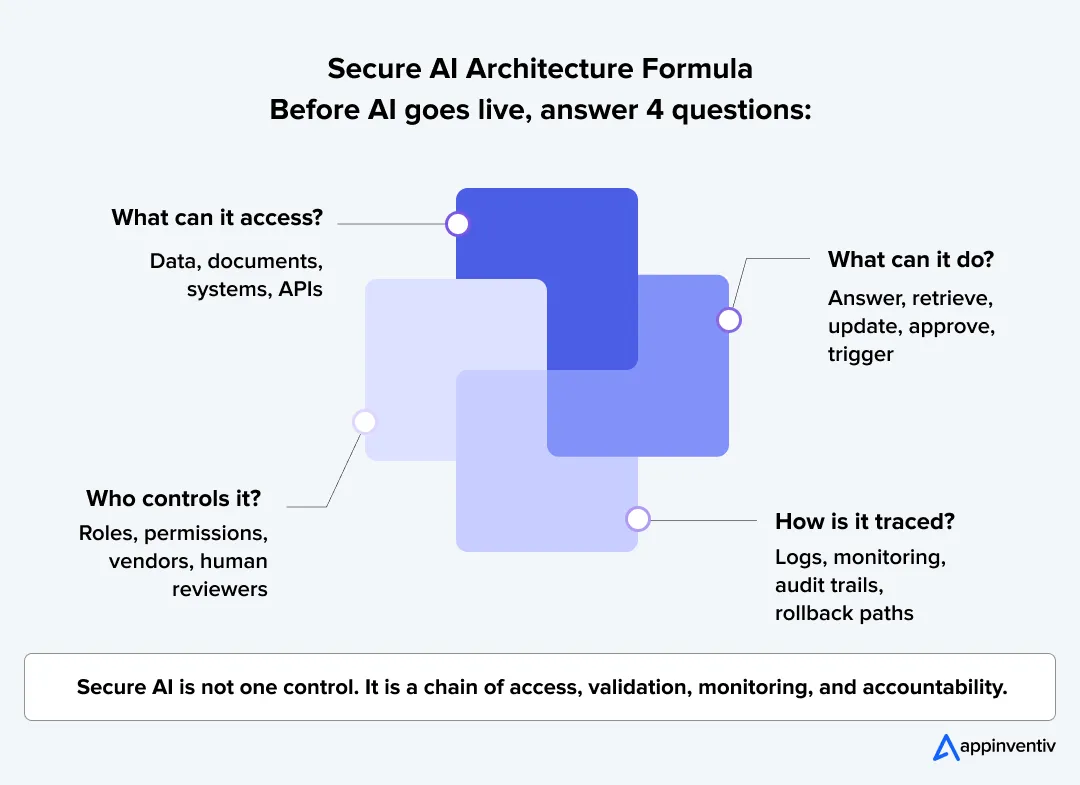
A secure AI architecture starts with clarity. Before connecting AI to customer data, CRMs, ERPs, codebases, internal documents, or workflow tools, enterprises need to know what the system can access, what it can change, and where it can fail.
Start With AI Threat Modeling
When starting with AI security, map the workflow first. Who will use the AI system? What data will it see? Which tools can it call? Can it only answer, or can it update records, send messages, approve actions, or trigger another system?
This helps teams catch risks like prompt injection, data leakage, unsafe tool use, and excessive agent permissions early.
Classify Data Before AI Access
Not every dataset should enter an AI workflow. Customer records, payment data, health information, contracts, credentials, source code, and finance documents need clear handling rules.
Some data should be masked. Some should be encrypted. Some should stay out completely.
Separate the Core AI Layers
Keep the architecture clean and controlled.
- Data layer: ingestion, masking, encryption, storage, and retention
- Model layer: model choice, inference, fine-tuning, versioning, and evaluation
- Orchestration layer: prompts, agents, APIs, plugins, and tool calls
- Application layer: user access, sessions, approvals, responses, and actions
- Monitoring layer: drift, misuse, failures, unsafe outputs, and incidents
This makes cybersecurity for AI easier to manage across the full system.
Review Models, Vendors, and Tools
Model selection should not depend only on accuracy or cost. Enterprises must check where data is processed, whether prompts are stored, how outputs are logged, whether vendor systems can train on customer data, and how APIs are secured.
The same review applies to vector databases, plugins, orchestration tools, open-source libraries, and third-party connectors.
Tighten Access and Agent Permissions
AI access should depend on role, department, location, document sensitivity, project, and business context.
Agents need stricter boundaries. If an agent can read a customer profile, it should not automatically be allowed to edit it, export it, approve a refund, or trigger another workflow.
Add Guardrails Before Action
Use prompt injection checks, input scanning, source validation, context separation, and output review inside the workflow.
AI-generated answers, code, SQL queries, customer messages, recommendations, or workflow actions should be validated before they reach users or connected systems.
Build Monitoring and Response Paths
Teams need visibility into prompts, retrieved documents, model versions, user identity, tool calls, API responses, approvals, failed guardrails, and final actions.
Monitoring should track drift, misuse, unusual tool calls, unsafe outputs, cost spikes, and data exposure signals. If something goes wrong, teams should be able to revoke access, disable an agent, roll back a model, and preserve evidence.
Security For AI Across Key Enterprise Use Cases
AI security changes with every AI use case. A copilot answering employee questions, an agent updating CRM records, and a fintech model flagging fraud all need different controls based on what they can access, generate, or trigger.
| Enterprise Use Case | Where the Risk Starts | Security Focus |
|---|---|---|
| AI Copilots | Copilots sit close to internal documents, policies, customer data, and employee workflows. The main risk is exposing information the user should not see. | Role-based access, prompt injection defense, document-level permissions, grounded responses, prompt and response logging |
| AI Agents | Agents can call APIs, update records, send emails, create tickets, or trigger workflows. A weak permission model can turn one bad prompt into an unauthorized action. | Tool-specific permissions, separate read/write/approve/execute rights, human approvals, API authentication, workflow validation |
| RAG-Based Knowledge Assistants | RAG systems can surface restricted content if retrieval is based only on relevance and not user permissions. | Secure vector databases, permission-aware retrieval, trusted source validation, sensitive data masking, retrieval audit trails |
| AI in Healthcare | Healthcare AI works with patient records, clinical notes, claims, diagnostics, and care workflows where privacy and patient safety matter. | HIPAA-aligned data handling, PHI protection, EHR/EMR permissions, explainable recommendations, human review for care decisions |
| AI in Fintech | Fintech AI touches payments, fraud checks, underwriting, credit scoring, and transaction data where decisions must be traceable. | PCI DSS and SOC 2 alignment, fraud model protection, transaction-level controls, encryption, decision auditability |
| AI in Enterprise Operations | Enterprise AI connects with CRMs, ERPs, HR systems, ticketing tools, data warehouses, and internal knowledge bases. Broad access is the main concern. | Internal data protection, workflow authorization, ERP/CRM access control, shadow AI governance, compliance-ready reporting |
AI Security and Compliance: What Enterprises Need to Consider
AI compliance cannot be something the team “adds” near launch. By then, the risky choices are already made. The model may already have access to customer data. Prompts may already be getting stored. A third-party API may already be handling inference. Logs may be sitting in places no auditor would be comfortable with.
For regulated businesses, AI security governance needs to shape the product while it is still being designed. The exact checklist will change by industry and region, but most enterprise AI systems should be mapped against:
- GDPR: personal data use, consent, retention, user rights, and cross-border transfers
- HIPAA: PHI protection across prompts, responses, logs, storage, and EHR/EMR integrations
- SOC 2: access control, monitoring, audit logs, availability, and operational security
- ISO 27001: risk controls, vendor governance, incident handling, and security management
- PCI DSS: payment data protection across fintech, commerce, wallet, and transaction systems
- NIST AI RMF: AI risk mapping, measurement, monitoring, and governance
- OWASP LLM Top 10: prompt injection, data leakage, model theft, insecure outputs, and risky tool use
- EU AI Act: risk-based controls for sensitive and high-impact AI use cases
- Regional data laws: UAE PDPL, Saudi PDPL, and India’s DPDP Act where user data or operations fall under those jurisdictions
The real test is whether these requirements show up in the system. Can the business limit what the model sees? Can it prove who accessed what? Can it trace a response back to the data used? Can it stop a vendor from using sensitive prompts for training? Can it roll back or disable a risky AI workflow fast?
That is where compliance becomes practical. It turns into data access rules, encryption, prompt and output logs, vendor reviews, model monitoring, incident response paths, and clear ownership for every AI workflow running in production.
Secure AI Without Slowing Innovation
Build AI systems that stay secure, compliant, and audit-ready without slowing down enterprise innovation.

How Appinventiv Helps Enterprises Secure AI Innovation
Securing AI is not just about blocking attacks at the edge. The real work is in designing systems that can safely use enterprise data, connect with business tools, respond to users, and still remain controlled. Appinventiv helps teams approach security for AI through threat modeling, AI security consulting, secure product architecture, and production-grade engineering.
Our teams work across LLM and generative AI app development, RAG systems with access control, AI agent orchestration, secure API and tool integration, data privacy engineering, and compliance-led development. The aim is simple: every prompt, retrieval request, model response, tool call, and workflow action should be scoped, logged, and reviewable.
As a cybersecurity consulting company, Appinventiv also looks beyond the model. We assess identity controls, API exposure, vendor risk, cloud security, model access, deployment patterns, and compliance requirements so AI does not become another unmanaged risk layer inside the enterprise.
Our cybersecurity solutions and services also support what happens after launch: MLOps, model monitoring, drift detection, audit trails, AI workflow testing, and incident response planning. With 300+ AI-powered solutions delivered and 200+ data scientists and AI engineers onboard, Appinventiv helps enterprises move from AI pilots to secure, scalable AI adoption.
If AI is already part of your roadmap, now is the time to make security part of it too, consult our AI + cybersecurity experts.
FAQs
Q. How is AI security different from regular application security?
A. Regular application security mostly protects fixed code, databases, APIs, and infrastructure. AI security also has to account for prompts, model behavior, retrieval logic, training data, embeddings, agents, and generated outputs. The system can be manipulated through language, context, data, or connected tools, which makes the risk surface wider.
Q. When should an enterprise start planning AI security?
A. AI security should begin before the model, vendor, or architecture is finalized. This is the stage where teams decide what data the AI can access, where inference will run, how prompts will be logged, which tools the AI can call, and what approvals are needed before action.
Q. What makes RAG-based AI systems risky?
A. RAG systems can expose restricted information if retrieval is based only on semantic relevance. A secure RAG setup needs document-level access control, tenant isolation, source validation, sensitive data masking, and retrieval logs so users only receive content they are actually allowed to see.
Q. Why do AI agents need stricter controls?
A. AI agents can perform tasks, not just generate answers. They may call APIs, update records, send messages, trigger workflows, or move data across systems. Without scoped permissions, action limits, and approval rules, a manipulated prompt can turn into an unauthorized business action.
Q. How can enterprises keep AI systems safe after deployment?
A. Post-launch security depends on continuous monitoring. Teams should track prompt activity, model responses, tool calls, retrieval behavior, drift, unsafe outputs, cost spikes, failed guardrails, and abnormal usage patterns. This helps detect misuse early and keep the system within approved operating limits.