[ad_1]
Guerrilla marketing for small business means using creativity, surprise, and unconventional tactics instead of a big ad budget to generate awareness, leads, and referrals. When you pair these attention-getting tactics with growth hacking — building viral and referral mechanics directly into what you deliver — you build a compounding growth machine that gets smarter every cycle, for less than $17 a day.
Every economic squeeze in the last 50 years has produced a new wave of marketing creativity. Jay Conrad Levinson wrote the original Guerrilla Marketing in 1984 because stagflation had strangled small business ad budgets. Sean Ellis coined “growth hacking” in 2010 because startups couldn’t afford traditional marketing agencies. Ryan Holiday documented the whole playbook in Growth Hacker Marketing — and the core insight still stands: the entrepreneurs who win during tight times are not the ones with the biggest media spend. They are the ones who figured out how to make the product do the marketing.
We are in one of those moments right now. The bag of tricks still works. It’s time to go back and get it.
What Is Guerrilla Marketing for Small Business
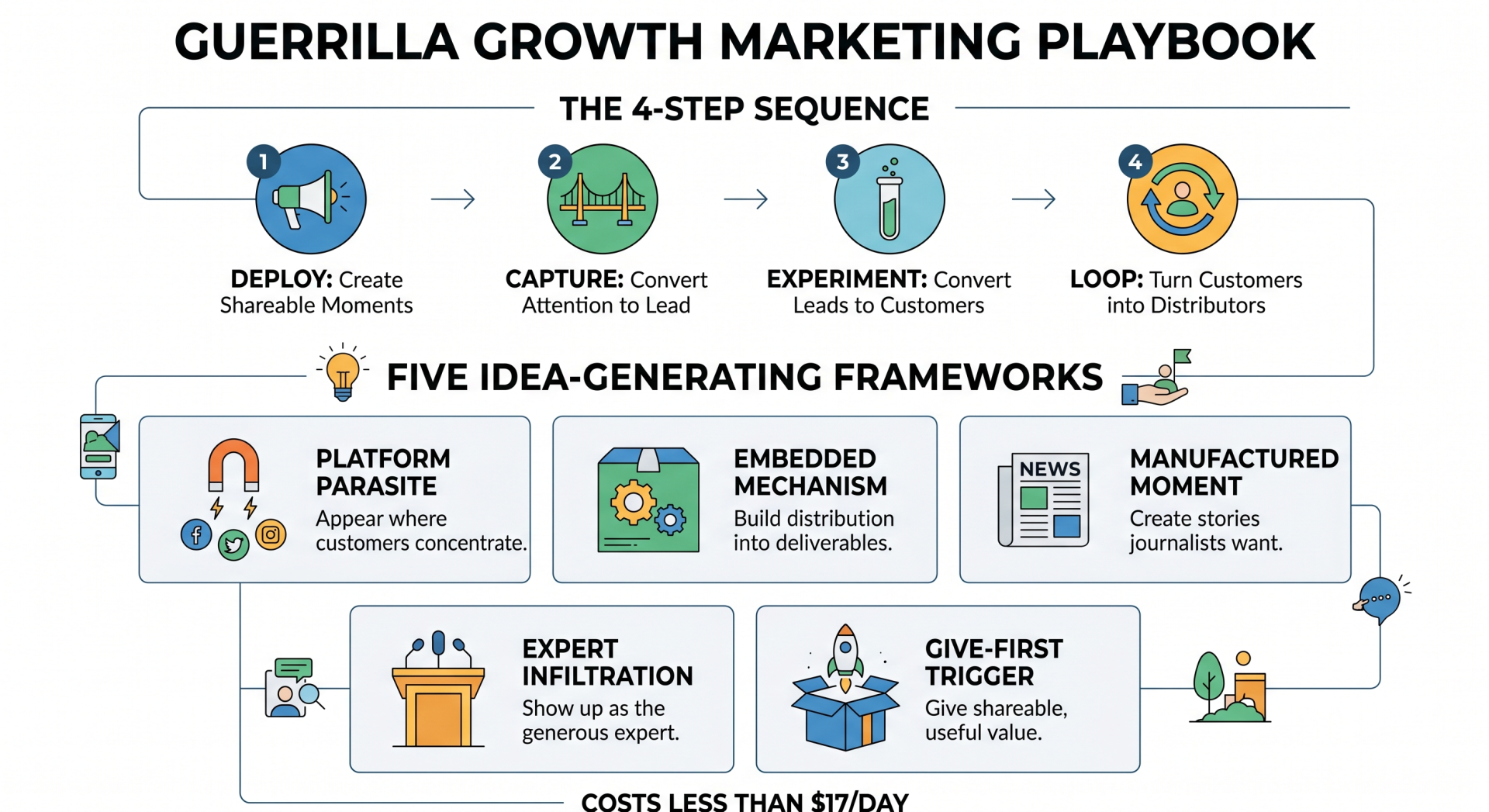
Guerrilla marketing for small business is the lowest-cost customer acquisition system available to any operator without a marketing team. Jay Conrad Levinson named it in his 1984 book of the same name, building on asymmetric military strategy — small forces using creativity and surprise to outmaneuver larger, better-funded opponents.
The core principle: you win by being more creative, more targeted, and more memorable than whoever has more money. Guerrilla marketing is about occupying the attention your customer was already going to spend somewhere else — on a sidewalk, in a LinkedIn feed, in a Facebook group — and redirecting it toward you at a fraction of what a traditional ad would cost.
Think of guerrilla marketing as the spark. It creates the crowd. Without something to do with the crowd, the moment disappears.
What Is Growth Hacking and Why It’s Not What You Think
Growth hacking is not A/B testing your subject lines. That framing misses the point entirely. Sean Ellis coined the term in 2010 to describe something far more structural: the practice of building scalable, measurable growth mechanics directly into your product, your service delivery, and your customer experience.
The true growth hacker asks a question that most small business owners never ask: “If someone uses my product or service, what happens automatically that might bring in the next customer?” Hotmail answered that question with a six-word tagline in every email. Dropbox answered it with free storage for referrals. PayPal answered it by paying people $10 to sign up and $10 more for every person they referred.
Growth hacking is the engine. It converts the crowd your guerrilla tactics created — and then it converts customers into a distribution system that runs without you.
⚠️ REALITY CHECK
The difference between a growth hacker and a regular marketer is where they apply their effort. A regular marketer runs campaigns at customers. A growth hacker builds mechanics INTO the product so customers bring in the next customers. For a small business, the question isn’t “what’s my next campaign?” It’s “what’s already leaving my hands every day that could carry a referral mechanism?”
Why Guerrilla Marketing and Growth Hacking Work Best Together
Most small business owners treat these as separate options. They run a clever guerrilla campaign, create buzz, and watch it evaporate because there’s no mechanism to capture the attention or convert it into anything durable. Or they build elaborate email sequences before they have any meaningful traffic to test against.
The sequence matters. Guerrilla marketing belongs at the top of your funnel — awareness and acquisition. Growth hacking belongs everywhere below it — activation, retention, referral, and revenue. Industry data shows 85% of marketers report lead generation as their primary top-of-funnel focus, but without a system to convert those leads, the awareness evaporates.
Guerrilla first. Growth hacking second. In that order, always.
Are You Ready to Run This System
Before any tactic makes sense, you need three pieces of infrastructure in place. Build these first:
- A capture page — A single landing page with one compelling offer in exchange for an email address. Free guides, templates, and discount offers all work. Cost: $0–$30/month on tools like Zoho Landing Pages or Carrd.
- An email platform — Somewhere to store captured emails and send automated follow-ups. Zoho Campaigns, Mailchimp, and ConvertKit all have free tiers. The SBA’s marketing guide covers foundational setup decisions before you pick any tool. Cost: $0–$20/month.
- Basic tracking — A UTM parameter on every capture URL so you know which tactic drove which leads. Free in Google Analytics. Without it, you’re repeating things that don’t work because you can’t tell the difference.
Build these before you launch anything. A brilliant guerrilla campaign sending leads to a dead-end is wasted effort. See how to build a marketing funnel before your first campaign goes live.
💡 STRATEGY ALERT
Before running any guerrilla tactic, answer one question: “Where do interested people go next?” If the answer is “nowhere,” redesign the tactic. The capture bridge — a QR code, a hashtag, a free offer redeemable with an email — separates a marketing moment from a marketing machine. Design the bridge before you design the stunt.
The 4-Step Sequence for Guerrilla Growth Marketing
| Step | Tactic | Your Goal |
|---|---|---|
| 1 — Deploy | Guerrilla Trigger (Top of Funnel) | Create a shareable moment |
| 2 — Capture | Capture Bridge (ToFu → MoFu) | Convert attention into a lead |
| 3 — Experiment | Growth Experiments (MoFu) | Convert leads into customers |
| 4 — Loop | Referral Mechanics (BoFu) | Turn customers into distributors |
The mechanics of step four — turning customers into a referral source without making it awkward — are where most small businesses leave money on the table. This guide on how to ask for referrals walks through the conversation and the timing in plain language.
Five Frameworks for Generating Guerrilla Marketing Ideas
The problem with most guerrilla marketing advice is that it gives you tactics without giving you the thinking behind them. Chalk art, pop-ups, social challenges — none of those work on their own. What makes them work is the mental model that generated them. Learn the five frameworks below and you’ll never run out of ideas.
Framework 1: The Platform Parasite
The question: Where is my ideal customer’s attention already concentrated? And how do I appear there without paying the platform?
Airbnb had a tiny team and zero media budget. So they wrote code that allowed Airbnb listings to post automatically to Craigslist — the platform where everyone shopping for short-term housing already lived. They didn’t build a new audience. They infiltrated an existing one.
Today’s equivalents for small businesses:
- LinkedIn newsletters — LinkedIn’s algorithm pushes newsletters to non-followers automatically. A newsletter on your area of expertise reaches your ideal client without paying for ads, in a feed they already check daily.
- Reddit and Quora as a distribution channel — Identify the top three subreddits and Quora topics where your ideal client asks questions. Systematically write the most comprehensive answers available. This is free distribution inside communities with millions of members who are pre-qualified by topic.
- Nextdoor for local service businesses — Still dramatically underused. Local service providers who show up consistently as helpful neighbors — not salespeople — become the default recommendation when someone needs what they offer.
- Facebook group expertise positioning — Find two or three Facebook groups where your ideal client is an active member. Don’t pitch. Answer every question in your area of expertise better than anyone else in the group. In 90 days, you become the person everyone recommends when a question about your topic comes up.
The platform parasite rule: the platform should want you there, which means you have to be genuinely useful — not promotional. The moment you lead with an offer, the strategy collapses.
Framework 2: The Embedded Mechanism
The question: What am I already putting in my customers’ hands every day that could carry a growth mechanism?
In 1996, Hotmail added “PS: Get your free email at Hotmail” to the bottom of every outgoing email. Every message users sent became a distribution vehicle. Every recipient was a potential new user. Within 18 months, Hotmail had 12 million users — without a single traditional ad. The CTA was embedded in the product itself.
Today’s equivalents for small businesses:
- The invoice as a referral vehicle — Every invoice you send is a document your client receives, reads, and often forwards. Add one line at the bottom: “Know someone who needs [what you do]? Forward this invoice — I’ll give you both 10% off the next project.” Zero extra effort. Already in their hands.
- The email signature rotation — Your email signature is a piece of real estate that reaches every person you communicate with. Rotate a “client win this week” or a link to your most useful free resource. Tim Ferriss tested his book title by running Google Ads before writing a word — you can test offers the same way, using your own outbound email as the channel.
- The deliverable with a built-in share prompt — Every PDF, report, template, or document you deliver to a client ends with: “Find this useful? Forward this to someone who needs it. They can get the full version at [your URL].” One page. Built into every deliverable.
- The Palm Pilot conference play — updated — In the early days of PDAs, Palm gave away free devices at conferences pre-loaded with their software. You can replicate this logic: at your next networking event, give away a QR code card that pre-loads a custom ChatGPT prompt designed specifically for your industry — pre-built with your name and website embedded in the output. The tool becomes the business card.
Framework 3: The Manufactured Moment
The question: What story would a journalist in my local market want to cover — and how do I create it on purpose?
Ryan Holiday, while working as a marketer for author Tucker Max, plastered deliberately provocative billboards in several cities — then called local journalists to tip them off that “outraged residents” were demanding the billboards come down. The coverage was massive. The budget was minimal. The controversy was engineered.
You don’t have to be provocative to manufacture a moment. You need a story. Journalists need stories. Give them both.
- The local industry “State of” report — Survey 20–30 of your local clients or peers on a topic relevant to your industry. Compile the findings into a one-page “State of [Your Industry] in [Your City] 2026” report. Pitch it to your local business journal. It is a data story — exactly what journalists need — and you own the authority position it creates.
- The public 30-day experiment — Tim Ferriss built his entire brand on being the subject of his own experiments. Document yourself attempting something specific for 30 days in public — “30 days of posting only client results on LinkedIn,” “30 days of zero paid ads” — and share the data weekly. The process is the content. The result is the story.
- The contrarian data take — Find the number everyone in your industry cites as gospel. Challenge it with real data from your own clients. “Every marketing consultant tells you to post daily. Here’s what happened when my clients posted twice a week instead.” Counter-intuitive findings travel on their own. They earn shares, comments, and press inquiries.
- The award nobody wanted — Sponsor or create an award for something specific to your local business community. “Most Innovative Small Business in [City]” or “Best Customer Experience in [Industry].” You get press for the award, your winners share it, and your name sits at the center of a community of ideal clients.
Framework 4: The Expert Infiltration
The question: Who already has my ideal client’s attention — and how do I show up in their world as the most generous expert in the room?
Before The 4-Hour Workweek launched, Tim Ferriss sent advance copies to hundreds of bloggers — specifically the bloggers his target audience was already reading. He didn’t build an audience from scratch. He borrowed existing audiences by being useful to their curators first.
- The podcast circuit — Identify 10 podcasts where your ideal client is the audience, not the host. Pitch yourself as a guest with a specific, counter-intuitive insight. One well-placed podcast episode builds more credibility than six months of self-produced content — because you’re borrowing the host’s trust with their audience.
- The community expert play — Find three online communities — Facebook groups, Slack workspaces, LinkedIn groups — where your ideal client asks questions regularly. Spend 20 minutes a day writing the best possible answer to one question per community. Do this for 60 days. You become the person everyone in the group recommends.
- The “reply resource” system — Build a library of three to five exceptional written resources — a short guide, a checklist, a case study — that directly answer your ideal client’s most common questions. When those questions appear anywhere online, you have a substantive reply ready to go, with a link to the full resource. You’re not self-promoting. You’re answering.
- The competitor’s audience approach — Identify who your ideal client is already following, paying, or reading in your space. Write a genuinely useful analysis, critique, or extension of that person’s work — and share it in the same communities they frequent. You’re not attacking the competitor. You’re showing up where their audience lives.
For the content side of this strategy, see this breakdown of content marketing for small business — specifically the section on distribution before creation.
Framework 5: The Give-First Trigger
The question: What can I give away that is so genuinely useful people want to share it — and contains a growth mechanism for me when they do?
Dropbox offered 500MB of free storage to both the person referring and the person being referred. The cost to Dropbox was near zero (server storage is cheap). The benefit to both parties was real and immediate. Referrals became the single biggest driver of their growth. PayPal paid users $10 to sign up and $10 more for each referral — expensive, but it bought a critical mass of users fast enough to hit viral escape velocity.
You don’t need $10 or free storage. You need something genuinely useful and genuinely shareable.
- The free tool that lives on your site — A pricing calculator, a quiz, a checklist generator — any interactive tool designed to solve one specific problem your ideal client has. The tool gets shared. Every share brings people to your site. The tool carries your brand. This is the modern equivalent of the Palm Pilot giveaway: you give away something with demonstrable value and your name on it.
- The competitor’s client audit — Identify five of your ideal clients who are currently working with a competitor. Offer them a free, no-pitch audit of their current setup in your area of expertise. You deliver extraordinary value. You demonstrate capability. They tell their peers. You get a client or a referral source — often both.
- The “office hours” in someone else’s community — Find a community where your ideal client lives and offer to host a free Q&A session for 60 minutes. You’re not selling. You’re answering. At the end, mention where to go for the next step. Hosts love it because it’s value for their community. You love it because it’s direct access to concentrated ideal clients.
- The done-for-you template with a sharing mechanism — Create a single template your ideal client desperately needs — a weekly marketing plan, a client onboarding checklist, a proposal framework. Give it away free on your site. On the last page, include: “Know someone who needs this? Send them to [your URL] to get their own copy.” The template does the distribution.
Five Growth Hacking Mental Models for Small Business Owners
Growth hacking is a mindset, not a menu of tactics. These five mental models are how you think your way into ideas that compound — rather than tactics that plateau.
Build the Mechanism INTO What You Already Deliver
Before adding any new marketing tactic, inventory everything that leaves your hands every week: emails, invoices, reports, PDFs, voicemails, project summaries, thank-you notes. Each of those touchpoints is a potential growth mechanism. Ask: “If I added one sentence or one link to this, what could happen next?” Hotmail didn’t build a new channel. They turned their existing channel into the campaign.
The 10x Better Rule
Ryan Holiday’s key finding from documenting growth hacking was this: the product has to be 10x better than the alternative for growth mechanics to work. A referral program attached to a mediocre service just accelerates churn. Before engineering viral mechanics, ask honestly: “Is what I deliver 10x better than the next option my client has?” If the answer is no, fix the product first. If the answer is yes, the growth mechanics have fuel.
Find the One Channel and Go All-In
Growth hackers don’t spread effort across eight channels simultaneously. They find the one channel where their ideal client concentrates, validate it with a small test, and then go disproportionately deep on that channel before expanding. For most small businesses, this means LinkedIn or local community channels — not every social platform at once. One channel done well beats six channels done poorly every time.
The Viral Coefficient Question
The viral coefficient is simply this: for every customer you acquire, how many more customers does that acquisition generate on average? A viral coefficient above 1.0 means your growth compounds without additional marketing spend. A coefficient below 1.0 means you’re always running to stay in place. Ask the question about your business right now: “For every client I get, how many referrals do they generate?” If the answer is less than one, your referral mechanics need engineering — not your marketing volume.
Growth Hack Your Existing Customers First
The fastest growth hack available to most small businesses costs nothing: extract more value from the customers already in the building. Customer retention strategies that increase purchase frequency, average transaction size, or service breadth are growth hacks in disguise. A 20% increase in repeat business from existing clients delivers the same revenue impact as acquiring 20% more new clients — at a fraction of the acquisition cost.
How AI Speeds Up the Whole System
Here is where 2026 is different from 1984 or 2010: you now have a strategy partner available 24/7 at near-zero cost. AI doesn’t replace the creativity behind guerrilla marketing — local knowledge, customer relationships, and real-world judgment still require you. What AI compresses is the time between thinking and testing.
Here are specific prompts for each of the five frameworks above:
AI Prompt: Platform Parasite
Paste this into Claude or ChatGPT: “My business is The low-cost marketing system that gets customers without big budgets.. My ideal client is [specific description]. List the top 10 online communities, platforms, and spaces where this exact person actively seeks advice — not where they passively scroll. For each, describe what a genuinely helpful non-promotional presence would look like.”
Run this before you spend a single hour on any platform. It forces precision on where your effort goes.
AI Prompt: Embedded Mechanism
Paste this into Claude or ChatGPT: “I am a [business type]. List everything I currently deliver to clients — emails, documents, invoices, reports, phone calls, physical items. For each touchpoint, suggest one sentence or one link I could add that creates a referral or sharing opportunity. Be specific. Show me the exact wording.”
This prompt finds the Hotmail CTA hiding inside your existing workflow.
AI Prompt: Manufactured Moment
Paste this into Claude or ChatGPT: “I am a [business type] in [city/region]. Describe three stories about my business or industry that a local journalist would genuinely want to cover — not press releases, but actual stories with conflict, data, or surprise. For each, tell me what I’d need to do to create the story, not just announce it.”
The output tells you the minimum viable stunt. Your local knowledge tells you which one fits.
AI Prompt: Expert Infiltration
Paste this into Claude or ChatGPT: “My ideal client is a [specific description] who struggles with [specific problem]. List 20 specific questions this person types into Google, Reddit, Quora, or LinkedIn when they’re trying to solve this problem. Rank them by how likely a thorough answer is to build trust and lead to a paid engagement.”
This gives you your content editorial calendar and your community answer library in one prompt.
AI Prompt: Give-First Trigger
Paste this into Claude or ChatGPT: “I want to create one free resource so useful my ideal client would share it with peers without being asked. My ideal client is The low-cost marketing system that gets customers without big budgets. and their biggest daily frustration is The low-cost marketing system that gets customers without big budgets.. Give me 10 specific formats — tools, templates, calculators, checklists, scripts — with the exact title and the one problem each solves. Then tell me where on my website it should live and what the call-to-action on the last page should say.”
🛑 DON’T COPY BLINDLY
AI generates frameworks and starting points — not finished campaigns. The Platform Parasite strategy requires knowing which Facebook group your specific clients post in. The Manufactured Moment requires knowing which local journalists cover small business. The Embedded Mechanism requires knowing which touchpoints your clients read. AI maps the territory. You walk it.
Common Mistakes That Kill Guerrilla Growth Marketing
- Guerrilla without a capture mechanism. Buzz with no lead capture is a party no one RSVPs to. Every stunt needs a next step designed before launch.
- Growth hacking an empty funnel. Optimizing email sequences before you have traffic means polishing something nobody sees. Get attention first.
- Scaling before the product is 10x better. Viral mechanics on a mediocre offering accelerate the wrong outcome. Fix the product before engineering distribution.
- Spreading across eight channels at once. Pick one. Validate it. Go deep before going wide.
- Treating the frameworks as tactics. The Platform Parasite, the Embedded Mechanism, and the Give-First Trigger are ways of thinking, not one-time campaigns. The goal is to build a permanent distribution architecture — not run individual stunts.
For context on budget allocation across the full system, this small business marketing budget guide shows how to assign your $17/day across tactics, tools, and experiments.
Your Starter Campaign Template
Fill this out before spending a single dollar. If you have all five elements, you’re ready to launch.
Which framework am I using? Platform Parasite / Embedded Mechanism / Manufactured Moment / Expert Infiltration / Give-First Trigger
My guerrilla tactic: ___________________________________________
My capture offer (what I give in exchange for an email): ___________________________________________
My capture page URL: ___________________________________________
Email 1 covers: ___________________________________________ (deliver the offer + introduce yourself)
Email 2 covers: ___________________________________________ (one genuinely useful tip for their biggest problem)
Email 3 covers: ___________________________________________ (soft offer for your core service)
My growth mechanism (built into the deliverable): ___________________________________________
What’s my viral coefficient goal? For every client this generates, I want ___ referrals.
This system costs less than a day’s work to build and less than $17 a month to run on free-tier tools. For the email infrastructure, this roundup of free email marketing tools covers what you need to start at zero cost.
And if you want to see how this system intersects with referral networking, the BNI review covers whether formal referral networks accelerate or replace the informal loop you’re building here.
Frequently Asked Questions About Guerrilla Marketing for Small Business
What is guerrilla marketing for small business and why does it work right now?
Guerrilla marketing for small business is any low-cost, unconventional approach that generates awareness, leads, and referrals without a traditional advertising budget. It works especially well during economic contractions because it relies on creativity and strategic positioning rather than media spend. The businesses that grew fastest during the early 1980s stagflation, the 2008-2009 recession, and the 2020-2021 pandemic were the ones that found ways to be memorable without being expensive. The same conditions are present now.
What is the difference between guerrilla marketing and growth hacking?
Guerrilla marketing generates attention at the top of your funnel — it creates the crowd. Growth hacking builds the mechanics that convert and compound that crowd into customers and then into referral sources. The deepest growth hacking is built into the product or service delivery itself: every Hotmail email carried a new-user invitation; every Dropbox user was incentivized to recruit the next user. For small businesses, the distinction is simple: guerrilla marketing gets people to show up; growth hacking determines what happens automatically after they do.
How do I come up with guerrilla marketing ideas for my specific business?
Use one of the five frameworks: identify the platform where your ideal client already concentrates (Platform Parasite); look at what you already deliver and ask what growth mechanism you could embed in it (Embedded Mechanism); think about what story a local journalist would cover if you created it on purpose (Manufactured Moment); find whose audience already trusts them and show up there as the most generous expert (Expert Infiltration); or create something so genuinely useful your clients share it with peers without being asked (Give-First Trigger). These frameworks apply to any business type or budget.
How can AI help me with guerrilla marketing and growth hacking?
AI is most useful at the research and ideation stages of both disciplines. Use it to map where your ideal client’s attention concentrates online (Platform Parasite prompt), find the growth mechanism hiding inside your existing workflow (Embedded Mechanism prompt), generate locally relevant story ideas for press (Manufactured Moment prompt), build an expert answer library from your clients’ most common questions (Expert Infiltration prompt), and design a shareable free resource with a built-in distribution mechanism (Give-First Trigger prompt). Each framework section above includes a specific prompt you can paste directly into any AI tool.
How do I know if my guerrilla growth marketing is working?
Track three numbers: capture page opt-in rate (above 20% means the offer resonates), welcome email open rate (above 40% means the captured audience is engaged), and your viral coefficient (the average number of new leads each acquired customer generates). Use UTM parameters on every campaign URL and give each tactic at least 100 leads before drawing conclusions. The viral coefficient is the number most small business owners never track — and it’s the one that tells you whether your system compounds or plateaus.
Additional Reading
[ad_2]
Source_link