[ad_1]
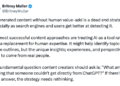
AI for content marketing is one of those things people either massively overhype or completely misunderstand.
Some marketers treat generative AI like it’s going to replace entire marketing teams overnight. Others think AI generated content automatically means low quality spam.
Neither is really true.
If you use AI lazily, your content is probably going to sound lazy too.
But if you use AI properly, it becomes an insanely useful assistant for speeding up repetitive work, improving content creation workflows, brainstorming ideas, and scaling parts of your marketing without sacrificing your brand voice.
That’s the real advantage of AI content marketing.
In this article, we’ll break down four practical ways to use AI for content marketing without turning your entire content strategy into generic AI slop.
Key takeaways:
- AI for content marketing works best when used as an assistant, not a replacement for human creativity and judgment.
- Generative AI can speed up content creation, keyword research, outreach personalization, and other repetitive marketing tasks.
- AI search and Google AI Overview results still rely heavily on traditional SEO practices like link building and strong content strategy.
- The best AI content marketing workflows combine automation with human editing to maintain a consistent brand voice.
- AI marketing tools are most effective when they help marketers save time on repetitive work so they can focus on strategy and creative decisions.

Link building cheat sheet
Gain access to the 3-step strategy we use to earn over 86 high-quality backlinks each month.
First Things First, AI Did Not Ruin Marketing
AI did not ruin content marketing.
Lazy marketers ruined content marketing.
There’s a huge difference.
A lot of people started using generative AI to mass-produce AI generated content with almost no editing, no real expertise behind it, no brand voice, and no actual thought put into the content itself.
And yeah, you can immediately tell.
But that’s not really a problem with artificial intelligence. It’s a problem with how people use AI.
The best way to think about AI content marketing is as an assistant, not a replacement.
Your marketing team still needs people who understand positioning, audience psychology, storytelling, content strategy, and what actually makes content interesting to read.
AI technology just speeds up the repetitive work.
Things like:
- Research
- Summarizing information
- Reformatting content
- Generating outlines
- Expanding bullet points
- Repurposing social media content
- Cleaning up drafts
Instead of spending hours doing repetitive tasks manually, marketers can spend more time on creative work, strategy, and decision-making.
For example, one content creator can now handle a much larger amount of content production than before. A marketing team can turn one article into multiple social media posts in a fraction of the time.
Existing content can be updated much faster too.
But none of that means human judgment stopped mattering.
If anything, it matters more now.
Since everybody has access to the same AI writing tools, the difference usually comes down to who edits better, who understands their audience better, and who keeps a consistent brand voice across all their content and marketing efforts.
Leverage Answer Engines for More Visibility
One of the biggest shifts in content marketing right now is that people are not just searching through Google anymore.
They’re asking ChatGPT. They’re using Gemini. They’re reading Google AI Overviews instead of clicking through ten different search results.
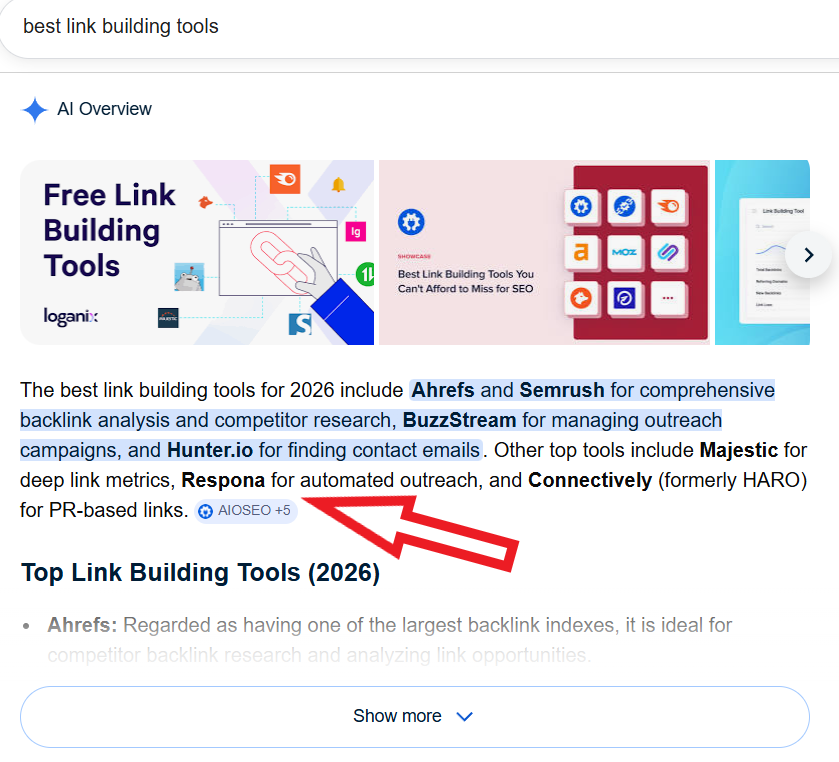
But despite all the hype around AI search, the underlying mechanics are still surprisingly similar to traditional SEO.
Answer engines still rely heavily on pages already performing well on Google.
Especially for commercial searches.
If someone searches for the best AI marketing tools, SEO software, outreach platforms, CRMs, or basically any type of product recommendation, AI systems usually pull those recommendations from listicles and roundup articles already ranking in search.
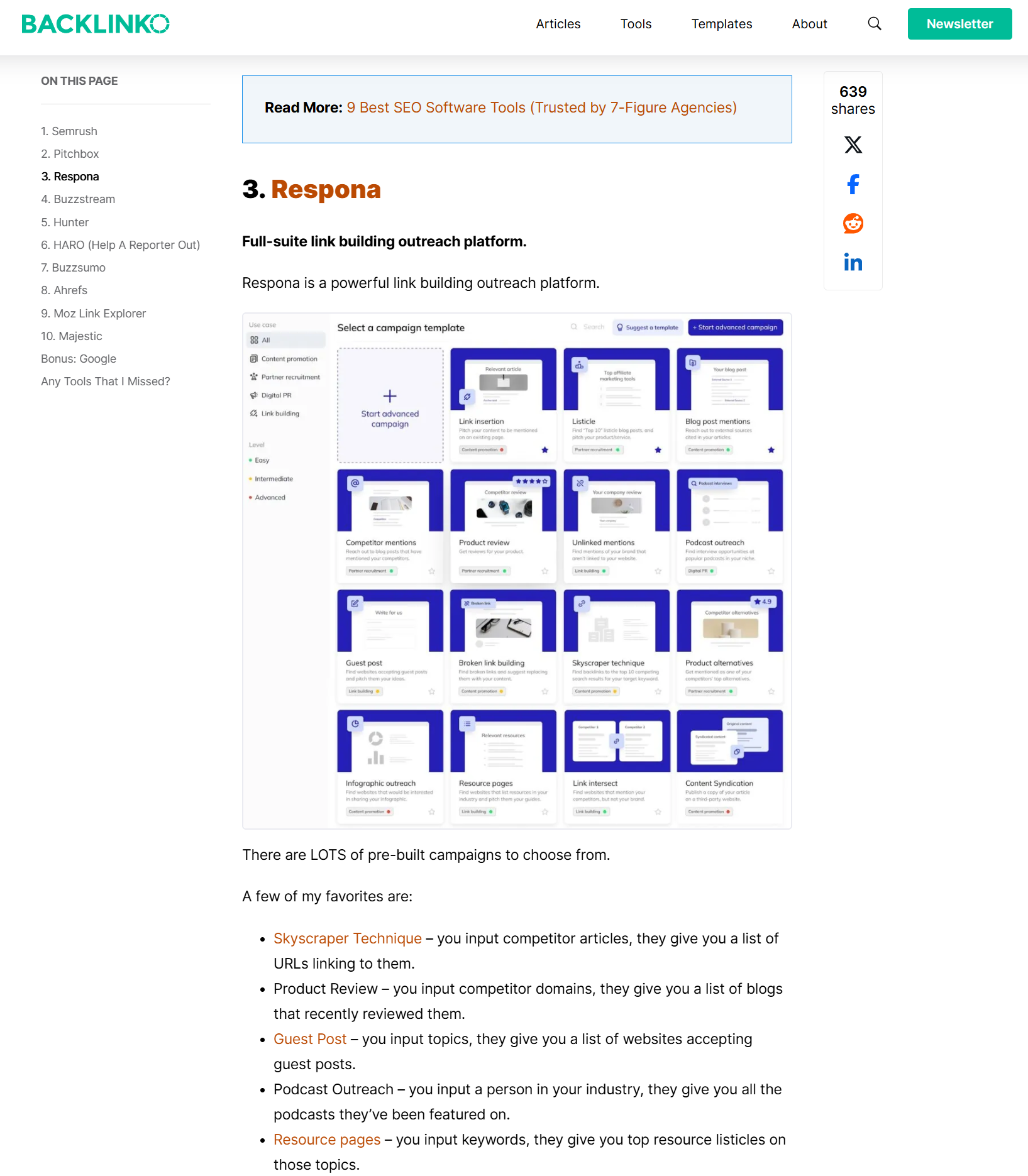
So showing up on those pages matters a lot more now than it used to.
A placement on a high-performing listicle does three things at once:
- Helps your page rank through normal link building signals
- Sends highly targeted commercial traffic
- Increases your chances of showing up in AI-generated recommendations
That last part is the biggest change.
You no longer need your own page ranking first to appear inside an AI overview or AI-generated answer.
If trusted articles already ranking on Google mention your brand, those mentions can get pulled directly into answer engines too.
This is why listicle placements became such a huge part of modern content strategy.
At Respona, this is basically what the campaigns feature is built around.
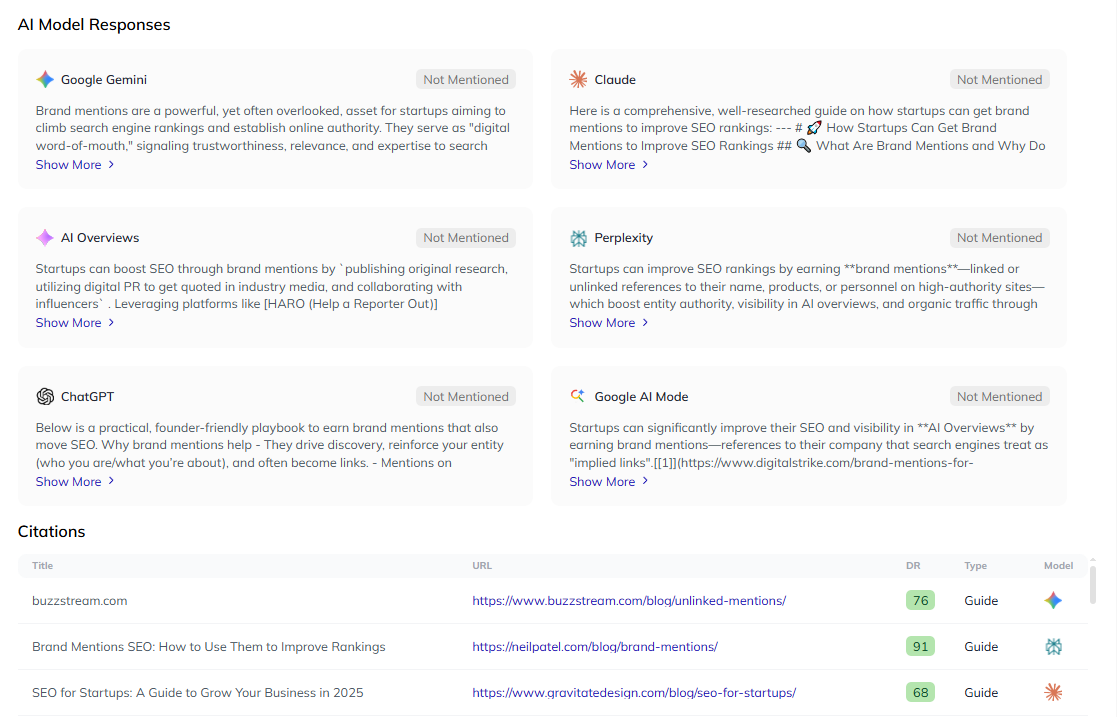
You enter the search queries you care about, and the tool finds listicles and articles already ranking well on Google and already getting cited by answer engines.
So instead of building random backlinks, you focus specifically on placements that already have visibility where your audience is searching.
Then the team handles the outreach, negotiations, follow-ups, and placements for you.
You just track your visibility increase over time.
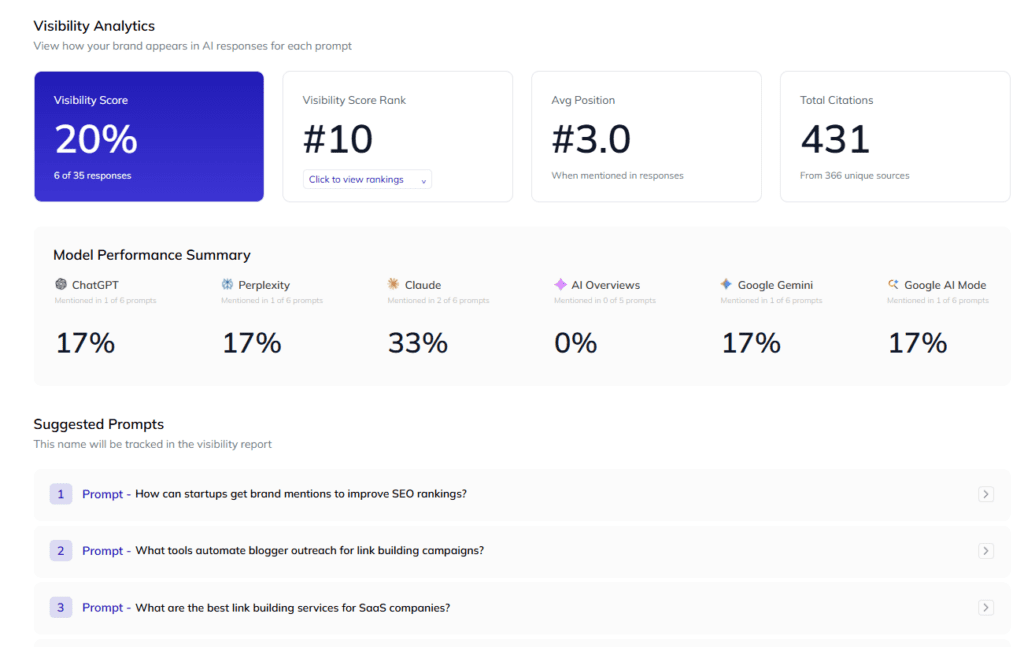
Since it’s pay-per-result, it works whether you need a handful of placements for a specific campaign or ongoing visibility across a much larger set of keywords.
Speed Up Content Creation & Optimization
This is probably the best use case for AI right now.
Not having AI write entire articles from a one-line prompt.
That’s usually how you end up with generic AI generated content that sounds exactly like everybody else.
A much better workflow is using AI as part of the process instead of handing over the entire process to it.
For example, one thing that works really well is giving the AI a very detailed outline with notes for every section explaining:
- What points need to be covered
- What examples to mention
- What tone to use
- What should and should not be included
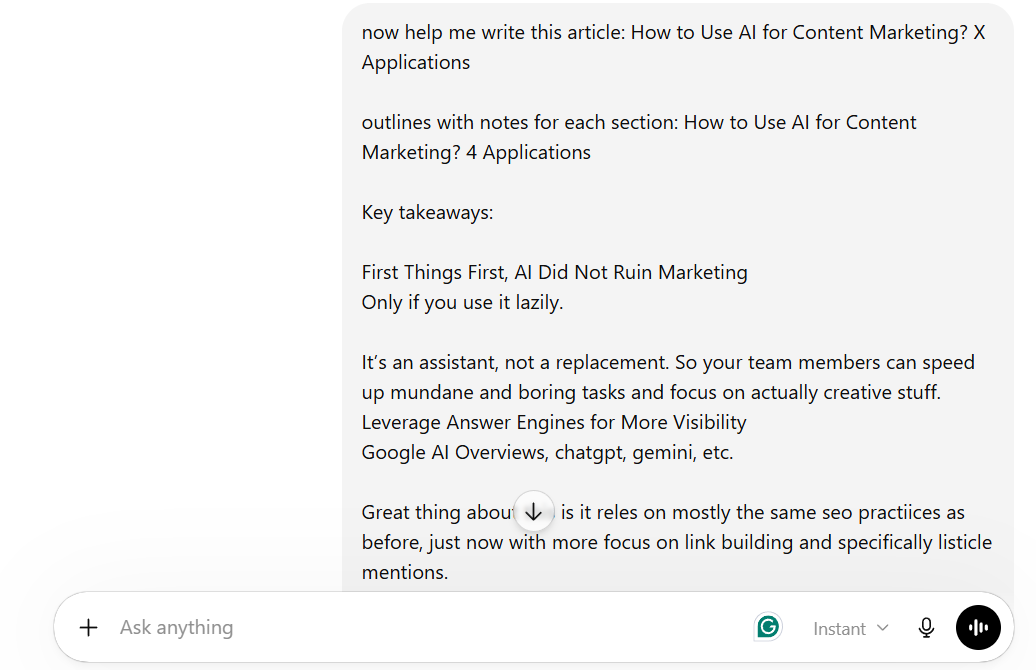
Then, alongside that, you give it examples of existing content you already wrote manually so it understands your brand voice better.
That alone improves the output massively.
You still need editing and judgment, but the drafting side of content creation becomes much faster.
The same applies to optimization.
For example, if you’re doing a content audit and trying to improve underperforming pages, AI can speed that process up a lot too.
You can combine AI with tools like MarketMuse to run quick keyword optimization passes across existing content and identify missing terms, weak sections, or content gaps without spending hours manually reviewing every page.
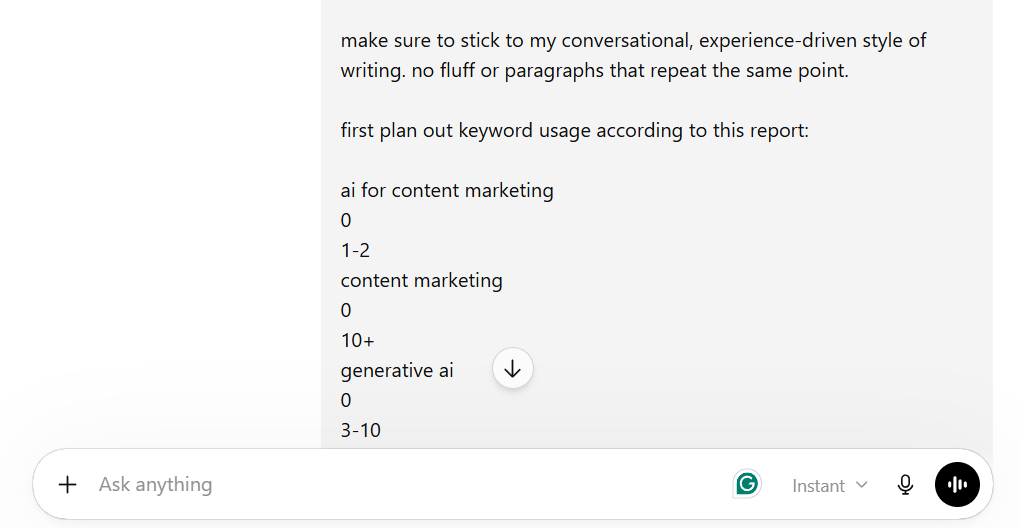
Especially when you have a lot of content, this saves an absurd amount of time.
Just make sure to proofread it, it can stuff keywords too aggressively sometimes.
Keyword Research
ChatGPT can actually be pretty decent for keyword research.
Especially for finding long-tail keywords, question-based searches, and content ideas for content marketing.
For example, you can ask it:
- what people search before buying a product
- common questions around a niche
- comparison keywords
- pain points people have before purchasing something
and it’ll usually give you a pretty good starting point.
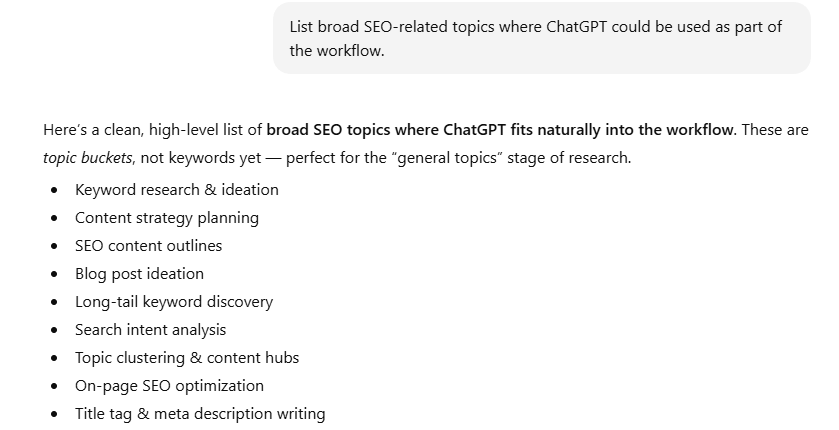
Just make sure you validate everything with Ahrefs afterward.
A lot of AI-generated keyword ideas are not real searches. They sound believable, but nobody is actually searching for them.
Alternatively, you can connect Ahrefs MCP to ChatGPT so it pulls live keyword data directly into your chats.
Automate Personalization
This is another place where AI saves an absurd amount of time.
For example, let’s say you’re doing sales outreach for link building services.
You have a spreadsheet full of prospects and you’re trying to come up with personalized article ideas, to include them in.
Doing that by hand can easily take five hours.
Instead, you can have something like Claude enrich the sheet for you automatically.
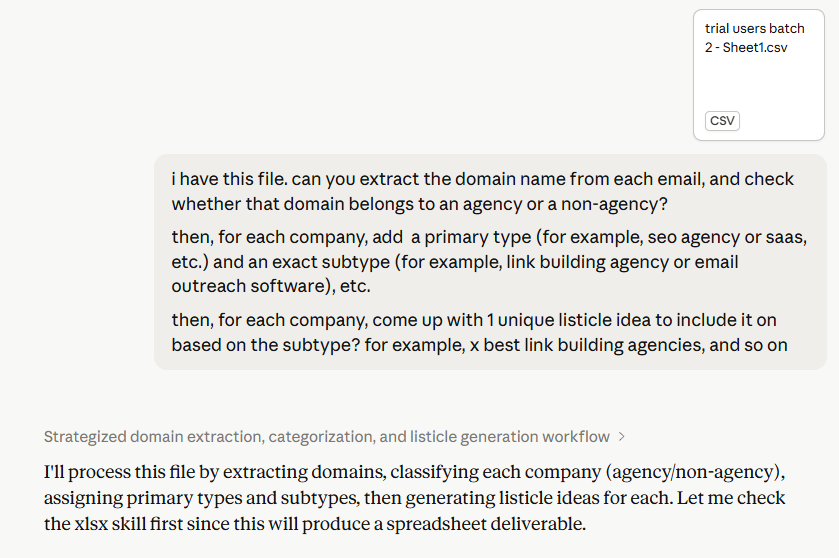
You feed it the company name, website, maybe a short description, and it can generate:
- article ideas
- outreach angles
- relevant content topics
- personalization snippets
- social media talking points
for every prospect in the sheet.
Then all you really need to do is review the output and make sure it actually makes sense.
That turns a five-hour task into a twenty-minute one.
Not replacing the work completely. Just removing a lot of repetitive manual research that nobody actually wants to spend their day doing.
Link building cheat sheet
Gain access to the 3-step strategy we use to earn over 86 high-quality backlinks each month.
Now Over to You
AI for content marketing works best when you treat it like an assistant, not a replacement.
The companies getting the best results right now are not blindly publishing AI generated content at scale. They’re using AI to speed up research, optimization, personalization, and production while still keeping humans involved in strategy, editing, and creative decisions.
That’s the real advantage.
AI helps marketers move faster. The actual marketing part still matters just as much as before.
And if you want help with the visibility side of AI content marketing, especially listicle placements and AI citations, you can simply place an order and let Respona handle the outreach, placements, and relationship building for you.
Frequently Asked Questions (FAQ)
How should marketers use AI for content marketing?
The best way to use AI for content marketing is to speed up repetitive tasks like research, outlining, optimization, and personalization while still keeping humans involved in editing and strategy.
Is AI generated content bad for SEO?
Not automatically. AI generated content becomes a problem when it’s published with no editing, no expertise, and no clear brand voice behind it.
What are the best AI marketing tools right now?
It depends on the workflow. ChatGPT, Claude, Notion AI, Ahrefs, and MarketMuse are all useful marketing tools for different parts of content creation and SEO optimization.
Can AI help with social media content?
Yes. A lot of marketers use AI to repurpose blog articles into social media posts, captions, summaries, and other social media content much faster.
What is the biggest mistake marketers make with AI content creation?
Usually it’s relying on AI to write entire articles without providing enough direction, examples, or editing afterward.
Can AI help with content audits?
Definitely. AI can speed up content audits by identifying missing keywords, weak sections, outdated information, and optimization opportunities across existing content.
Does AI replace content creators?
No. AI can speed up content production, but human judgment, positioning, storytelling, and brand voice still matter a lot.
What is the best AI tool for keyword research?
ChatGPT is good for brainstorming ideas, but SEO tools like Ahrefs are still necessary for validating search volume and actual keyword demand.
Can AI improve personalization for outreach campaigns?
Yes. AI can help marketers generate outreach angles, article ideas, personalization snippets, and campaign ideas much faster than doing everything manually.
What is an AI content marketing tool?
An AI content marketing tool helps marketers speed up parts of content creation, optimization, research, planning, or distribution using artificial intelligence.
What is the difference between AI content generation and normal content writing?
AI content generation uses generative AI to help draft or structure content faster, while traditional writing is done completely manually from start to finish.
Do AI content creation tools replace marketers?
No. AI content creation tools can help with repetitive work and content production, but marketers still handle strategy, editing, positioning, and brand voice.
Can AI help improve content performance?
Yes. AI can help identify weak sections, missing keywords, optimization opportunities, and content gaps that may improve overall content performance.
How do marketers use AI for social media?
A lot of marketers use AI to turn long-form content into social media content, captions, summaries, and social media posts much faster.
Can AI help with marketing automation?
Definitely. AI is becoming a big part of marketing automation workflows, especially for outreach personalization, lead enrichment, and campaign management.
What role does AI play in performance marketing?
AI helps performance marketing teams analyze data faster, generate actionable insights, improve targeting, and speed up repetitive campaign tasks.
What are some useful AI features for content marketers?
Some of the most useful AI features include outline generation, keyword clustering, rewriting, summarization, personalization, and optimization suggestions.
What is the best AI content tool for marketers?
There is no single best AI content tool. Most marketers use a combination of tools like ChatGPT, Claude, Notion AI, Ahrefs, and other AI marketing tools depending on the workflow.
Does AI help with digital marketing outside of content creation?
Yes. AI is now used across digital marketing for personalization, reporting, outreach, automation, customer support, SEO optimization, and marketing campaign analysis.
Should a content marketer rely completely on AI writing?
Probably not. AI writing is great for speeding up workflows, but human editing and judgment are still what make content feel original and aligned with your marketing strategy.
What does Marketing AI Institute recommend about AI content marketing?
A lot of research from Marketing AI Institute focuses on using AI to support marketers and improve workflows instead of replacing creative decision-making completely.
[ad_2]
Source_link