[ad_1]
A model trained on poorly labeled imaging data produces inaccurate predictions and risks misdiagnosis and poor clinical outcomes. This raises a noteworthy question: what truly defines a specialized medical imaging data provider, and why does it matter for clinically safe AI models?
The blog answers this crucial question: what truly defines a specialized medical imaging data provider, and why it matters?
Why is Medical Imaging Data Annotation Different?
Medical image annotation differs from general-purpose annotation, as it operates in a more complex and sensitive domain. The task is not confined to drawing bounding boxes or labeling objects. Whether it is MRIs, X-rays, CT scans, or histopathology slides, medical images are inherently nuanced. Even experienced clinicians might disagree on interpretation, leading to high inter-observer variability. Therefore, it is not just a task but a process that demands validation, consensus, and domain expertise.
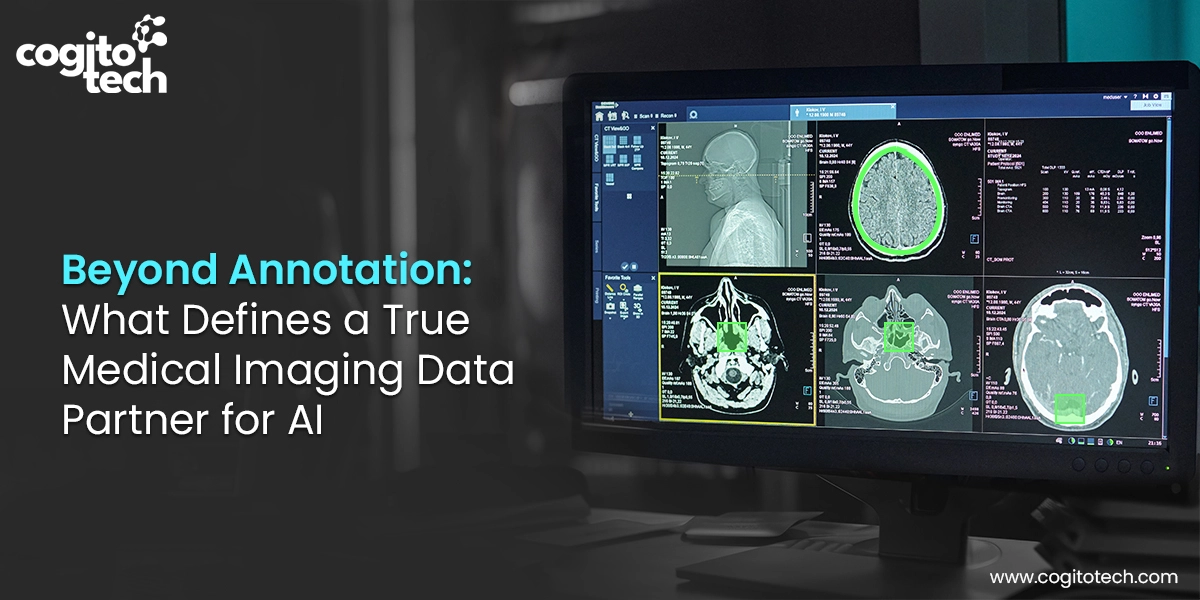
Medical imaging workflows also involve 3D and volumetric data, in which structures must be labeled across multiple slices. It adds complexity in both expertise and tooling. Given the need for clinically meaningful labels and the scarcity of accurate data, it becomes a specialized and high-stakes operation.
What Makes a Medical Imaging Data Provider “Specialized”?
All data annotation service providers do not meet the demands of healthcare AI. For a specialized partner, you need to consider the following factors:-
Supporting Different Imaging Modalities
From MRI and CT to digital pathology to ultrasound, each modality is different. The selected service partner must be able to handle diverse data types while adapting annotation approaches accordingly. For instance, annotating an MRI brain scan needs understanding soft tissue contrast, while pathology slides require cellular-level precision, two very different skill sets and workflows.
Clinical Expertise
Specialized providers are known for their clinical expertise, having a perfect team of pathologists, radiologists, and medical professionals in the annotation workflow. With experts in the loop, they ensure that labels are technically correct and clinically meaningful. For example, it is not enough to identify a tumor in a CT scan. Experts have to delineate tumor boundaries, distinguish between benign and malignant patterns, and account for subtle variations that could be interpreted by expert clinicians.
Advanced Annotation Capabilities
Medical AI demands detailed techniques such as instance segmentation, semantic segmentation, and volumetric labeling. This is not just about basic classification; it needs precision at the pixel level. For example, in oncology, it could mean segmenting a tumor across hundreds of slices in a 3D scan to calculate growth, volume, and response to treatment.
Specialized Tooling and Infrastructure
A specialized service provider is equipped with purpose-ready annotation platforms to handle formats like DICOM and 3D imaging data. For instance, annotating a cardiac MRI requires tools that complement slice-by-slice navigation, 3D visualization, and precise contouring, which standard image annotation tools generally lack.
Regulatory and Data Privacy Readiness
Given the healthcare sector’s data sensitivity, it is necessary to determine data security and privacy by adhering to standards such as GDPR and HIPAA. For instance, before any radiology dataset is annotated, patient identifiers must be eliminated from DICOM metadata to maintain privacy and compliance.
What to Look for in a Medical Imaging Service Provider?
Selecting the right partner is a critical decision that directly impacts model outcomes. Things to look for include:-
Depth of Clinical Validation – High-quality datasets are built with multi-layer validation. It often involves multiple medical experts to establish consistency and reduce inter-observer variability.
Multimodal and 3D Data Expertise – The service provider must be able to handle diverse imaging modalities along with 3D and volumetric data. It is essential to build comprehensive and accurate models.
Scalable and Accurate Workflows – Annotation precision becomes more challenging as data volume grows. The right partner balances scalability with strict quality control.
Regulatory and Compliance Readiness – Proven experience with healthcare regulations and data privacy standards ensures the secure handling of sensitive medical data and smoother deployment.
Human-in-the-Loop Integration – With continuous human oversight, feedback loops, and validation, datasets can be refined, and model performance improved over time.
Use Cases Where Annotation Quality Matters the Most
The importance of high-quality medical imaging annotation becomes evident in clinical workflows, where annotation precision directly influences model behavior, diagnostic accuracy, and ultimately patient outcomes.
Oncology
Poor annotations can lead to incorrect volume estimation, affecting dose planning and treatment efficacy. Models that are trained on high-quality annotations can track tumor growth accurately across time-series scans and support radiation planning with precise tumor boundaries. For volumetric analysis, assessment, and staging of treatment response, precise tumor segmentation is imperative.
Radiology
In radiology, annotated datasets train models to detect subtle abnormalities like lesions, microcalcifications, or early-stage pathologies. High-quality annotations reduce false positives and false negatives that can directly affect diagnostics and clinical decisions in high-throughput environments.
Surgical Planning
Accurate annotation of anatomical structures helps create 3D models used for surgical planning and navigation. This is especially important in complex procedures like neurosurgery or cardiac surgery, where even small errors can impact understanding and increase risk.
Early Disease Detection
Early-stage diseases often appear as low-contrast, subtle variations in imaging data. High-fidelity annotations allow models to learn these fine-grained patterns, improving early detection capabilities. This is especially significant in conditions like cancer or neurodegenerative diseases, where early diagnosis significantly improves prognosis.
Data is a True Differentiator
Data will continue to remain a differentiator as medical AI transforms. It is more than algorithms; it includes the quality, reliability, and clinical integrity of the data used to train AI models. Here, the role of leading medical imaging data providers is crucial. By combining domain expertise, annotation workflows, and validation processes, they enable the development of AI systems that are not only accurate but also safe, trustworthy, and ready for real-world clinical use. Thus, building effective medical AI is not all about teaching machines to see, but it is about ensuring they see the way clinicians do.
[ad_2]
Source_link