[ad_1]

The following is a joint announcement by the MIT Schwarzman College of Computing and IBM.
IBM and MIT today announced the launch of the MIT-IBM Computing Research Lab, advancing their long-standing collaboration to shape the next era of computing. The new lab expands its scope to include quantum computing, alongside foundational artificial intelligence research, with the goal of unlocking new computational approaches that go beyond the limits of today’s classical systems.
The MIT-IBM Computing Research Lab builds on a distinguished history of scientific excellence at the intersection of research and academia. Evolving from the MIT-IBM Watson AI Lab, which originated in 2017 on MIT’s campus, the new lab reflects a transformed technology landscape — one which AI has entered mainstream deployment, and quantum computing is rapidly advancing toward practical impact. Together, MIT and IBM aim to help lead research in AI and quantum and to redefine mathematical foundations across both domains.
“We expect the MIT-IBM Computing Research Lab to emerge as one of the world’s premier academic and industrial hubs accelerating the future of computing,” says Jay Gambetta, director of IBM Research and IBM Fellow, and IBM chair of the MIT-IBM Computing Research Lab. “Together, the brightest minds at MIT and IBM will rethink how models, algorithms, and systems are designed for an era that will be defined by the sum of what’s possible when AI and quantum computing come together.”
“For a decade, the collaboration between MIT and IBM has produced leading-edge research and innovation, and provided mentorship and supported the professional growth of researchers both at MIT and IBM,” says Anantha Chandrakasan, MIT’s provost, who, as then-dean of the School of Engineering, spearheaded the creation of the MIT-IBM Watson AI Lab and will continue as MIT chair of the lab. “The incredible technical achievements sets the bar high for our work together over the next 10 years. I look forward to another decade of impact.”
Addressing the next frontiers in computation
The MIT-IBM Computing Research Lab will serve as a focal point for joint research between MIT and IBM in AI, algorithms, and quantum computing, as well as the integration of these technologies into hybrid computing systems. The lab is designed to accelerate progress toward powerful new computational approaches that take advantage of rapid advances in AI and quantum-centric supercomputing, including those that combine maturing quantum hardware with classical systems and advanced AI methods.
This research initiative will include improving capabilities and integrating AI with traditional computing, alongside pursuing advances in small, efficient, modular language model architectures, novel AI computing paradigms, and enterprise-focused AI systems designed for deployment in real-world environments, where reliability, transparency, and trust are essential.
In parallel, the lab will rethink the mathematical and algorithmic foundations that underpin the next era of computing by accelerating the development of novel quantum algorithms for complex problems, with impacts in areas such as materials science, chemistry, and biology.
Additionally, the lab will investigate mathematical and algorithmic foundations of machine learning, optimization, Hamiltonian simulations, and partial differential equations, which are used to approximate the behaviors of dynamical systems that currently stump classical systems beyond limited scales and accuracy. Innovations from the lab could have wide implications for global industries, from more accurate weather and air turbulence prediction to better forecasts of financial market performance. Similarly, with improved optimization approaches, research from the lab could help lower risks in areas like finance, predict protein structures for more targeted medicine, and streamline global supply chains.
With its focus on AI, algorithms, and quantum, the MIT-IBM Computing Research Lab will complement and enhance the work of two of MIT’s strategic initiatives, the MIT Generative AI Impact Consortium and the MIT Quantum Initiative. MIT President Sally Kornbluth launched these strategic initiatives to broaden and deepen MIT’s impact in developing solutions to serious global challenges. The MIT-IBM Computing Research Lab will also leverage IBM’s longtime leadership and expertise in quantum computing. As part of its ambitious roadmap, IBM has laid out a clear path to delivering the world’s first fault-tolerant quantum computer by 2029, and is working across industries to drive value from quantum-centric supercomputing, tightly integrating quantum computers with high-performance computing and AI accelerators to solve the world’s toughest problems.
Deep integration with scientific domains
The MIT-IBM Computing Research Lab will also continue to serve as a foundation for training the next generation of computational scientists and innovators. It will do so by engaging faculty and students across MIT departments, enabling new computational approaches to accelerate discoveries in the physical and life sciences.
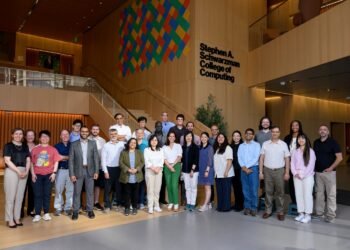
The lab will continue to be co-directed by Aude Oliva, senior research scientist at MIT’s Computer Science and Artificial Intelligence Laboratory, and David Cox, vice president of AI Foundations at IBM Research. MIT and IBM have appointed leads for each of the lab’s three focus areas — AI, algorithms, and quantum. Jacob Andreas, associate professor in the Department of Electrical Engineering and Computer Science (EECS), and Kenney Ng, principal research scientist at IBM Research and the MIT-IBM science program manager, will co-lead AI; Vinod Vaikuntanathan, the Ford Foundation Professor of Engineering in EECS, and Vasileios Kalantzis, IBM Research senior research scientist, will co-lead algorithms; and Aram Harrow, professor of physics, and Hanhee Paik, IBM director of Quantum Algorithm Centers, will co-lead quantum.
“The MIT-IBM Computing Research Lab reflects an important expansion of the collaboration between MIT and IBM and the increasing connections across AI, algorithms, and quantum. This deepened focus also underscores a strong alignment with the MIT Schwarzman College of Computing’s mission to advance the forefront of computing and its integration across disciplines,” says Dan Huttenlocher, dean of the MIT Schwarzman College of Computing and MIT co-chair of the lab. “I’m excited about what this next chapter will enable in these three areas, and their impact broadly.”
Building on nearly a decade of collaboration
The MIT-IBM Watson AI Lab helped pioneer a model for academic-industry research collaboration, aligning long-term scientific inquiry with real-world impact. Since its inception, the lab has funded over 210 research projects involving over 150 MIT faculty members and over 200 IBM researchers. Collectively, the projects have led to over 1,500 peer-reviewed articles. The lab also helped shape the career growth of a number of MIT students and junior researchers, funding more than 500 students and postdocs.
“The true measure of this lab is not just innovation, but transformation of a field. Hundreds of students have contributed to thousands of publications in top conferences and journals, demonstrating their capabilities to address meaningful problems,” says Oliva. “The MIT-IBM Computing Research Lab builds on an extraordinary legacy of impact to advance a trusted collaboration that will redefine the future of AI and quantum computing in a way never seen before.”
“By coupling academic rigor with industrial scale, the lab aims to define the computational foundations that will power the next generation of AI, quantum, and scientific breakthroughs,” says Cox. “By bringing together advances in AI, algorithms, and quantum computing under one integrated research effort, we’re creating the conditions to rethink the mathematical and computational foundations of science and engineering.”
The MIT-IBM Computing Research Lab will capitalize on this foundation, expanding both the scientific scope and the ecosystem of collaborators across the Cambridge-Boston region and beyond.
[ad_2]
Source_link