
[ad_1]
Key Takeaways
- ERP implementation costs typically range from $50,000 to $1,000,000+, varying by business size, customization, and deployment model.
- Major cost drivers include software licensing, infrastructure, customization, data migration, integration, training, and change management.
- Hidden costs often arise from data preparation, process reengineering, scope changes, and ongoing post-launch support.
- Advanced technologies like AI, IoT, and RPA can increase upfront costs but drive long-term ROI and efficiency.
- A structured budgeting approach and phased rollout help control costs and maximize ERP investment value.
Enterprise Resource Planning (ERP) has become a quiet constant across industries that rarely operate the same way twice. A mid-sized manufacturer depends on it to reconcile production gaps with supplier timelines. A retail chain leans on it to prevent stock distortions across channels.
Given how central these systems have become, the ERP market is projected to exceed $123 billion by 2030. Also, about 34% of business leaders have reported measurable gains in operational efficiency and productivity after investing in ERP (Source: Deloitte).
Even service-led businesses now use ERP to align billing, staffing, and compliance in one place. Its strength lies in this flexibility. The framework remains consistent, but the execution bends to each business model.
That is precisely why cost becomes a central concern. Businesses are no longer asking if they need ERP. They are trying to understand how far the investment will stretch and where it may expand without warning. Implementation is rarely a fixed exercise. It unfolds alongside process adjustments, system integrations, and internal adoption challenges.
In practical terms, ERP implementation costs typically range from $50,000 to $1,000,000+ for most organizations. The variation depends on scale, customization depth, and deployment approach.
What often escapes early estimates are the secondary cost drivers such as data restructuring, user training, and workflow redesign, all of which shape the final total cost of ownership.
In this blog, we will explore every aspect of ERP implementation costs, from visible expenses to hidden drivers, providing a complete guide for informed budgeting and planning. Let’s take a quick walkthrough.
Join the 92% of top-performing midsize enterprises embracing ERP
Our experts will guide you through every step of implementation to ensure a smooth, efficient rollout

Cost Components of ERP Implementation
Having a clear understanding of the cost elements will help differentiate between one-off investments and recurring costs. The difference is essential to consider in light of long-term financial considerations and the overall cost of ownership. Here are some of the key types of ERP software implementation costs:
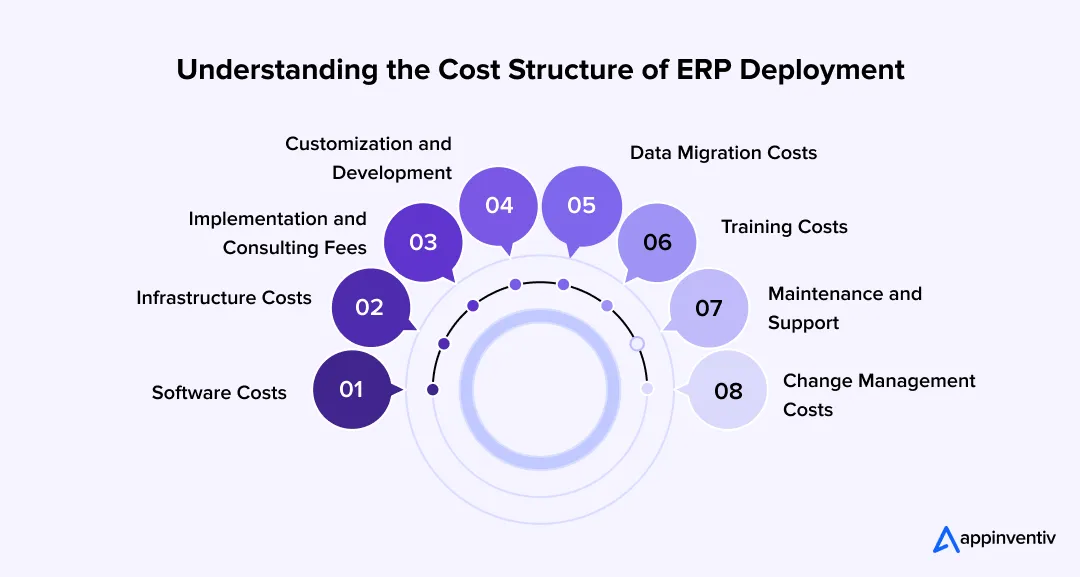
Software Costs: These include ERP licensing and user/module/use-level subscription costs. Cloud systems are sold on a recurring model, whereas on-premise systems are sold as a one-time license.
Infrastructure Costs: For on-premises deployments, this includes servers, storage, networking, and security systems. Cloud infrastructure is often provided as a bundle under subscription fees, but can also incur additional usage fees.
Implementation and Consulting Fees: These are the planning, system configuration, customization and deployment costs. A large part of this element is typically comprised of external consultants or implementation partners.
Customization and Development: A custom workflow, report, or integration is commonly necessary in businesses. This element involves developing work to adapt the ERP system to meet specific operational requirements.
Data Migration Costs: This entails the extraction, cleansing, mapping, and transfer of data in legacy systems. The attempt is based on volume, structure, and quality of data.
Training Costs: This category includes user training, documentation and onboarding. Prices rise as the number of users and the system’s complexity increase.
Maintenance and Support: Post-implementation services include monitoring, updates, bug fixes and system optimization. This is usually a recurring cost.
Change Management Costs: Internal alignment process adjustments and adoption strategies take time and resources. This aspect makes the system successfully utilized following deployment.
A Comprehensive View of the ERP Implementation Costs
ERP implementation costs rarely sit in a single bucket. They are distributed across technical setup, process alignment, and organizational readiness. A clear breakdown helps avoid underestimation and gives decision-makers a working view of total exposure.
| Complexity Level | Cost Range | Scope | Key Cost Drivers |
|---|---|---|---|
| Basic | $50,000 – $150,000 | Core modules (finance, inventory), small groups | Limited customization, standard workflows, few integrations |
| Mid-Level | $150,000 – $450,000 | Multi-department implementation | Medium customization, third-party integrations, systematic data migration |
| Advanced | $450,000 – $1,000,000 | Enterprise-wide or multi-location | High customization, migration to a legacy system, advanced analytics, change management |
ERP Implementation Costs by Business Scale
ERP budgets vary widely based on business size, process complexity, and deployment scope. While small businesses may manage with minimal modules, large enterprises require extensive customization, integration, and multi-location support, which drives costs toward the higher end of the range. Overall, most ERP implementation projects fall between $50,000 and $1,000,000.
| Business Size | Annual Software Cost | Implementation Fees | Total First-Year Cost |
|---|---|---|---|
| Small Business (up to $10M revenue) | $10,000 – $50,000 | $20,000 – $100,000 | $30,000 – $150,000 |
| Mid-Sized Business ($10M – $50M revenue) | $50,000 – $150,000 | $75,000 – $300,000 | $125,000 – $450,000 |
| Large & Enterprise ($50M+ revenue) | $150,000 – $400,000 | $300,000 – $600,000 | $450,000 – $1,000,000 |
This table highlights how ERP system implementation costs scale with business size, showing a clear correlation between scope, complexity, and investment. It helps organizations set realistic budgets while anticipating potential hidden costs in larger deployments.
Cost Breakdown by Implementation Stages
ERP implementation is carried out in layers, with each providing a definite portion of the total investment. The study of these phases helps plot ERP system implementation costs more precisely, particularly when scope and complexity change throughout the project.
Planning and Discovery (10%–15%) – Cost range: $5,000 – $150,000: This phase lays the groundwork. It involves analysis of requirements, stakeholder workshops, evaluation of vendors and solution design. Gaps in this phase often lead to rework later, which increases the cost of ERP implementation beyond initial estimates. Here, documentation and realistic scoping are critical.
Software and Licensing (15%–25%) – Cost range: $7,500 – $250,000 : This includes the ERP platform itself, whether it be it subscription based platform or perpetual licensing. Prices are differentiated based on the deployment model, users and modules. Although this seems simple, the long-term cost of implementing an ERP system may vary depending on licensing levels and additional features.
Customization and Development (20%–30%) – Cost range: $10,000 – $300,000: Most businesses require customization. This involves workflow design, module extensions, and interface modifications. The more customization is done, the more reliant it becomes on the development resources and the long-term maintenance.
Integration (10%–20%) – Cost range: $5,000 – $200,000: ERP systems can hardly operate in isolation. The integration with CRM, HRMS, payment systems, or third-party platforms ensures operational continuity. The situation becomes even more complicated when non-standard APIs or legacy systems are needed.
Data Migration (10%–15%) – Cost range: $5,000 – $150,000: This includes data purification, mapping and transfer of records between current systems. Low data quality will slow implementation and create inconsistencies that will influence reporting and decision-making.
Testing and Deployment (5%–10%) – Cost range: $2,500 – $100,000: The system is tested during go-live with operational and performance testing before go-live. This phase provides stability, detects, and makes the system ready to be used in the real world.
Training and Change Management (5%- 10%) – Cost range: $2,500 – $100,000: The long-term success is based on user adoption. The teams can be easily transitioned through training sessions, documentation, and process alignment efforts, which minimize resistance and disruption of the operations.
Also Read: ERP Software Development Cost: Steps, Timeline & Budget
Estimating ERP Implementation Costs (Structured Approach)
A reliable estimate combines baseline cost components with structured calculation models. This reduces guesswork and gives stakeholders a defensible budget range, while also enabling a clearer ERP implementation cost breakdown across stages and resources.
Simple Cost Formula
A practical starting point:
Total Cost = (Base Software Cost + Customization + Integration + Data Migration) + (Users × Training Cost per User) + Contingency (10–20%)
This formula captures both fixed and variable elements. It is particularly useful when accounting for ERP implementation costs, as it separates direct expenses from user-driven and risk-adjusted components. The contingency layer accounts for scope shifts, hidden dependencies, and execution risks that typically emerge during implementation.
Advanced Estimation Models Used in Practice
To move beyond rough estimates, structured models are applied to quantify effort and reduce bias, especially in large-scale ERP system implementation costs scenarios.
Work Breakdown Structure (WBS)
This is a bottom-up approach where the entire ERP implementation is divided into smaller tasks such as requirement mapping, module configuration, integration points, and testing cycles. Each task is assigned estimated hours and resource costs, then summed to arrive at the total.
- Offers high accuracy when the scope is well-defined
- Helps identify cost-heavy stages early
- Forms the baseline for detailed project planning
Parametric Model (COCOMO II)
This model estimates effort based on system size and complexity, often measured in thousands of lines of code.

Where:
- E = Effort (person-months)
- KLOC = Thousands of lines of code
- a, b = Constants based on project type
- EAF = Effort Adjustment Factor (accounts for complexity, team capability, tools)
This approach is useful when customization levels are high, and development effort needs to be quantified systematically, which also supports the capitalization of ERP implementation costs in financial planning.
Three-Point Estimation (PERT)
This method reduces estimation bias by considering three scenarios: optimistic (O), most likely (M), and pessimistic (P).

- Balances uncertainty across best and worst cases
- Produces a weighted average that reflects realistic timelines and costs
- Commonly used for large ERP programs with multiple dependencies
Why This Matters
ERP implementation costs are rarely static. A structured estimation approach ensures that projections are grounded in measurable inputs rather than assumptions. It also allows teams to revisit and refine estimates as the project progresses, keeping financial planning aligned with actual execution.
Ready to implement ERP?
Get a clear cost estimate and see how our experts can help you plan, deploy, and optimize without surprises

Understanding Total Cost of Ownership (TCO) in ERP Implementation
Whereas implementation costs represent the initial investment, Total Cost of Ownership (TCO) represents the entire financial outlay of operating an ERP system throughout its lifetime. TCO does not just consider software and deployment costs; it also includes hidden costs and other costs that arise after ongoing maintenance, support, training, and go-live.
| Component of Cost | Description | Typical Share of TCO |
|---|---|---|
| Software & Licenses | Module and user fees, subscription or perpetual license charges | 20–30% |
| Implementation & Consulting | Planning, configuration, customization, and deployment services | 25–35% |
| Infrastructure & Hosting | On-premise servers or cloud hosting charges | 10–20% |
| Integration & Customization | ERP relation with existing systems and workflow modification | 15–25% |
| Training & Change Management | User onboarding, documentation, and adoption programs | 5–10% |
| Maintenance & Support | Updates, bug fixes, monitoring, and optimization | 5–15% |
| Non-apparent Costs | Data migration, workflow redesign, and post-go-live adjustments | 5–15% |
When ERP projects are assessed in terms of TCO, organizations have the opportunity to strike a balance between the cost of ERP system implementation and the operational efficiency and scalability in the long-term.
At Appinventiv, our experts worked on projects that streamlined operations, improved productivity, and enhanced data visibility for global clients including retail and eCommerce ERP implementation:

IKEA

Challenge:
High store traffic and scattered customer data slowed onboarding and in-store engagement.

Appinventiv’s Role:
Built an ERP-driven in-store platform with digital catalogs and centralized inventory & customer records.

Impact:
- 40% faster navigation
- 30% higher staff productivity
- 25% more structured customer data

Y.K. Almoayyed & Sons (YKA)
Challenge:
Disjointed systems slowed reporting and limited financial visibility.
Appinventiv’s Role:
Implemented cloud ERP on AWS integrating finance, HR, logistics, and CRM with real-time dashboards.
Impact:
- 32% lower operational costs
- Reporting time reduced
- Full operational visibility
Factors Affecting the Cost of Implementing an ERP System
ERP implementation costs may seem modest at the outset, but they tend to rise during execution. These variables can cause the same system to be at the extreme ends of the budget range by how they combine to play out during the planning and delivery stage, and consequently affect the overall ERP system implementation cost.
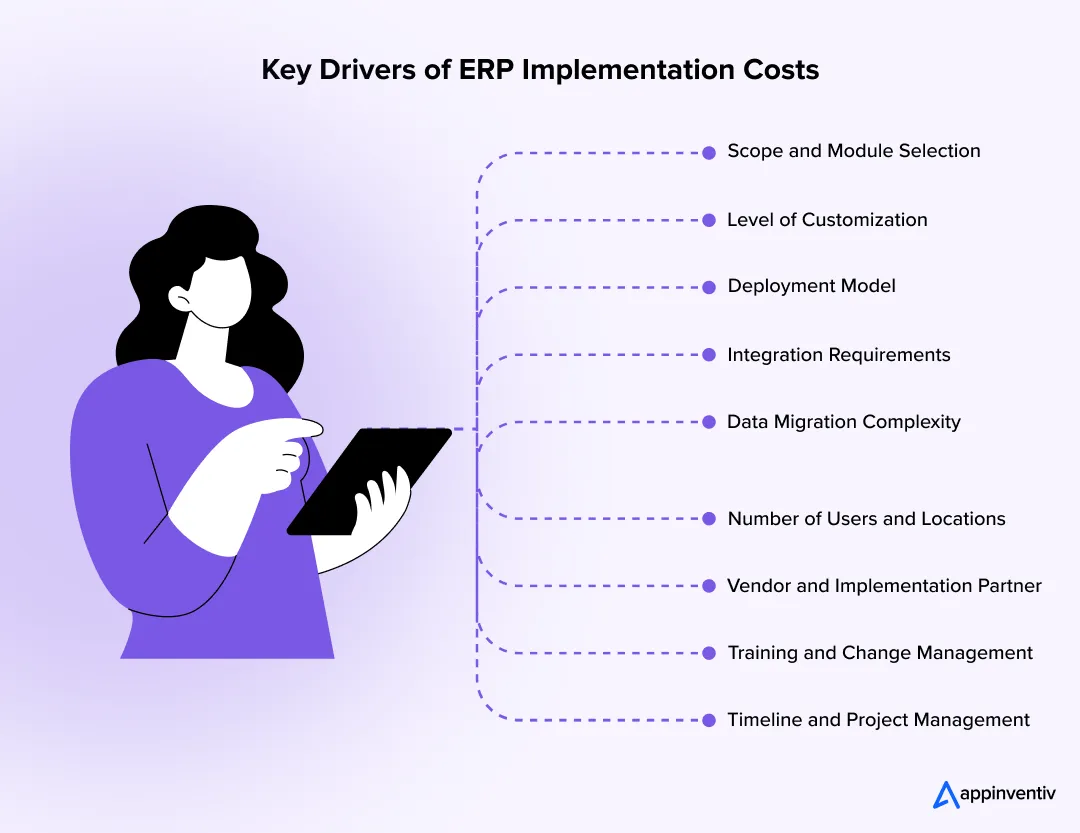
Scope and Module Selection: Cost is directly proportional to the number of modules. An ERP finance-only implementation is not expensive, but additional supply chain, HR, procurement, and analytics add to the licensing and implementation work. The expansion of scope is also associated with cross-functional dependencies that lengthen timelines.
Level of Customization: Normal ERP solutions are inexpensive and seldom adapt to complicated workflows. The development of custom applications, customized dashboards, and customized business logic increases both upfront costs and maintenance efforts.
Deployment Model: Cloud ERP integration reduces the initial infrastructure cost and minimizes installation time. On-premise systems require hardware, a security hierarchy, and internal technical support, which increases capital expenditure and operating costs.
Integration Requirements: ERP systems typically interface with CRM systems, HRMS solutions, payment gateways and legacy systems. The complexity of each integration increases, particularly where data structures are inconsistent or the APIs are limited.
Data Migration Complexity: The quality and quantity of the available data are vital. Well-structured, clean data saves time and effort, whereas fragmented or out-of-date datasets require extensive cleaning, mapping, and validation.
Number of Users and Locations: The number of users affects access control setup, licensing and training. Multi-location or multi-entity organizations demand further configuration for compliance, reporting and operational alignment.
Vendor and Implementation Partner: Prices are highly dependent on the vendors’ pricing models and the implementation partner’s experience. Established partners can initially set higher costs but tend to reduce risk, rework, and delays, which directly impact the cost of ERP implementation in the long term.
Training and Change Management: User adoption is not taken seriously. Formal training, documentation and internal change management initiatives contribute to the cost, but are necessary for long-term system effectiveness.
Timeline and Project Management: Reduced schedules demand larger workforces and concurrent implementation, which makes them more expensive. The longer schedules might seem cost-effective, but they inject some inefficiencies and prolonged resource allocation.
How Advanced Technologies Impact ERP Implementation Costs
Advanced technologies are reshaping ERP systems by adding intelligence, automation, and real-time responsiveness across operations. Their integration introduces additional cost layers, but also creates opportunities for long-term efficiency gains and higher returns. Let’s have a look at those:
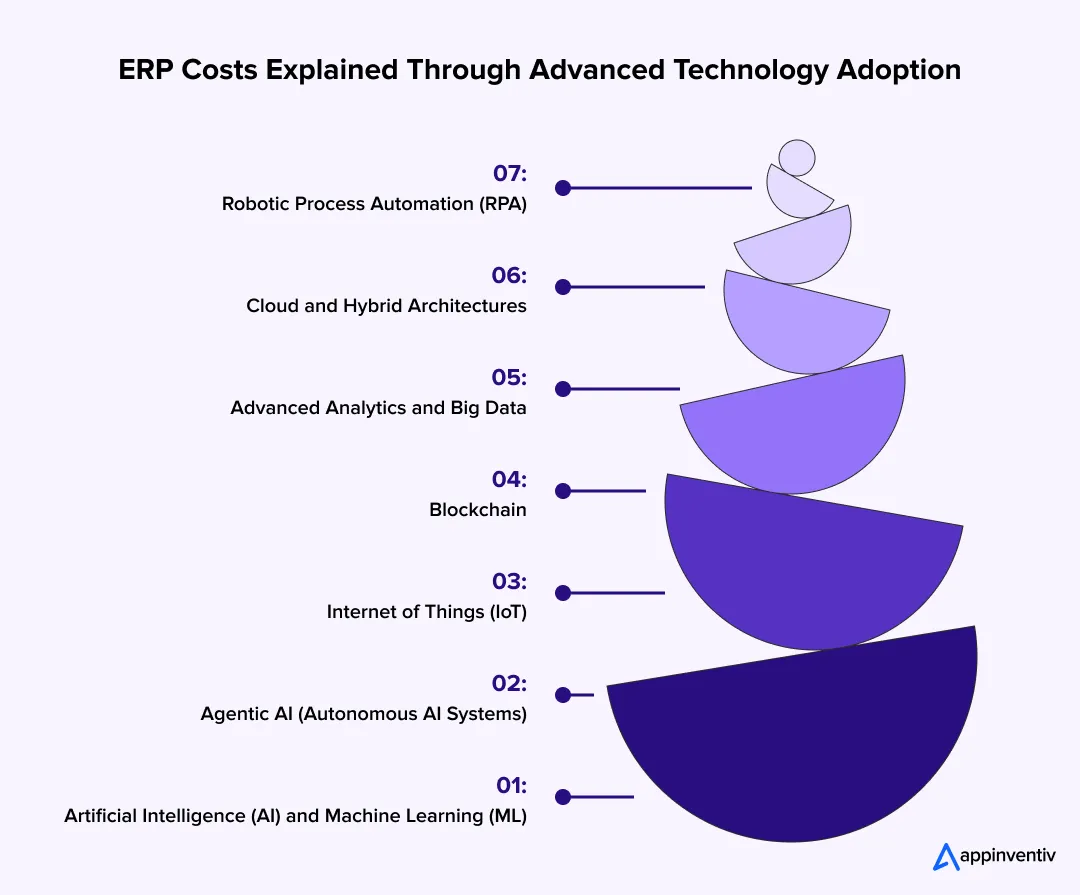
Artificial Intelligence (AI) and Machine Learning (ML)
ERP systems that are powered by AI allow predictive analytics, automated processes, and smart decisions. But implementation consists of model training, data preparation and integration with core ERP modules.
Cost impact: Moderate to high, based on data maturity and application.
Estimated range: $10,000 to $300,000+ (typically 15%–40% of total ERP cost)
Agentic AI (Autonomous AI Systems)
The agentic AI allows the ERP systems to work with little human intervention throughout the workflows, including procurement, planning, and support. It greatly enlarges system intelligence and autonomy.
Cost impact: High to very high because of orchestration layers and continuous learning systems.
Estimated range: $25,000 to $500,000+ (typically 25%–60% of total ERP cost)
Internet of Things (IoT)
Enterprise IoT integration enables ERP systems to receive real-time information from connected devices, such as sensors, machinery, and logistics systems. It is popular in supply chains and manufacturing.
Cost impact: Medium to high, depending on the scale and complexity of the integration of devices.
Estimated range: $10,000 to $250,000+ (typically 10%–35% of total ERP cost)
Blockchain
Blockchain technology implementation improves transparency, traceability and security of ERP systems, especially in finance and supply chain activities.
Cost impact: High because of special development and integration needs.
Estimated range: $20,000 to $400,000+ (typically 20%–50% of total ERP cost)
Advanced Analytics and Big Data
Current ERP platforms incorporate high-level analytics to process large volumes of both structured and unstructured data, providing deeper insights into the business and forecasts.
Cost impact: Moderate based on volume of data and complexity of reports.
Estimated range: $10,000 to $200,000+ (typically 10%–30% of total ERP cost)
Cloud and Hybrid Architectures
Cloud ERP saves infrastructure overhead, whereas hybrid designs provide flexibility but require more integration complexity and deployment work.
Cost impact: Variable; hybrid environments expand the scope of implementation.
Estimated cost: between $5,000 and $150,000+ to install and migrate (usually 10 percent -25 percent to hybrid complexity)
Robotic Process Automation (RPA)
Robotic Process Automation (RPA) automates tedious ERP tasks like invoice handling, payroll, and order management, enhancing efficiency.
Cost impact: Low to moderate based on the amount of automated workflow.
Estimated range: $5,000 to $100,000+ (typically 5%–20% of total ERP cost)
The Unseen Costs Behind ERP Implementation for Large Scale Deployments
ERP budgets often capture visible expenses such as licensing, development, and integration. What tends to slip through are the hidden costs that surface only after execution begins. These costs do not always appear large in isolation, but they accumulate and can significantly alter overall ERP system implementation costs.
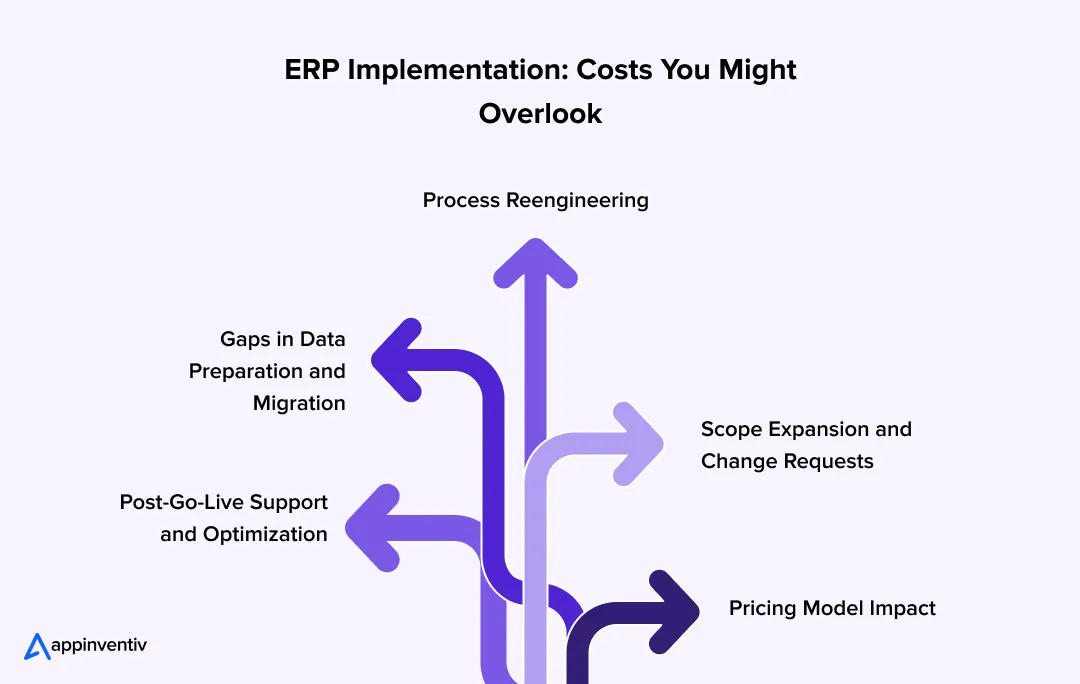
Process Reengineering
ERP systems enforce organized workflows and, therefore, the organizational processes may be required to be redesigned. This entails internal alignment, workshops and, in certain instances, external consulting assistance. The work involved in this is often underestimated at an earlier stage of planning.
Gaps in Data Preparation and Migration
Old systems can hardly be cleanly migrated. The process of cleaning, validating and restructuring datasets is time-consuming and requires skilled resources. Any delay in this phase may spill into testing and deployment, making it even more expensive and effort-intensive.
Scope Expansion and Change Requests
New requirements come up as teams start using the system. These add-on changes reflect the hidden costs of ERP implementation, as they create extra development and configuration effort, gradually increasing the project’s overall size beyond initial estimates.
Post-Go-Live Support and Optimization
The system will need a continuous monitoring process, bug fixes, and performance tuning after deployment. These expenses are not always included in the initial budgets but are required to stabilize the operations.
Pricing Model Impact
Long-term costs can be affected by different ERP pricing models, such as subscription-based, user-based, or module-based. What might seem economical initially can grow in different ways as the number of users, features or transactions grows.
Hidden hurdles can slow down even the most well-planned ERP initiatives
Partner with our specialists to stay prepared and move forward with confidence
Practical Approaches to Optimize ERP Implementation Expenses
ERP implementation may be costly, yet planning and sound decisions can reduce costs without compromising system effectiveness.
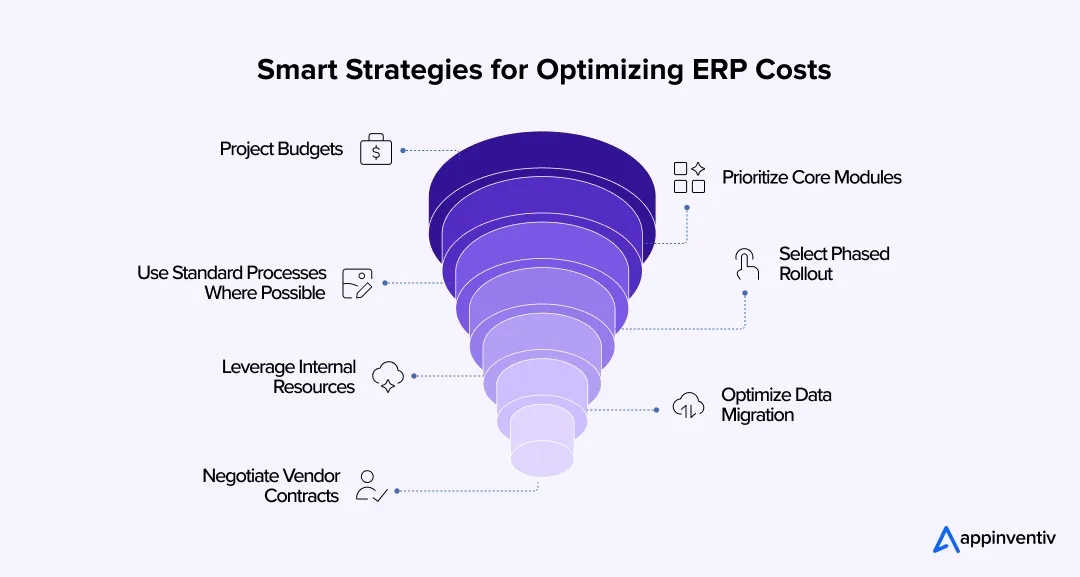
Prioritize Core Modules
Start with basic modules that deliver instant value to the business. Don’t install everything in one go, which will save on first software and implementation costs and avoid wasting time on features that are not used.
Use Standard Processes Where Possible
Reducing customization reduces initial and maintenance expenses. Streamline business processes using standard workflows in the ERP to minimize configuration, testing, and maintenance costs.
Select Phased Rollout
ERP implementation in phases, by department, location, or module, is a way of spreading costs over time and leveraging experience from one phase to optimize subsequent rollouts, without redoing the work.
Leverage Internal Resources
Internal people should be assigned to support configuration, testing, and training rather than relying on external consultants. Well-trained employees will be able to reduce implementation costs and enhance system adoption.
Optimize Data Migration
Clean and prepare the data beforehand to make the migration process simpler and quicker. Automated, repetitive tasks and redundant historical data transfers that are avoided reduce effort and cost.
Negotiate Vendor Contracts
Look through software licensing terms, support packages and subscription fees carefully. Bargaining over payment plans or service packages will significantly reduce the ERP implementation cost breakdown.
How ERP Implementation Drives Business ROI
An ERP implementation, when properly handled, can have a direct positive impact on profitability, operational optimization, and pay off the capital investment. The following are some of the best benefits of the ROI of ERP implementation:
Operation Cost Cutting: The ERP lowers the cost of labor by automating repetitive tasks, removing the manual entry of data and enhancing business process efficiency; thus, minimizing the error rate and financial waste. These efficiencies in the long run result in high operational savings.
Inventory Optimization: This is real-time data on the stock level, demand and supplier performance that can help reduce excess inventory, holding costs and also liberate the capital that is currently bound up in idle resources.
Enhanced Revenue Recognition: Centralized billing, in-built sales tracking, and faster order processing will help companies to recognize revenue earlier and more effectively, increase the flow of cash and improve their financial position overall.
Improved Decision-Making: Due to the consolidated information in the departments, managers will be able to determine the high-value prospects, allocate resources more efficiently and take proactive measures to minimize expenses or maximize revenue, which will make the strategic initiatives pay off more.
Less Compliance Costs and Fines: Standardized workflows, in-built audit trails and automated reporting minimize regulatory fines and compliance errors and maintain profit margins and legal and industry compliance.
How to Plan Your ERP Implementation Budget
An effective ERP budget takes into consideration a lot more than the software license. These 4 tips can help ensure you capture all expenses and avoid surprises.
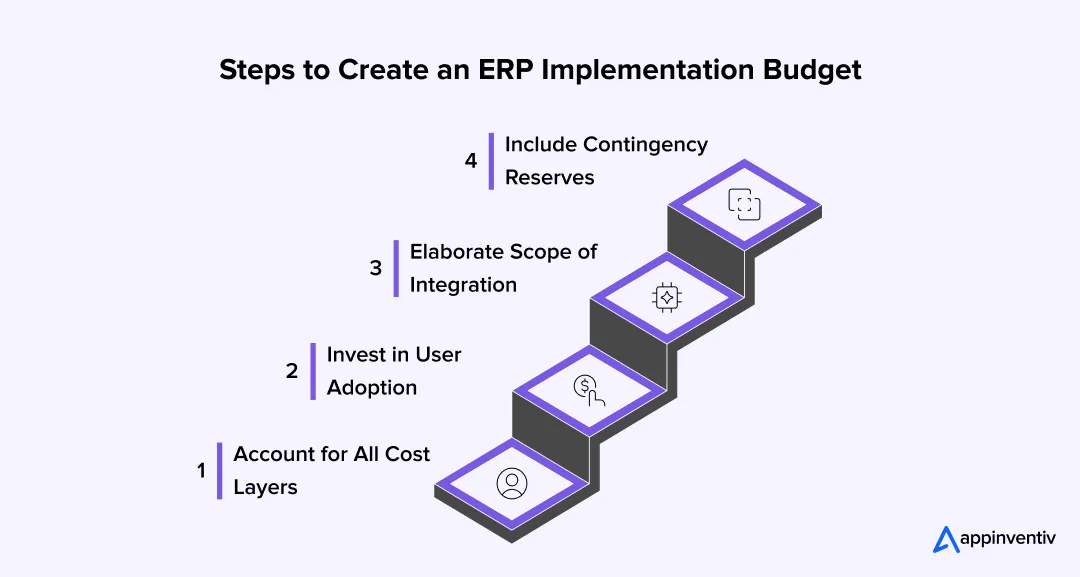
1. Account for All Cost Layers
ERP software does not stop there. Each of the implementation services, customization, data migration, integrations, and maintenance is a distinct allocation. As an illustration, post-implementation support can be 12-20% of the total licensing cost, and overall ERP expenditure can be between 3-6% of annual revenue.
2. Invest in User Adoption
Documentation, training and onboarding are vital to ROI. Set aside 15-18% of your total project budget to ensure the staff can utilize the system to its fullest. Efficiency can be eroded by skimming here, thereby reducing measurable returns.
For example, for ERP accounting software development, teams that invest in structured training and role-based onboarding tend to see faster adoption, fewer reporting errors, and more consistent use of financial workflows across departments.
3. Elaborate Scope of Integration
New integrations can be expensive to find out at a late stage. Every ad hoc system connection can be an additional cost of $7,000-40,000 and timeframes. Determine all the CRM, HRMS, payment, and legacy system contacts prior to conclusive contracts.
4. Include Contingency Reserves
ERP projects are nearly always faced with unexpected challenges. Allocate 15-20% to regular projects, 20-25% to multi-location or moderately customized projects, and 25-30% to highly customized projects or strict timescales.
Is your ERP budget ready for real-world challenges?
We stress-test your plan and make sure it stands firm during implementation
How Appinventiv Helps You Execute ERP Implementation Efficiently
The trend in ERP implementation is towards more adaptive, intelligent and highly integrated systems with new emerging technologies. Predictive analytics and automated decision-making are becoming possible through artificial intelligence and machine learning, made quicker and more scalable by cloud-native architectures.
IoT and low-code are enhancing real-time monitoring of operations and are minimizing the effort needed to make the platform customizable. With these developments, ERP systems are no longer the sole record-keeping systems but dynamic systems that can support business strategy.
Meanwhile, ERP implementation costs are becoming increasingly complex. Businesses require partners who can match technology to business targets, coordinate integrations across ecosystems, and scale over time. Here lies the value of Appinventiv’s ERP software development services.
With experience in developing and implementing enterprise-level solutions, the team facilitates end-to-end ERP implementation, including requirement analysis and architecture design, integration, customization and after-sales support. The emphasis is on providing systems that are not just functional initially but also flexible to changes in business requirements.
Avoid letting technology choices inflate your ERP investment without clear returns. Share your implementation scope, and our experts will conduct a focused evaluation of your architecture, integrations, and cost structure to identify inefficiencies and optimization opportunities.
FAQs
Q. How much does it cost to implement an ERP system?
A. ERP implementation costs may vary between $50,000- $1,000,000 or more, based on the size of business, customization requirements and the complexity of integration. At the low end are smaller deployments with few modules, and on the high end are enterprise-wide deployments with advanced features, multi-location support, and migration of legacy systems, which substantially raise the total cost.
Q. How do cloud-based ERP solutions affect overall implementation costs?
A. Cloud-based ERP solutions save initial infrastructure expenses as they do not require on-premise servers and hardware. They also reduce deployment timeframes and reduce maintenance costs by making pricing subscription-based.
Nevertheless, the long-term costs can change with the scaling of the users, usage of data and other features, and it must be considered.
Q. What are the pricing for the top ERP platforms?
A. Here’s how some of the top ERP platforms are priced:
- SAP S/4HANA: $20,000 – $100,000+ annually (subscription), implementation can exceed $100,000
- Oracle NetSuite: $10,000 – $100,000+ per year, implementation starts from $25,000
- Microsoft Dynamics 365: $50 – $180 per user/month, implementation ranges from $20,000 – $250,000
- Odoo: $20 – $30 per user/month, implementation from $10,000 – $100,000
- Infor ERP: Prices varying based on scope, from $50,000 to implement.
Q. Is it possible to reduce costs beyond implementation services?
A. Yes, with initial discussion with respective tech partner, companies can save on their budget by optimizing licensing plans, restricting the unnecessary modules, and enhancing the use of internal resources. Long-term costs are also managed by efficient data management, phased implementation and reduced customization. The vendor negotiation and post-implementation support strategies are other ways of minimizing the total cost of ERP ownership.
Q. How to choose the right ERP implementation partner?
A. Here’s the checklist for hiring the right ERP implementation partner like Appinventiv:
- Experience in Industry: Demonstrated experience in your particular field.
- Technical Skills: Good integration, customization, and deployment skills.
- Scalability Focus: Capability to plan systems to accommodate future expansions.
- Transparent Pricing: Excellent cost structure with no hidden expenses.
- Post-Implementation Support: Maintaining, upgrading and optimizing services.
- Client References: Confirmed case studies and customer success stories.
[ad_2]
Source_link










![What are the latest Hootsuite product features? [May 2026]](https://mgrowtech.com/wp-content/uploads/2026/06/What-are-the-latest-Hootsuite-product-features-May-2026-120x86.png)