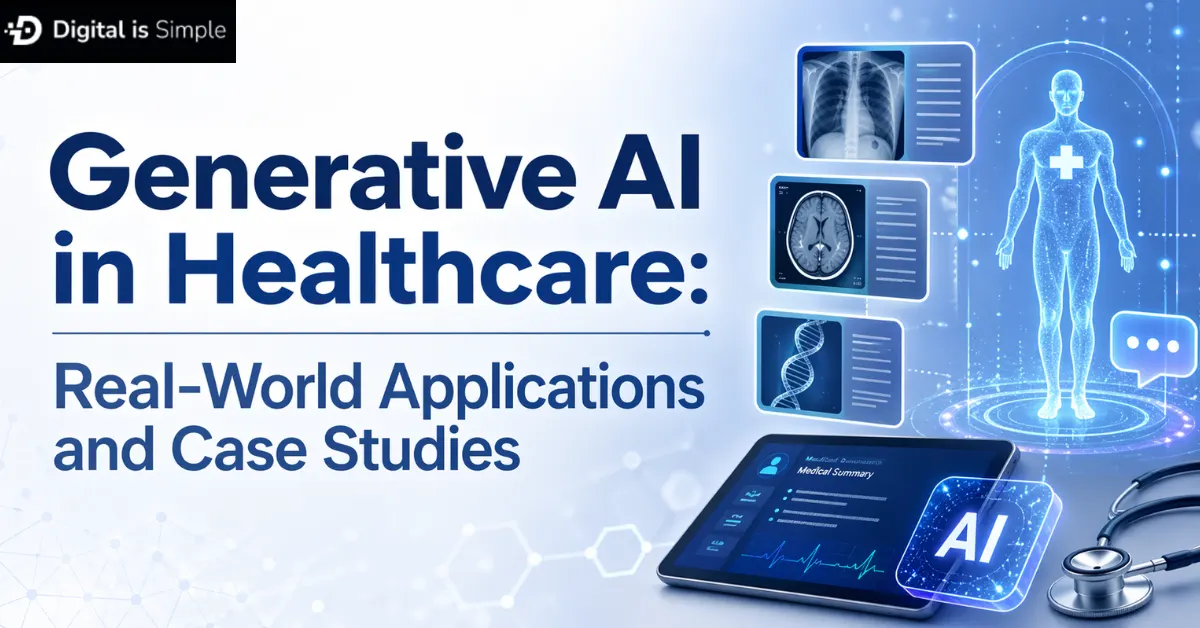
Generative AI in healthcare is no longer a futuristic concept. It is actively reshaping how hospitals diagnose diseases, how pharma companies develop drugs, and how providers deliver personalized patient care. In 2026, the stakes are higher than ever, and the results are measurable. According to McKinsey & Company, generative AI could unlock up to $100 billion annually in value across the healthcare and pharmaceutical sectors, highlighting the scale of transformation already underway.
This blog explores where generative AI is delivering the most impact, backed by real-world use cases that decision-makers and business leaders can learn from.
Real-World Applications of Generative AI in Healthcare(With Examples)
Here are some of the most practical ways generative AI is being used in healthcare today.
1. Medical Imaging and Radiology Diagnostics
AI-generated image analysis is transforming radiology departments worldwide. Generative models can reconstruct high-resolution scans from low-dose inputs, reducing patient radiation exposure without sacrificing diagnostic quality.
At Massachusetts General Hospital, AI tools trained on millions of mammography images now flag early-stage breast cancer with accuracy that rivals senior radiologists. The speed advantage is even more striking. Reports that once took hours are now delivered in minutes.
These systems do not replace radiologists. They act as a second pair of expert eyes, catching anomalies that might be missed during high-volume workflows.
2. Drug Discovery and Clinical Trial Acceleration
One of the most transformative applications is in pharmaceutical research. Traditionally, bringing a new drug from concept to approval took 12 to 15 years. Generative AI is compressing that timeline in meaningful ways.
Companies like Insilico Medicine have used generative models to design novel drug candidates targeting specific proteins. In one landmark case, they moved from target identification to a preclinical candidate in under 18 months, a process that typically takes four or five years.
These models generate thousands of molecular structures, evaluate their binding properties, and eliminate unpromising candidates before any lab work begins. This saves hundreds of millions in research costs.
3. Clinical Documentation and Administrative Efficiency
Physician burnout driven by documentation overload is a global crisis. Generative AI tools like ambient clinical intelligence are now listening to patient consultations and automatically generating structured clinical notes in real time.
Systems built on large language models transcribe conversations, extract diagnoses, prescriptions, and follow-up instructions, then populate EHR fields automatically. Physicians review and confirm, rather than type from scratch.
Nuance’s DAX Copilot, deployed in health systems across the United States, has reduced documentation time by up to 50 percent for some providers. That is time returned directly to patient care.
4. Personalized Treatment Planning
Generic treatment protocols often fail to account for individual variability. Generative AI changes this by synthesizing a patient’s genetic profile, medical history, lab results, and lifestyle data to generate tailored treatment recommendations.
In oncology, this is particularly powerful. AI platforms are helping oncologists match patients with targeted therapies based on tumor gene expression patterns, moving beyond standard chemotherapy protocols toward precision medicine.
Understanding generative AI use cases across industries makes clear why healthcare is seeing the deepest adoption. The combination of high data availability and high decision stakes creates the ideal environment for generative models to deliver value.
5. Mental Health Support and Patient Engagement
Conversational AI is now deployed as a frontline mental health resource in several health systems. These tools screen for depression and anxiety using validated frameworks, provide cognitive behavioral therapy exercises, and escalate urgent cases to human clinicians.
Woebot and similar platforms have demonstrated clinically meaningful improvements in patient-reported anxiety and mood scores in controlled studies. They are not a replacement for therapy. They are a scalable bridge for patients who face long wait times for professional care.
Gen AI Healthcare Case Studies Worth Studying in 2026
The following examples showcase how organizations are applying generative AI to solve real healthcare challenges.
Mayo Clinic and Ambient AI Documentation
Mayo Clinic rolled out ambient AI documentation tools across multiple departments in 2024 and 2025. Physician satisfaction scores improved significantly, and average documentation time per patient dropped by 40 percent. The system flags potential drug interactions in real time, adding a patient safety layer that had not previously existed in the workflow.
Pfizer and Generative Protein Design
Pfizer partnered with AI companies to explore generative models for antibody design. Using diffusion model architecture similar to those behind image generation, researchers generated novel protein structures optimized for binding affinity to specific viral targets. Early pipeline results showed higher hit rates in biological testing compared to traditional screening methods.
NHS Digital and Diagnostic AI at Scale
The UK’s National Health Service began deploying AI-assisted diagnostic tools across GP practices and urgent care settings. The tools analyze patient symptom data, lab results, and risk scores to suggest priority conditions for further investigation. Early pilots showed a measurable reduction in time to diagnosis for sepsis and cardiovascular events.
What Business Leaders Need to Know Before Adopting Generative AI in Healthcare
Adoption requires more than technology. Organizations must think carefully about data governance, regulatory compliance, clinician training, and integration with legacy systems.
Businesses that rush implementation without a structured approach often face costly setbacks. Understanding generative AI implementation mistakes helps organizations build realistic roadmaps and avoid the most common failure points.
Healthcare leaders should also identify the specific workflows where generative AI creates the highest value. Radiology, documentation, and drug discovery are well-validated. But the opportunity is far broader, including supply chain optimization, fraud detection, and patient scheduling.
Building custom generative AI solutions tailored to specific clinical workflows, regulatory environments, and patient populations consistently outperforms off-the-shelf deployments. Generic tools rarely account for the depth of domain complexity that healthcare demands.
Final Thoughts
Generative AI in healthcare will continue evolving rapidly. Multimodal models that combine imaging, genomics, and clinical text are becoming commercially viable. Real-time AI at the point of care, embedded into diagnostic devices and wearables, is on the near horizon.
The future of generative AI trends points toward models that are smaller, faster, and deployable at the edge rather than only in cloud environments. This will make AI-assisted care accessible in low-resource settings and rural communities for the first time.
Regulatory frameworks are also catching up. The FDA has approved over 500 AI-enabled medical devices as of early 2026, and international bodies are developing standards for algorithmic transparency and clinical validation.
FAQ
1. Is generative AI in healthcare safe for clinical decision-making?
Generative AI tools used in healthcare are designed to support clinical decisions, not replace them. Approved tools undergo rigorous validation processes, and most are deployed as decision aids with human oversight remaining central to all final judgments.
2. What data does generative AI use in healthcare applications?
Healthcare AI models are trained on de-identified patient records, medical imaging databases, genomic datasets, clinical trial data, and published medical literature. Data privacy regulations like HIPAA and GDPR govern how this data is collected and used.
3. How long does it take to implement generative AI in a healthcare organization?
Implementation timelines vary based on use case complexity and system integration requirements. Pilot programs for documentation tools can launch in weeks. Full clinical deployments typically take six to eighteen months, including training, compliance review, and workflow redesign.
4. What is the ROI of generative AI in healthcare?
ROI varies by application. Administrative AI tools often deliver measurable cost savings within the first year through reduced documentation time and lower transcription costs. Diagnostic AI typically generates value through faster throughput, reduced errors, and avoided downstream costs from missed diagnoses.
5. Can small hospitals and clinics benefit from generative AI?
Yes. Cloud-based generative AI platforms have made advanced tools accessible to smaller providers without large IT infrastructure. Ambient documentation, patient triage tools, and diagnostic support systems are all now available as subscription services with minimal onboarding requirements.