
Key takeaways:
- Regulatory pressure from APRA, CDR, and CPS frameworks is forcing banks to prioritise auditability, resilience, and real-time capabilities over legacy stability.
- Australian banks modernising core banking systems are reducing risk by migrating high-value functions first while maintaining legacy ledgers for stability.
- The cost of core banking modernisation for an Australian bank is shaped by data migration, compliance validation, and parallel system operations, not just development effort.
The operational inertia of legacy infrastructure has reached a critical tipping point for the Australian financial sector. For tier-1 and mid-market institutions alike, modernising core banking systems in Australia is no longer a backend upgrade. It is a defensive necessity driven by the intersection of the Consumer Data Right (CDR), Australian Prudential Regulation Authority (APRA)’s evolving operational resilience standards (CPS 230), and the dire need for AI-readiness.
A primary example of successful execution is the Commonwealth Bank of Australia (CBA). the bank has recently completed a monumental migration of over 61,000 data pipelines to a cloud-native environment, enabling the processing of 157 billion data points daily. This shift allowed CBA to move beyond basic transactions into the realm of “agentic AI,” where the core system facilitates real-time, autonomous financial decisioning for millions of customers.
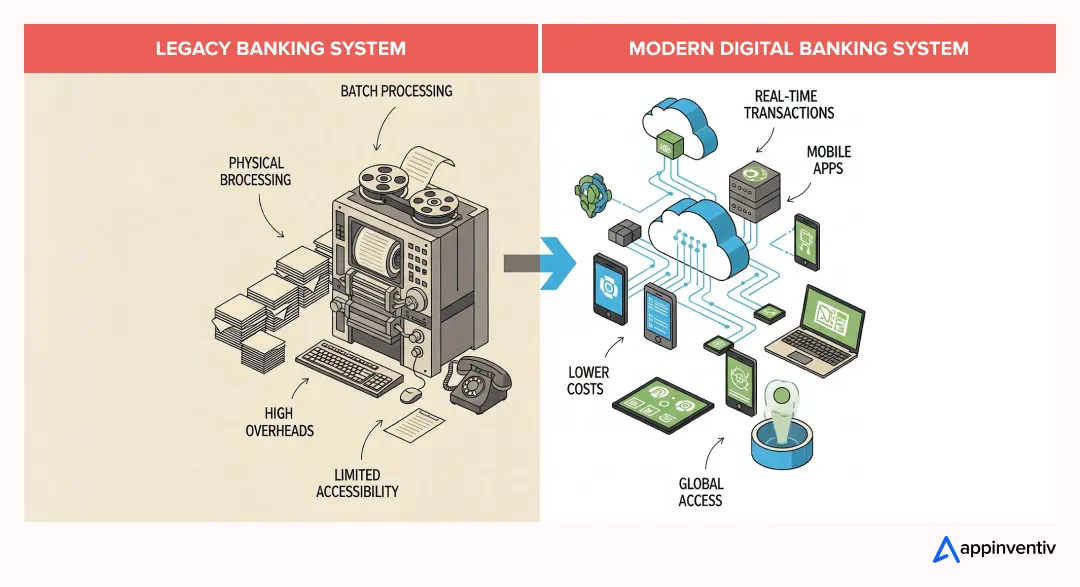
At its core, core banking system modernisation in Australia refers to re-architecting foundational banking systems to support real-time processing, data-driven decisioning, and scalable digital services while maintaining strict compliance alignment.
The question is no longer whether to modernise. It is how to execute without introducing operational risk, compliance gaps, or cost overruns. This blog focuses on how Australian banks modernising core banking systems are approaching that balance in practice, where strategies are working, and where execution continues to fail.
Assess Your Core Banking Risk and Modernisation Readiness
- Identify migration risk exposure across legacy systems
- Map APRA and CPS compliance gaps in your architecture
- Estimate realistic cost and transformation timelines

The Real Problem: Where Legacy Systems Are Failing Australian Banks
Most banks are not dealing with failing systems. They are dealing with 30–40-year-old core systems that still run, but no longer keep pace with how the business needs to operate. That distinction matters. The pressure is less about outages and more about the cost, effort, and risk involved in making even controlled changes to the core. The tension is in the maintenance-to-innovation ratio.
The Rigidity of Monolithic Technical Debt
Many institutions still rely on COBOL-based architectures where a single product update requires exhaustive regression testing across the entire ledger. This “spaghetti” integration makes it impossible to meet the rapid deployment cycles of digital-first competitors. Consequently, up to 80% of IT budgets are often swallowed by maintenance, leaving little for actual innovation.
Data Silos and AI Impotence
Data is often distributed across multiple systems with inconsistent formats and latency issues. This restricts real-time visibility into customer behaviour and financial risk. As a result, initiatives involving AI in core banking Australia struggle to scale beyond isolated use cases.
Compliance and Integration Hurdles
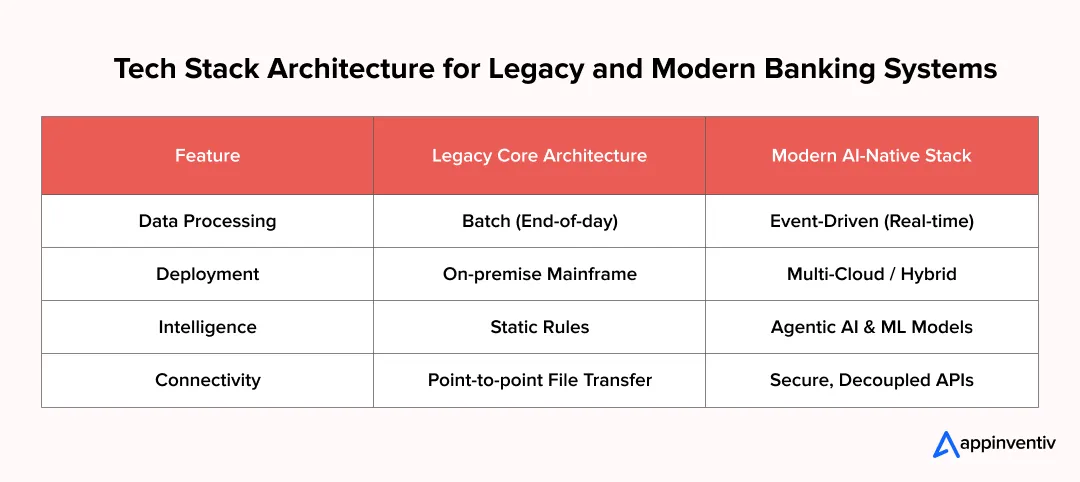
The Australian regulatory environment is becoming increasingly granular. Between CDR mandates and APRA’s CPS 230 standards, the demand for transparency is at an all-time high. Batch-processed legacy systems struggle to provide the real-time auditing and API-driven connectivity required to participate in the “banking-as-a-service” economy, limiting your ability to scale via fintech partnerships.
Gaps in Supporting Real-Time and Embedded Models
Customer expectations have shifted faster than most core systems. Real-time payments, instant onboarding, and personalised offerings are now standard expectations in the Australian market.
Legacy systems, particularly those dependent on batch processing, struggle to support:
- Real-time transaction updates
- Integration with third-party ecosystems
- Dynamic product configuration
As embedded finance models expand, these limitations become more visible. Banks are not just competing with each other anymore. They are competing with platforms that are built for speed and flexibility from day one.
What Modernisation Strategies Are Adopted by Australian Banks?
Core banking system modernisation in Australia is no longer a “big bang” replacement. It is a strategic unbundling of the monolithic core to favor modularity and speed. Australian executives must decide between absolute stability and the necessity of real-time, data-driven service delivery. There are typically the six strategies dominating the Australian landscape in 2026:
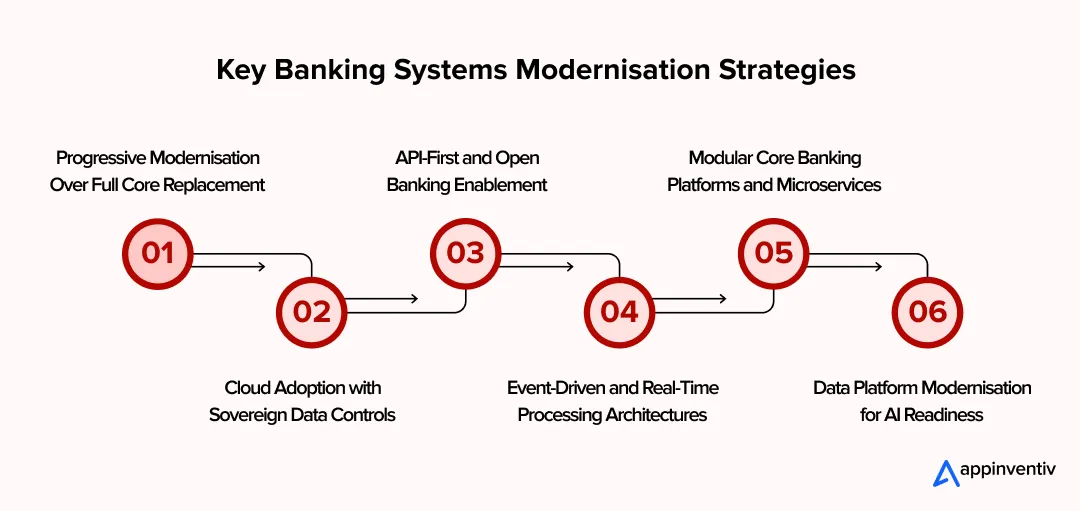
1. Progressive Modernisation Over Full Core Replacement
Rather than a high-risk “rip and replace,” most Australian banks are opting for a “hollow out the core” approach. This involves migrating specific high-value functions such as term deposits or personal loans to a new digital engine while keeping the legacy ledger for low-velocity accounts. This reduces the blast radius of any potential migration failure and allows for incremental ROI.
2. Cloud Adoption with Sovereign Data Controls
The shift to cloud is now standard, but the focus has moved to sovereign resilience. Australian banks are building multi-cloud architectures to satisfy APRA’s concentration risk concerns. By leveraging local Azure or AWS regions, institutions ensure that data remains on-shore while gaining the elasticity required for peak National Payments Platform (NPP) transaction volumes.
3. API-First and Open Banking Enablement
With the CDR now mature, the core must act as an open ecosystem. Strategies now focus on building a “headless” banking layer where the backend is entirely decoupled from the frontend. This allows you to launch new digital products or partner with fintechs in weeks rather than years, using standardised API gateways to manage secure data exchange.
4. Event-Driven and Real-Time Processing
Moving from batch processing to event-driven architecture is critical for modern core banking modernisation in Australia. By using streaming platforms like Kafka, banks can process transactions as they happen. This is essential for meeting customer expectations of “instant everything,” from real-time fraud alerts to immediate credit approvals at the point of sale.
5. Data Platform Modernisation for AI Readiness
A core is only as good as the insights it generates. Modern strategies involve creating a “data mesh” where the core banking system feeds a unified data layer. This architecture ensures that AI models have access to clean, high-concurrency data, enabling the hyper-personalisation that is now a key competitive battleground in the local market.
6. Modular Core Banking Platforms and Microservices
Rather than relying on a single system, banks are moving toward modular architectures where each domain operates independently. Payments, deposits, lending, and customer management are separated into services that can scale and evolve individually.
This approach reduces system-wide risk and enables faster deployment cycles.
When to Choose the Right Core Modernisation Approach
| Scenario | Recommended Approach |
|---|---|
| High technical debt but stable ledger | Progressive modernisation |
| Regulatory pressure (APRA/CPS gaps) | Hybrid transformation |
| Launching new digital bank | Cloud-native core replacement |
| Need faster product rollout | API-first modular architecture |
| Legacy system nearing end-of-life | Full core replacement |
Transform Your Legacy Systems in Australia with Appinventiv
- 10+ Years of APAC delivery experience
- 500+ legacy systems transformed
- Alignment with APRA, ASIC, and AU data laws
- Cloud-native, scalable, and secure architectures
- End-to-end delivery from audit to deployment

Cloud, AI, and Open Banking: The New Core Architecture Stack
The convergence of cloud elasticity, agentic AI, and API-driven ecosystems has fundamentally redefined the “target state” for modernising core banking systems in Australia. By the end of 2026, the architectural benchmark is no longer just about uptime; it is about “operational intelligence” – the ability of a core system to autonomously sense and respond to market shifts. For Australian CXOs, this means moving away from passive ledgers toward active, self-optimising platforms.
Microsoft forecasts that Australian public cloud spending will reach AUD 22.4 billion in 2026, an 83% increase, from AUD 12.2 billion in 2022. This projections is fueling a new stack characterised by the following:
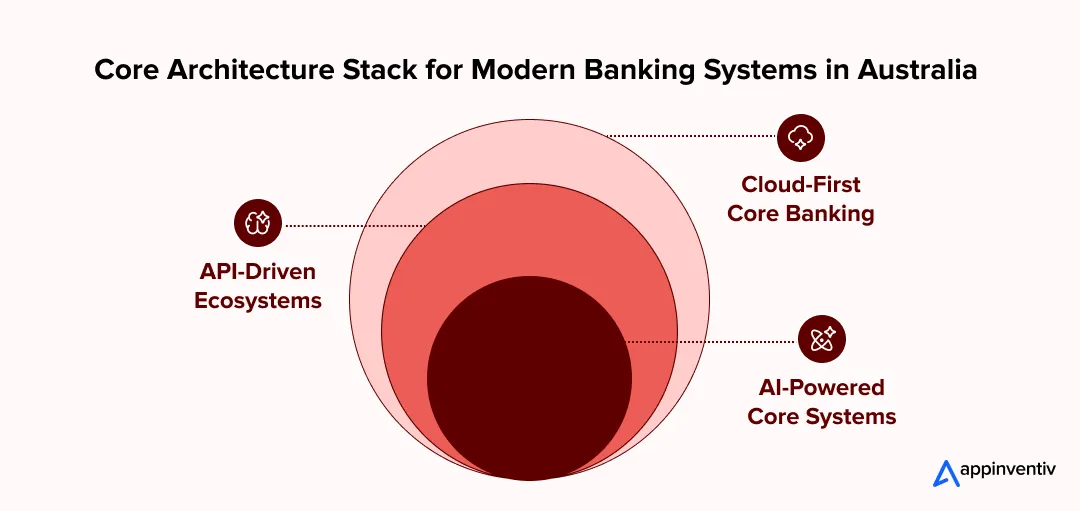
Cloud-First Core Banking
Modern cores are being deployed in hybrid-cloud environments to satisfy APRA’s resilience requirements. This setup provides the scalability needed for “peak” events like the massive spike in real-time transactions during the holiday season or major government stimulus disbursements without the capital expenditure of physical data centers.
AI-Powered Core Systems
There is a rapid shift from Generative AI (chatbots) to Agentic AI in Australia integrated directly into the core. Commonwealth Bank, for instance, has leveraged AI to reduce customer fraud losses by over 20% in the first half of the 2026 financial year compared to 2025. These AI agents operate within the core to monitor 20 million daily payments for unusual patterns in real time.
API-Driven Ecosystems & CDR
Open Banking in Australia is no longer a compliance burden; it is a distribution channel. A modern core architecture uses a “data mesh” approach, allowing banks to securely expose data to third-party providers via CDR framework. This enables “embedded finance,” where your banking products (like home loans or insurance) are sold directly through non-banking platforms like real estate apps.
Regulatory and Compliance Landscape Regulating Banking Systems in Australia
Core banking transformation in Australia operates within one of the most tightly governed financial environments globally. Modernisation decisions are rarely driven by technology alone. They are shaped by regulatory accountability, audit readiness, and risk exposure. For most banks, architecture choices are evaluated through the lens of compliance first, innovation second.
Regulatory Oversight Driving Architectural Decisions
Institutions are expected to maintain strong operational resilience, data protection, and risk controls. Regulatory bodies such as APRA and Australian Securities and Investments Commission play a central role in shaping these expectations.
This has a direct impact on how systems are modernised. Every architectural shift must demonstrate:
- Clear risk management controls
- Traceability of financial data
- System reliability under stress conditions
Security and Risk Framework Alignment
APRA’s CPS 234 (Information Security) and CPS 220 (Risk Management) have elevated cybersecurity and governance to board-level concerns. Core banking systems must now embed security into their design rather than treat it as an overlay.
This affects:
- Access control mechanisms
- Encryption standards
- Incident response frameworks
Security is no longer an IT function. It is a governance requirement tied to executive accountability.
Anti-Money Laundering and Financial Monitoring
Regulatory expectations from Australian Transaction Reports and Analysis Centre require banks to maintain real-time monitoring and reporting capabilities.
Legacy systems often struggle to support this level of responsiveness, which is why modernisation increasingly prioritises:
- Real-time transaction visibility
- Automated compliance reporting
- Integrated monitoring systems
Data Privacy, Sovereignty, and Customer Rights
The Privacy Act 1988 and upcoming reforms are reshaping how banks manage customer data. Combined with CDR, there is a strong push toward transparency, control, and secure data sharing.
This introduces architectural requirements such as:
- Local data storage and processing
- Consent-driven data access frameworks
- Secure API exposure
Data sovereignty is particularly critical in Australia, influencing cloud strategy and vendor selection.
Alignment with National Digital Standards
Guidance from bodies such as the Australian Digital Transformation Agency reinforces the need for scalable, secure, and interoperable systems.
Banks are expected to:
- Design for interoperability
- Ensure long-term maintainability
- Avoid vendor lock-in risks
What Is the Cost of Core Banking Modernisation in Australia?
Cost remains one of the most scrutinised aspects of modernising core banking systems in Australia. The challenge is not just upfront investment, but controlling long-term ownership costs while meeting compliance and performance expectations. Most programs fail not because of underinvestment, but because cost drivers are underestimated at the architecture and migration stages.
Typical Investment Range
The cost of core banking modernisation for an Australian bank typically falls within:
- AUD 70,000 – AUD 150,000 → basic modernisation
- AUD 150,000 – AUD 400,000 → Mid-scale transformation
- AUD 400,000 – AUD 700,000+ → Enterprise-wide transformation
Cost Breakdown by Development Stage
| Stage | Estimated Cost Range (AUD) | Key Cost Drivers |
|---|---|---|
| Discovery | 10,000 – 150,000 | Legacy audit, compliance gap analysis |
| Architecture | 15,000 – 80,000 | Cloud setup, API frameworks, integration design |
| Migration | 30,000 – 300,000 | Data transformation, refactoring, system decoupling |
| Testing | 10,000 – 100,000 | Security validation, regulatory compliance checks |
| Deployment | 5,000 – 70,000 | Infrastructure scaling, monitoring setup |
Hidden Cost Drivers That Impact Budgets
Beyond visible development costs, several factors influence total cost of ownership:
- Data migration complexity: Cleansing and validating legacy financial data often expands scope unexpectedly
- Downtime risk mitigation: Parallel systems and rollback strategies increase infrastructure and testing costs
- Vendor lock-in and licensing: Long-term platform costs can exceed initial implementation budgets
- Workforce transformation: Training, hiring, and cultural adaptation require sustained investment
- Compliance and audit readiness: Continuous monitoring and reporting systems add recurring operational overhead
Cost decisions in core banking system modernisation in Australia are not about minimising spend. They are about distributing investment across stages in a way that reduces execution risk while maintaining regulatory alignment and scalability.
Also Read: How Much Does It Cost to Develop a Software in Australia?
What Are the Key Challenges in Core Banking Modernisation and How to Overcome Them?
Modernisation programs in Australian banking rarely fail because of technology choices. They are typically driven by governance friction, unclear ownership, and risk escalation cycles that slow execution. This creates a constant tension between speed, stability, and compliance discipline.
The following represent the major challenges of core banking modernisation for Australian banks and strategies to overcome them in the Australian banking landscape:
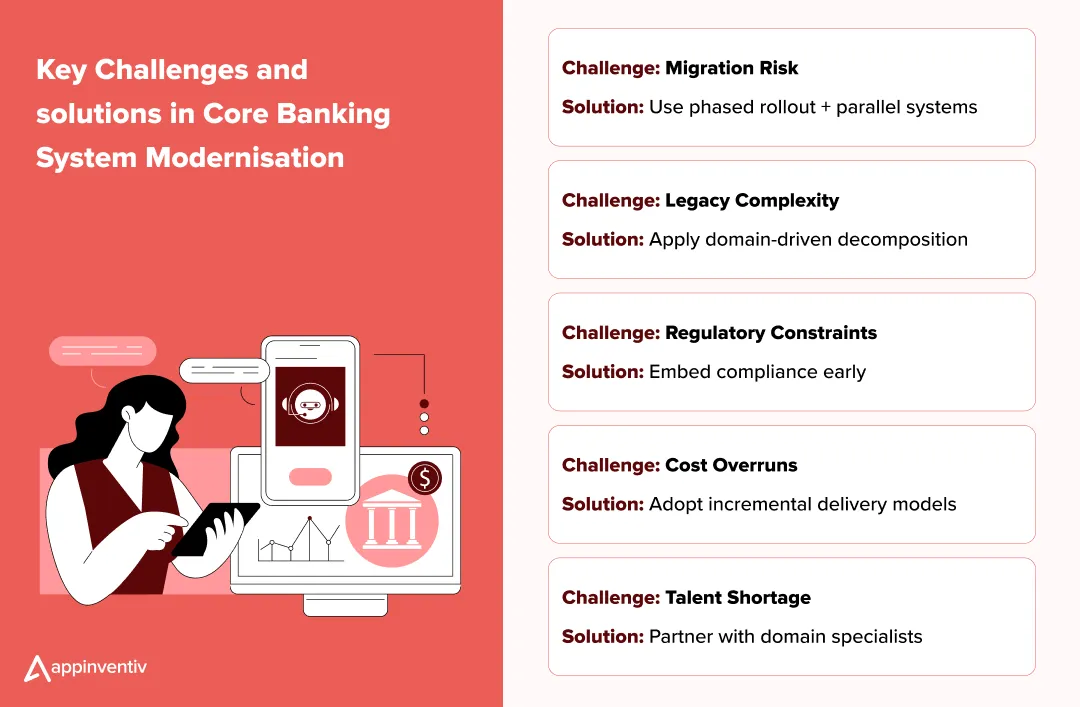
1. The Migration Risk and “Zero-Downtime” Expectation
In the era of the NPP and 24/7 digital banking, there is no longer a “quiet window” for migration. Any disruption to real-time payments leads to immediate reputational damage and potential ASIC intervention.
- The Fix: Advocate for a “Parallel Run” strategy where the new system operates in the background, mirroring live transactions for months before the final cutover. This allows for real-world stress testing without impacting the customer experience.
2. Legacy Data Complexity and “Dark Data”
Decades of product iterations have left many Australian banks with “dark data” (records with inconsistent schemas or missing lineage). Moving this data into a modern, AI-ready environment in Australia often reveals deep-seated architectural flaws.
- The Fix: Implement an automated data discovery and sanitisation layer. By using machine learning to map legacy data structures to modern ISO 20022 standards before migration, you reduce the risk of data corruption and ensure the new core is “clean” from day one.
3. Regulatory and Cybersecurity Risks
Cybersecurity risks of core banking modernisation in Australia are amplified during the transition phase. Hackers often target the “integration glue” between the old and new systems. Furthermore, maintaining compliance with APRA CPS 230 throughout a three-year transformation is a significant governance hurdle.
- The Fix: Adopt a “Zero Trust” architecture for all new components. Security should not be a perimeter; it should be embedded at the API and data-object level. Engaging a core banking consultant in Australia to perform “red team” simulations on the transition architecture is now a standard de-risking move.
4. The Talent and Cultural Gap
There is a profound shortage of engineers who understand both the nuances of legacy COBOL/mainframe systems and modern cloud-native stacks. This “skills chasm” often leads to project delays and cost overruns.
- The Fix: Avoid a “purely outsourced” or “purely internal” approach. Build a hybrid delivery squad where external specialists provide the technical “heavy lifting” while internal teams retain the institutional knowledge. This ensures that when the consultants leave, your internal team is equipped to manage the new ecosystem.
Real-World Use Cases: How Australian Banks Are Executing Modernisation
The strategic value of Australian banks modernising core banking systems is best understood through the lens of recent high-stakes deployments. Moving beyond theory, these examples demonstrate how local institutions are balancing the transition from rigid legacy ledgers to agile, cloud-native environments to secure a competitive edge in 2026. Here are the major bank initiatives for modernising core banking systems in Australia:
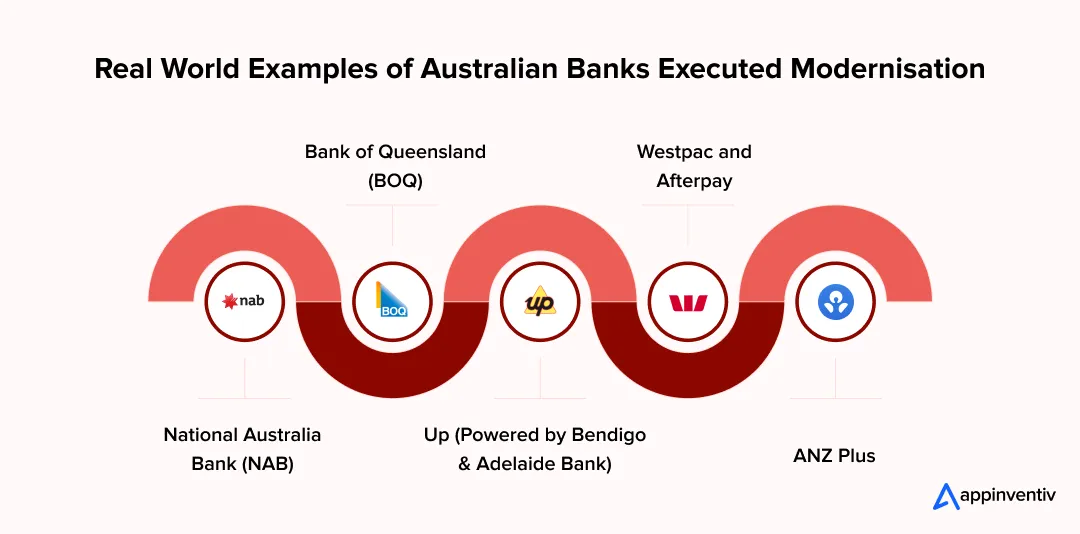
1. Tier-1 Hybrid Migration: National Australia Bank (NAB)
NAB has transitioned over 80% of its applications to the cloud, utilising a “hollow out the core” strategy. By moving non-transactional services to AWS and Azure, they’ve reduced infrastructure costs while maintaining the stability of their high-volume mainframe for essential ledgers.
2. Digital-First Regional Play: Bank of Queensland (BOQ)
BOQ’s multi-year “Digital Transformation” involves migrating its retail and business banking brands to a single, cloud-native core. This consolidation has eliminated redundant systems, allowing for faster product launches such as their recent digital deposit accounts built on a unified, API-ready platform.
3. Neobank Agility: Up (Powered by Bendigo & Adelaide Bank)
Up represents a successful collaboration where a traditional institution leverages a modern, cloud-native stack to capture the younger demographic. Their event-driven architecture allows for real-time spend notifications and gamified savings features that legacy batch-processed cores simply cannot support.
4. Embedded Finance: Westpac and Afterpay
Westpac’s Banking-as-a-Service (BaaS) platform demonstrates the power of a modernised API layer. By allowing partners like Afterpay to offer Westpac-backed savings accounts directly within their own apps, the bank has created a new distribution channel that bypasses traditional branch-based acquisition.
5. Cloud-Native Core Reinvention: ANZ Plus
When Australia and New Zealand Banking Group launched its digital platform ANZ Plus, it was not positioned as a feature upgrade. It was a structural shift away from legacy constraints toward a cloud-native, flexible banking model. Within its first year, ANZ Plus crossed over one million customers and nearly $20 billion in deposits. This signals strong market adoption of modernised banking experiences.
Business Benefits: What Banks Gain from Modernisation in Australia
Modernising core banking systems in Australia yields quantifiable competitive advantages. Beyond technical hygiene, these transformations rewrite the bank’s unit economics and market responsiveness, shifting the operational focus from system maintenance to strategic growth. Here are some core benefits of modern core banking systems:
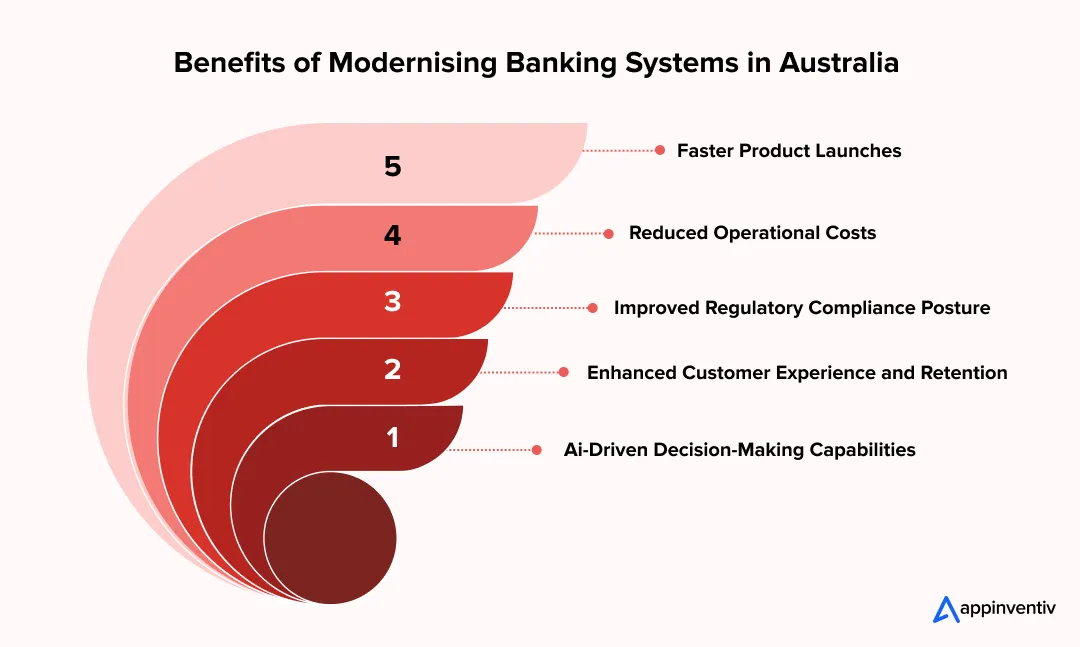
1. Accelerated Time-to-Market
Modern architectures reduce dependency on legacy release cycles, allowing banks to introduce new products in weeks instead of months. This directly improves competitiveness in modernising core banking systems in Australia programs.
2. Radical Operational Efficiency
Cloud-native cores automate manual back-office tasks and reconciliation. This shift reduces the cost-to-income ratio by lowering the headcount required for legacy system oversight and “patchwork” fixes.
3. Superior Regulatory Resilience
Modern systems improve traceability, logging, and reporting accuracy. This supports faster compliance validation with APRA CPS 230 and AUSTRAC and strengthens core banking transformation Australia outcomes.
4. AI-Driven Revenue Growth
A modernised core provides the clean, high-velocity data required for Australian agentic AI. In practice, this allows hyper-personalised cross-selling and predictive fraud detection that legacy batch systems cannot match.
5. Enhanced Customer Lifetime Value
By supporting real-time interactions and embedded finance partnerships, banks improve the digital experience. Faster approvals and seamless third-party integrations lead to higher retention and lower acquisition costs.
Future Trends: What Core Banking Will Look Like by 2030
The trajectory of core banking modernisation in Australia points toward a total disappearance of the “backend” as a static entity. By 2030, the core will function as a fluid, autonomous nervous system, capable of reconfiguring itself to meet shifting regulatory and market demands. Here is the what the future of banking will look like in Australia:
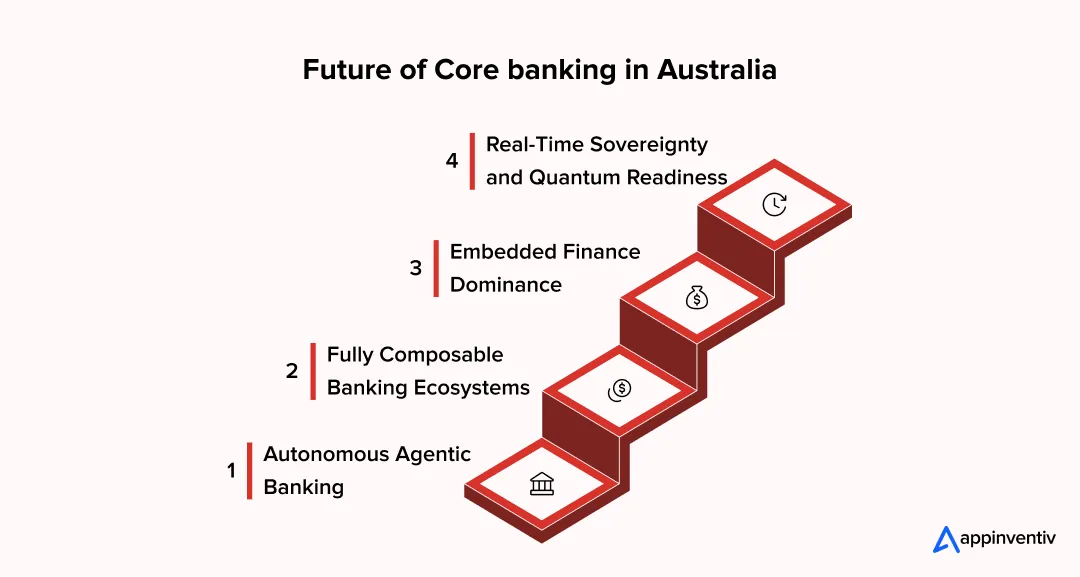
1. Autonomous Agentic Banking
Banks will transition from “mobile-first” to “agent-first.” Your core system will house autonomous AI agents that negotiate interest rates, manage liquidity, and settle payments on behalf of customers in real-time without manual intervention.
2. Composable “Lego-Style” Ecosystems
The concept of a single vendor for a core will vanish. Financial institutions will assemble their “core” using best-of-breed microservices, one for ledgers, another for KYC, and another for cards, swapping them out via APIs as better tech emerges.
3. Deeply Embedded Finance
Banking will become invisible, integrated directly into the software of non-financial industries. Whether buying a car or paying for healthcare, the core banking system will facilitate “at-the-edge” credit decisions at the exact moment of need.
4. Real-Time Sovereignty and Quantum Readiness
As cyber threats evolve, Australian cores will adopt quantum-resistant encryption. Data residency will move beyond “on-shore cloud” to edge computing, where sensitive customer data is processed and secured on-device to meet 2030-era privacy mandates.
The direction is clear. Core banking transformation in Australia is evolving into a continuous capability, not a one-time program, with data, AI, and interoperability at its centre.
Facing legacy constraints in your banking systems?
Build a modern core banking foundation that supports growth while maintaining operational stability and regulatory alignment.

How to Approach Core Banking Modernisation Strategically
Moving forward with core banking system modernisation in Australia isn’t just about the technology; it is a high-stakes balancing act between keeping the lights on and building for 2030. Each step must balance risk, compliance, and long-term scalability.
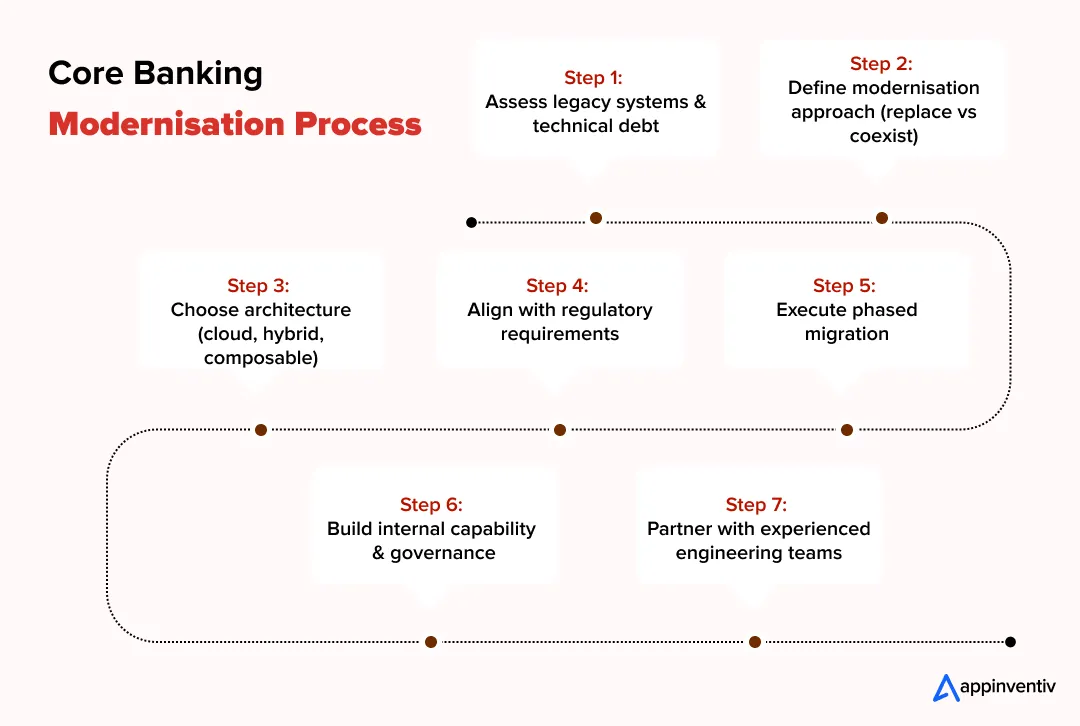
Step 1: Audit the “Spaghetti”
Start with a forensic look at your technical debt. You need to know exactly where your legacy code is so tangled that it creates a bottleneck. Quantify what it costs you in lost speed and compute power just to maintain those old COBOL or mainframe connections.
Step 2: Choose Your Battle (Replace vs. Coexist)
You don’t have to switch everything off at once. Most successful Australian banks use a “hollow out the core” method. Pick a specific product like a new digital offset account and build it on a modern engine while letting the old “slow” accounts sit on the legacy ledger.
Step 3: Architecture for APRA
Select a stack that makes sense for local laws. A hybrid-cloud setup is usually the sweet spot, giving you the scale of AWS or Azure while keeping the data sovereignty and resilience that APRA demands. Ensure you aren’t locked into a single vendor.
Step 4: Compliance by Design
Don’t treat the Privacy Act 2026 reforms or CPS 230 as an afterthought. Build your data tagging and audit trails directly into the API layer. This way, when the regulator asks for a report, the system generates it automatically instead of your team spending weeks on manual extraction.
Step 5: The “Safe” Migration
Move in waves. Start with low-risk data and use “parallel runs” where the new system processes data alongside the old one. If the numbers match for a month, you know you’re safe to cut over. This is the only way to ensure the zero-downtime expected by the NPP.
Step 6: Bridge the Skills Gap
The biggest risk is often people, not code. You need a team that speaks both “mainframe” and “cloud.” Since this talent is rare, you may need to hire a core banking consultant in Australia to lead the heavy lifting while your internal team learns the new ecosystem.
Also Read: How to Develop a FinTech App in Australia in 2026
What Most Banks Get Wrong in Core Modernisation
– Treating it as an IT upgrade instead of a risk program
– Underestimating data migration complexity
– Delaying compliance integration until late stages
– Over-relying on vendors without internal capability
How Appinventiv Helps Australian Banks Modernise Core Systems?
Navigating the transition from legacy infrastructure to a digital-first architecture requires a trusted provider of FinTech software development services in Australia who understands the high-stakes nature of Australian financial services.
At Appinventiv, we don’t just provide digital platform engineering services in Australia; we provide a strategic engineering bridge. We have moved away from traditional outsourcing to a “Hybrid Delivery Model,” where our engineers work alongside your internal teams to bridge the “skills chasm” between COBOL and Cloud-Native.
Our team of 1600+ tech architects ensures that modernising core banking systems in Australia is executed with surgical precision, keeping your institution compliant, secure, and ready for the 2030 autonomous banking era.
Our delivery model is built on transparency and technical depth, specifically tailored for the Australian market’s unique regulatory intensity. This expertise is reflected in our work with fintech innovators like Mudra, where we built a secure, scalable digital banking ecosystem, and Edfundo, where we developed a financial intelligence platform designed for the next generation of users.
With over 10 years of experience in APAC delivery and a local presence maintained through 5+ agile delivery centers across Australia, we have successfully deployed more than 3000+ digital assets within the region. Our commitment to operational excellence has resulted in a 98% client retention rate and a proven track record of driving 35% efficiency gains across the 35+ industries we have digitally transformed.
For institutions concerned with governance, our 99.50% security compliance SLA (ISO, SOC2) provides the peace of mind required for tier-1 transformations. It is this consistent performance that has seen us ranked among APAC’s High-Growth Companies by Statista and the Financial Times for two consecutive years.
How We Modernise Build with Regulatory Confidence and Architectural Clarity
- Legacy Audit to Deployment: We handle the full lifecycle, from mapping out COBOL dependencies to deploying multi-cloud architectures.
- Compliance-First Engineering: Every line of code is written to align with APRA, ASIC, and Australian data residency laws.
- Cloud-Native Innovation: We specialise in building the API layers and data meshes required for AI in core banking Australia.
Ready to de-risk your legacy transformation? Get a custom modernisation plan.
FAQs
Q. What is core banking modernisation and why does it matter for Australian banks?
A. Core banking modernisation is the process of replacing or upgrading a bank’s backend transaction engine with cloud-native, API-first technology. For Australian banks, it is critical because legacy systems cannot handle the real-time demands of the NPP or the data sharing requirements of the CDR.
Q. Why do Australian banks need to modernise core systems?
A. Beyond staying competitive with fintechs, banks must comply with APRA’s CPS 230 standards and the 2026 Privacy Act reforms. Older systems often have “dark data” and high maintenance costs that prevent the adoption of AI and real-time fraud detection.
Q. How are Australian banks modernising their core banking systems in 2026?
A. For modernising core banking systems in Australia, many banks are adopting a “hollow out the core” strategy. This involves keeping the legacy system for basic ledgers while moving high-value products like digital loans or savings to a modular, cloud-based engine that allows for faster updates.
Q. What is the cost of core banking modernisation for an Australian bank?
A. While small migration waves can start around AUD 700,000, full-scale transformations for mid-to-large institutions often involve multi-year investments that can exceed even AUD 700,000. Key cost drivers include data sanitisation, cloud architecture, and parallel-run testing.
Q. What role does AI play in modernising Australian bank core systems in 2026?
A. AI is moving from the “chat” layer into the “core” layer. Modern cores allow for AI in core banking Australia to perform agentic tasks, such as autonomous fraud prevention and hyper-personalised product offers based on real-time transaction data.
Q. What does a core banking modernisation roadmap look like for an Australian bank?
A. Core banking modernisation process starts with a technical debt audit, followed by choosing a cloud-hybrid architecture. The migration is then executed in phases, starting with low-risk products and using parallel runs to ensure zero-downtime before a full cutover.