Key takeaways:
- Partner selection drives real security outcomes; weak architecture and poor integration create gaps that tools alone cannot fix
- UAE regulations like PDPL and ADGM require system-level controls, not policies, with audit-ready logging and access tracking
- Identity, cloud configuration, and API security now define the primary attack surface across UAE enterprise environments
- Enterprises gain faster response, broader threat visibility, and lower operational strain by working with mature cybersecurity partners
- Structured evaluation of architecture, detection capability, and compliance depth separates operational partners from tool-focused vendors
The UAE has built much of its growth on digital systems, making cybersecurity services in Dubai and across the Emirates more critical than ever. Banks process payments through cloud platforms. Hospitals store records in connected systems. Government services run through apps and shared data networks. Each new connection creates another point that an attacker can test.
Recent regional reports show that cyber threats in UAE businesses are increasing across sectors. Phishing emails still succeed. Ransomware cases continue to rise. Data leaks often trace back to misconfigured systems or weak access controls.
Around 40% of social media users in the UAE have experienced privacy breaches after sharing personal information online. These are not rare events. They affect large enterprises as well as mid-sized firms.
Many organizations react by adding more security tools. Over time, they build a stack of separate systems. One team handles monitoring. Another manages access. A third runs audits. These systems often do not share data well. Alerts increase, but clear action does not follow. Security becomes harder to manage, not easier.
This highlights the importance of cybersecurity for UAE businesses; a breach can stop operations, trigger fines under UAE data laws, and damage long-term trust. Rules from the Personal Data Protection Law and financial zones such as ADGM and DIFC require clear controls and audit trails.
This is why cybersecurity now demands a different approach. It must be planned as one system, built and managed with the right partner from the start.
40% Data Breaches Demand Immediate Action
Attack patterns in the UAE are already targeting weak identity and cloud controls across enterprise environments.
How to Choose the Right Cybersecurity Consulting and Cybersecurity Implementation Partner
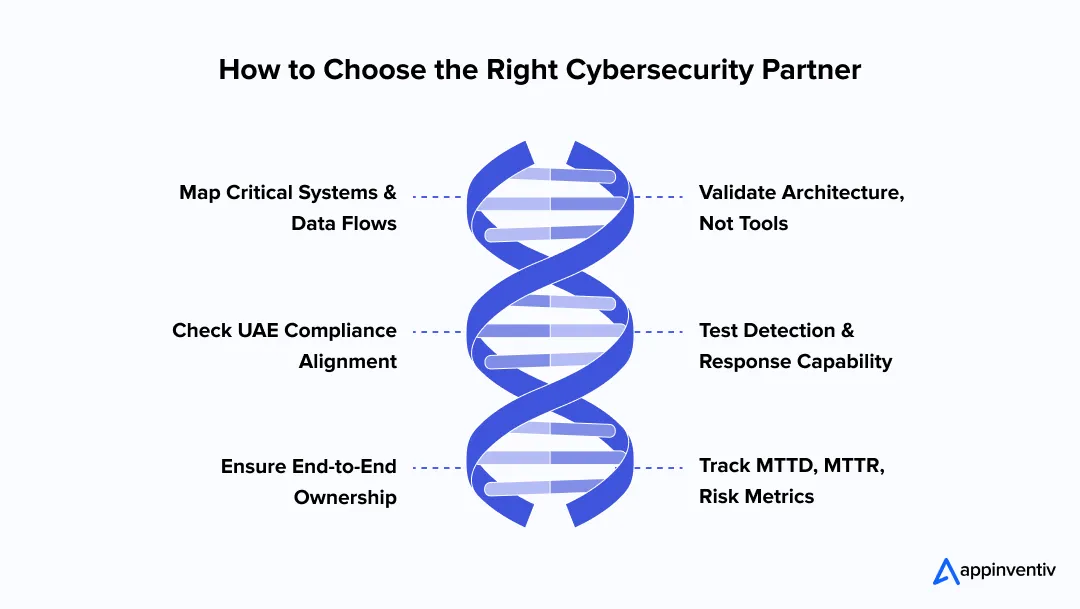
Understanding the key factors to consider when choosing the right cybersecurity partner is critical. In many UAE enterprises, selection happens during procurement, but real gaps appear during operations. Systems go live, alerts increase, and teams struggle to respond. This section focuses on how to test real capability across architecture, compliance, and execution.
1. Architecture-First Approach
A capable partner starts by mapping how your systems actually run. This includes identity flows, data movement, and trust boundaries across cloud and on-prem environments. In UAE enterprises, hybrid setups are common, so the design must cover every layer.
- Identity flows across Azure AD, on-prem AD, and third-party access
- Network segmentation between critical and non-critical systems
- Data flow mapping across APIs, storage, and workloads
- Clear trust boundaries for Zero Trust enforcement
2. Proven UAE Compliance Expertise
Regulation in the UAE requires system-level controls, not policy documents. A partner must show how they implement PDPL requirements and financial zone standards in real environments.
- PDPL-aligned data access controls and logging
- Audit trails for ADGM and DIFC-regulated entities
- Log retention policies based on regulatory timelines
- Access reviews and reporting built into systems
3. End-to-End Capability
Security breaks when different vendors handle different stages. A single partner should design, deploy, monitor, and respond. This avoids delays during incidents.
- One team handling consulting, deployment, and SOC operations
- Direct escalation paths during incidents
- No dependency on third-party responders
- Consistent visibility across all stages
4. Industry-Specific Experience
Each sector has distinct risks. Tailored cybersecurity services for industries such as BFSI, healthcare, and energy mean a partner with prior experience will understand system behavior and threat patterns without delay
- BFSI: transaction monitoring, fraud detection, SWIFT controls
- Healthcare: patient data access, device security and uptime needs
- Energy: OT systems, SCADA protection, physical risk exposure
- Government: citizen data protection and access control
Also Read: How to Choose a Healthcare App Development Partner in Dubai
5. Advanced Threat Detection Capabilities
Detection must go beyond simple alerts. Systems should identify patterns that signal real threats across users, devices, and networks.
- SIEM platforms and XDR security solutions with log correlation across systems
- UEBA for detecting unusual user behavior
- Threat intelligence feeds for known attack patterns
- Detection of lateral movement inside networks
6. Integration with Existing Ecosystems
Most enterprises run a mix of old and new systems. Security must cover all of them without creating gaps.
- Integration with legacy ERP and core banking systems
- API-based connections between tools
- Centralized logging across cloud and on-prem
- Identity federation across platforms
7. Scalable Managed Security Operations
A SOC must handle volume without delay. The focus should be on how alerts are handled, not just that monitoring exists.
- 24/7 monitoring with defined escalation paths
- SLA-based response timelines
- Tiered analysis for alert triage
- Regional presence for faster context and response
8. Measurable Outcomes and KPIs
Security performance must be tracked using clear numbers. This helps leadership understand progress and risk levels.
- Mean Time to Detect (MTTD)
- Mean Time to Respond (MTTR)
- Incident trends over time
- Risk scoring based on control coverage
9. Strategic Partnership Mindset
Security needs ongoing review and adjustment. A partner should stay involved as systems and risks change.
- Regular review of controls and policies
- Updates based on new threat patterns
- Continuous tuning of detection rules
- Alignment with new business systems and services
This structure helps separate partners who deploy tools from those who can run security across complex enterprise environments in the UAE.
Your Security Stack May Already Be Failing
Disconnected tools and poor visibility delay response. Act now to regain control across systems and identities.

Types of Cybersecurity Services Enterprises Must Evaluate
Most large firms already have security tools in place. Over time, they add more systems to handle new risks. The problem starts when these systems do not connect well. Data stays in silos. Teams work in isolation. Gaps form, and attackers find them.
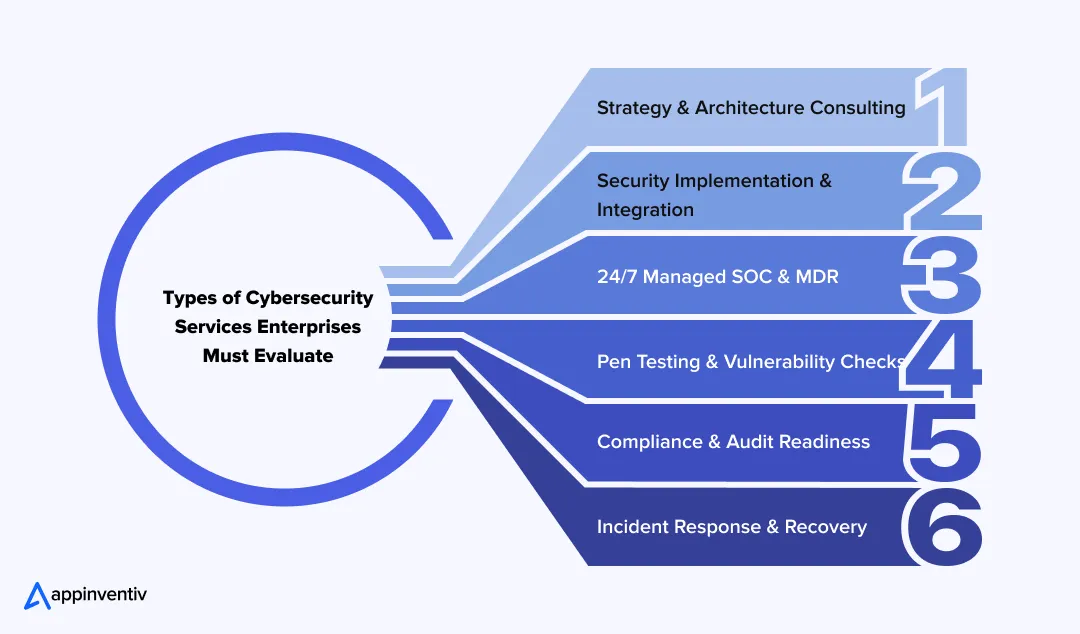
Cybersecurity Consulting (Strategy and Architecture)
This work starts with a thorough cybersecurity risk assessment and a clear review of current controls. Teams check how security is set up across users, data, and systems. They compare this against standards such as ISO 27001. Gaps are listed and ranked based on real business risk. Access rules get tightened. Cloud environments are mapped so teams know where data sits and who can reach it.
Security Implementation Services
Once plans are clear, teams build the actual cybersecurity solutions. Monitoring tools collect logs from across the network. These logs help detect unusual behavior. Automation tools reduce manual work and speed up response. Identity systems control access across employees and external users. Application security checks are added during software releases so issues do not reach production.
Managed Security Services (MSS and MDR)
Once setup is complete, managed security services take over. Teams watch systems at all hours. They track alerts and decide which ones need action. Real threats get handled at once. Some setups study user behavior to spot patterns that do not match normal activity. Response timelines are defined in advance, so teams act without delay.
Penetration Testing and Vulnerability Assessment
Regular testing shows where systems can fail. Automated tools scan for known weaknesses. Manual tests simulate real attack paths. These tests cover web apps, APIs, cloud setups, and internal systems. Many firms now factor in the cost of penetration testing in the UAE and run these checks several times a year instead of once.
Compliance and Governance
Regulations in the UAE require strict control over data and access. Teams define policies for how data is stored and used. They track who accessed what and when. Records are kept for audits. Financial zones such as ADGM and DIFC have added rules that firms must follow.
Incident Response and Recovery
Incidents can still happen. Teams prepare for them in advance. They define clear steps for detection, containment, and recovery. Forensic work helps trace the source and impact. Backup systems support recovery so business operations continue with minimal delay.
Also Read: Why Partnering with an IT Consulting Company in Dubai is Essential for Your Business
Where Most UAE Enterprises Go Wrong with Cybersecurity Partners
Many enterprises invest in security but still face repeated gaps. With so many cybersecurity companies in Dubai to choose from, the issue often lies in how partners are selected and managed.
Teams buy SIEM, EDR, or IAM tools early. They skip system design. The tools run, but they do not work together.
- Weak UAE Compliance Understanding
Some global vendors lack local regulatory depth. Gaps appear in PDPL controls, audit logs, and reporting.
- Limited Visibility In Managed Services
MSS providers often act as closed systems. They send alerts, but do not show how decisions are made.
- Poor Integration With Legacy Systems
Older platforms in banking or healthcare remain outside modern controls. These become easy entry points.
- No Clear Performance Metrics
Many firms do not track response time or detection speed. Without data, progress cannot be measured.
Also Read: Digital Transformation Strategies You’ll Wish You Knew Sooner
Types of Cyber Attacks That Influence Partner Selection
The type of attacks an enterprise faces should guide how it evaluates a cybersecurity partner. In the UAE, many incidents follow similar patterns. These patterns expose gaps in identity control, cloud setup, and third-party access. A partner should show how they handle these cases in real environments.
- Credential misuse
Stolen usernames and passwords remain a common entry point. Attackers log in as valid users and move across systems. Strong access control and login tracking reduce this risk. - Ransomware events
Systems get locked, and operations stop. Recovery depends on how fast teams detect and isolate the attack. Backup and restore plans play a key role here. - API misuse
APIs connect apps and services across sectors. Weak validation or exposed endpoints allow unwanted access. Monitoring and access control must cover these interfaces. - Cloud setup gaps
Storage or access settings in cloud platforms can expose data. Regular checks and clear policies help prevent this. - Internal access misuse
Employees or vendors may have more access than needed. Tracking usage and limiting privileges helps reduce this risk. - Third-party entry points
Vendors and external tools connect to core systems. These links must be monitored and controlled to avoid indirect access.
Regulatory & Compliance Requirements That Shape Partner Selection
In the UAE, compliance is part of day-to-day security work. It is not handled later or during audits alone. Systems must record who accessed data, what changed, and when it happened. If these records are missing, issues surface quickly during reviews. This is why partner choice matters at the start.
- Personal Data Protection Law (PDPL)
Sets rules for handling personal data. Access must be controlled, and activity must be logged at all times. - UAE Information Assurance (IA) Standards
Used across government-linked entities. Focus areas include access control, system logging, and incident tracking. - ADGM and DIFC requirements
Fintech environments’ app development in the Middle East requires detailed audit trails. Every action on sensitive systems must be traceable. - Sector-specific rules
Banks, hospitals, and telecom providers follow added controls. These often cover data access, storage, and uptime. - Audit records and reporting
Logs must be stored, easy to retrieve, and complete. Missing records often lead to compliance gaps.
A partner should build these controls into systems from the start. Fixing them later is far more difficult.
Build vs Partner: Why Enterprises in the UAE Prefer Strategic Cybersecurity Partners
Many UAE enterprises start with the idea of building everything in-house. It feels safer to keep control inside the organization. After a few months, the gaps become clear.
Hiring takes longer than expected. Night shifts remain understaffed. Tools get deployed, but tuning and monitoring lag behind. Security work does not stop, and pressure builds on internal teams.
The benefits of choosing the right cybersecurity partner become clear when looking at how this load is handled. Instead of building from scratch, enterprises tap into teams that already run full-time security operations.
| Factor | In-House Security Team | Strategic Cybersecurity Partner |
|---|---|---|
| Talent | Hiring skilled analysts is slow, and retention is hard | Teams are already trained and available |
| Setup Time | Tools and processes take months to stabilize | Systems go live faster with tested setups |
| Cost | High spend on hiring, tools, and training | Costs stay more predictable over time |
| Threat Visibility | Limited to internal logs and manual checks | Access to wider threat data and shared intelligence |
| Coverage | Hard to maintain full 24/7 monitoring | Continuous monitoring is already in place |
| Growth | Scaling requires more hiring and setup | Capacity adjusts based on need |
Most enterprises do not replace internal teams. They extend them. Internal staff focuses on business systems, and partners handle monitoring, response, and tuning. This split keeps systems stable without overloading teams.
Appinventiv works in this model. Enterprise teams keep control of core systems, and Appinventiv supports security operations, integration, and ongoing monitoring as systems expand.
Security Complexity Will Only Increase From Here
Cloud, identity, and API risks continue to grow. Build a system that can handle scale and future threats.
Future of Cybersecurity in the UAE: Trends Shaping Enterprises in 2026 and Beyond
Security priorities in the UAE are changing as systems expand across cloud, APIs, and connected devices. The cybersecurity services market is expected to reach $3.93 billion by 2030, which reflects rising investment across sectors.
Enterprises are tightening control across users, data, and infrastructure. The trends below reflect what teams are actively working on across large organizations.
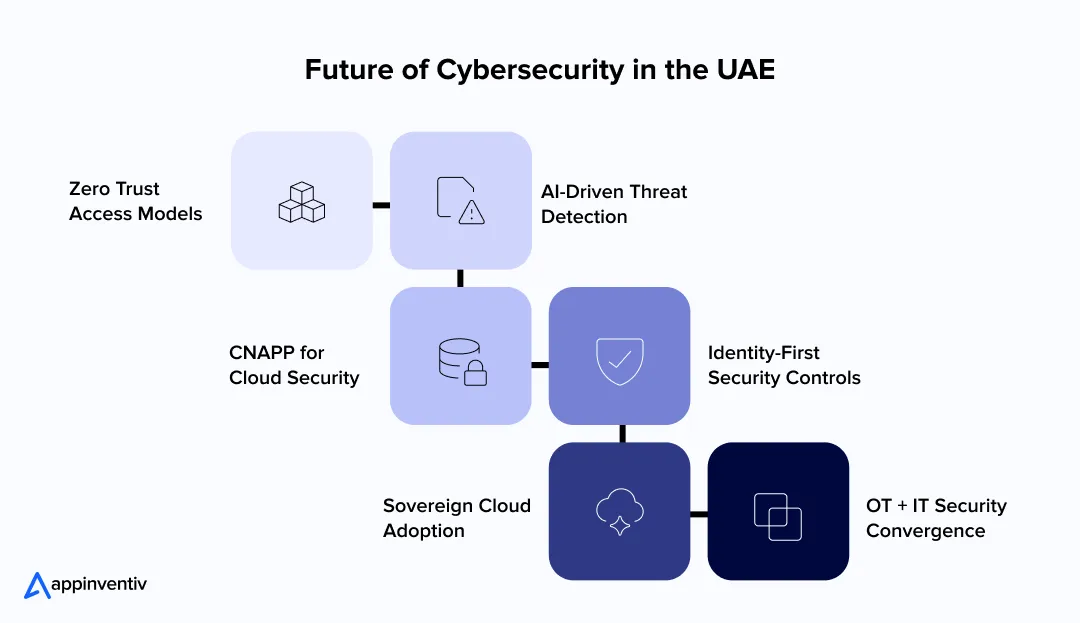
Zero Trust as the Default Model
Access is no longer based on network location. Every request is checked using identity, device status, and session context. This model fits UAE enterprises where remote access and third-party integrations are common.
AI in Security Operations
SOC teams deal with large volumes of alerts each day. Manual review slows response. Enterprise AI models in the Middle East now help flag unusual activity across users, endpoints, and networks. This reduces noise and helps teams act faster.
Cloud & Modern Security: CNAPP for Cloud Security Control
Demand for cloud application security solutions in the UAE continues to grow as workloads expand across AWS and Azure environments. CNAPP tools bring visibility across containers, storage, and compute. Teams use them to track misconfigurations and enforce policies from one place.
Identity as the Primary Control Layer
Many incidents start with compromised credentials. This has pushed identity controls to the center of security design. Strong authentication, privilege control, and session tracking are now core requirements.
Sovereign Cloud and Data Residency
UAE regulations require clear control over where data is stored and who can access it. Enterprises are shifting toward setups where enterprise data protection ensures sensitive data stays within approved regions and access is fully logged.
OT and IT Security Convergence
Energy, manufacturing, and infrastructure sectors now connect operational systems with digital platforms. This creates new entry points. Security must now cover both IT systems and industrial control environments.
With more than a decade of experience and thousands of systems delivered across regions, Appinventiv has worked closely with enterprises facing these exact shifts. Their experience reflects how security must evolve alongside business systems, not after deployment.
Why Appinventiv Is a Strategic Cybersecurity Partner for UAE Enterprises
Among cybersecurity companies in Dubai, enterprises need more than tool deployment; they need a partner who can design, connect, and run security across complex systems while meeting local regulatory demands.
Appinventiv, a top cybersecurity services company in the UAE, works closely with enterprise teams to handle this full scope.
What Appinventiv Brings
- Architecture-led system design across cloud, on-prem, and hybrid setups
- Strong alignment with UAE regulations such as PDPL, ADGM, and DIFC
- Full-cycle delivery from consulting to monitoring and incident response
- Integration across legacy systems, APIs, and modern platforms
- Continuous monitoring supported by data-driven detection methods
Regional Track Record
| Metric | Impact |
|---|---|
| Digital projects delivered | 1000+ across the Middle East |
| Industries served | 35+ sectors, including BFSI, healthcare, and government |
| Enterprise workflows modernized | 500+ |
| Strategic partnerships in the UAE | 20+ |
| Government and compliance programs | 12+ executed |
Business Outcomes
| Area | Result |
|---|---|
| System uptime | 99.90% for mission-critical environments |
| Cost savings | Up to 40% through structured transformation |
| Regional experience | 10+ years with 3 excellence centers |
Appinventiv works as an extension of enterprise teams, delivering cybersecurity services in Dubai and across the UAE to help maintain stable, compliant, and well-connected security systems as operations grow
FAQ’s
Q. What are cybersecurity services in an enterprise context?
A. Cybersecurity services are not single tools. They form a layered system that covers strategy, architecture, implementation, operations, and governance, and the cost of cybersecurity services in the UAE varies depending on how many of these layers an enterprise needs to cover. Each layer must connect and work together. Many vendors sell isolated services. Only a few build integrated security systems that protect the enterprise as a whole.
Q. How do I verify that a cybersecurity company is CREST or DESC-accredited in the UAE?
A. Check the official CREST member directory for listed companies. For DESC, review approved vendor lists or request proof of certification directly from the provider. A valid partner will share documentation, audit reports, or references from past UAE projects.
Q. What is NESA compliance, and which businesses in the UAE are required to comply with it?
A. NESA, now part of the UAE Information Assurance framework, sets security standards for government and critical sectors. It applies to federal entities and organizations handling sensitive national infrastructure such as energy, telecom, and finance.
Q. What is the Dubai Electronic Security Center (DESC) ISR, and how does it affect my organization?
A. DESC ISR defines baseline security requirements for Dubai government entities and their partners. It covers access control, monitoring, and incident handling. If your business works with government systems, you must align with these controls.
Q. How does UAE Federal Decree-Law No. 34 of 2021 (Cybercrime Law) affect business cybersecurity obligations?
A. This law defines penalties for unauthorized access, data misuse, and cyber fraud. Businesses must protect systems and data to avoid legal exposure. Weak controls that lead to breaches can result in fines and operational impact.
Q. What is the UAE Personal Data Protection Law (PDPL), and does my company need to comply with it?
A. PDPL governs how personal data is collected, stored, and processed. Any company handling personal data of UAE residents must comply. This includes setting access controls, maintaining logs, and protecting data from unauthorized use.
Q. Is ISO 27001 certification mandatory for businesses operating in the UAE?
A. ISO 27001 is not mandatory for all businesses. Many enterprises still adopt it to structure security controls and meet client or regulatory expectations. It is often required in sectors like finance, government projects, and large enterprise contracts.