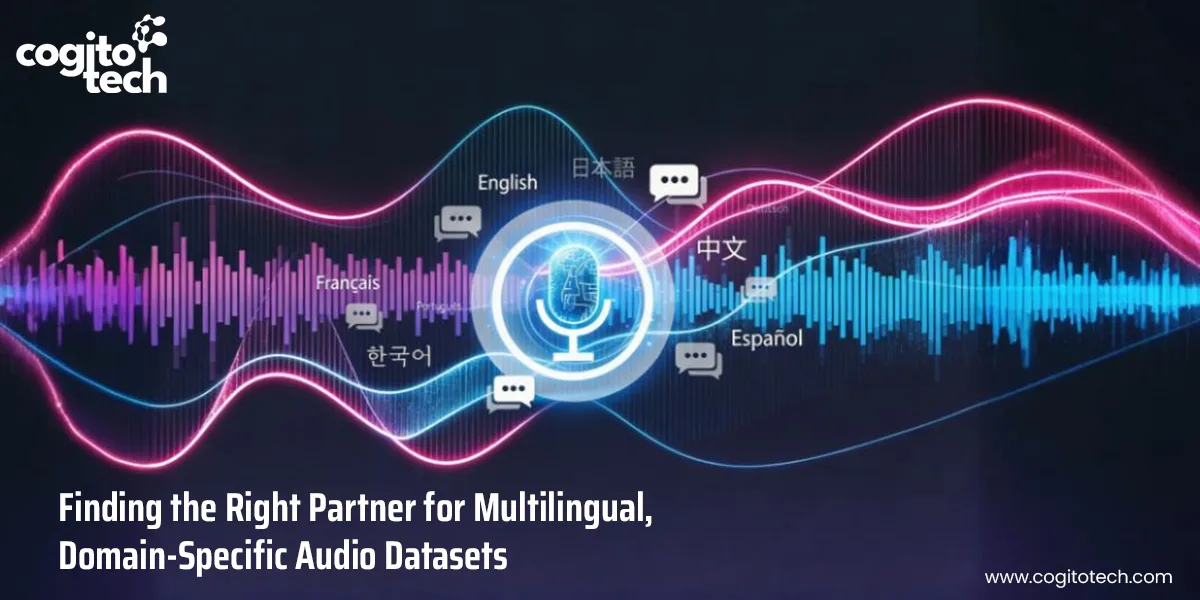
Building a speech recognition system that works in the real world requires audio datasets that mirror it: diverse speakers, realistic acoustic environments, domain-specific vocabulary, and language variation at scale. That is precisely what Cogito Tech focuses on.
An enterprise building a multilingual voice assistant, a healthcare AI in need of clinical transcription, or an automotive industry developing in-car speech commands has one thing in common. The demand for domain-specific audio datasets. Cogito’s expertise lies in offering high-quality speech datasets tailored to diverse AI and ML requirements, with a focus on feeding models with compliant-ready data.
Here is a closer look at the kinds of datasets Cogito Tech builds and the industries that depend on them.
Types of Data Powering Speech Recognition Systems
Every groundbreaking audio AI model needs multilingual datasets, because speech is the most natural form of human communication, and converting it into structured, machine-readable text unlocks significant practical value across industries.
Let’s break down how Cogito Tech audio datasets work in simple terms.
Conversational Speech Datasets
There’s something powerful about speaking in your own language and still being fully understood. That is something that can be achieved through conversational speech datasets that help build real-time voice translation applications. It is a field that’s moving faster than most people realize.
Unlike traditional translation, which happens after speech or text is produced, real-time translation works on the spot. It listens, understands, and speaks almost as quickly as a human conversation. Here’s how it works:
- Automatic Speech Recognition (ASR) converts spoken audio into machine-readable text.
- Natural Language Processing (NLP) interprets the meaning and translates it into the target language.
- Text-to-Speech (TTS) synthesis generates the translated message in a natural-sounding voice.
The result is an instant conversational experience enabled by language-specific audio datasets, which are the most commercially valuable and most difficult to build. It is because, in their raw form, the audio files contain dialogues and speech with background noise, speakers interrupting each other, trailing off mid-sentence, switching languages, and using domain jargon that never appears in a textbook.
Conversations are unpredictable, and building an audio dataset in this category may contain thousands of hours of human-transcribed dialogue collected across dozens of global languages.
For example, a spontaneous speech dataset might be structured as 12,000 hours of audio across read speech (8%), extempore or unscripted monologue (76%), and natural conversational audio (15%) collected from more than 22,000 unique speakers spanning multiple ages, genders, dialects, and environments.
Cogito Tech creates scalable conversational datasets. Our speech datasets include general conversation, call center audio, wake words & keyphrases, ambient sounds, TTS & spontaneous dialogue, and scripted monologues and singing audio, across more than 65 languages and regional dialects, including US English, Arabic, Mandarin, Hindi, and Spanish. Sample rates for these datasets vary by use case, but we support 8 kHz, 16 kHz, 44 kHz, and 48 kHz, among others.
Multilingual Language Datasets
Audio datasets are not just essential for Automatic Speech Recognition (ASR) systems but are also crucial for training advanced voice technologies and enhancing AI applications in government-backed platforms targeting digital inclusion.
Govtech platforms targeting digital public services, edtech companies building vernacular learning tools, regional banks deploying voice banking in native languages, and telecom operators building IVR systems for emerging markets all require substantial multilingual datasets.
The implications for dataset design in this domain are significant. Cogito Tech delivers a carefully designed corpus, with speaker demographics, explicit consent from all participants, and datasets that are compliant-ready. These can range from 100 million natural-language texts, correction pairs, and question-answer pairs meticulously annotated with descriptive captions and metadata, among other offerings.
Utterance & Wake Word Datasets
Not all speech recognition datasets have to be based on hours of audio. Voice-based assistants, smart home devices, automotive systems, and enterprise command-and-control systems all rely on seconds of highly accurate recognition: a user’s ability to say “navigate home” or a custom “wake word” that triggers the assistant without spurious activation.
This kind of dataset isn’t defined by hours of audio, but by the richness of phrasing variation a model is trained on. If a model is trained only on the phrase “navigate home,” it won’t recognize “find a hospital near me,” “where is the closest hospital,” or “is there a hospital nearby?” A model trained on limited command phrasing won’t survive the phrasing variations it encounters in the wild.
Who should look at this? Consumer electronics firms (smart speakers, earbuds), automotive firms, appliance manufacturers, and enterprise software firms that enable product interactions via voice commands.
Call Center & Telephony Datasets
Call center audio is one of the most valuable and technically difficult use cases for enterprise AI. The audio itself is compressed, often encoded at the modest 8 kHz telephony rate, is tainted by hold music, and filled with domain-specific terminology that varies wildly by industry, insurance claim codes, medical diagnosis codes, financial product names, and legal cases.
The structure of these datasets reflects the reality of agent-customer interactions: domain-specific vocabulary, interrupted flow, hold music pauses, and the sonic aftermath of telephony compression. Layers of metadata include labels for speaker roles, turn-by-turn time stamps, and diarization annotations that isolate agent and customer dialog, essential for any subsequent processing of the audio, such as call quality scoring, agent performance evaluations, or compliance monitoring.
Who’s interested? Insurance companies, banks, healthcare payers, and BPO vendors that want to build speech analytics, automated quality monitoring, real-time coaching tools, or transcriptions compliant with regulatory requirements need telephony audio that sounds like their actual call center environment—not cleaned-up recordings from a sound studio.
Medical & Clinical Speech Datasets
Clinical speech recognition is a category of its own. Physician dictation is fast, dense with Latin-derived terminology, often recorded on handheld devices in noisy ward environments, and subject to strict patient data protection requirements. A word error in a discharge summary is not just an inconvenience — it can have clinical consequences.
Cogito Tech supplies PHI-safe de-identification alongside accent-rich multilingual datasets and gold test sets evaluated on word error rate, entity accuracy, diarization quality, and latency — enabling healthcare AI teams to fairly compare models and tune systems for regulated deployment.
Cogito Tech’s medical dataset offerings include physician dictation recordings, transcribed clinical notes, and electronic health record data — each delivered with de-identification protocols that strip personally identifiable information while preserving the linguistic structure that makes the dataset medically useful for training.
Custom vs. Off-the-Shelf Audio Datasets
Many enterprise teams begin with an off-the-shelf dataset to bootstrap model training, then commission custom data collection once their word error rate elevates on domain-specific audio models. Cogito Tech supports both solutions — from ready-to-use datasets that can jumpstart AI development (off-the-shelf dataset) to a customized option for domain-specific datasets that covers transcription, annotation, and delivery.
When an enterprise client approaches Cogito Tech and says, “I need audio data to train my voice assistant,” we do not just start annotating but define a specification—essentially a blueprint—the right starting point depends on the following questions:
- How long should each clip be? (3 to 30 seconds) i.e., we define the range of audio clips, whether a dataset is required for short utterances, long-form speech, or conversation. A clip of 3 seconds might be “set an alarm for 7 AM.” A 30-second clip might be a slightly more complex spoken command or a short voice query.
- How many speakers? Let’s say a client asks for single-speaker datasets. Meaning it contains only one person speaking, with no back-and-forth dialogue, no overlapping voices, and no second participant.
- What sample rate? (16 kHz, 44 kHz, etc.); age groups, genders, and dialects be represented? And which languages? (Tier 1 and Tier 2, 13 languages) Tier 1 languages are the world’s highest-demand, highest-speaker-volume languages — think English, Mandarin, Spanish, Arabic, and French. Tier 2 languages are the next rung down in global commercial priority — including Hindi, Portuguese, Japanese, German, Korean, and Indonesian.
If any of these answers point to a highly specific requirement, custom data annotation is the fastest route to a working model.
Why Cogito Tech
Cogito Tech can work on projects of any scope and size by offering custom audio data transcription and annotation, customizing services to suit specific needs with high-quality domain-specific datasets that target dialects, tones, and languages. Every project of ours is backed by a global network of linguists, domain experts, and annotators, with contributor consent, ethical data-collection standards, and transparent quality assurance embedded in every workflow.
You do not have to look anywhere else to find the right partner for multilingual, domain-specific audio datasets for speech recognition systems. If data is holding you back, that is the problem Cogito Tech is built to solve.