A customer buys a winter coat from you on Tuesday.
By Wednesday, your retargeting ads are showing them the same coat on every website they visit. Your email team sends a “we think you’d love this” campaign featuring outerwear.
Your SMS fires a 15% off nudge for the jacket they already own and paid full price for.
Every one of those touchpoints cost you money. None of them made that customer more loyal.
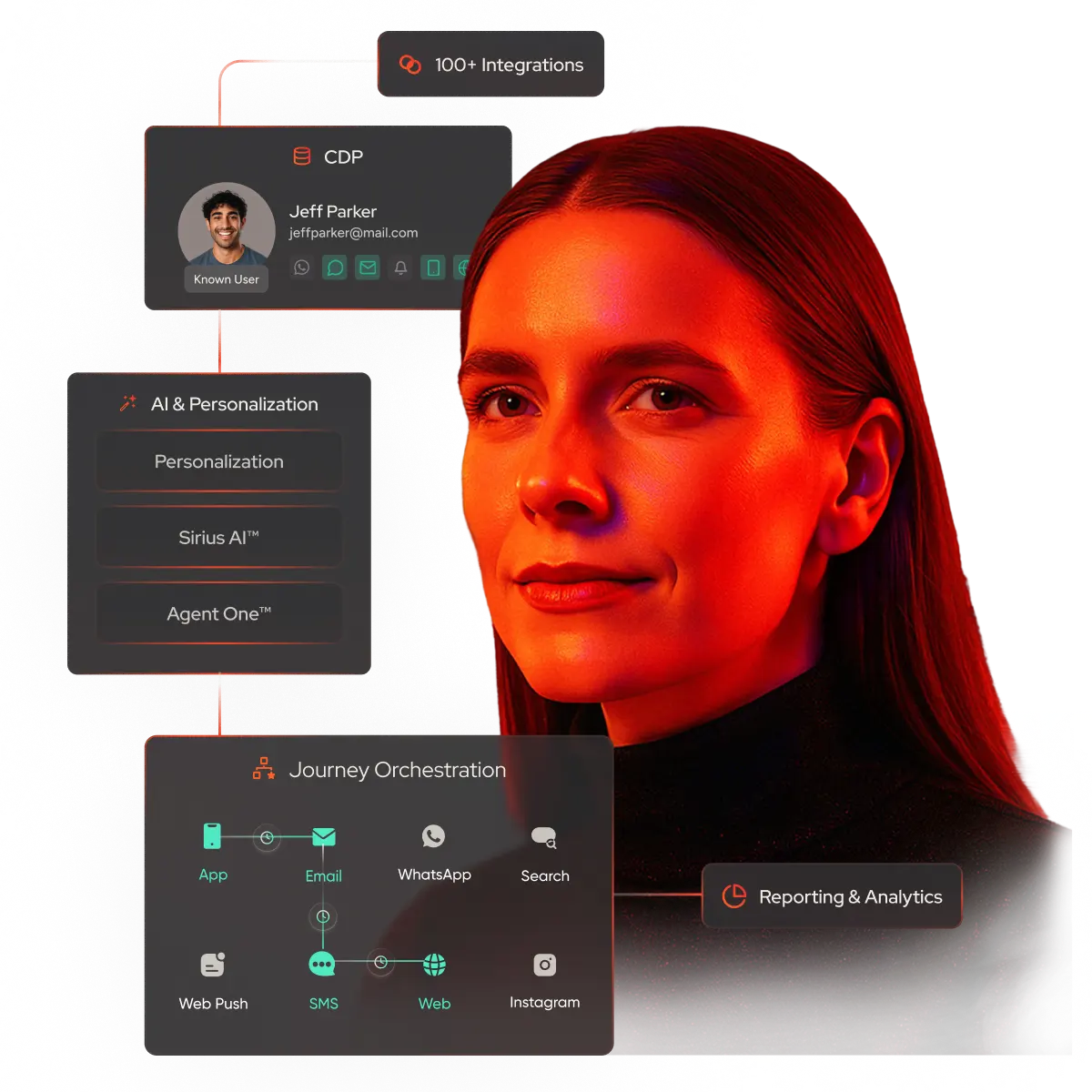
Here is what that same interaction looks like in a properly orchestrated system: the moment the purchase is confirmed, every active promotional track for that product is suppressed. The customer’s profile updates to reflect the new purchase — triggering a post-purchase sequence focused on care, accessories, or complementary categories, not the coat they already own. The next message they receive feels like it came from a brand that was paying attention.
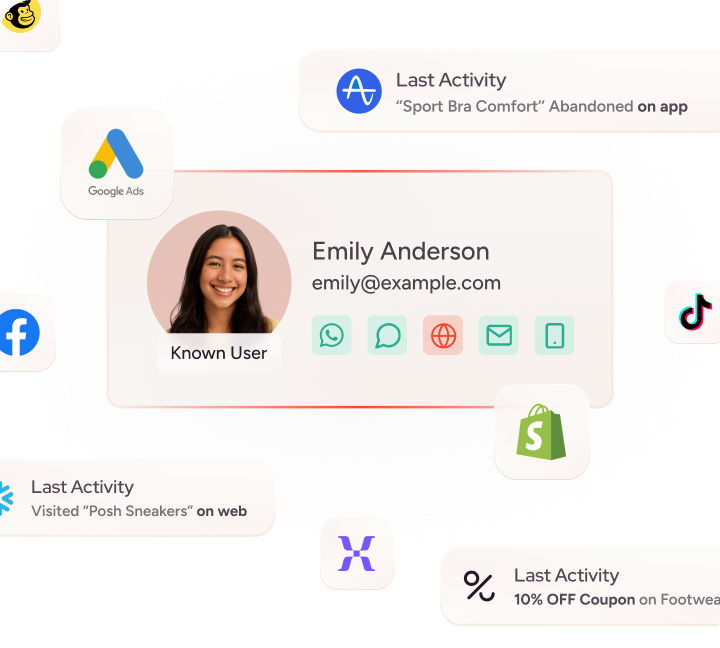
B2C personalization, done correctly, means every interaction a customer has with your brand updates in real time based on what they just did, what they’re likely to do next, and where they are in their relationship with you. This applies across the full spectrum of your traffic , not just known, logged-in customers. Effective personalization begins before a customer identifies themselves. Insider One’s CDP builds behavioral profiles for anonymous visitors from the first session, resolving identity progressively as signals accumulate (device, browsing patterns, email click-through) and linking those profiles to a known record the moment a customer logs in or converts. No session is wasted, and no prior behavior is lost when identity is confirmed.
Most brands are nowhere near that.
They’re running scheduled sequences against stale segments and calling it personalization.
This guide covers the strategies, the technical foundations, and the practical use cases that actually move retention and revenue for ecommerce brands at scale.
What B2C personalization actually means
B2C personalization is the practice of shaping messages, offers, and experiences around individual consumer behavior across multiple channels (email, SMS, push, web, in-app, and physical touchpoints) in real time.
The term “real time” is doing a lot of work in that sentence, and most teams underestimate how literally it needs to be applied.
A customer who abandons a cart at 2:00 PM and receives a recovery message at 9:00 PM has already made their decision. They either bought elsewhere, forgot about it, or moved on.
The message arriving at 9:00 PM is noise.
For personalization to influence behavior, it needs to close four gaps simultaneously:
- Speed: signals trigger responses in seconds
- Channel coordination: your email team and SMS team are reading from the same customer profile so conflicting offers don’t land within hours of each other
- Profile continuity: when a customer buys in-store, your web and app experience updates immediately, not in the next morning’s batch sync
- Predictive action: the system anticipates what a customer needs next, based on behavioral patterns, rather than waiting for them to signal it explicitly
The B2B comparison is worth flagging briefly.
B2B marketing targets buying committees across months-long sales cycles.
B2C operates at the speed of individual consumer decisions, where a customer can browse, add to cart, and exit in under four minutes.
The infrastructure requirements are completely different, and borrowing B2B personalization logic for a consumer audience is one of the more common ways enterprise teams end up with underperforming programs.
What this looks like in practice:
A customer browses a mobile app, spends four minutes on a specific running shoe model, and checks the sizing guide before closing the app without adding the item to their cart.
In a standard ecosystem, this session remains a static data point until the next day’s batch report.
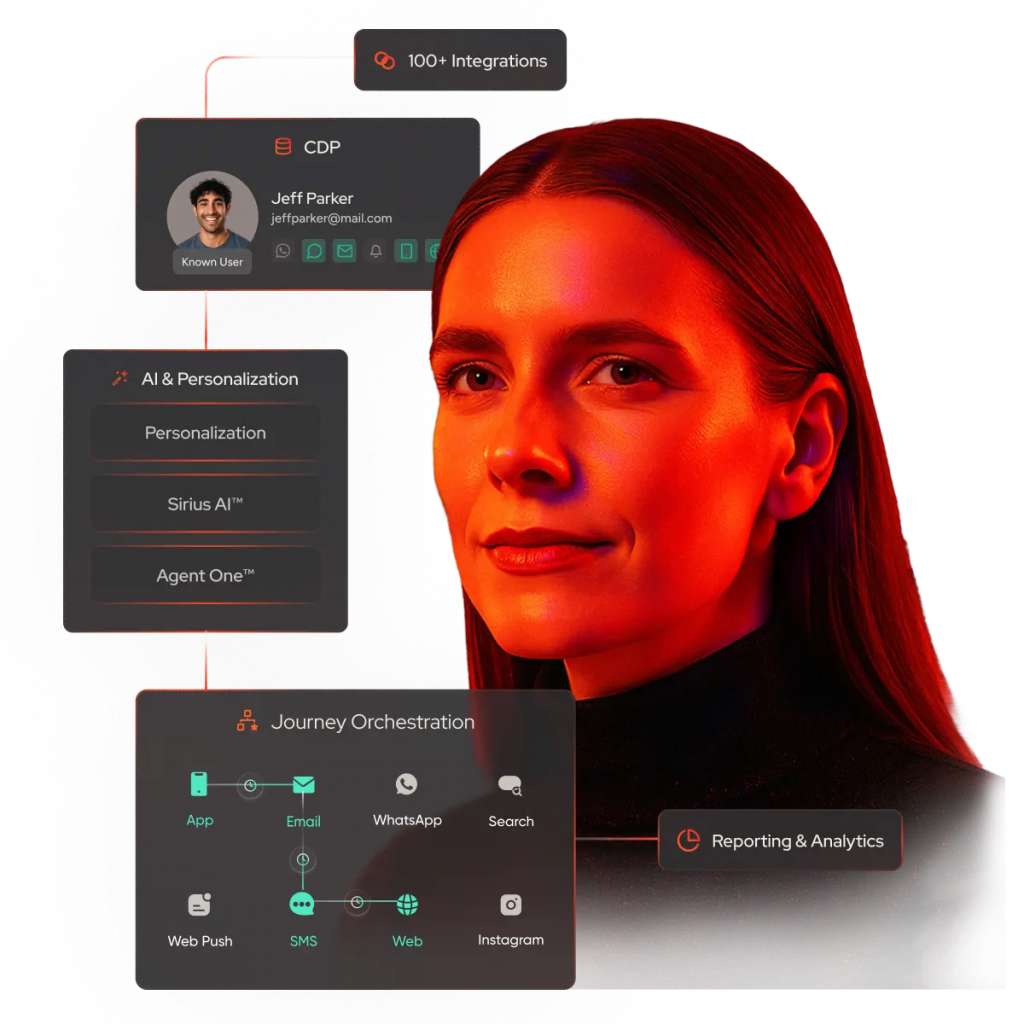
With Insider One’s AI-native Customer Data Platform and behavioral analytics, this session triggers an immediate profile update.
The customer’s browse affinity, time-on-page, and exit behavior are processed within milliseconds.
If that customer opens a social media feed an hour later, they encounter a personalized ad for the exact shoe they viewed, filtered by their specific size, and featuring a “low stock” alert to create urgency.
The system further refines the outreach based on channel preference.
If the customer maintains a 90% open rate on WhatsApp but has not engaged with email in months, the subsequent nudge transitions to WhatsApp. This automation ensures the response arrives on the preferred channel before the intent window closes.
Success in this scenario depends on three factors:
- Instant profile updates: Processing behavioral signals as they happen rather than at the end of a session.
- Inventory integration: Dynamically linking personal size preferences to real-time stock levels.
- Next-best-channel decisioning: Using Sirius AI™ automation features like Next Best Channel to bypass unresponsive channels in favor of the ones that drive action.
Why most personalization strategies produce diminishing returns
The primary cause of plateauing conversion rates is Data Latency.
When an ecommerce stack relies on fragmented systems, the personalization it produces is structurally inaccurate.
A unified customer profile that updates in under 200 milliseconds across every touchpoint (online and offline) – a threshold consistently achieved across enterprise deployments on standard integration configurations and measurable via Insider One’s real-time analytics dashboard – is the prerequisite for growth. The system is designed to detect cart exit signals within 90 seconds under standard integration conditions, compared to the industry norm of batch processing that delays response by hours or until the following morning’s sync.
Without this speed, personalization functions as basic targeting that arrived too late to matter.
Most enterprise teams discover that as their personalization investment increases, the results eventually stagnate.
This occurs because the underlying architecture cannot support the velocity of consumer behavior. Fragmented data leads to a degradation of trust, and in B2C, trust is the only currency that compounds over time.
- Offline-online disconnect: When a CRM fails to register an in-store purchase, the email system continues to retarget the customer for a product they already own.
- Conflicting cross-channel offers: If the SMS platform is unaware of an active 20% discount sent via email, the customer receives two different incentives within 24 hours. This creates confusion and delays the purchase.
- Stale web recommendations: Without a real-time sync, a customer who just completed a transaction continues to see recommendations for that exact item for weeks.
- Batch-processing limitations: Relying on morning batch syncs means your personalization engine is always reacting to who the customer was yesterday, not who they are during their current session.
- Channel blindness: Continuing to prioritize email for a customer who only engages with WhatsApp or InStory ensures your highest-value messages remain unread.
For a deeper look at how disconnected channels compound revenue leakage, see our guide to customer engagement strategies.
The Insider One platform at a glance
Three core capabilities power everything described in this guide:
- Sirius AI™ — the predictive intelligence layer. It analyzes behavioral signals across every channel to determine the next-best action, channel, and timing for each individual customer, without manual rule-building.
- Architect — the journey orchestration engine. It connects triggers, channels, and timing into automated sequences that adapt in real time as customer behavior changes.
- Agent One™ — the agentic AI layer. It handles multi-step customer interactions autonomously, from product discovery conversations to post-purchase support, without human intervention at each step.
5 B2C personalization strategies that drive measurable loyalty
Brands with the highest retention rates utilize systems where customer behavior continuously dictates what is sent, when, and where. These five strategies represent the core mechanics of a high-velocity personalization program.
1. Behavioral segmentation built on RFM + real-time signals
Behavioral segmentation involves grouping customers by active intent rather than demographic attributes.
Recency (how recently they purchased), frequency (how often), and monetary value (how much they spend) give you a reliable starting framework.
A customer can be classified as high value in a static report while their engagement is actively decaying.
By layering real-time signals on top of historical RFM, teams can identify a high-value customer who hasn’t opened an email in 45 days. This allows for a reactivation sequence before they officially churn.
At Insider One, our AI-native Customer Data Platform (CDP) processes these signals instantly to update the following layers:
- Recency decay tracking: Detecting when a customer’s purchasing cadence slows before they stop buying.
- Category affinity: Identifying product categories a customer gravitates toward to suppress irrelevant recommendations.
- Discount responsiveness: Isolating customers who only purchase during promotions to protect profit margins.
- Channel affinity: Prioritizing the communication channel a customer actually engages with, such as WhatsApp or SMS.
2. Real-time trigger sequences across customer journeys
A drip campaign fires on a predetermined schedule regardless of what a customer does between sends. Whereas, a trigger sequence fires because a customer did something specific, and the response is built around that specific action.
The conversion difference between the two is significant, particularly for high-intent moments like cart abandonment and price drop alerts, where timing determines whether the intervention is useful or irrelevant.
Architect, Insider One’s journey orchestration capability, eliminates this delay by identifying high-intent moments and automating the response across the most effective channel.
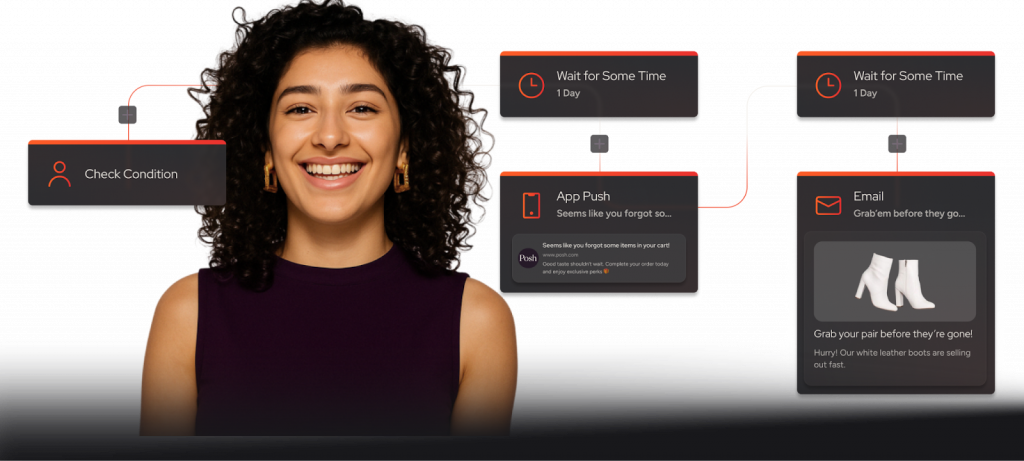
- Behavioral recovery: When a customer exits a checkout, the system detects the signal within 90 seconds. Instead of a generic reminder, it identifies the friction (such as shipping costs or size unavailability) and triggers a targeted intervention on the channel where the customer is currently active.
- Hesitation mapping: If a user views a specific product category multiple times without a transaction, the system surfaces social proof, inventory urgency, or a comparison guide to resolve the browse-loop hesitation.
- Transactional suppression: The moment a purchase is confirmed, the system must purge that customer from all active promotional tracks for that product. This shift to post-purchase care (delivery updates and usage guides) prevents the high unsubscription rates caused by irrelevant “buy now” prompts.
- Latent intent activation: Price drop or “back in stock” alerts are restricted to the precise segment that previously engaged with the item. This ensures outreach is perceived as a service rather than a broadcast promotion.
For more on how omnichannel marketing automation connects these triggers across channels, explore our customer stories to see how brands scale ROI with Insider One.
3. Dynamic content that renders differently for each customer
Dynamic content allows a single campaign template to adjust its product recommendations, offers, and imagery based on the recipient’s recent behavior.
Building separate campaign versions for every segment is inefficient and cannot account for actions taken after a message is scheduled.
Sirius AI™ enhances this by analyzing individual purchase and browsing history to surface higher-intent product recommendations than generic sitewide bestsellers.
To ensure dynamic content is driving results, not just activity, Insider One includes native A/B and multivariate testing built into the same platform. Teams can test subject lines, offer structures, recommendation algorithms, and send-time variations within a single workflow, without exporting data to a separate tool. Results feed back into the personalization engine automatically, so winning variants are promoted and losing ones suppressed without manual intervention.
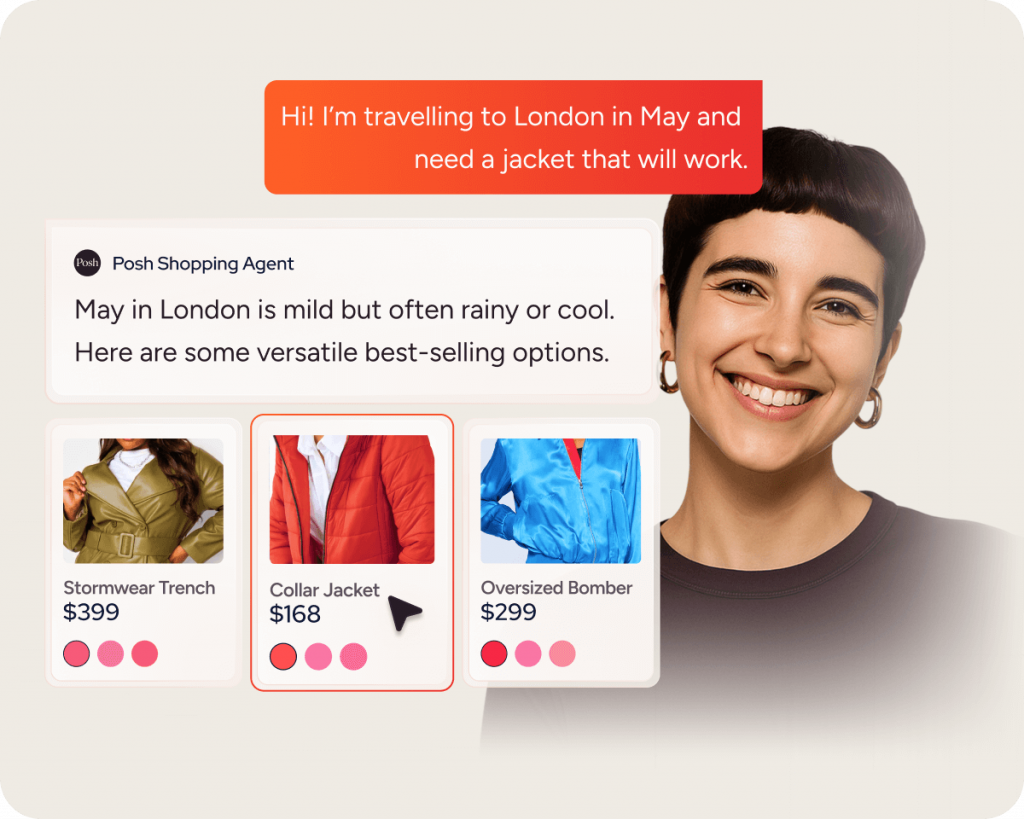
- Product recommendations ranked by individual purchase history and browsing behavior, not category-wide bestsellers
- Promotional offers that reflect loyalty tier (a customer with $2,000 in lifetime spend should see early access messaging, not a 10% discount that degrades their perceived brand relationship)
- Imagery that matches the customer’s demonstrated aesthetic preferences based on what they’ve clicked and purchased
- Timing that adjusts to each customer’s engagement window, so a customer who opens emails at lunch receives the message at lunch, not at 9:00 AM when your batch send fires
4. Lifecycle-aware B2C personalization
Lifecycle-aware personalization requires messages and channels to change based on the customer’s relationship stage. For instance:
- A new customer in their first week needs reassurance and guidance.
- A customer who hasn’t bought in 75 days needs a reason to come back.
- A high-value loyalist needs recognition instead of another percentage-off code.
Most brands build a welcome series and a win-back campaign and leave everything in between on autopilot.
The window between day 8 and day 90 is where a large portion of customer lifetime value is built or lost. To understand where this journey typically breaks down, see our guide on AI-powered customer journey mapping.
Insider One manages these transitions through automated journey orchestration with Architect:
- Onboarding (First 7 Days): Focuses on order confirmation and first-use guidance.
- Cross-Sell (Days 8 to 30): Recommends complementary products based on the initial purchase.
- Replenishment (Days 31 to 60): Triggers reminders for consumables based on predictive reorder intervals.
- Reactivation (Days 61+): Deploys escalating incentives for customers who have not repurchased.
For brands running structured loyalty programs, Insider One integrates directly with loyalty tier data to ensure every touchpoint reflects a customer’s current status. Tier upgrades trigger congratulatory sequences automatically. Approaching-milestone nudges (“You’re 200 points from Gold”) deploy at the optimal engagement window for that individual. High-tier members are routed to early access and experiential offers rather than discount-first messaging, protecting margin and the brand relationship that loyalty programs are designed to build.
Each stage requires different messaging, different channel priorities, and different frequency caps. A unified journey orchestration layer makes this manageable without manual audience management for each segment.
5. Cross-channel consistency as a loyalty driver
Cross-channel consistency ensures every interaction point is reading from the same customer profile. When a customer redeems an offer on the web, every other channel must know immediately to prevent redundant messaging.
Without this synchronization, brands are running disconnected channel strategies that happen to reach the same person.
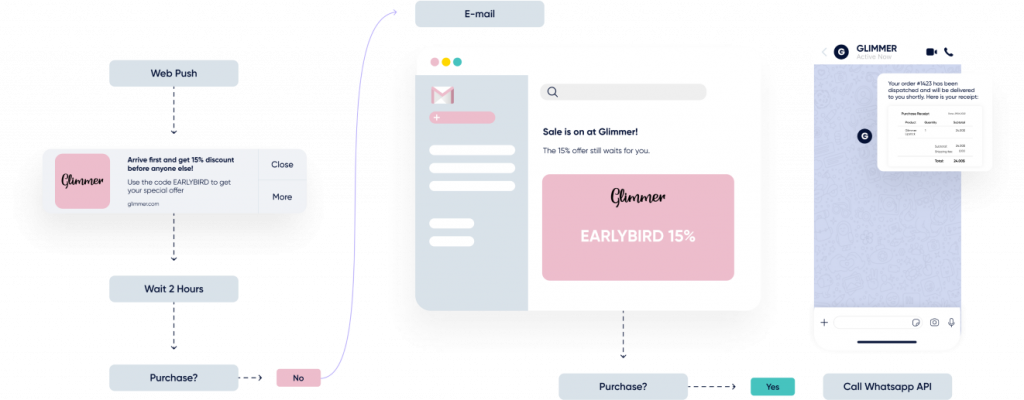
Insider One keeps every customer journey in sync across channels by updating profiles and offers in real time at every touchpoint.
- Omnichannel transaction sync: A purchase made in a physical retail store must update the digital profile instantly. This ensures the customer’s next mobile app session reflects their new loyalty status and suppresses retargeting for the item they just walked out with.
- Preference propagation: Opt-out signals are the most critical data points to sync. If a customer unsubscribes on SMS, that preference must propagate to Email and Web Push immediately.
- Live offer management: Personalized discount codes need a coordinated lifecycle to avoid confusion and protect customer trust. Once a benefit is claimed on the web, it must vanish from InStory and App headers to prevent the frustration of a customer attempting to use an already-spent reward.
- Cross-device cart persistence: A shopper who builds a cart on a desktop expects to see those exact items when they open the mobile app later that hour. Maintaining this state across devices removes the friction of restarting a purchase journey.
Industry-specific applications
Fashion and apparel: Size-aware inventory alerts triggered when a browsed item in a customer’s saved size comes back in stock, sent via the channel with the highest open rate for that individual, not a broadcast email.
Grocery and FMCG: Replenishment reminders timed to a customer’s actual consumption cadence, not a generic 30-day interval. A customer who buys coffee every 18 days receives the nudge on day 16, not day 30.
Beauty and wellness: Loyalty-tier sequencing that withholds discounts for high-value members and substitutes early access or free samples instead, protecting both margin and perceived brand relationship.
Travel and hospitality: Post-booking cross-sell sequences timed to trip proximity, where recommendations shift from “add luggage” at 30 days out to “airport transfer” at 72 hours before departure.
Measuring B2C personalization: the metrics that actually matter
The metrics worth tracking to understand whether your personalization is driving loyalty include:
- Repeat purchase rate by cohort: This is the most accurate pulse check for personalization. It measures the percentage of customers who made their first purchase in a specific window and returned within 90 days. If your personalized onboarding and cross-sell journeys are effective, this number should trend upward for every new cohort. If it’s flat, your personalization isn’t creating a reason to return.
- Customer lifetime value trajectory: While standard CLV is a historical average of what a customer has spent, CLV Trajectory projects the future revenue potential of customers based on their current engagement level. It allows you to compare the 12-month revenue potential of customers in personalized journeys versus those receiving generic broadcasts. High-integrity personalization should show a clear widening of this gap as the relationship compounds. If the two lines stay parallel, your automated triggers are failing to influence long-term spending habits.
- Churn rate at each lifecycle stage: Rather than tracking a single churn rate for your entire database, this metric breaks down exactly where the drop-off occurs in the customer journey. It identifies the leaky parts of your bucket. Are you losing customers between day 8 and day 30, or between their third and fourth purchase? Mapping churn to specific lifecycle stages tells you exactly where your journey orchestration needs more depth or better timing to catch a departing customer before they go silent.
- Revenue per customer per quarter: This metric highlights how much revenue is associated with personalized interventions, based on your attribution model. Personalization success is found in the margins. Based on aggregated performance data across Insider One deployments in retail and ecommerce verticals, brands running personalized reactivation sequences in lapsed segments have consistently outperformed generic broadcast campaigns by 25–35% on revenue per recipient. Results vary by industry, segment size, and prior personalization maturity; your account team can provide vertical-specific benchmarks for your category.
- Channel-specific conversion rates: This measures the specific amount of time elapsed between a high-intent signal (like a category deep-dive or sizing guide check) and the final transaction. It tracks the efficiency of your nudge. Effective personalization should compress this window. If your browse-abandonment triggers are well-timed and relevant, the latency between intent and action should decrease. A shrinking window indicates you are capturing the customer while their interest is at its peak, rather than catching them after they’ve already moved on.
What an AI-powered personalization engine actually does differently
Traditional personalization often relies heavily on deterministic logic.
Teams attempt to map out every possible customer journey using rigid “if-this, then-that” conditions, an architecture that assumes consumer behavior is linear and predictable. At enterprise scale, with millions of customers interacting across twelve channels, these manual rule trees become a structural liability.
AI-powered personalization replaces these human-defined workflows with autonomous predictive decisioning.
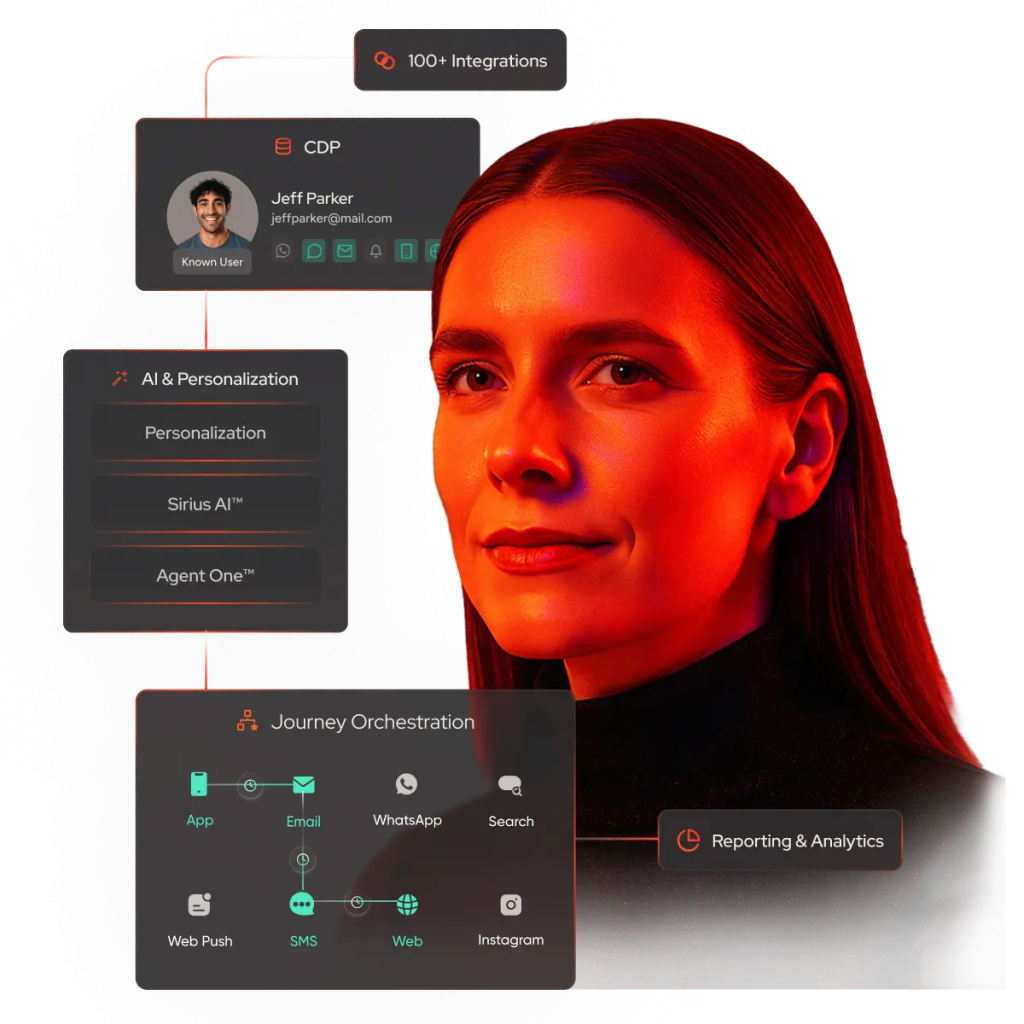
Instead of a marketer attempting to guess which segment an individual belongs to, the system uses Sirius AI™ to analyze high-dimensional behavioral data and determine the next requirement of a customer based on probability.
This autonomous model produces three fundamental shifts in how a brand operates:
- Temporal fluidity: Most brands send messages when it is convenient for their internal schedule. An AI-native system sends messages when it is optimal for the consumer. If a customer historically engages during a lunch break, the notification arrives at 12:15 PM. This precision ensures the message is at the top of the feed during the peak intent window.
- Autonomous channel selection: Channel preference is not static. A customer might prefer WhatsApp for service alerts but Instagram for discovery. An AI-native engine recognizes these nuances by processing real-time engagement patterns. If a customer maintains a 90% open rate on WhatsApp while ignoring email for six months, the system shifts the entire journey to the high-affinity channel. It bypasses unresponsive touchpoints to maintain the brand connection.
- Pre-emptive churn mitigation: Standard retention is reactive. It triggers a “win-back” campaign only after a customer has already stopped spending. Predictive decisioning identifies the subtle decay in engagement (the silent churn signals) long before the final transaction occurs. This allows for a pre-emptive intervention while the customer is still active, protecting the relationship before it requires a desperate margin-killing discount to recover.
- Agentic customer interaction: Agent One™ extends personalization beyond messaging into autonomous conversation. When a customer initiates a chat on the mobile app or WhatsApp, Agent One™ handles product discovery, size and fit guidance, and post-purchase support without routing to a human agent — while writing every interaction back to the unified customer profile in real time. This means a conversation that starts in WhatsApp informs the next email recommendation, the next web header, and the next loyalty offer. No interaction is siloed.
Real-world example
A global beauty retailer runs a loyalty program with 2 million active members across mobile, web, and physical retail.
A high-value member (90-day purchase history, loyalty tier, strong WhatsApp engagement, zero email opens in six months) adds a luxury serum to their cart on the mobile app and exits without purchasing.
Without orchestration, this customer receives a generic cart abandonment email at 9:00 AM the next morning. It goes unopened.
With real-time journey orchestration:
- The cart abandonment signal fires within 90 seconds
- The system queries the customer’s unified profile: WhatsApp-first, last email opened 187 days ago, loyalty tier qualifies for free sample offer
- A WhatsApp message goes out: “Complete your routine, your serum is waiting.” No discount. The loyalty relationship handles the incentive.
- While reading the message, the customer returns to the website. The system detects the live session immediately
- A personalized web header appears: “Free sample with your serum”; addressing the final hesitation point
- The customer completes the purchase
Every step in this sequence depends on minimizing manual rules and letting AI handle most of the decisioning in real time. The journey adapts to the customer in real time, rather than forcing the customer to fit into a pre-defined marketing box.
Why Insider One in a competitive evaluation
Insider One is purpose-built for enterprise B2C brands operating at scale, typically mid-market to global retailers, telcos, travel brands, and consumer apps with complex, high-volume customer bases across multiple channels and geographies. Most enterprise personalization platforms require separate point solutions for CDP, journey orchestration, and AI decisioning, then charge for the integration work to connect them. Insider One ships all three in a single platform, which means:
- No latency introduced by syncing data between a CDP vendor and a separate ESP
- No conflict between a journey tool that doesn’t know what the AI layer decided
- No separate contract or implementation timeline for predictive capabilities
For teams evaluating against other platforms, the architectural question is the same regardless of vendor: where does the data live between the trigger and the send, and how long does that handoff take? In fragmented stacks, that gap is where personalization degrades. In Insider One, it doesn’t exist.
Three comparisons worth pressure-testing in any evaluation:
Braze is a strong channel execution tool but relies on external CDPs for unified customer data. That means a separate contract, a separate implementation, and a sync latency between your data layer and your messaging layer that Insider One eliminates by design. While Braze has added Cloud Data Ingestion (CDI) and direct warehouse integrations (Snowflake, Databricks), these approaches require engineering resource to configure and maintain, introduce row-level sync dependencies, and do not provide the millisecond-level profile updates that Insider One’s native CDP delivers as part of its core platform, with no additional implementation effort.
Klaviyo is built for email-first ecommerce and performs well at that. Companies requiring complex, custom, real-time onsite personalization that goes beyond standard pop-ups and product recommendations (e.g., full site dynamic restructuring based on user identity) often need dedicated personalization engines, not just a CRM.
Salesforce Marketing Cloud offers broad enterprise capability but carries a significant implementation burden. Time-to-value is typically measured in quarters, not weeks, and the AI decisioning layer requires additional licensing and configuration that Insider One ships as part of the core platform.
The question for any evaluation team is not which platform has the longest feature list. It’s which platform closes the gap between a customer signal and a brand response fastest, at scale, without requiring five vendors to do it.
Insider One is built for rapid time-to-value. Most brands see initial high-intent triggers, cart recovery, back-in-stock alerts, behavioral reactivation, operational within the first 30 days of deployment, without requiring dedicated engineering resources or a months-long integration project. A dedicated onboarding team manages technical setup, data connection, and first-campaign launch, so marketing teams can focus on strategy rather than infrastructure.
Win your customers with Insider One
B2C personalization is becoming a technical requirement for staying competitive in a high-velocity market. When a brand reduces the latency between a customer signal and the brand response, the organization moves from reactive marketing toward predictive orchestration.
Success depends on a shift in perspective. Retention is won by ensuring every touchpoint is structurally accurate and temporally precise.
Insider One unifies a 360-degree customer view to provide the structural accuracy needed for high-scale engagement. This unified data allows the platform to deliver unique experiences across every channel, from WhatsApp and SMS to on-site search and mobile app push.
By putting your marketing on autopilot with Sirius AI™, the platform combines Generative AI, predictive models, automation features, and emerging agentic AI to decode customer signals in real time.
This system automates decision-making across the entire journey. Your message arrives when a customer is active and most likely to convert.
Insider One doesn’t just react to customer behavior, it predicts it, delivering the right message at exactly the right moment. Every interaction becomes an opportunity to engage, convert, and retain your audience at scale.
Book a demo to see how Insider One transforms real-time customer signals into seamless, revenue-driving journeys.
FAQs
B2C personalization is the practice of synchronizing messages, product recommendations, and site experiences based on individual behavioral signals in real time. It requires a system to process data across every channel (including mobile apps, WhatsApp, and physical retail) to ensure the brand response matches the consumer’s current context.
Loyalty is a byproduct of relevance. When a brand demonstrates an understanding of a customer’s previous actions (such as a recent purchase or a specific category preference), it eliminates the friction of irrelevant outreach.
Recognizing a consumer as an individual rather than a database entry prevents the communication fatigue that leads to churn.
Success requires a unified customer profile that aggregates behavioral data, transactional history, and channel engagement into a single live record.
An AI-native real-time Customer Data Platform (CDP) is essential to ensure that online and offline signals are processed within milliseconds.
Without this infrastructure, personalization remains limited to delayed batch-processed segments.
Multichannel marketing involves sending messages across various platforms in isolation. Whereas, omnichannel personalization ensures those platforms are connected to a single orchestration layer.
This coordination allows your orchestration layer to share data between channels, suppress redundant offers, and maintain a continuous customer journey regardless of where the interaction occurs.
Predictive models handle much of the decisioning that manual rules cannot manage at scale. The system identifies which channel a customer prefers, determines the optimal engagement window, and surfaces the most relevant content autonomously.
At the enterprise level, this predictive layer can identify early churn signals and automate retention interventions before the customer relationship lapses.
Insider One is built with enterprise compliance requirements as a foundation, not an afterthought. The platform supports GDPR, CCPA, and regional data residency requirements, with consent management tools that capture, store, and enforce opt-in and opt-out signals across every channel. When a customer withdraws consent or opts out on any channel, that preference propagates across the entire platform immediately, suppressing messaging across email, SMS, push, and web in real time. Data processing agreements, sub-processor documentation, and security certifications are available through your account team.