Facebook is a new frontier for me. I’ve been having loads of fun over the past few months experimenting with the shiny new features Facebook has launched to woo creators.
Facebook itself may not be all that shiny, but there’s no denying that it’s enormous. And for a lot of creators, small business owners, and marketers, it’s a great place to find new audiences.
I’ll be honest, though: even Facebook has over three billion monthly active users, and I’m… not reaching even a teeny tiny fraction of them. My content performance has been hit and miss.
So when Buffer’s senior data scientist, Julian Winternheimer, dug into over a million Facebook posts as part of his cross-platform comment engagement study, I was really curious to see what he’d find.
Could being super on top of replying to comments help me boost my reach?
Short answer: Yes! Long answer: Yes, potentially… Let’s unpack that.
Posts where creators replied to comments received about 9.5% more reactions than posts where they didn’t. That might not sound like a jaw-dropping number — especially compared to the 42% lift Julian found on Threads or the 30% on LinkedIn — but on a platform as mature and broad as Facebook, a consistent single-digit lift across a million posts is nothing to wave away.
What I find most interesting about this data is what it reveals beneath the surface. The raw numbers actually suggest the opposite at first glance — and it took some smart statistical analysis to uncover what’s really going on.
How we analyzed the data
Let’s get nerdy. Julian pulled around one million Facebook posts that received at least one comment, spanning accounts of all sizes and niches.
Rather than comparing big Facebook Pages to small ones (which would tell us very little), he compared each account to its own performance over time. The method — called a fixed-effects regression model — holds constant all the things that make each account different: audience size, niche, location, posting frequency. All of that gets baked into the baseline.
So instead of asking “Do Facebook Pages that reply get more engagement than pages that don’t?” we’re asking: “Does this specific Facebook Page perform better when it replies versus when it doesn’t?”
He also ran a Z-score analysis as a second check — measuring how far above or below “normal” each post performed for that specific account. Both methods pointed in the same direction, which gives us a lot more confidence in the finding.
(If you’re interested in the full methodology — and want more charts — you can check Julian’s full analysis on his blog.)
A few things worth keeping in mind before we get into the numbers: we can’t say with absolute certainty that replying causes higher reactions. It’s possible that posts that naturally perform well attract more activity, and creators are simply more motivated to reply when there’s a buzzing comment section.
Julian’s dataset also measures reactions specifically (likes, loves, hahas, etc.) rather than total engagement — a deliberate choice to avoid the circularity of including comments in an engagement metric that’s testing the effect of comments.
That said, the pattern shows up across all six platforms Julian analyzed, with lifts ranging from 5% to 42%. That kind of cross-analysis consistency is something data scientists love to see. It makes the findings that much more convincing.
Julian’s fixed-effects model — covering over 1 million posts across 97,427 Facebook profiles — found that posts with replied-to comments receive approximately 9.5% more reactions on average.
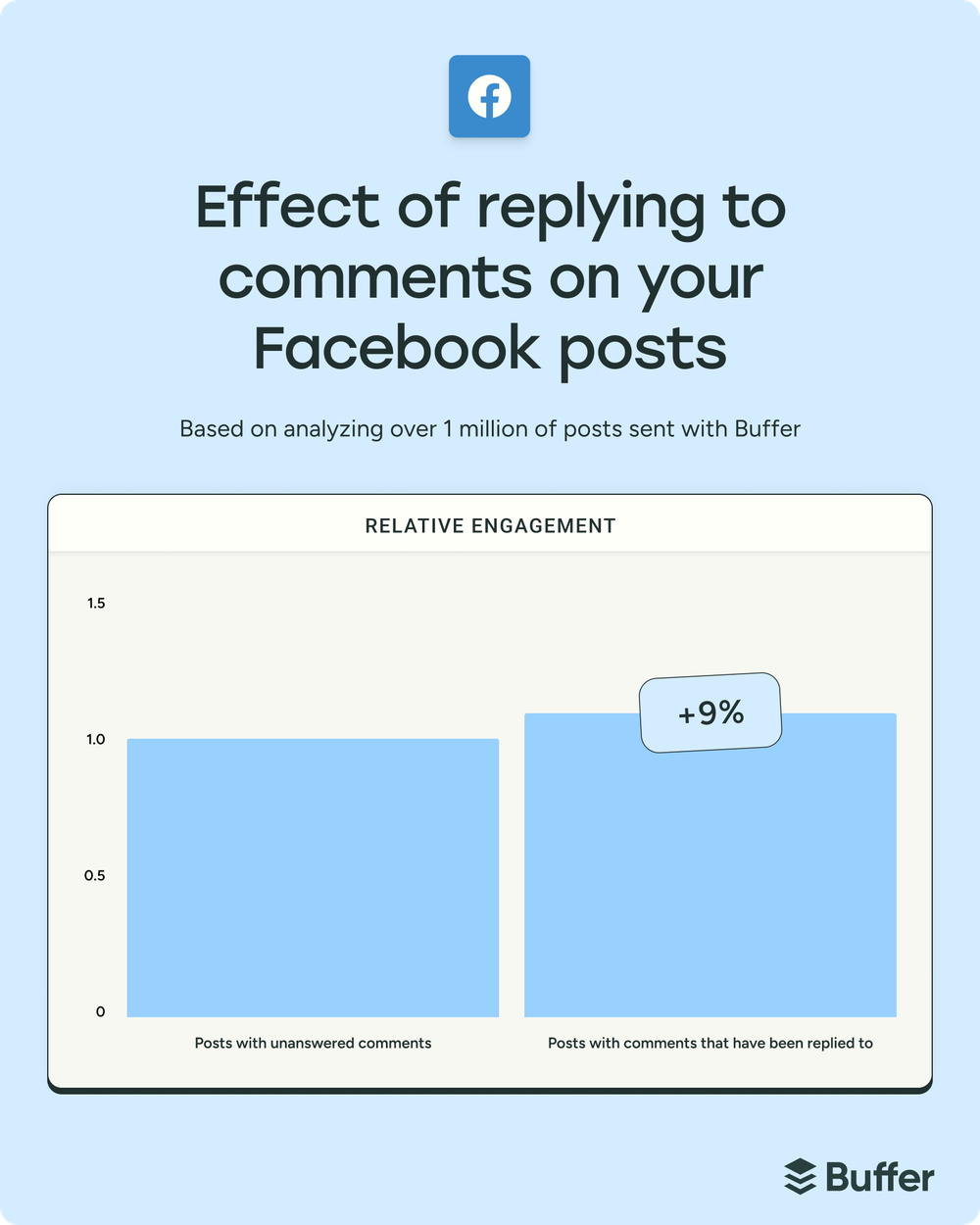
The effect is statistically significant (p < 0.001, for the stats-inclined among us).
The Z-score analysis backed this up. About 53.8% of Facebook Pages performed better when they replied. In other words, posts with replied-to comments sat slightly above each account’s usual performance level, while posts without replied comments hovered right at baseline.
That “53.8%” number is worth pausing on. It’s a slimmer majority than what Julian found on Instagram (63%) or LinkedIn (83%). Facebook’s effect is statistically significant, but it’s more modest — which tracks with the platform’s broader, more mature engagement patterns.
Some fun behind-the-scenes stuff: If we just looked at the raw median numbers, posts without replied-to comments actually have slightly higher median reactions (22) than those with replies (16). On the surface, that seems to contradict everything I just said.
But that comparison is misleading — it’s mixing together Facebook Pages of wildly different sizes and activity levels. Once Julian controlled for those differences and compared each account to itself, things looked very different (and gave us the numbers I shared above).
Why this matters for Facebook
Facebook is a different beast compared to newer, more conversation-forward platforms like Threads or LinkedIn.
The Facebook algorithm prioritizes what it calls “meaningful interactions” — and comments, particularly back-and-forth exchanges, are one of the strongest signals of that. When you reply to a comment, you’re creating a conversation thread that signals to the algorithm that your post is sparking real discussion, not just passive scrolling.
There are a few reasons why this likely translates into higher reactions:
Extended visibility. Comment threads keep posts active in the feed longer. Every reply is another signal fire to the algorithm that might resurface the post for the commenter’s connections — and for anyone else who’s previously interacted with your page.
Relationship signals. Facebook tracks interaction history between accounts. When you consistently reply to someone’s comments, the platform registers that connection and is more likely to show your future posts to them. Over time, these micro-interactions compound.
Social proof. An active comment section with replies from the creator or brand signals that there’s a real person behind the Page. People are more likely to stop scrolling and react when they see that the creator is actually present in the conversation.
The 9.5% lift might feel modest next to Threads’ 42%, but context matters. Facebook’s sheer scale means that even a small percentage increase in reactions can translate to meaningfully more people seeing and engaging with your content. And unlike some platform-specific tactics, replying to comments is something you can start doing right now with zero additional tools, budget, or strategy overhaul.
If you’re managing a Facebook Page alongside other platforms (who isn’t?), keeping up with comments can feel like another full-time job.
Here are a few approaches that have helped me keep on top of my comments across Instagram, LinkedIn, Threads, YouTube, TikTok, and Facebook:
Time block your replies
Rather than trying to respond to every single comment (which can quickly become unsustainable as you grow), dedicate two 10-to-15-minute windows each day for comment engagement. Mid-morning and early evening tend to work well — you’ll catch comments from both the morning scrollers and the after-work crowd.
Prioritize conversations
A “thanks!” reply is fine, but it’s not what drives the engagement flywheel. Try asking a follow-up question or adding a detail that keeps the thread going. “Great question — have you tried…” or “That’s a good point, we actually found that…” are the kinds of replies that tend to generate more activity.
Reply while the post is fresh (if you can)
Like most platforms, Facebook’s algorithm gives early engagement heavy weight. If you can get into the comments within the first couple of hours after posting, you’re more likely to spark additional reactions while the post is still being distributed. (This is where posting at times when you’re actually available to engage becomes a real strategic advantage.)
Use a tool that keeps everything in one place
If you’re active on Facebook and a couple of other platforms, bouncing between apps to manage comments gets old fast. Buffer’s Community tab pulls all your comments across platforms into a single dashboard — and you can reply directly from there without opening Facebook and getting pulled into the feed. It’s free for up to three social accounts.
There’s also a Comment Score feature that tracks your reply consistency over time — think of it like a streak tracker for engagement. It helps turn commenting from something you remember to do sporadically into an actual habit.
Julian’s cross-platform analysis covered millions of posts, and Facebook’s 9.5% reaction lift sits at the lower end of the spectrum. But “lower end” doesn’t mean it’s not helpful — it’s fitting for a platform where engagement patterns are broader and more varied than on conversation-first networks like Threads.
What I keep coming back to with this data — across Facebook and every other platform Julian analyzed — is how refreshingly simple the takeaway is. You don’t need to crack some secret code or find a loophole in the algorithm. You’re just showing up for the people who showed up for you.
The 9.5% lift isn’t guaranteed for every Facebook Page (remember, around 54% of profiles in Julian’s study saw positive effects), but the odds tilt in your favor if you’re willing to put in the time. And on a platform with Facebook’s reach, even a modest, consistent boost in reactions can make a real difference over time.
For the full breakdown of Julian’s findings across all six platforms, check out our cross-platform engagement study.