The rumors are true: The definition of marketing visibility is changing, and quickly.
Our main historical metric was page rankings, and marketing teams invested heavily in SEO, measuring metrics like rankings, impressions, click-through rates, and website traffic.
We all know by now that AI has disrupted how people search. Large language models (LLMs), like ChatGPT, do the research, cite sources, and recommend vendors directly in the answer. In fact, half of B2B software buyers say they now start their research on an AI search platform versus Google (a stat that jumped 71% in four months between April and August 2025).
This shift changes what visibility means. It’s no longer just about showing up in search results. It’s about being cited in AI-generated answers. And that raises a new question for marketing leaders: How visible is your brand in AI-driven discovery — and how do you measure it?
In a recent conversation, Guy Yalif, Chief Evangelist at Webflow, shared that some organizations are already seeing 2–5% of website traffic coming from AI-driven referrals. And while that may sound low as a total percentage, the conversion rates of those visitors are so much higher. And that’s just what we can measure as a direct referral. They may also be going from the prompt to second-party sites like G2, and then come to you when they are ready to engage.
Even more interesting, visitors arriving from AI systems can convert 6x better than traditional unbranded SEO traffic. Other industry data points reinforce this pattern. Ahrefs has observed AI search visitors converting up to a 23x higher rate than traditional organic search traffic, reinforcing the idea that AI-driven discovery may represent a smaller — but more qualified — stream of buyers.
Clearly, AI answers are increasingly influencing how buyers discover and evaluate vendors. And that means marketing teams need to start thinking differently about visibility.
TL;DR:
- 50% of B2B software buyers now start research in AI tools — a shift that’s redefining visibility from rankings to citations
- AEO (answer engine optimization) is about getting your brand mentioned, trusted, and recommended inside AI-generated answers
- AI-driven traffic is smaller but significantly higher intent, converting 6x to 23x higher than traditional organic search
- Brand presence in AI should be measured across three dimensions: visibility (mentions), comprehension (accuracy), and conversion (impact)
- There is no single AEO metric — teams must combine signals like AI citations, share of voice, and conversion from AI traffic
- The goal isn’t just to rank anymore — it’s to earn consensus across trusted sources so AI systems recognize your brand as the answer
Understanding AEO vs. SEO — and why you need both
For years, SEO has helped brands appear when buyers search for information online. Success was largely determined by ranking position — appearing as high as possible on the search engine results page (SERP).
AI-driven search introduces a different model. Instead of presenting a list of links, AI systems generate synthesized responses that summarize options, cite sources, and recommend solutions directly within the answer itself.
To adapt, many teams are beginning to focus on answer engine optimization (AEO). AEO focuses on ensuring a brand appears when AI systems generate answers about a category, product, or problem. Instead of optimizing only for search rankings, teams must now consider how their content, expertise, and brand signals influence whether they are mentioned, cited, or recommended within AI-generated responses.
But AEO doesn’t replace SEO. Traditional search visibility still matters, and many of the same signals that influence SEO — authority, trusted sources, and strong content — also influence whether a brand appears in AI answers.
“AEO doesn’t replace SEO. It reframes the goal entirely. SEO puts you on a list while AEO puts words in the model’s mouth. That’s a fundamentally different bar. A brand doesn’t just have to win the search game anymore, but also needs to earn consensus. Every brand should aspire to be talked about, cited, and agreed upon across independent, authoritative, and unbiased sources,” explains Mohammad Farooq, Director of SEO at G2.
In practice, many organizations are beginning to treat AEO as a new visibility layer that sits alongside traditional SEO, rather than a replacement for it.
As Kevin Indig, Growth Advisor for G2, suggests, teams can begin tracking signals like mention rate, top-three recommendation rate, and competitive presence to understand how often their company appears in AI-generated responses.
The takeaway is simple: Visibility in the AI era isn’t just about ranking. It’s about whether AI systems recognize your brand as a credible answer. As AI discovery becomes more influential, marketing leaders need practical ways to measure and manage their visibility.
What you can do today to measure AEO
Two levels of measurement are emerging: operational dashboards for marketing teams and high-level indicators for executive reporting.
Build operational dashboards for AEO execution
Traditional SEO dashboards track metrics like rankings, impressions, and click-through rates (CTR). But these metrics alone can’t capture how a brand appears inside AI-generated responses.
Kevin points out that one of the biggest challenges teams face is knowing what to measure in the first place. “The problem with AEO measurement is that most teams are measuring the wrong thing. In a survey of 313 practitioners, I found 78% said their current approach to measuring LLM visibility is inaccurate, and 22% aren’t measuring at all. Ranking position is a directionally helpful proxy for AI citation, but not exhaustive,” he explains.
While no single metric fully captures AI visibility today, the goal is to move beyond single proxies and instead build a more complete picture of how your brand shows up across AI-generated responses.
That means expanding measurement to include a broader set of signals for AEO.
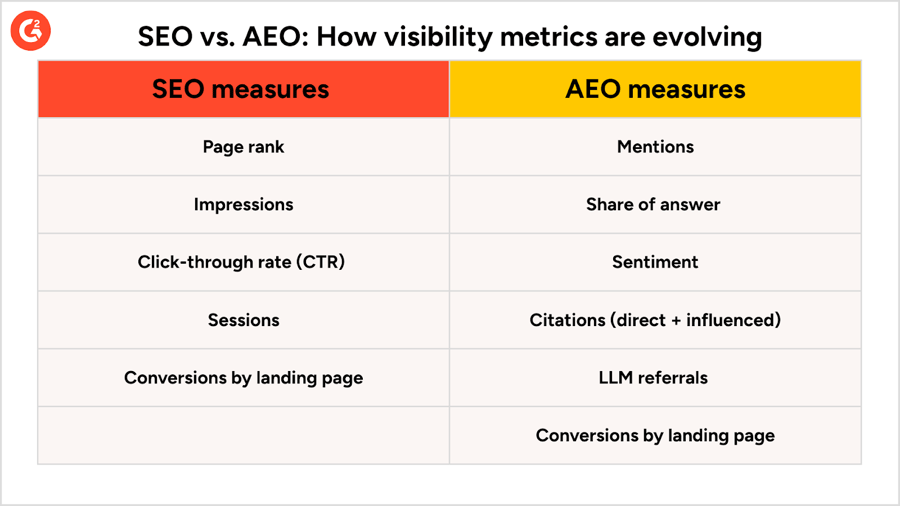
Many teams are beginning to organize these metrics across three dimensions.
In his analysis of Webflow’s growth strategy, Kyle Poyar, Founder & Creator of Growth Unhinged, highlights a framework focused on visibility, comprehension, and conversion.
- Visibility: How often a brand appears in AI-generated responses across answer engines.
- Comprehension: Whether AI systems accurately describe the company’s positioning and strengths.
- Conversion: Whether AI-driven discovery leads to meaningful business outcomes, such as signups or product trials.
Some organizations are also beginning to build dashboards specifically designed to track these signals. Trevor Pyle, Head of Marketing at Profound, notes that teams are increasingly consolidating metrics into centralized dashboards. Here’s what he shared about how the team at Profound is approaching this with customers:
“Effective AEO measurement and prioritization starts with real-world data. At Profound, we focus on capturing the actual prompts people use across platforms, then layering deep analytics on top — things like visibility, citation share of voice, share of voice, and agent logs. From there, we make the data usable: custom dashboards for ongoing monitoring, raw exports into tools like Looker for advanced teams, and auto-generated decks so CMOs and boards can quickly see what’s working, what’s not, and where to double down. Our customers are now taking analysis a step further by deploying Profound agents to scan data, surface insights, and take action autonomously.”
Capture board-level metrics that show strategic impact
AEO is a top priority for all companies today, and it’s making its way into board conversations, too. They want to know your strategy and how it’s performing, so it’s important to educate your board on this topic, in addition to consistently showcasing results and impact.
Operational dashboards are useful for day-to-day optimization. But board conversations typically focus on a smaller set of high-level indicators.
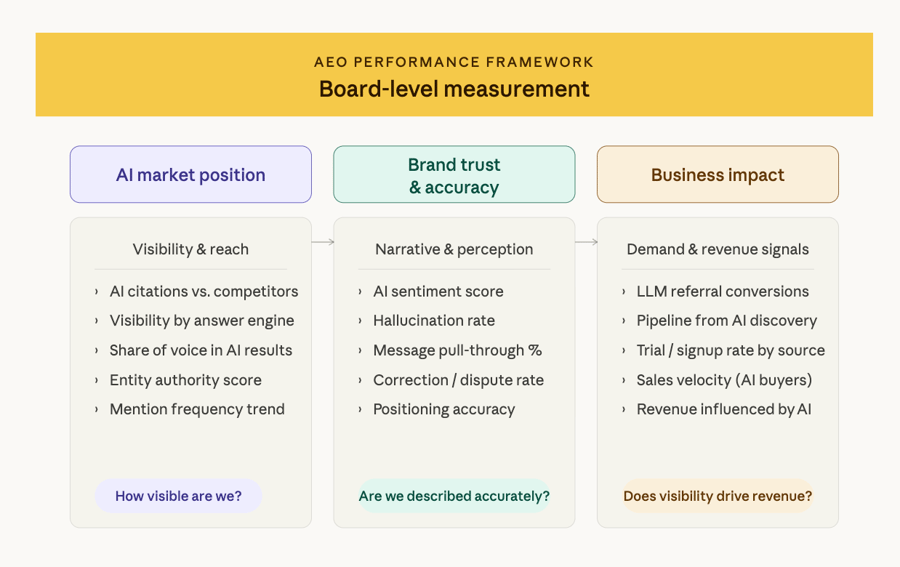
One helpful way to frame AEO performance is around three strategic pillars: AI market position, brand trust and accuracy, and business impact.
1. AI market position
This reflects how visible the company is in AI-generated answers relative to competitors. Metrics may include AI citations compared to competing vendors, visibility across prioritized answer engines, and overall entity authority.
2. Brand trust and accuracy
AI systems effectively generate a narrative about a company. Tracking signals like sentiment, hallucination, or correction rates, and message pull-through can help teams understand whether AI systems describe the brand accurately and positively.
3. Business impact
Ultimately, leadership teams want to understand whether AI visibility translates into demand and revenue. Metrics in this category may include pipeline influence from AI discovery, conversion rates from LLM referral traffic, and sales acceleration signals tied to AI-originating buyers.
Together, these indicators help marketing leaders show not only how their brand appears in AI answers, but also how that visibility connects to brand perception and demand generation over time.
Kevin’s perspective reiterates this. He shared with me that: “Most board decks show AI citation volume, but that’s not enough. The boards asking the right questions are tracking sentiment drift and message pull-through: is AI saying what we want it to say about us, and is that narrative moving deals forward? Those two questions cut closer to the actual business risk than share of voice ever will.”
The future of marketing visibility
AI-driven discovery is still early, but it’s already reshaping how buyers research and evaluate vendors. As I often like to say, there is no playbook yet, and we’re all writing it together!
As answer engines become more embedded in the buying process, marketing teams will need to think beyond rankings and traffic. The new question isn’t just whether your brand appears in search results; it’s whether AI systems recognize your company as the answer.
The marketers who succeed in this shift won’t be the ones chasing every new tactic. They’ll be the ones building systems to understand how AI describes their brand, where their authority signals come from, and how that visibility translates into real buyer demand.
Because in the age of AI discovery, the narrative that AI tells about your company may matter as much as the content you publish.
Frequently asked questions
1. How is brand visibility changing in the age of AI search?
Brand visibility is shifting from ranking in search results to being cited and recommended in AI-generated answers. Instead of competing for clicks, brands now compete to be included in the answer itself.
2. What is AEO, and why does it matter now?
AEO (answer engine optimization) focuses on ensuring your brand appears in AI-generated responses. It matters because more buyers are starting their research in AI tools, where traditional rankings are replaced by summarized recommendations.
3. What are the most important metrics for measuring AEO?
AEO requires a combination of metrics, including AI mention rate, share of voice in AI responses, top recommendation frequency, brand accuracy, and conversion from AI-driven traffic.
4. How do you measure whether AI understands your brand correctly?
You measure comprehension by analyzing how AI systems describe your company — including positioning accuracy, sentiment, message consistency, and hallucination or correction rates.
5. Does AI-driven traffic actually impact revenue?
Yes. While AI-driven traffic is typically smaller in volume, it is significantly higher intent, with conversion rates reported between 6x and 23x higher than traditional organic traffic.
6. How should AEO performance be reported to executives or boards?
At the executive level, AEO should be reported across three pillars: AI market position (visibility vs. competitors), brand trust and accuracy, and business impact (pipeline, conversion, and revenue influence).
7. Why is there no single metric for AEO success?
Because AI visibility is distributed across platforms and responses. No single metric captures it fully, so teams must combine multiple signals to understand how often, how accurately, and how effectively their brand appears in AI answers.
8. What does it take to become “the answer” in AI systems?
Brands need strong authority signals across trusted sources, consistent positioning, and widespread third-party validation so AI systems can confidently cite and recommend them.