[ad_1]
Vintage photos and historical rigor are key to social media and media relations strategies.
Record snowfall was expected. The social media team at John Deere reached out to Neil Dahlstrom with a simple question: What do you have for us?
As the branded properties and heritage manager, Dahlstrom went to the archives he manages to find something interesting related to the snow. He found vintage snowmobiles, which garnered more than half a million likes on Instagram.
View this post on Instagram
For communicators, it’s a reminder that some of the most engaging content isn’t created from scratch. It’s rediscovered.
Archive materials also helped John Deere jump onto the “What were you like in the ‘90s trend?” and a carousel detailing the evolution of the iconic John Deere logo.
“It’s about sharing, not hoarding information and contributing to the story,” Dahlstrom told PR Daily.
His enthusiasm for his work shines through every word he speaks, whether he’s talking about spending two hours figuring out why the contents of one book contradict another or acquiring new items for John Deere’s various museums. He also works closely with marketing and other departments to tell John Deere’s story through its history.
“Most of my day is spent responding to what other people are interested in, and then I kind of grow an appreciation for what they’re interested in,” he said.
At John Deere, archives aren’t just a repository. They function as a real-time content engine for marketing and PR teams.
Preparing for milestone anniversaries
In 2027, John Deere will celebrate the 100th anniversary of their combine. Obviously, that will come with a major marketing and PR push — but much of it will be driven by Dahlstrom’s meticulous work. For instance, he has to make sure 2027 is the right year. Was the combine created in calendar year 1927 or fiscal year 1927? Or maybe that’s a model year.
“You’ve got to work through all those challenges to make sure that you hopefully get the story right,” he said. “And then the exciting part is, you put this out into the world, and everyone’s got a little something additional to contribute to the conversation.”
Dahlstrom is in charge of more than just providing marketing and PR with photographs and advertisements — he’s looking to tell a whole story through his archival work that looks to the future even as it elevates the past.
“It’s not a celebration of 100 years. It’s OK, well, we got 100 years stuck on this — what comes next?” he asked.
Taking the past to TikTok
In addition to providing the social media team with archival content, sometimes Dahlstrom plays an even more vital role.
Saying no. Not every historical asset is fair game for modern content.
“Say … a painting was done in 1932, and it’s really a valued part of our collection in John Deere’s history. And we don’t want to maybe minimize what it is by doing something so out of the box that it kind of — I think — hurts the integrity of what it was intended to be.”
And sometimes, Dahlstrom admits he doesn’t understand how a piece of the archive is being used, but he trusts the teams asking for it and goes with it anyway.
“Whether it’s PR or communications or marketing, it’s, I think, this kind of mutual relationship of I need to be in the business. I need to be part of the operation,” he explained.
Looking at the logo
Dahlstrom is also the keeper of the history of John Deere’s logo, which celebrates its 150th anniversary in 2026. The original image was created by Deere himself, made out of brass. While the image has gone through eight different trademarks since 1876, the core is still the same: that jumping deer.
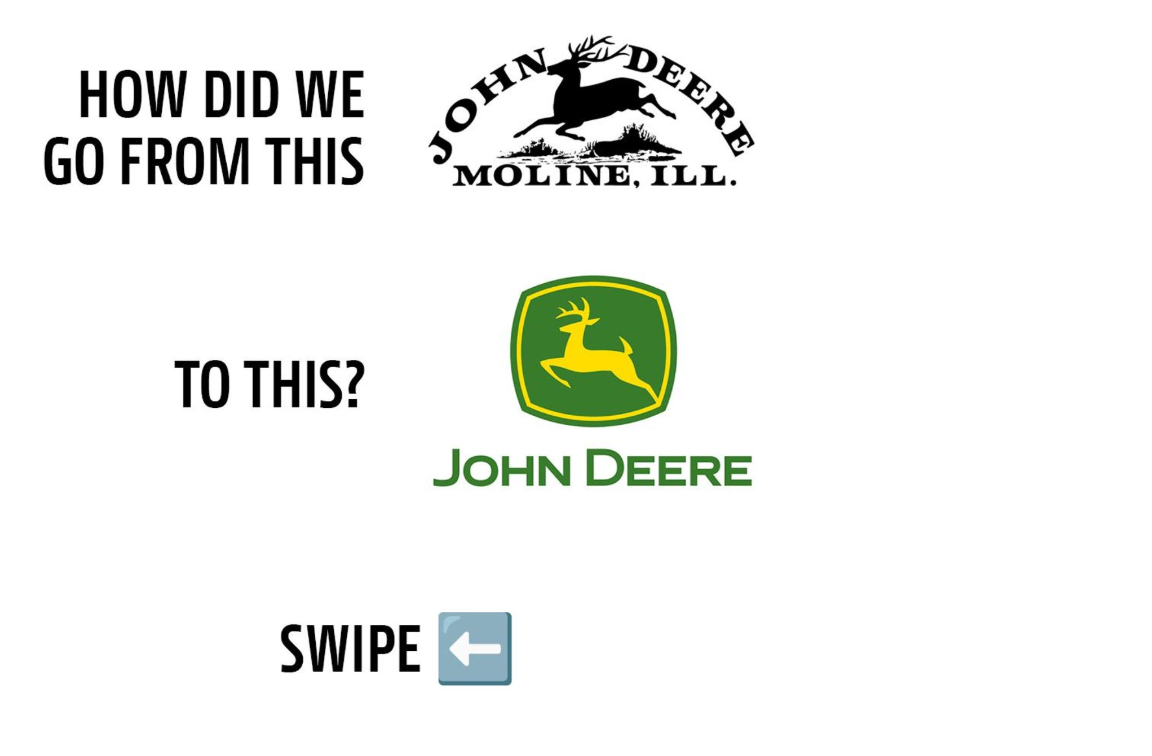
Dahlstrom appreciates all the previous versions, of course, but he has his favorite: The current one, which was adopted shortly before he joined the company in 2001. He appreciates that it’s the first John Deere logo of the digital age, designed to look good on the company’s website. But he also values the symbolism it provides.
“Above all else, I love that it’s the first deer that’s leaping up instead of landing,” he said. “And so this statement of we are a company on the rise versus our best days are behind us, I think, is a really important statement.
“I joined that company as an archivist and historian, so seeing a logo where our leadership is saying we’re a company that’s just getting started. I just — I love that juxtaposition, and I think it’s a really important statement.”
Tips for making the most of your archive
Even if your wealth of material isn’t as deep as John Deere’s is, there are likely ways you can use your historical material in your modern comms. Here are a few suggestions:
- Take inspiration from now. John Deere didn’t seek to highlight the snowmobile — they took inspiration from the falling snow. Start with what’s happening now and fit your content into it, not the other way around.
- Archives are a content goldmine, not a storage unit. Historical materials can fuel everything from social posts to campaign storytelling to executive communications.
The key is making them accessible and aligning them with current business needs. - Use milestones strategically, not automatically. Anniversaries can be powerful, but only if they’re accurate and meaningful.
- Think beyond nostalgia. The most effective historical storytelling connects the past to what’s next.
- Recognize the emotional value of history. Stories tied to products, milestones or shared experiences can reinforce loyalty and deepen connection in ways that purely new content often can’t.
Allison Carter is editorial director of PR Daily and Ragan.com. Follow her on LinkedIn.
The post John Deere’s archives are powering its modern-day marketing appeared first on PR Daily.
[ad_2]
Source_link