
[ad_1]
Key takeaways:
- Australia’s tightening regulatory landscape (TEQSA, ASQA, CRICOS) makes student management system development in Australia a compliance-driven necessity, not just a digital upgrade.
- Monetisation models such as SaaS subscriptions, institutional licensing, white-label partnerships, and hybrid pricing offer scalable commercial opportunities in Australia’s expanding EdTech market.
- Addressing challenges early – data privacy, legacy migration, multilingual access, and compliance updates – ensures long-term sustainability and user adoption.
- Building a student management system in Australia is both an educational and commercial opportunity, aligning institutional efficiency with recurring revenue potential.
Across Australia, classrooms have changed, but the systems running them mostly haven’t. Schools, universities, and training institutions are now trying to keep up with hybrid models, compliance checks, and growing expectations – all with the same goal of creating digital-first learning experiences. Yet many still depend on spreadsheets, legacy CRMs, or a mix of old tools that were never really meant for how education works today.
This widening gap between digital learning and manual management is where the real opportunity sits. As TEQSA, ASQA, and CRICOS tighten reporting norms and as government funding starts to favor transparency and accountability – institutions are under increasing pressure to stay both compliant and efficient.
For edtech entrepreneurs, that pressure looks a lot like potential. It’s a rare moment – maybe once in a decade – where technology can completely redefine how education systems in Australia operate. The demand for intelligent, automated, and secure student platforms is exploding – not as a trend, but as an operational necessity. In fact, over 70% of Australian education providers plan to expand their digital infrastructure by 2026, with student information and engagement systems ranking highest on their list.
This shift is what makes student management system development in Australia such a pivotal opportunity. A well-built system doesn’t just help schools manage attendance, assessments, or enrolments – it becomes the backbone of how education is delivered, governed, and experienced.
Whether you are looking to create a SaaS platform for institutions or build cloud-based student management system for Australia’s education standards, the goal is the same: simplify administration, strengthen compliance, and give teachers and students more time to focus on learning and not paperwork.
This article breaks down how to build a student management system in Australia – from features and costs to AI integration and monetisation – designed to help you capture both the educational and commercial potential in this fast-growing sector.
Ready to tap into Australia’s booming EdTech market with your own student management platform?

What a Student Management System Really Does – and Why Australia Needs It Now
At its center, a student management system software is built to ease everything that would keep an institution running – from enrollments and attendance to grading, communication, and compliance reporting. It’s a single digital hub that connects administrators, teachers, students, and parents in real time.
For Australia, these stakes are even higher. Institutions are increasingly coming under the pressure to operate under strict frameworks like TEQSA, ASQA, and CRICOS, where accuracy, transparency, and audit readiness are not optional – they are required. This is where student management system development in Australia plays a critical role by ensuring that every process is aligned with the local education standards and global privacy regulations.
Unlike all the generic global platforms, software developed specifically for the Australian market can manage nuances like NAPLAN analytics, multi-campus reporting, and integration with government-regularised systems. They don’t just store data; they create accountability and measurable outcomes.
The Benefits of Student Management System Implementation
The benefits of student management system adoption go far beyond automation:
- Operational efficiency through unified data and automated workflows.
- Compliance accuracy with built-in regulatory reporting.
- Enhanced student experience via transparent communication.
- Data-driven decisions through insights on performance, attendance, and engagement.
In a sector where administrators spend hours compiling reports or cross-verifying attendance, moving from manual processes to a digital ecosystem saves not only time – but significant costs too.
Manual vs. Software: The Time and Cost Advantage
| Activity | Manual Time (per week) | With Software | Cost Reduction | Key Benefit |
|---|---|---|---|---|
| Attendance tracking | 5-6 hours | 30 mins | 85% | Real-time visibility & compliance-ready reports |
| Report card creation | 10 hours | 2 hours | 80% | Automated grade computation |
| Parent communication | 6 hours | 1 hour | 83% | Multi-channel updates (email, SMS, app) |
| Timetabling & scheduling | 8 hours | 1 hour | 87% | Smart resource allocation |
| Fee collection | 4 hours | 30 mins | 88% | Integrated payment gateway & reminders |
Even small institutions report saving 20-25 admin hours per week after switching to an online student management system development model – time that can instead be spent improving the learning experience or expanding course offerings.
In short, investing in student information management system development is no longer about convenience; it’s about competitiveness. Institutions that digitise today will lead tomorrow’s education market – and those who build these solutions will drive that transformation.
The Step-by-Step of How to Build a Student Management System in Australia?
Building a system that handles enrolments, attendance, assessments, and compliance isn’t just about writing code – it’s about designing trust, efficiency, and long-term scalability.
Here’s what a successful student management software development Australia roadmap looks like when built with both educators and institutions in mind.
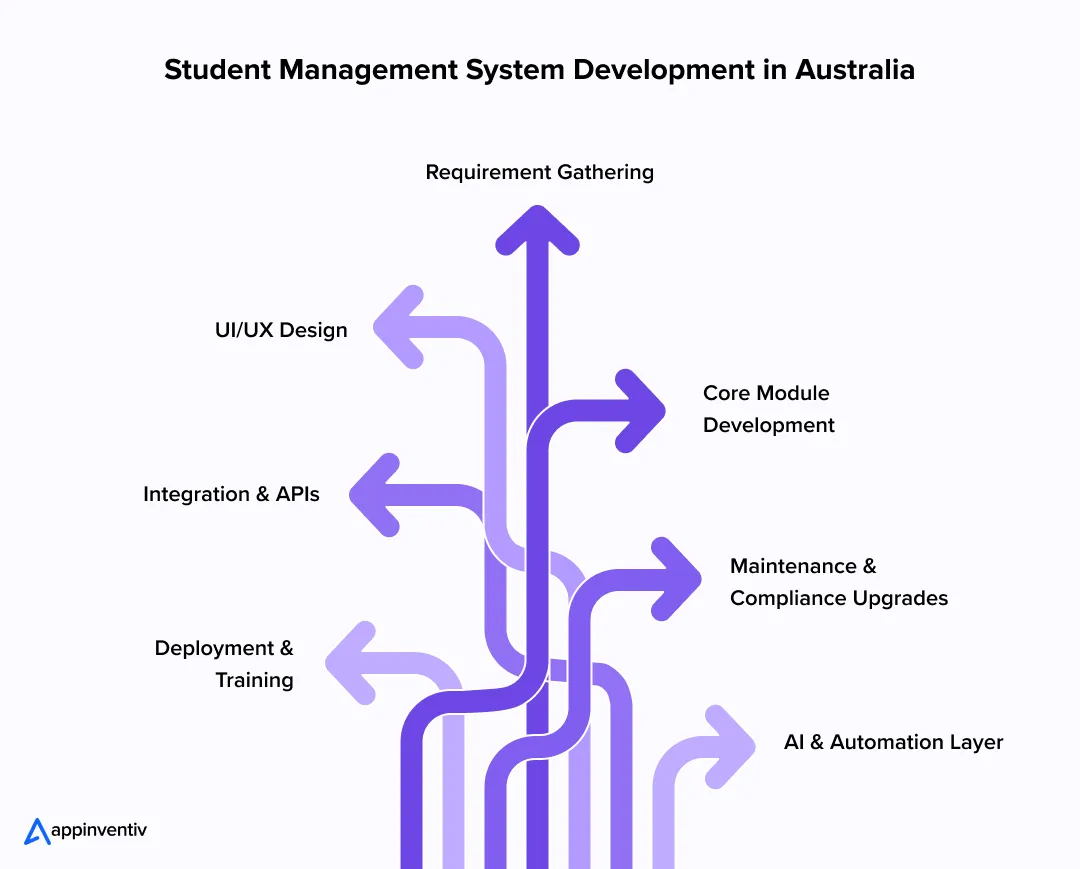
1. Requirement Gathering
Start by understanding the institution’s structure, course hierarchy, and operational workflows.
In student management system development in Australia, this phase is critical because of strict education frameworks. It ensures the product meets compliance and accessibility standards right from day one.
2. UI/UX Design
Every user – teacher, admin, parent, or student – interacts with the system differently, expecting a tailored experience. Designing interfaces that tend to feel natural and localised (multi-language, multi-role dashboards) is what sets apart great systems from generic ones and ultimately accessibility and usability should lead the design process.
3. Core Module Development
This is where the heart of the platform takes shape. The major modules include:
- Enrolment Management – Digital registration, document verification, and course allocation.
- Attendance Tracking – Real-time student attendance management system to log and monitor participation.
- Grade and Assessment – Automated grading tools and analytics dashboards for student assessment management system requirements.
- Communication Hub – Direct messaging and announcements should be passed uniformly across mobile, email, and web portals.
- Finance & Payments – Fee management, receipts, and integrated payment gateways should be a high-critical functionality.
4. Integration & APIs
A modern platform must integrate seamlessly with existing systems – Learning Management Systems (LMS), CRMs, HR tools, and even government reporting databases. That is where open APIs and cloud compatibility become essential for online student management system development.
5. AI & Automation Layer
The role of AI in student management software is growing at a lightning speed.
AI-powered workflows can help flag all the attendance anomalies, predict student performance, automate communication, and even offer chatbot-based support for parents and learners. Adding this layer early will help you ensure that the product is able to evolve intelligently with time.
6. Deployment & Training
Once the platform is tested, deployment happens on a secure, scalable infrastructure – typically when you build cloud based student management system models. Training is equally crucial; your end users must understand how to extract real value from automation and analytics.
7. Maintenance & Compliance Upgrades
The post-launch phase is where many solutions fail.
Regular maintenance ensures that the platform stays compatible with new policies, tech updates, and user needs. In the Australian context, compliance changes happen frequently – so planning for periodic audits and feedback loops is essential.
A well-structured student management system development in Australia project follows this cycle continuously – refine, test, retrain, repeat. That’s what turns a one-time build into a long-term education ecosystem.
Building an SMS is more than coding – it’s creating a digital ecosystem that scales with every institution’s needs.

Core Features for Student Management System Development in Australia
A successful student management system development in Australia project doesn’t start with features – it starts with people.
Every user group in the education ecosystem interacts differently with the system, making it critical for education software development services to be designed around their distinct needs and responsibilities.
Here’s a breakdown of what effective student management system development features look like across user levels:
For Students
Students expect clarity and ease of use above all else.
The best student management system software empowers them with:
- Unified dashboards for tracking course schedules, grades, and attendance rates.
- Real-time notifications on assessments, fee due dates, and general announcements.
- Mobile accessibility and responsive design for on-the-go learning.
- Self-service portals to update information, submit assignments, or download transcripts.
These tools not just enhance engagement levels but also improve accountability levels, where the students know exactly where they stand in their academic journey.
For Teachers & Academic Staff
Educators benefit most from automation and analytics.
When you develop school management software in Australia, the faculty module should support:
- Smart timetabling having automatic conflict resolution functionality.
- Attendance automation built on biometric, RFID, or AI-powered recognition.
- Assessment tools to manage and analyse student performance.
- Integrated communication channels for one-click parent or admin updates.
This frees up teachers from repetitive administrative work, allowing them to focus more on pedagogy and mentoring.
For Administrators
Institutional administrators rely on precision, compliance, and operational visibility.
Their core requirements include:
- Centralised dashboards that seamlessly combine enrollment, finance, and staffing data.
- Regulatory compliance with TEQSA, ASQA, and other state-level reporting.
- Workflow automation for students’ and teachers’ document validation and approval tracking.
- Financial integration with invoicing, receipts, and multi-currency support.
This admin-level layer will form the backbone of student information management system development, while ensuring data accuracy and governance across different departments.
For Parents and Guardians
Parents expect assurance and transparency from a SMS, which is usually – real-time insights into their child’s progress.
Key tools that can help enhance trust and communication levels include:
- Parent portals for monitoring grades, attendance, and get behavior updates.
- Multi-channel alerts through email, SMS, or app notifications.
- Online payment gateways for tgeir childrens’ tuition and activity fees.
Feature sets like these can together create a culture of collaboration and shared accountability among schools, parents, and students.
For Regulators and Compliance Officers
This is where Australian edtech systems must go beyond global templates.
Local compliance is stringent, and a well-built platform supports:
- Automated compliance reporting aligned with TEQSA and ASQA standards.
- Audit trails that ensure traceability of changes and decisions.
- Accessibility compliance under WCAG and Australia’s Disability Discrimination Act.
These elements turn your platform into more than just a management tool – they make it a partner in institutional credibility.
By addressing every stakeholder’s needs, student management system development in Australia evolves from a product into a complete ecosystem. The result?
Streamlined operations, improved learning outcomes, and stronger trust across the educational community.
Understanding the Cost to Build a Student Management System in Australia
Every institution and edtech startup wants clarity before they commit – what’s the real cost to build a student management system in Australia?
The answer depends on your scale, compliance complexity, and how tailored you want the platform to be.
On average, student management software development Australia projects range between AUD $70,000 to $700,000, depending on features, integrations, and architecture maturity.
The following table provides a realistic overview of how costs vary by build type and functional depth:
| Build Tier | Ideal For | Core Inclusions | Estimated Cost (AUD) | Timeline |
|---|---|---|---|---|
| Basic (MVP) | Small private institutions or early edtech pilots | Student enrolment, attendance tracking, communication tools | $70,000 – $150,000 | 8-10 weeks |
| Standard | Mid-sized schools or online academies | Adds finance, assessment modules, and reporting compliance | $150,000 – $300,000 | 12-16 weeks |
| Enterprise | Universities, CRICOS-registered institutions, or multi-campus platforms | Advanced AI-driven analytics, LMS integration, automation, data privacy & audit trails | $300,000 – $700,000+ | 20-28 weeks |
The factors influencing cost of student management software development are not just technical – they are operational and regulatory too.
- Scope of Modules:
More modules = more customisation. A student attendance management system costs less than a complete student information management system development suite. - Integration Requirements:
Plugging the software into your existing CRMs, ERPs, or cloud-based LMS platforms will add to the cost, but it will guarantee long-term scalability and interoperability. - Compliance Complexity:
Systems that must meet TEQSA, ASQA, or CRICOS standards require added documentation, encryption, and reporting logic. - Cloud Hosting & Scalability:
If you plan to build cloud based student management system, your cost will vary by provider (AWS, Azure, GCP) and expected traffic volume. - AI Features & Automation:
Adding intelligent grading, attendance prediction, or chatbot support increases cost but massively boosts long-term ROI – a key part of the role of AI in student management software. - Support & Maintenance:
Post-deployment maintenance typically costs 15-20% of initial build annually – crucial for updates, new compliance norms, and feature enhancements.
How to Budget Smartly
A well-planned student management system development in Australia doesn’t always mean going all in at once. Many institutions start with MVPs, validate adoption, and scale in phases – spreading costs over 12-18 months.
The goal isn’t just affordability; it’s sustainability – ensuring the system remains compliant, flexible, and easy to evolve.
What are Some Common Student Management Software Challenges in Australia?
Even with growing adoption, many institutions struggle to make their platforms truly efficient. The biggest student management software challenges in Australia don’t come from coding – they come from balancing compliance, scalability, and evolving pedagogy.
Here are the key challenges we have seen firsthand and overcome:
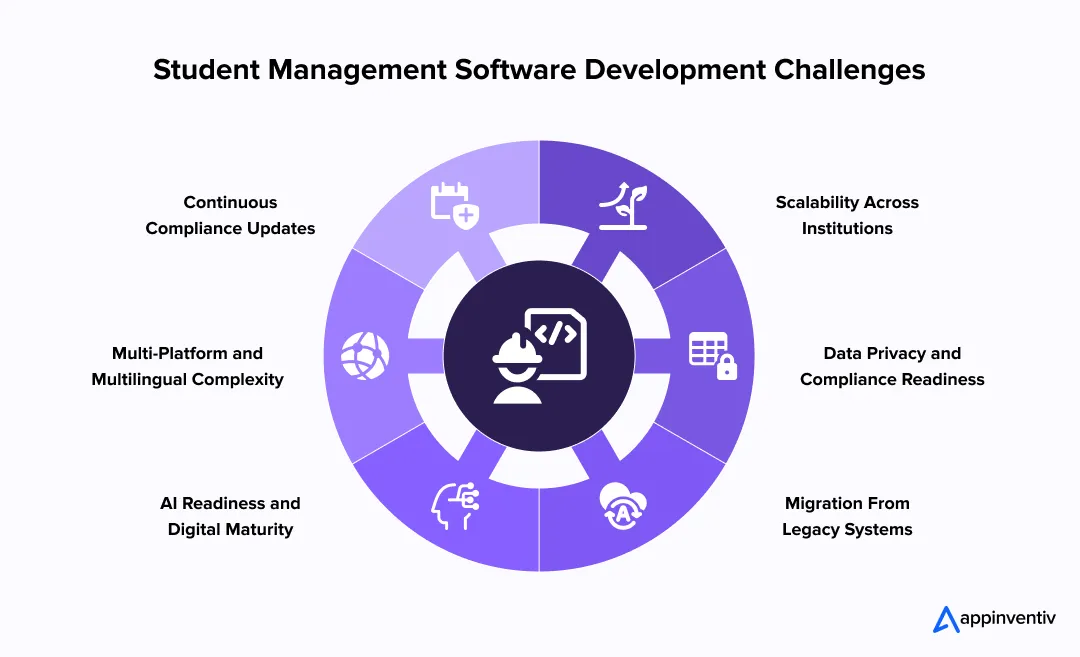
1. Scalability Across Institutions
As student volumes grow, so does system stress. A platform that handled 500 users last semester might crash at 5,000 if the backend isn’t cloud-native.
Mitigation: When you build cloud based student management system on AWS or Azure, use autoscaling and container orchestration (like Kubernetes) to maintain uptime during spikes such as exam or enrollment seasons.
2. Data Privacy and Compliance Readiness
Australia’s Privacy Act 1988 and state-level data protection rules (especially for K-12) make compliance non-negotiable. Many legacy systems store student data without audit trails or role-based access.
Mitigation: Implement granular access control, regular encryption audits, and strict adherence to TEQSA and ASQA frameworks – integral to compliant student information management system development.
3. Migration From Legacy Systems
Institutions still relying on Excel or outdated ERP-based databases face huge migration friction. Data formatting inconsistencies lead to errors and time loss.
Mitigation: Use middleware and integration APIs in your online student management system development journey to refine, validate, and import all the records seamlessly. A structured ETL (Extract-Transform-Load) approach here would minimise the downtime greatly.
4. AI Readiness and Digital Maturity
AI integration is no longer optional – predictive analytics, attendance alerts, and performance trends all depend on machine learning. Yet, most schools lack the digital readiness to enable it.
Mitigation: Start small – introduce intelligent modules within the student attendance management system or the student assessment management system, then expand gradually. This allows incremental ROI while building organisational trust in automation.
5. Multi-Platform and Multilingual Complexity
With multicultural classrooms and remote learning models, accessibility and multilingual interfaces are crucial. A single-language or desktop-only platform alienates users.
Mitigation: From the first sprint of student management system development in Australia, prioritise mobile-first design and language localisation (English, Arabic, Mandarin). It improves inclusivity and user adoption.
6. Continuous Compliance Updates
Australian education policy evolves fast. CRICOS, ESOS, and ASQA compliance modules often need yearly revisions. Static systems become obsolete quickly.
Mitigation: Adopt modular architecture – where compliance logic is isolated, updatable, and versioned – ensuring long-term system adaptability without full rebuilds.
In short – Every challenge here is solvable – but only when addressed at the architecture and planning stage of student management software development Australia projects.
Struggling with scalability, compliance, or migration issues?
We have solved them for leading institutions across Australia – yours could be next.

Profitable Monetisation Model of Student Management System Australia
Once you have figured out how to build a student management system in Australia, the next question that naturally comes up is – how does it pay back?
There isn’t one-size-fits-all pricing here. The monetisation model of student management system in Australia depends heavily on who you are selling to and how they prefer to operate. A private K-12 school with 1,000 students will think very differently from a CRICOS-certified university or an edtech marketplace expanding across APAC.
Let’s look at what’s actually working in the Australian edtech landscape today
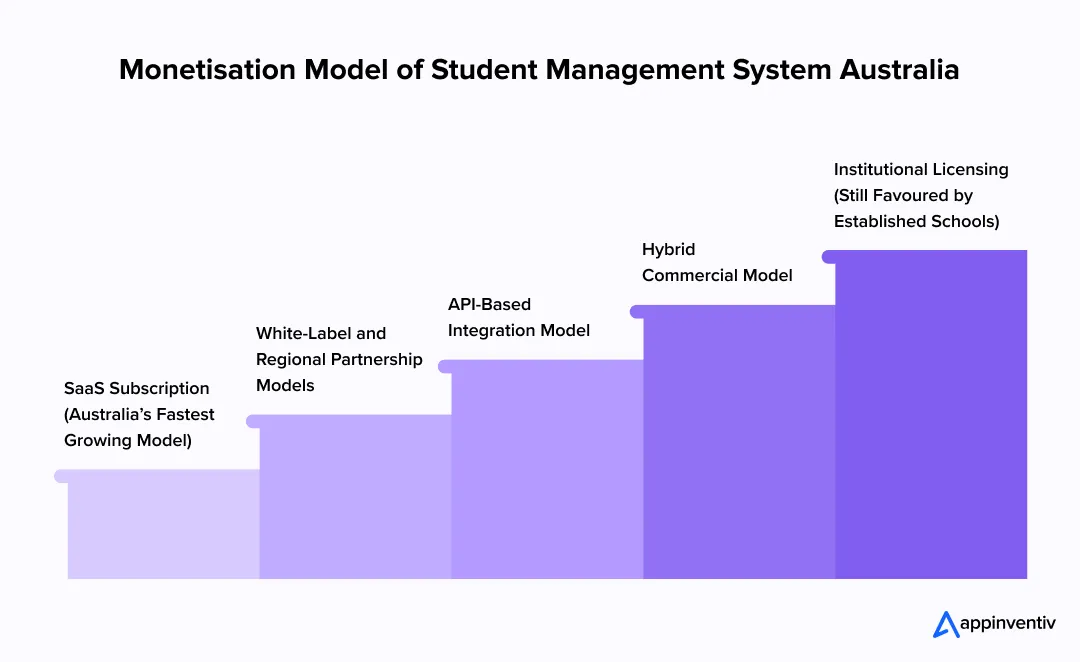
SaaS Subscription (Australia’s Fastest Growing Model)
Most modern edtech startups now package their student management system software as a cloud platform that schools subscribe to monthly or yearly. Instead of paying all the amount upfront, institutions are billed based on per student, feature, or even active user count.
This gives founders the chance to get recurring revenue and institutions the flexibility to start small and then scale as their enrolment counts grow. In practice, smaller schools spend roughly AUD $3-$10 per student per month, while enterprise clients pay more for AI analytics or CRM integration.
It’s a smart model if you plan to build cloud based student management system products aimed at constant evolution rather than fixed deployments.
Institutional Licensing (Still Favoured by Established Schools)
Some schools and universities – especially those with strict internal IT policies – still prefer buying a license outright and hosting the software on their own servers.
Here, you are looking at one-time deals between AUD $50,000 and $120,000, followed by an annual support fee of around 15-20%. While slower to close, these contracts usually have longer retention because institutions like the predictability of ownership.
This model aligns well with compliance-heavy setups where student information management system development needs local hosting under TEQSA or ASQA oversight.
White-Label and Regional Partnership Models
Several edtech founders in Australia now license their tech to other solution providers – letting them rebrand and resell it under their own name. It’s one of the quieter but powerful growth routes for startups without large marketing teams.
Revenue is shared between the platform owner and the local reseller. In return, the brand reach expands across geographies without additional sales overheads. White-label models are especially useful when your student management system development in Australia is mature enough to serve multiple institutions with minimal tweaks.
API-Based Integration Model
Instead of offering a full platform, some teams package their strongest modules – like attendance or finance – into APIs and connect them with existing CRMs or accounting systems.
These micro-products often stem from student attendance management system or payment automation modules. Schools using larger ecosystems like Canvas or Moodle can plug them in instantly. It’s a steady source of revenue through integration fees or per-use pricing.
Hybrid Commercial Model
Larger edtech platforms often blend one-time customisation fees with subscription revenue. Schools pay a setup amount to get their own workflows built in, then continue paying monthly for hosting, maintenance, and AI analytics.
For example, a hybrid plan might include a $25,000 setup followed by $5 per student per month for continuous updates. It’s a balanced approach that ensures upfront development costs are covered while still maintaining predictable income.
No single monetisation model of student management system Australia works for everyone. Startups lean toward SaaS, universities still prefer licensing, and regional resellers thrive on white-labeled solutions.
The best model is the one that scales with your customer’s budget cycle, not against it – turning each new enrolment into recurring, measurable value.
How Appinventiv Helps Build the Best Student Management System in Australia
Choosing the right development partner can define whether your platform thrives or struggles after launch. At Appinventiv, our role in student management system development in Australia goes far beyond writing code – it’s about building systems that meet regional standards, scale sustainably, and empower institutions to deliver world-class digital learning.
Deep Alignment With Australian Education Compliance
Our teams work with frameworks defined by TEQSA, ASQA, and CRICOS to ensure that every student management system software we develop meets the compliance and reporting benchmarks set by Australian regulators.
We build platforms that don’t just store data – they structure it for instant retrieval during audits, NAPLAN reporting, or board reviews. This makes compliance automatic, not an afterthought.
Customisation for Real Institutional Workflows
Through multiple student management system development in Australia projects, we have seen how drastically workflows vary between public and private institutions.
A Catholic K-12 school’s attendance process looks nothing like a private university’s grading module.
That’s why every system we build – whether it’s a student attendance management system or an online student management system development project – starts with deep requirement mapping. We design for how teachers actually work, how parents access updates, and how administrators manage time.
Building Cloud-First, AI-Ready Platforms
Appinventiv has helped education providers build cloud based student management system products that handle high concurrency during enrolment periods and provide real-time visibility to decision-makers.
We integrate predictive analytics and automation wherever it adds real value – from early attendance anomaly detection to student engagement insights. Our custom software developers in Australia focus on tangible, useful AI that improves outcomes instead of overcomplicating workflows.
Collaboration Across Sectors
Education isn’t isolated – it overlaps with finance (fees and grants), healthcare (well-being tracking), and government systems (CRICOS and visa compliance). Our cross-sector experience in fintech, healthtech, and public services enables us to design integrations that go beyond siloed education data.
This multi-domain fluency helps us deliver student information management system development projects that align with national data strategies and open standards.
Why Institutions Trust Us
From startups building their first product to universities digitising legacy systems, Appinventiv’s student management software development Australia team combines local expertise with global delivery standards.
We bring the same discipline that helped brands like Rapid Teachers succeed in regulated environments.
For clients, it means you are not just getting a vendor – you are getting a tech partner that understands both compliance and classroom dynamics.

From Idea to Impact – Building What Education in Australia Truly Needs
The Australian education sector is evolving faster than ever – hybrid classrooms, digital assessments, and tighter compliance are rewriting how institutions operate. In this landscape, knowing how to build a student management system in Australia isn’t just a technical advantage – it’s a competitive necessity.
Founders and institutions that invest early in student management system development in Australia are already seeing the difference: less administrative drag, stronger compliance visibility, and improved parent-teacher communication. The benefits of student management system adoption are no longer theoretical; they are measurable, visible, and scalable.
Appinventiv’s student management software development Australia practice brings the perfect balance of engineering and insight – deep compliance awareness, strong UI/UX foundations, and a roadmap built for long-term adaptability. Whether it’s deploying an online student management system development platform for a startup or rearchitecting a student information management system development project for a major institution, our approach remains the same: clarity, compliance, and capability.
As Australia’s edtech landscape matures, the opportunity can be found in not just building software but in developing systems that can define the future of learning.
Let’s reshape the future of the student management system together.
FAQs
Q: What is a student management system?
A: A student management system software is the system that keeps everything about students, teachers, and classrooms in one place. It stores details of enrollments, attendance, grades, and even parent communication. For most schools, it has started replacing a dozen spreadsheets and files that once used to take hours to update. Instead, information gets logged once and is visible to everyone who needs it, whether that is a teacher or the principal checking performance.
Q: Why do Australian institutions need a student management system?
A: The short answer is compliance. The longer one is that manual work simply cannot keep up anymore. Australian institutions have to meet TEQSA, ASQA, and CRICOS rules, and these change often. With student management system development in Australia, schools can track data automatically and generate audit-ready reports instead of doing them by hand. It saves on time, reduces mistakes, and gives staff a lot of free time to focus on students instead of paperwork.
Q: How much does it cost to create a student management system in Australia?
A: The cost to build a student management system in Australia doesn’t come with a fixed rate range. A lot of it is decided by the size and complexity of what you need. A small, cloud-based setup usually starts near AUD $40,000, while a full system with automation or analytics can be around AUD $150,000.
Q: How long does it take to develop an SMS?
A: A standard student management system development in Australia project usually takes around three to six months. Simpler builds with core functions such as attendance and grading are faster to deliver. Projects which work around automation or custom analytics tend to take a longer development time as they need more testing and data preparation. Most teams, however, tend to launch the base version early post which they collect feedback and keep improving over time.
Q: Can the system integrate with existing tools like LMS or CRM?
A: It definitely can. Modern online student management system development supports open APIs, which means you can link it with platforms such as Canvas, Moodle, Salesforce, or HubSpot. Many schools prefer that route because it avoids replacing existing systems. Everything connects, data flows automatically, and teachers get a single login for multiple tools
[ad_2]
Source_link