
[ad_1]
Key takeaways:
- MVP to enterprise scaling requires planned architecture, governance, and cost controls for sustainable growth.
- Modular, reusable systems and automation can reduce development costs by 30–40%.
- Scaling should be triggered by repeatable demand and operational readiness, not just early traction.
- Avoid common pitfalls like premature scaling, overengineering, and lack of ownership clarity.
- Case studies from companies like Netflix, Amazon, and Airbnb show that disciplined frameworks drive successful enterprise transitions.
Figma was launched in 2015 in a very populated market with a highly constrained browser-based design tool that focused on real-time collaboration more than depth of feature functionality. It did not make an effort to compete with well-established desktop platforms on the first day.
Instead, it confirmed a high-impact insight: teams wanted to design in the browser without friction, and once that need was met, adoption accelerated, and product-market fit strengthened. In several years, Figma was no longer a lean prototype but an enterprise platform that was used worldwide, and finally, it became a landmark by Adobe.
However, initial traction is not an indicator of persistent scale. According to the U.S. Bureau of Labor Statistics and business research aggregators, about 50% of new businesses do not survive beyond five years, with roughly 65% failing within 10 years. It is hardly the absence of ambition that caused the failure. It is a result of unsustainable growth.
The very same fast decision-making, casual procedures, and tightly integrated systems that make an MVP successful may prove to be the source of structural vulnerability when it comes to the demands of an enterprise.
The real issue is not how to start fast, but how to grow deliberately and with structural discipline. To transform an MVP into an enterprise-grade solution, one needs a scalable architecture, well-scheduled feature prioritization, operational governance, security hardening, and pricing controls that grow in tandem with revenue. Expanding should be planned, not done haphazardly.
In this blog, we will discuss the MVP to enterprise scaling framework. We will also analyze the real-world case studies of enterprise evolution, key transition stages, and other essential sections, which we will gradually walk through.
Rapid feature expansion can inflate engineering costs if systems are not designed for reuse and control
Strengthen your foundation before growth compounds complexity

How High-Growth Companies Scale Products While Reducing Development Costs by 30–40%
High-growth companies reduce development costs by strengthening architecture before expanding features, automating repetitive workflows, and aligning hiring with platform maturity. By scaling systems methodically instead of reactively, they avoid duplicated engineering effort and prevent cost overruns that typically accompany rapid expansion.
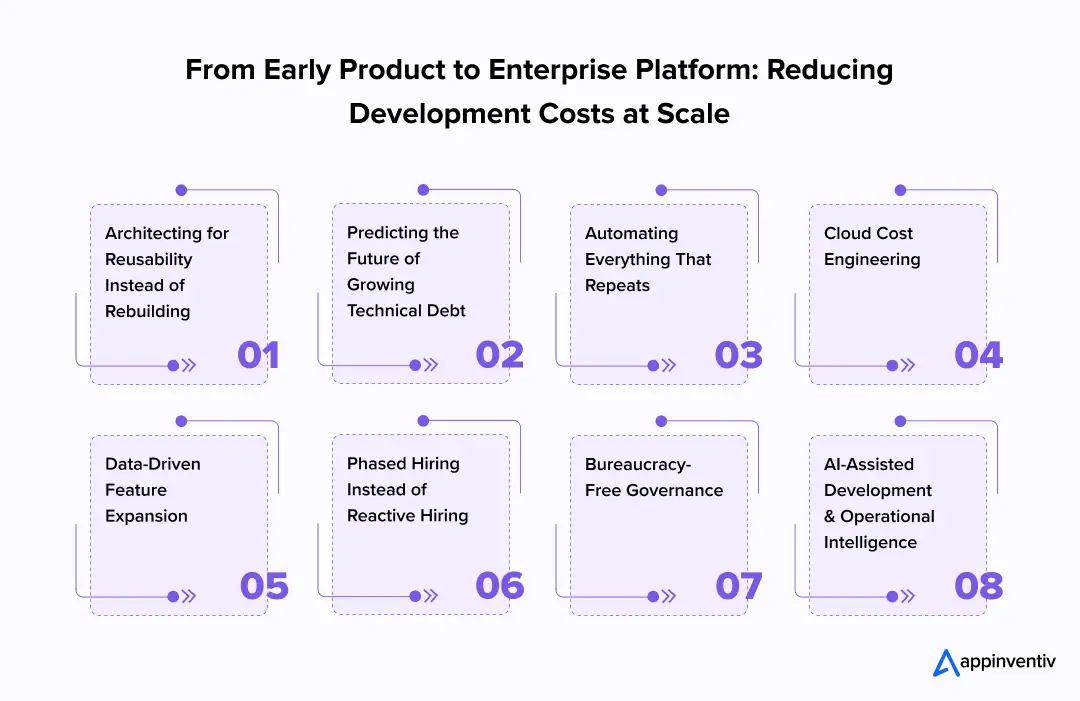
Architecting for Reusability Instead of Rebuilding
Organizations that scale well avoid rewriting core systems each time demand increases. They structure applications into modular components and clearly defined services so new features extend the existing base rather than replace it. Shared libraries, reusable APIs, and standardized integration layers reduce duplication across teams.
Reusability also improves release stability. When core services are tested, hardened, and reused across products, engineering teams spend less time correcting regressions and more time refining functionality. Over time, this approach lowers long-term maintenance overhead and creates a foundation that can support sustained enterprise growth without repeated structural resets.
Predicting the Future of Growing Technical Debt
Technical debt increases the cost of systems as they grow, in many cases exceeding the cost of original development. According to a 2025 McKinsey analysis on enterprise technology economics, when technology investments are not tightly aligned with business value, indirect expenses can dominate overall spending.
In such cases, costs related to cloud consumption, security controls, tooling, and ongoing maintenance may account for as much as 80% of a product’s total lifecycle cost. This strengthens the argument on the importance of early refactoring and avoiding runaway debt as a cost constraint measure.
Automating Everything That Repeats
Scalable engineering practices revolve around continuous delivery and integration automation. The State of CI/CD 2024 report says that 83% of developers worldwide are engaged in DevOps activities, and the widespread adoption of CI/CD pipelines is associated with more standardized delivery results.
As organizations mature, automation extends beyond builds and deployments into testing, monitoring, and infrastructure provisioning. Over time, this reduces manual intervention, lowers error rates, and creates a predictable release cadence that can support enterprise-level scale.
Cloud Cost Engineering
As analyzed by the Capgemini 2025 cloud report, 76% of organizations exceeded their public cloud budgets, with an average overspend of approximately 10%. Primary causes included a lack of cost visibility, decentralized provisioning, and underutilized resources and an ideal demand growth. As business units increase workloads, uncontrolled elasticity is rapidly converted to margin pressure.
Cloud cost engineering is the counter to this drift. Right-sizing infrastructure, getting rid of idle capacity, implementing automated policies, and FinOps discipline will allow us to match consumption with real usage. These controls can ensure that infrastructure costs do not increase proportionally to growth when enforced at the start and can also reduce the total cost of development at enterprise scale.
Data-Driven Feature Expansion
76% of enterprises are focusing on legacy refactoring, 58.6% are adding more automation to development and operations, and more than 50% are adopting API-first methods, as per The State of Enterprise Technology Survey 2025. This is an indication of a definite turn to disciplined modular systems as opposed to the rampant addition of features.
This solidifies a cost principle in the case of scaling companies: construct what the data justifies. Guided by usage patterns and quantifiable business impact, feature roadmaps help teams to build less, maintain less, and spend less on downstream infrastructure and support.
Phased Hiring Instead of Reactive Hiring
The existing 2025-2026 studies are limited to the specifics of hiring during the transition from MVP to enterprise. Nonetheless, larger datasets on the workforce reveal structural stress in the talent market. 74% of employers are finding it challenging to fill essential technical positions, and this has a direct impact on the compensation levels and cost of recruitment.
From a software development cost perspective, reactive hiring during growth can inflate payroll without proportional productivity gains. The expansion of teams into a platform that is not yet stable leads to a higher coordination overhead, longer onboarding cycles and more rework due to architectural inconsistencies.
Matching hiring and system readiness helps bound fixed engineering expenses and mitigate productivity per developer to keep scaling costs economically viable.
Bureaucracy-Free Governance
The PMI Pulse of the Profession 2025 study indicates that only 18% of project professionals demonstrate high business acumen. Projects led by more business-oriented leaders show stronger budget performance and lower failure rates than those managed by less mature counterparts. Those teams aiming to tie delivery decisions to strategic value outperform those that focus on timelines and outputs.
In the case of software development, this translates into cost control. Concrete ownership, self-disciplined prioritization, and decision-making based on value will minimize rework, low-impact builds, and enhance budget compliance. A properly but not overly structured governance reduces waste and makes enterprise scaling economically efficient.
AI-Assisted Development and Operational Intelligence
84% of enterprise CIOs believe Artificial Intelligence will be as significant to business as the rise of the internet. Yet only 11% report full implementation, with security and data infrastructure cited as primary barriers. This gap highlights both urgency and unrealized efficiency.
From a software development cost perspective, scaling with AI optimizes costs by improving code generation, strengthening automated testing, and enabling predictive monitoring that prevents expensive defects and downtime. When embedded into engineering and operations workflows, it shortens release cycles and limits unnecessary infrastructure expansion, supporting scale without proportional cost growth.
Also Read: Guide to Build an AI MVP for Your Product
From MVP to Market Leader: Real-World Enterprise Scaling Journeys
When large corporations launch new digital products, they rarely begin at enterprise scale. Many start with contained pilots, regional releases, or narrow internal deployments that function. The following examples reflect documented transitions within the top global enterprises.
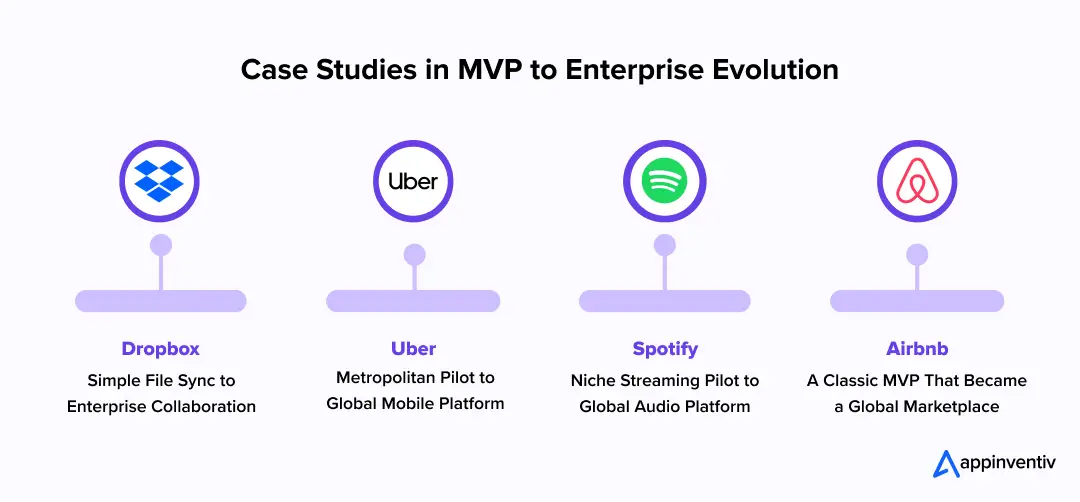
Dropbox: Simple File Sync to Enterprise Collaboration
Dropbox validated demand before building a full platform. A brief demonstration video showing the process of synchronizing files between the devices produced thousands of new sign-ups before a massive investment in infrastructure. Its initial product focused on trustworthy sync, as opposed to enterprise controls or layered collaboration.
Upon finding product-market fit, Dropbox introduced business subscriptions, administrative governance, compliance tooling and API integrations. This development is indicative of an MVP to enterprise scaling framework in which monetization and platform maturity developed with the user base.
The annual revenue of Dropbox is projected to be over $2.521 billion by 2025, reflecting sustained enterprise adoption beyond its original consumer utility roots.
Uber: Metropolitan Pilot to Global Mobile Platform
Uber was founded in 2010 as UberCab in San Francisco with a well-focused black car service. The initial prototype involved only one change in behavior: making a reservation via a mobile interface as opposed to conventional dispatch.
Following the initial traction, Uber expanded city by city, developing dynamic pricing engines, driver onboarding systems, payments infrastructure and compliance processes. This demanded the establishment of a resilient enterprise scaling operating model that would be able to handle the global logistics and regulatory complexity.
In 2025, Uber reported total revenue of approximately $52.0 billion, reflecting year over year growth of about 18%. Monthly active platform consumers increased to nearly 202 million worldwide, with more than 13.5 billion trips completed during the year.
Spotify: Niche Streaming Pilot to Global Audio Platform
Spotify was founded in 2008 as a narrow-scope streaming service in limited markets in Europe. The initial product was dedicated to fast and legal music streaming, having a small collection and being available on the desktop. Its first objective was mere validity: would users switch to subscription streaming instead of piracy and downloads?
Following the product market fit, Spotify has moved into mobile apps, recommendation engines, curated playlists and global licensing relationships. It has subsequently rolled out advertising levels, podcast hosting, creator monetization capabilities and enterprise advertising infrastructure. This development is indicative of an MVP to enterprise scaling strategy, in which initial validation led to systematic growth in technology, app monetization, and international activities.
By 2025, subscriber numbers had grown 12% year over year to 281 million, while monthly active users increased 11 percent to 713 million. Quarterly revenue rose 12 percent in constant currency to €4.3 billion, and operating income reached €582 million, reflecting disciplined expansion supported by a mature enterprise platform.
Also Read: 30+ Spotify Statistics, Facts and Trends to Know in 2026
Airbnb: A Classic MVP That Became a Global Marketplace
Airbnb was founded in 2008, when its two founders offered air mattresses to conference attendees in their San Francisco apartment. The initial draft of the platform was barebones, and basically, it was the confirmation that strangers would pay to spend the night at the place of another person. It lacked any global infrastructure, automated pricing engine or enterprise trust framework.
In 2009, the company was accepted into Y Combinator and received $20,000 in seed funding. In 2025, Airbnb reported about $12.24 billion in annual revenue, including $2.78 billion in Q4, with net income of $2.51 billion. The company also repurchased over $6 billion in shares, and by early 2026, continued expanding monetization channels across its marketplace model, reinforcing how Airbnb makes money through diversified ways.
Its expansion needed organized marketplace regulation, identity confirmation frameworks, remuneration safeguards layers, and cloud-based infrastructures that can be expanded. What began as a simple demand experiment had grown into a controlled, enterprise-level global hospitality marketplace.
Key Stages in MVP to Enterprise Transition
MVP to enterprise transition is a structural move rather than a growth stage. A scale-up should demonstrate that the solution can sustain demand, support wider integrations, handle increased user concurrency, and withstand financial interrogations. A roadmap for defining this transition is provided below.
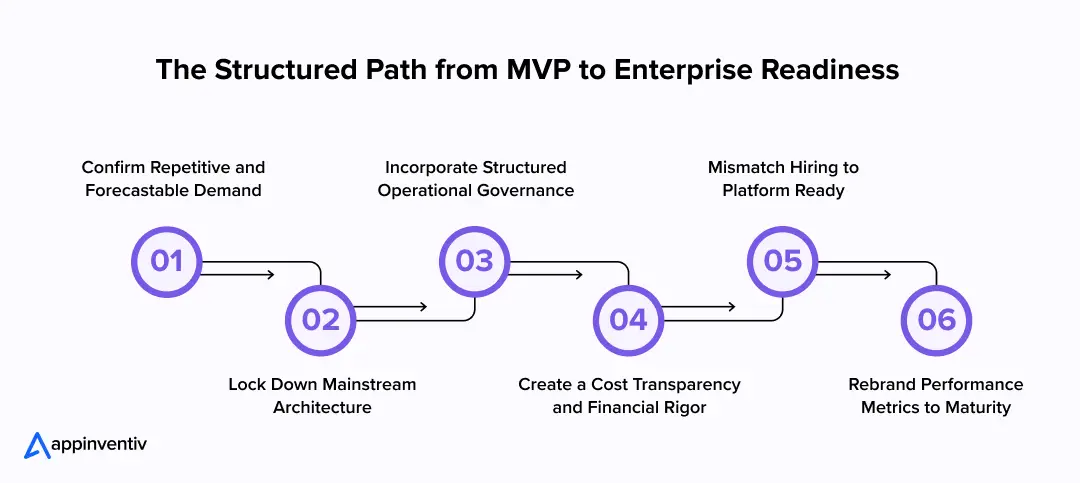
Confirm Repetitive and Forecastable Demand
Demand should be stable and repeatable before increasing infrastructure or workforces. It implies stable retention trends, enhanced customer lifetime value, and cost-effective acquisition costs.
A disciplined MVP to enterprise scaling framework begins with revenue stability, not feature expansion. Expansion based on transient campaigns, price cuts, or single enterprise victories is not worth expanding any structure.
A scale-up entails providing evidence of the ability of revenue patterns to sustain increased operational commitments. The absence of that validation augments combustion instead of fortitude and undermines lasting posturing.
Lock Down Mainstream Architecture
Developing an MVP can be highly integrated and oriented towards delivery speed. These shortcuts are liabilities when under scale. Architectural weaknesses are revealed by higher user load, data volume, integration requirement and uptime expectations.
An efficient enterprise scaling operating model requires hardened systems, modular services, and the separation of responsibilities. Refactoring of key elements and formalizing the deployment environments is a way of ensuring that the foundation can sustain the growth and not short-term patchwork solutions.
Incorporate Structured Operational Governance
Small teams work well under informal alignment. With an increase in the headcount, ambiguity causes friction and stalls delivery. It must have clear release protocols, documentation standards, ownership definitions and change management practices.
A well-crafted MVP to enterprise scaling strategy brings a structure that is not too bureaucratic. Governance is expected to enhance transparency, minimize redundancy and to harmonize engineering and business requirements without compromising the speed of decision-making.
Create a Cost Transparency and Financial Rigor
During growth, infrastructure, tooling and support costs grow quickly. Margins are lost by unseen means without insight into resource consumption and budget ownership. Moving towards scaling to an enterprise level needs financial transparency in engineering and operations.
Budget accountability, workload monitoring, and disciplined provisioning prevent hidden inefficiencies. Financial discipline ensures that expansion strengthens profitability rather than disguising structural cost drift.
Mismatch Hiring to Platform Ready
Premature hiring disproportionately reduces output/payroll and increases coordination complexity. Architectural stabilization should not happen before the MVP to enterprise transition.
Strategic recruiting focuses on positions that initially fortify the system, such as platform engineering, infrastructure reliability, and DevOps for speeding up development. Once the core platform is able to support increased throughput, then feature expansion teams should follow.
Rebrand Performance Metrics to Maturity
In MVP, progress is indicated by the speed of release. The reliability, uptime, consistency of deployment, security posture, and the service’s ability to respond to incidents all have equal weight at scale. An effective MVP to enterprise product scaling strategy resets the success metrics to a focus on durability and predictability.
An established organization is one that balances between innovation and stability. Sustainable growth relies on the ability of systems to work reliably under pressure and teams that accomplish with controlled discipline instead of brute speed.
The Enterprise Scaling Readiness Model
Scaling does not make a single decision. It is a simulated test of the ability of the product, revenue engine, systems, and organization to withstand growth without compromising performance. The enterprise scaling readiness model establishes five structural tests that establish whether growth will compound or kill value.
Economic Durability
Economic durability evaluates whether margins, unit economics and cost structures stand firm with an increase in volume. An effective MVP to enterprise product scaling strategy would guarantee that the contribution margins would be positively scaling with the scale, as opposed to being squeezed at the point of operational pressure. This must be clear about infrastructure costs, support overhead, and customer acquisition efficiency.
Sustainable economics shows that scale will enable greater resilience in the financial system rather than amplify unseen inefficiencies.
Revenue Repeatability
Revenue repeatability determines the predictability, diversification, and renewal of the nature of the income as opposed to being opportunistic. A good enterprise product scaling framework will consider the recurring revenue ratios, expansion revenue trends, and churn stability prior to committing itself to structural expansion.
Scaling creates volatility without the ability to have repeatable revenue sources. Growth is now quantifiable and justifiable with them.
Operational Maturity
Operation maturity shows the consistency of systems, deployment process, security posture and support infrastructure. The transition from MVP to enterprise will involve the transfer of a reactive problem-solving environment to structured delivery environments where service levels and incident management procedures are established.
The strength of operations will make sure that the growth in demand does not jeopardize performance and customer trust.
Organizational Architecture
Organizational architecture determines how teams are formed, decision-making in organizations, and accountability within each line of functions. Building enterprise-ready architecture from MVP extends beyond code; it includes reporting lines, ownership models, and cross-functional coordination mechanisms.
The structural alignment eliminates duplication, minimizes the decision-making process and maintains clarity in execution as the business grows.
Governance & Risk Controls
With scale, financial, operational and compliance risks are exposed to in a proportionate manner. A capital-efficient scaling model brings about financial control, audit preparedness, discipline of documentation and risk management without decelerating innovation.
In a disciplined MVP to enterprise scaling framework, governance turns out not to be overhead. It is a growth capital control mechanism that minimizes rework, protects it, and making growth enhance long-term enterprise value, not increasing unmanaged risk.
Rapid scaling without a readiness framework can lead to wasted resources
Ensure your product, systems, and organization can handle growth

When to Build a Full-Scale Product Directly
Although the MVPs are applicable to lean startups, there are situations when a full-scale product should be launched; trust, compliance, and scalability are more important than lean experimentation.
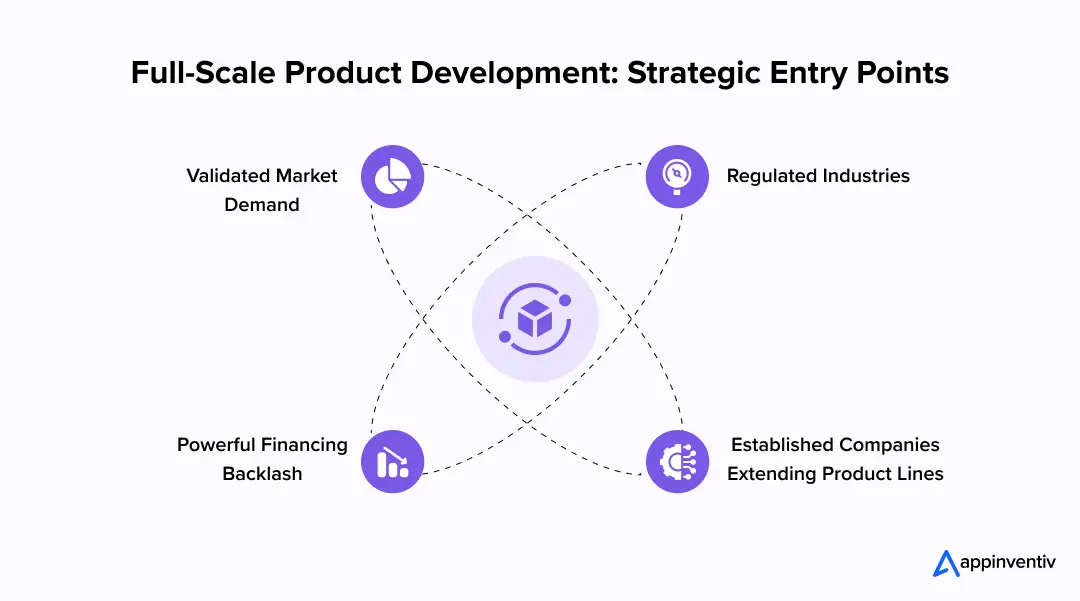
Validated Market Demand: When pilots or previous ventures have shown interest to customers, it will grow fast and not in small steps by building full-scale captures.
Powerful Financing Backlash: Well-funded products have the potential to generate a presence in the market at the very first step due to the substantial investor support or huge budgets.
Regulated Industries: When dealing with healthcare, fintech, or enterprise SaaS, there is a need for compliance, security, and trust that cannot be broken by a biased MVP.
Established Companies Extending Product Lines: Companies that have a prior brand credibility can offer refined solutions and still retain their reputation and meet customer expectations.
In such cases, skipping the MVP stage allows for scaling product development for enterprise growth efficiently, but it demands careful planning, robust architecture, and operational readiness to support immediate large-scale adoption.
Also Read: From MVP to IPO: How to scale your startup business?
Enterprise Cost Structure Optimization
Shifting to the enterprise level changes the framework of capital allocation. Initial products focus on quick-engineering and delivery of features. The cost changes as the scale grows to be in favor of automation, infrastructure resilience, governance, and reliability.
An organization culture that focuses on a disciplined MVP to enterprise scaling framework can make sure that this change is premeditated and not spontaneous.
Cost Structure Shift: MVP vs Enterprise
| Cost Category | MVP Stage (Typical Allocation %) | Enterprise Stage (Typical Allocation %) | Structural Shift |
|---|---|---|---|
| Core Engineering | 60%-70% | 35%-45% | Reduced through automation and reuse. |
| Cloud & Infrastructure | 10%-15% | 20%-30% | Optimized provisioning, increased scale. |
| DevOps & Automation | 5%-8% | 10%-15% | CI/CD, monitoring, and IaC growth. |
| Security & Compliance | 35%-5% | 8%-12% | Governance and risk controls. |
| QA & Reliability | 5%-10% | 8%-12% | Automated testing and SRE practices. |
| Support & Operations | 5%-10% | 10%-15% | Structured incident management. |
As organizations mature under an enterprise scaling operating model, engineering effort becomes more reusable, and infrastructure spending becomes more performance-driven.
Estimated Investment to Scale
The financial commitment is based on complexity and regulatory exposure. The average 12-24 month ranges of investments are witnessed across digital platforms:
| Company Stage | Revenue Band | Estimated Scaling Investment |
|---|---|---|
| Early Growth Startup | $1M–$10M | $500K – $2M |
| Growth-Stage SaaS | $10M–$50M | $2M – $8M |
| Late Growth / Pre-IPO | $50M+ | $8M – $20M+ |
| Enterprise Modernization | $100M+ org revenue | $10M – $50M+ |
These investments are aimed at architectural remodelling, automation, optimizing clouds, compliance, and restructuring of the organization. A proper MVP to enterprise scaling strategy is centered on enhancing the strength of the core systems and then increasing the capacity of delivery.
Where Cost Optimization Occurs
Cost optimization occurs when automation, architectural stability, and disciplined operations reduce rework, manual oversight, and unpredictable infrastructure expenses as the product scales.
Architectural Reusability: Shared components and modular services avoid redundant engineering work, reducing per-feature costs in the long run.
Cloud Efficiency: Autoscaling and observability help to eliminate waste caused by overprovisioned infrastructure.
Automation of Delivery: Automated regression testing and CI/CD reduce manual work and shorten release cycles.
Structured Hiring: Platform-first recruiting builds a capital-efficient scaling model, so every new addition to the system makes it more stable rather than increasing payroll.
Those organizations that invest in designing MVP for enterprise scale shift spending more on durability and automation which enables growth to increase margins rather than reduce them.
Common Scaling Pitfalls: What Derails Growth and How to Avoid Them
Most organizations believe that momentum is the only thing that will take them from prototype to enterprise. As a matter of fact, scaling is associated with new operational, architectural and financial demands which need to be consciously recalibrated. The most common break-even points in high-growth transitions are listed below.
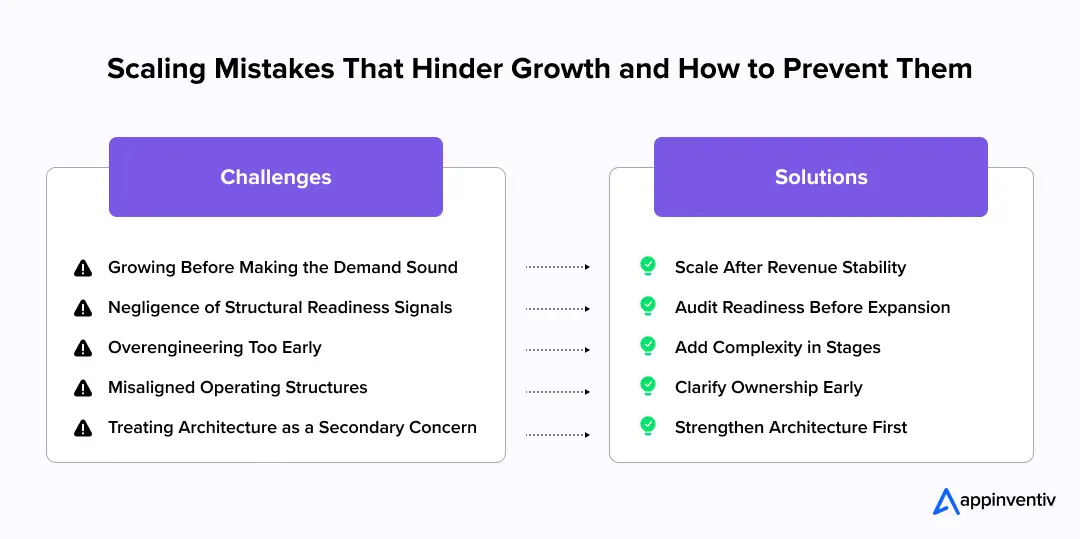
Growing Before Making The Demand Sound
Expanding infrastructure, hiring, and feature sets before revenue stability has been established is one of the most intractable common scaling pitfalls. Durable demand is confused with early traction. In the case of volatile retention and unit economics, high growth increases the cost exposure. Scaling must be based on proven revenue trends, but not hope or influence.
Solution: Validate repeatable demand with retention and unit economics. Only scale once revenue trends are predictable to avoid cost overruns.
Negligence of Structural Readiness Signals
Several teams do not have a formal scaling from MVP to enterprise, as they believe that operational maturity will emerge in a natural way. In the absence of formal analysis of architecture resiliency, release discipline, and support capacity, the systems will shatter under pressure.
Solution: Audit architecture resiliency, deployment discipline, and support capacity before scaling to identify weak points. Also, an AI readiness checklist helps organizations identify weak points before they translate into enterprise-level failure.
Overengineering Too Early
A partial or timed-out MVP to enterprise scaling framework may drive teams down the road to untimely complexity. The addition of elaborate microservices architecture, layers of governance or tooling stacks in advance of actual demand justifies itself by slowing delivery and raising the cost of maintenance. Scaling structures must reflect business maturity and not best practice theory.
Solution: Build system complexity gradually, adding features, automation, and monitoring only as user adoption and business needs expand. This ensures efficiency without overcomplicating the product prematurely.
Misaligned Operating Structures
Expansion tends to reveal lapses in responsibility and ownership. In the absence of a well-established enterprise scaling operating model, teams will overlap in their efforts, resources, and have indistinct decision rights. Structural clarity is needed in scaling. The complexity of coordination changes necessitates the need to change operating models.
Solution: Define ownership, decision rights, and workflow clarity early to reduce friction and enable coordinated growth.
Treating Architecture as a Secondary Concern
Probably the worst mistake is to delay basic improvements in the system. Aggressive feature expansion should be preceded by building a scalable architecture for growth. With architecture characterized by tight, fragile coupling, every release adds risk.
Solution: Invest in building a scalable architecture for growth first; a modular, resilient design ensures each release strengthens, rather than destabilizes, enterprise operations.
Let Appinventiv Help You In Your Journey From MVP To Enterprise
The process of expanding an MVP into a full-blown enterprise platform is no longer the choice for emerging businesses seeking to compete globally. Test products prove concepts, yet the true business impact is achieved when systems, processes, and teams can handle thousands or millions of users without spiraling.
When done properly, such a transition can save 30-40% of the development expense by removing duplicated engineering work, automating redundant workflows, and enhancing infrastructure before the additional features or workforce.
At Appinventiv, we specialize in guiding companies through this journey with a proven MVP to enterprise scaling framework. In the case of emerging businesses such as JobGet, Edamama, Edfundo, and Koda, we assisted in growing lean prototypes into platforms that can support complex user interactions, customized user flows, and real-time analytics.
These initiatives created a modular architecture, common component libraries, and automated CI/CD pipelines, increasing the likelihood of building scalable ventures and keeping development overhead under control.
In the case of enterprise clients like IKEA, Adidas, Americana ALMP, and Hoi, Appinventiv has deployed large-scale systems that combine legacy, cloud infrastructure, and enterprise security standards. These projects required the use of structured enterprise-scaling operating models, strong governance, and performance monitoring to ensure that growth would not interfere with stability.
Regardless of whether you are a high-growth emerging business or an international brand in need of modernizing your operations, Appinventiv, as a reliable software development company, will guide you through the MVP to enterprise transition process with proper strategic planning, cost-effective development, and scalable architecture.
As a recipient of the “Leader in AI-First Product Engineering” recognition at the ET Industry Changemakers’26 Awards, we build platforms that are dependable, scalable, and aligned with measurable return on investment. Our delivery approach is grounded in disciplined engineering and long-term value creation.
Get in touch with our experts today!
FAQs
Q. How do we scale from MVP to enterprise without doubling engineering costs?
A. Here’s how you can scale from an initial MVP stage to an enterprise-grade platform without doubling costs:
Core Architecture Stabilize: Factor out weak code in MVP. Minimize technical debt in the initial stages to ensure the release of subsequent releases have fewer alterations.
Adopt a Structured MVP to Enterprise Scaling Framework: Architectural standards, release discipline, and ownership models should be defined in advance and then extended to additional teams. Scale the headcount, then scale the system.
Automate Repeat Work Processes: Make an investment in CI/CD, automated testing, and infrastructure as code. During growth, manual deployment and testing swell the engineering costs.
Focus on the High-Impact Features: Grow where customer information is shown to be in demand. Do not have a speculative feature build that adds to the maintenance load.
Recruit Platform Engineers First: Enhance the teams of DevOps and system reliability, and then increase the feature squads. The deep foundations minimize the coordination overhead.
Also Read: How to Build a Minimal Viable Product and Secure Funding
Q. When should a company move from MVP to enterprise scaling?
A. When demand is repeatable and predictable, then a firm needs to transition to enterprise scaling and not MVP. Retention trends have to be normalized, the cost of customer acquisition must be cost-effective, and infrastructure load should not be driven by promotion but by actual utilization. Early scaling increases cost inefficiency, whereas late scaling can reduce market capture. It should be transitioned on the basis of structural preparedness rather than optimism.
Q. What financial metrics matter most during enterprise scaling?
A. Here are a few financial metrics you need to consider while scaling your enterprise:
Gross Margin Stability: Guard profit even as it grows. The erosion of gross margin is an indicator of operational inefficiency.
Customer Acquisition Cost/LTV Ratio: Sustainable scaling presupposes a healthy lifetime value as compared to acquisition expenditure.
Burn Multiplefinancial: Measure the efficiency of capital to net revenue growth. Reduced burn multiples denote disciplined scaling.
Cost per Active User Infrastructure: Measure efficiency of cost along with usage. This ratio should be enhanced by economies of scale.
Capital Allocation Discipline: In building your scaling roadmap product, make sure to invest in what has been proven in demand and not in guesswork.
Q. What distinguishes scalable growth from revenue acceleration?
A. Acceleration of revenues may be done by discounts, excessive marketing expenditure or temporary business contracts. It improves topline figures but can put pressure on operations or squeeze margins.
Scalable growth, on the other hand, enhances system resilience and increases revenue. Governance, cost structures, and infrastructure are reinforced with expansion. The larger the business, the stronger rather than the weaker.
[ad_2]
Source_link