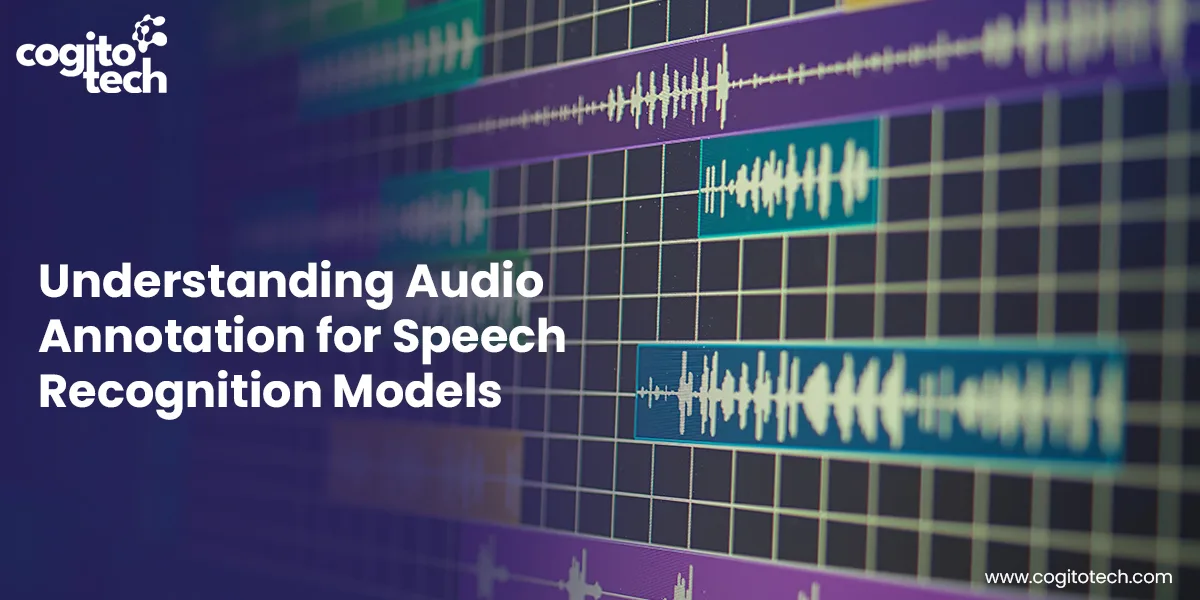
Many smart devices now have an in-built virtual assistant that uses ASR technology to process voice commands, such as “set an alarm,” “create reminders with AI,” and “listen to music.” From video caption generators and voice search to the development of personal assistants that respond to voice commands, it is all made possible by ASR.
Speech recognition systems find numerous applications, and as developers create more sophisticated solutions, the demand for extensive, high-quality datasets rises. This blog describes the potential of audio speech annotation to power AI-driven applications.
Speech recognition vs voice recognition
Many people use speech recognition and voice recognition interchangeably, but they are actually quite different. Speech recognition is all about turning spoken words into written text, focusing on what is being said rather than who is saying it.
Voice recognition, in contrast, aims to recognize or confirm who is speaking. It does not care about the words themselves; it only cares about matching the voice to the right person.
So, what exactly is ASR?
Automatic Speech Recognition (ASR), or speech-to-text recognition, is a useful technology that enables computers to convert spoken words into text. It means analyzing audio speech and transcribing spoken words into written text from various digital formats, a task popular for creating voice-operated AI systems that require annotated datasets to function. But before we understand the audio annotation process, let us explore the formats used in ASR.
What comprises audio formats for ASR?
Audio files hold raw sound for model training and annotation. ASR training is best with
- WAV, which is uncompressed and has high audio fidelity;
- MP3, which compresses files but may affect model performance;
- FLAC, which balances quality and storage efficiency;
- AAC and OGG, which are used for streaming or mobile data collection;
- and AIFF, a high-quality format similar to WAV.
All the above formats are organized and handled electronically through audio annotation.
The audio annotation role in ASR
Audio data annotation is useful for an efficient human-computer interface, which has progressed from requiring users to type on keyboards to touchscreens, and users now use voice commands for interaction. Sound waves, recorded as raw analog audio, are transformed into digital signals that represent the wave amplitude at specific time points.
Along with raw audio, annotation output types store timestamps, transcriptions, speaker names, and acoustic events. Simple transcriptions are recorded in.txt, whereas organized and scalable annotations are in JSON, CSV/TSV, or XML. Praat (.TextGrid) labels phonemes and words, whereas ELAN (.eaf) annotates language. SRT and VTT are used in speech, subtitles, and timestamp captions. The combination of these formats ensures accurate labeling, speech, and ASR model communication, and quick training.
All this raw data is given structure by data labelers. The process of audio data labeling creates datasets that AI algorithms need to operate on before AI-driven voice applications become available.
What features do speech recognition systems have?
Voice recognition systems depend on multiple components working together to analyze human speech. The essential components of voice recognition systems include.
Audio preprocessing: The input device produces raw audio signals that need preprocessing to improve voice input quality. Some audio preprocessing captures the correct pronunciation, tone, and timing of spoken words. Behind this feature, annotators manually eliminate artifacts and noise.
Feature extraction: The process of extracting features converts preprocessed audio data into more useful information. It can be for video captioning, transcribing customer support interactions for analysis, or part of a voice assistant interaction, to name a few.
Language model prioritization: The system assigns a higher value to specific words and phrases, such as product references, in audio and voice data. The system becomes more likely to detect these particular keywords in future speech recognition operations.
Acoustic modeling: This technology detects and extracts phonetic units from spoken audio recordings. Acoustic models are trained on large language databases that contain audio recordings of speakers with various accents and from different cultural backgrounds.
Profanity filtering: The system is trained to detect profanity to filter out offensive content. The audio data preparation process needs to eliminate all inappropriate words and explicit language to enhance the differentiating quality of spoken content in ASR models, i.e., abusive and non-abusive words.
What are the challenges of speech recognition with solutions?
Speech recognition technology offers various advantages, yet it requires addressing multiple existing problems. Some limitations of audio speech recognition include the following.
- Acoustic Challenges: Speech recognition applications face challenges because different accents and dialects use distinct pronunciation patterns, words, and grammatical structures.
If a speech-to-text model is trained primarily on a single dataset, say American English-accented recordings, then it creates difficulties for speakers of Scottish accents because their speech patterns differ from the established pronunciation.
Solution: The solution requires researchers to include speech recordings from speakers who have different accent patterns. The system can identify multiple speech patterns much more conveniently.
- Background noise: Sometimes, the model cannot predict words because, in real-life scenarios, sound comes with background noise that contains non-essential sounds, such as construction noise, car horns, bird songs, and other environmental sounds, making it difficult for speech recognition applications to correctly analyze phrases and convert them into text.
Solution: Pre-processing eliminates background noise and is useful for voice AI systems operating in noisy conditions. The application of data augmentation methods helps minimize the effects of audio data corruption caused by noise entering the system.
- Out-of-vocabulary words: Since the speech detection model has not been trained on OOV words, they may be misrecognized or not transcribed when encountered.
Solution: Word Error Rate (WER) can help in ASR model development. It is a key metric that assesses dataset quality by comparing model-generated transcripts with human-annotated ground truth data. Cogito Tech offers high-quality datasets focused on labeling and supporting WER analysis in its audit and quality-check workflows.
- Data privacy and security: Speech recognition systems process and store sensitive personal information, such as financial data. An unauthorized party could use the captured information, leading to privacy breaches.
Solution: Encryption protects data privacy by ensuring that sensitive audio data is securely encrypted before transmission to clients and can be accessed only by authorized parties. Whereas we also use data masking to replace sensitive speech data with similar-sounding alternatives; for example, muting names, beeping PII, or redacting segments that cannot be restored to their original form and are only for model training purposes
Conclusion
Speech recognition systems are only as effective as the quality of the audio data used to train them. Current ASR systems require human oversight because speech recognition requires precise word meanings.
As more businesses expand their use of AI, their operations will require more detailed audio information, as voice-based AI systems now operate across multiple industries and require enhanced annotation methods to create scalable speech recognition systems that provide excellent user experiences.
By choosing Cogito Tech, you can work with language experts and other skilled data annotators to turn raw audio data into actionable insights that machines can understand, helping ASR solutions support stable multilingual speech/music/song recognition and language detection, delivering accurate results across languages, accents, and real-world scenarios.