
Key takeaways:
- Generative AI could contribute $110 billion to $180 billion in value across real estate processes, including marketing, leasing, and asset management.
- AI chatbots can improve lead generation outcomes by responding instantly and qualifying prospects.
- Early adopters report faster response times and improved customer engagement across digital channels.
- Conversational automation is emerging as a core interaction layer for property discovery, leasing support, and tenant services.
- Real estate automation with AI chatbots strengthens tenant engagement while reducing repetitive operational workload.
Property management is no longer just about maintaining physical assets; it is about managing a relentless stream of digital data. Today’s property teams are inundated with inquiries across web forms, WhatsApp, and listing portals. The friction isn’t just in the volume—it’s in the latency.
Industry data suggests that Generative AI could unlock $110 billion to $180 billion in value for the real estate sector. However, the true winners won’t be those who simply install a “chat window,” but those who build a conversational layer integrated into their core operational stack.
The Enterprise Shift: A real estate chatbot is not a replacement for agents; it is an organizer. It is an orchestration layer that captures intent, logs requests, and initiates actions directly within your CRM and Property Management Systems (PMS).
Companies that Respond Within 5 Minutes are 100× More Likely to Convert
Automate property inquiries for faster conversions.
Where Chatbots Fit Across the Property Lifecycle
As portfolios expand and operations stretch across cities (sometimes countries), communication gaps tend to surface at predictable points: first inquiry, application, move-in, maintenance, renewal.
A property management chatbot works best when positioned as a lifecycle layer rather than a standalone widget. It connects conversations directly to systems, triggering actions in the CRM, database systems, and tenant platforms. That’s how property operations automation becomes practical rather than conceptual.
Below is how a real estate chatbot typically supports each stage of the property journey.
Pre-Sales and Lead Qualification
Most property journeys begin with uncertainty. “Is this unit still available?” “Does it allow pets?” “What’s the move-in cost?” Prospects compare options quickly and often abandon them if responses lag.
A conversational interface reduces that drop-off. In this phase, a chatbot for real estate lead generation or an AI chatbot for property listings can:
- Guide property discovery based on budget, location, and preferences
- Capture buyer or renter requirements in a structured format
- Match prospects with relevant units in real time
- Schedule tours or consultations automatically
- Sync lead data into CRM for follow-up
The advantage is not just speed; a structured intake improves data quality. Agents receive pre-qualified leads instead of fragmented messages scattered across inboxes. This is where AI-powered property inquiries begin to turn into pipeline-ready opportunities.
Also Read: How Much Does AI Chatbot Development Cost?
Leasing and Sales Support
Once interest is established, complexity increases. Applicants need guidance on documentation requirements, clarification of policies, and visibility into the timeline. Back-and-forth email threads often slow momentum.
A well-designed AI chatbot for real estate streamlines this stage by providing consistent, policy-aligned responses while initiating workflow actions. Typical support includes:
- Confirming availability and eligibility criteria
- Guiding applicants through required forms and documentation
- Answering lease-related and compliance questions
- Coordinating application follow-ups and reminders
- Updating CRM status through real estate chatbot CRM integration
Here, the chatbot functions almost like a structured leasing coordinator. It does not negotiate; that remains human, but it removes friction from administrative steps. This improves throughput without compromising oversight.
Property Management and Tenant Services
After move-in, the interaction pattern shifts. Tenants are less concerned with listings and more concerned with response reliability.
A tenant or property management chatbot supports day-to-day operations by:
- Logging and routing maintenance requests with priority tagging
- Providing real-time status updates on open tickets
- Sending rent reminders and payment guidance
- Sharing building policies and amenity information
- Escalating complaints based on predefined rules
When integrated into AI-powered property management software, these actions are not merely conversational; they trigger system-level updates. Maintenance teams receive structured tickets, managers gain visibility into response times, and tenants receive acknowledgment instantly, even outside office hours.
This is where tenant engagement automation delivers measurable impact. Reduced waiting times often correlate directly with higher satisfaction and fewer repeat complaints.
Also Read: How Chatbot Development is Shaping The Business Growth Story
Post-Occupancy Engagement and Retention
Retention rarely depends on a single interaction, but rather on consistent communication over time.
A real estate virtual assistant chatbot can support post-occupancy engagement through:
- Lease renewal reminders and early-renewal incentives
- Feedback collection and satisfaction surveys
- Community announcements and amenity updates
- Guided move-out instructions
This continuous interaction supports lease management automation while maintaining responsiveness throughout the tenant lifecycle.
Importantly, it also captures engagement data. Patterns in inquiries, service requests, or renewal hesitations provide insight into portfolio health, an often overlooked advantage of AI-driven real estate workflows.
Also Read: Cost to Build a Property and Lease Management Software
Operational Impact Across the Lifecycle
When examined end-to-end, the value of real estate automation with AI chatbots lies in continuity. Conversations that once ended in email threads now generate structured actions. Leads are recorded, tickets are created, and status updates are logged.
Instead of fragmented communication across departments, conversational data flows through connected systems: CRM, PMS, listing platforms, creating a unified interaction layer. That layer strengthens reporting accuracy, reduces duplicated effort, and improves response consistency across properties.
For organizations considering deeper chatbot development for real estate, the key architectural decision is how tightly the chatbot should integrate with operational systems. A structured development plan ensures integrations, compliance requirements, and governance controls are addressed early, preventing rework as adoption scales.
In practice, chatbots fit best not at a single touchpoint, but across the entire property lifecycle, from discovery to renewal.
Real Estate Chatbot Use Cases That Deliver ROI
Return on investment becomes clearer when automation is examined at the workflow level, not at the feature level. In day-to-day property operations, the gains from a real estate chatbot typically show up in three areas: time saved, response consistency, and conversion lift.
What looks like a simple chat window on the surface often reshapes how leasing teams and property managers handle volume behind the scenes. Below are real estate chatbot use cases where measurable impact is commonly reported.
1) Maintenance triage (high-volume, after-hours)
Situation: Tenants report issues at all hours; on-call teams get swamped with low-value tickets.
What the bot does: capture structured inputs (unit, photo, severity), run rule-based priority (electrical > water > cosmetic), write a work order via PMS API, push async notification to vendor queue. Use confidence threshold for natural-language intent; escalate if confidence < 0.65. Store attachments in a secure object store; log metadata to audit trail.
KPIs: first acknowledgement <10s; ticket accuracy ≥92%; containment 40–60%.
How Appinventiv helps: build the PMS connector, implement rule engine + fallback, and set up audit & encryption controls.
2) Lead Qualification and Tour Scheduling (Front-door Conversion)
Situation: High web traffic but many leads drop off after slow replies.
What the bot does: run a quick intake form, map responses to property inventory via listing DB, reserve tentative viewing slots (calendar API + locking), create leads in CRM with property & prospect IDs, and send confirmation via SMS/WhatsApp. Use RAG to surface unit-specific facts (availability, fees) with provenance.
KPIs: lead-to-tour time reduced by up to 60%; lead qualification accuracy ≥85%; no-show rate ↓10–15%.
How Appinventiv helps: integrate CRM + calendar + listing feed; design booking lock patterns to avoid double-books.
3) Lease Renewals and Billing Nudges (Retention Automation)
Situation: Renewals are missed or handled late; revenue churn increases.
What the bot does: trigger conversations 90/60/30 days before expiry, present renewal options pulled from lease datastore, generate draft renewal docs (template + prefilled fields), and queue workflows for approvals. For billing, send payment links and reconcile status via payments API. Ensure all PII access is role-restricted.
KPIs: renewal engagement rate ↑ 20–30%; automated renewals processed without agent intervention (containment) 30–50%; late payments reduced.
How Appinventiv helps: design templating engine, payments integration, and role-based access policies.
4) Smart-building Actions via Chat (IoT Control + Safety)
Situation: Tenants want simple controls (temp, access) without separate apps.
What the bot does: authenticate users, call building IoT APIs with rate limits, validate commands against safety rules, and log all control actions to immutable audit. For critical requests (door unlock, HVAC emergency), run deterministic escalation to on-call staff. Use tokenized access for device calls.
KPIs: command success rate ≥98%; security incidents = 0; average time-to-action <30s.
How Appinventiv helps: implement secure IoT gateway, per-field redaction, and emergency escalation workflows.
5) Portfolio Analytics & Anomaly Detection (Operational Insight)
Situation: Teams lack early signals (e.g., spikes in HVAC tickets at a building).
What the bot does: aggregate conversational metadata into a data lake, run simple anomaly detection (moving average + z-score), and surface alerts into dashboards and chatbot briefings. Combine ticket trends with sensor and weather feeds for context. Provide drill-downs via conversational queries.
KPIs: anomaly detection lead time (weeks → days); percent of issues proactively addressed ↑; decision cycle time reduced.
How Appinventiv helps: build ETL pipelines, model simple threshold detectors, and wire alerts into Slack/ops dashboards.
Manage Leasing Inquiries, Property Questions, and Tenant Requests Without Increasing Manual Workload.
A custom real estate chatbot connects conversations directly to your property workflows.

Architecture and Build Considerations for a Production-Ready Real Estate Chatbot
A real estate chatbot is only as effective as the workflow behind it. The strongest results come when the bot is designed as part of the operating stack, not as a website add-on. That means clear conversation design, reliable integrations, and controls that protect tenant and buyer data.
Below is a practical reference architecture for real estate chatbot development that supports leasing, tenant support, and property operations automation at scale.
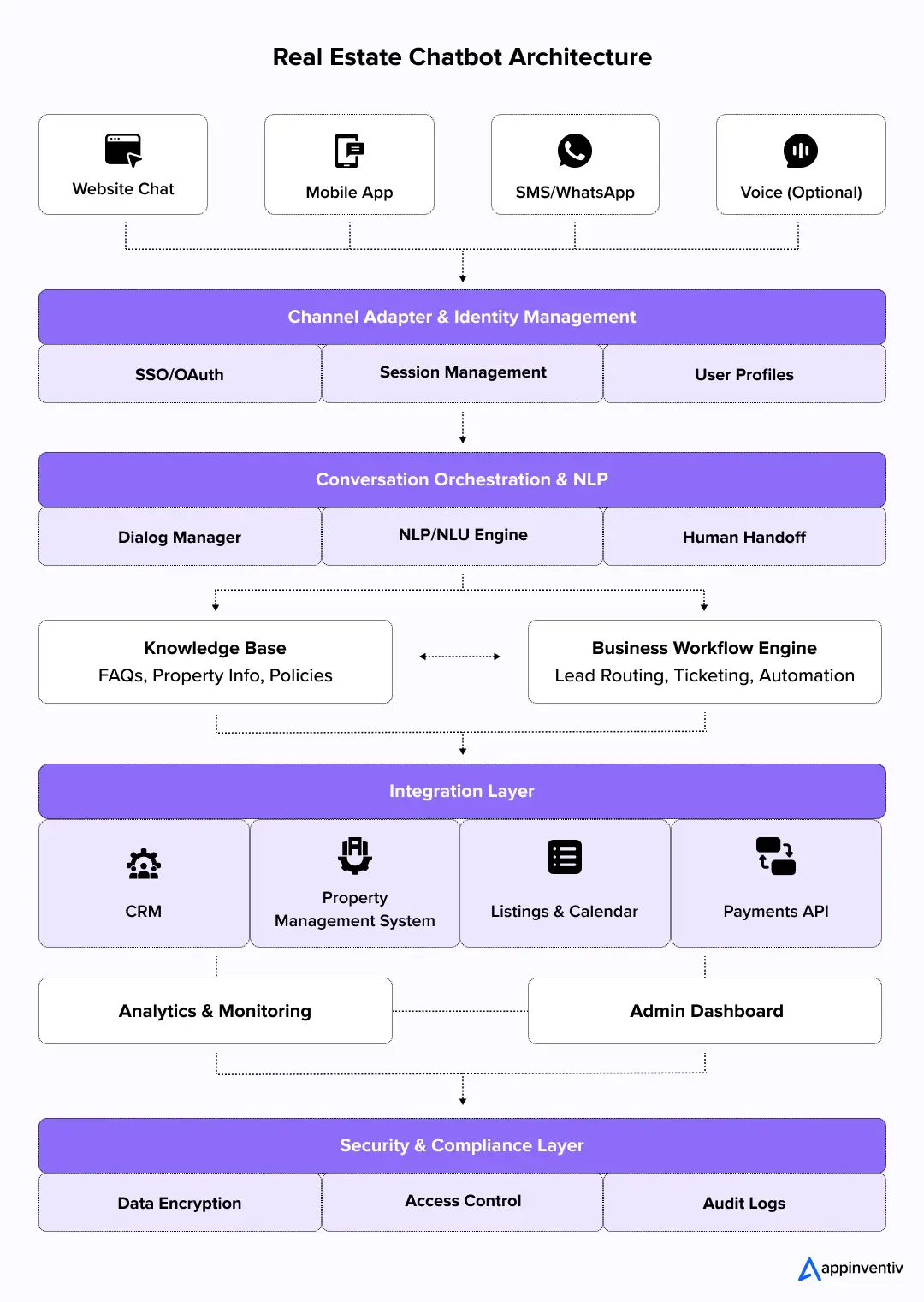
1) Conversational Layer that Handles Real Property Language
Most failures happen here. Users don’t speak in neat menu options; they ask mixed questions: “Is parking included?” “Can I schedule a viewing today?” “My AC is leaking.”
A production-grade conversational AI for real estate needs:
- Intent detection that separates sales, leasing, and tenant-support requests
- Entity extraction for address, unit number, budget, dates, lease terms, ticket category
- Context memory across turns (so the user doesn’t repeat details)
- Multilingual support if your tenant base spans languages
This layer should be tuned with real inquiry transcripts and updated regularly, not trained once and left alone.
2) Workflow Engine that Turns Chat Into Action
A chatbot becomes useful when it can initiate workflows, not just respond.
Typical workflow patterns:
- Create a lead record and assign it to the right agent based on territory or property type
- Auto-schedule viewings by checking calendar availability
- Open a maintenance ticket with priority rules and vendor routing
- Send tenant updates that reflect ticket status changes
This is where tenant engagement and lease management automation are usually delivered.
3) Integration Layer for Systems You Already Run
For B2B property teams, chatbot success depends on integration. Without it, conversations end as dead-end transcripts.
Common integrations in an AI chatbot for property management build:
- CRM for lead capture, scoring, assignment, and follow-up
- Property management system (PMS) for resident records, work orders, notices, and renewals
- Listing/property database for availability, unit attributes, pricing, and amenities
- Booking and scheduling for viewings, inspections, and calls
- Payments for rent reminders, payment links, receipts (where applicable)
- Document management for lease packets, ID checks, and application docs
If you are planning a build, it is worth mapping these integration points early. A short consultation with a product engineering team often prevents months of rework later.
4) Intelligence that Improves Outcomes Over Time
Once the basics work, intelligence improves consistency and prioritization.
High-value capabilities:
- Lead qualification and routing based on budget, move-in timeline, and property fit
- Recommendations for listings based on preferences and constraints
- Inquiry triage that identifies urgent maintenance or compliance-related requests
- Response quality monitoring through human review and feedback loops
This is how an AI chatbot for real estate customer support becomes dependable, not just fast.
5) Security, Privacy, and Governance
Real estate chatbots touch PII, payment context, and tenant history. Controls need to be designed in, not bolted on.
Data classification & PII handling
- Tag data at ingestion (tenant, payment, lease-docs); redact or hash sensitive fields before indexing.
- Store only IDs in the vector index; keep raw PII in a protected vault with strict role-based access.
Fair housing & decision guardrails
- No automated eligibility denials. The bot flags edge cases for human review and uses approved phrasing for policy queries.
- Maintain a deterministic rule layer (non-ML) for eligibility-sensitive responses.
Audit & logging
Immutable logs for ticket creation, policy statements issued, and human handoffs. Keep retention aligned with legal policy.
Also Read: Enterprise AI Governance, Risk, and Compliance
Technical Appendix For Architects
Recommended stack checklist:
- Vector DB (managed) for RAG; retention + TTL by policy.
- API gateway/middleware for schema translation, throttling, and audit logging.
- Message queue (pub/sub) for asynchronous ticket creation & calendar bookings.
- Logic/Rules engine for deterministic escalations (e.g., emergency rules).
- Secrets vault & KMS, encryption in transit & at rest, per-field redaction.
- Monitoring & SRE metrics: latency, containment rate, escalation rate, model confidence distribution.
- SLOs & SLAs: response latency, ticket creation success rate, escalation turnaround.
RAG & grounding
- Keep the RAG corpus limited to: availability feeds, lease clauses, published policies, and non-PII tenant history references.
- Show provenance: when referencing lease terms or pricing, append a source snippet (e.g., “(source: leasing-feed-2026-02-01)”).
Handoff rule (example): Create escalation record if confidence < 0.65 OR user asks “I want to speak to an agent”.
Observability & Dashboards
Track containment rate, ticket accuracy, lead qualification accuracy, model confidence distribution, hallucination incidents per 10k queries, and request latency. Expose these metrics in a daily operations dashboard for property managers and a weekly technical health dashboard for SRE/engineering.
Operational and Customer Experience Benefits of Real Estate Chatbots
Most property teams don’t invest in a real estate chatbot just to “automate chat.” The real payoff shows up elsewhere: in how quickly prospects get answers, how smoothly tickets move through the system, and how visible operations become across properties.
When real estate automation with AI chatbots is tied into actual workflows, the impact is both operational and experiential. Tenants feel heard. Leasing teams feel less burdened by repetitive work, and managers see clearer data.
Here’s how those benefits of chatbots in real estate tend to play out in practice.
Faster Lead Response and Conversion Readiness
In leasing, speed is rarely neutral: it either works for you or against you.
When a prospect submits a question about availability or pricing, even a 1-hour delay can mean they’ve already contacted two competing properties. An AI chatbot for real estate responds instantly: acknowledging the inquiry, collecting move-in timelines, budget range, preferred unit type, and routing the lead through real estate CRM integration without manual entry.
That immediate engagement changes the tone of the interaction. Instead of waiting for a callback, the prospect receives structured next steps: available units, viewing slots, and application links. Agents step in with context already captured.
The result is not just faster response time, but a better-prepared follow-up. That distinction matters.
Operational Efficiency and Cost Control
Leasing offices spend a surprising amount of time on the same five or six questions:
- “Is parking included?”
- “When is rent due?”
- “Are pets allowed?”
- “How do I submit a maintenance request?”
Individually, these interactions are minor. Collectively, they absorb hours.
A property management chatbot handles routine exchanges, logs requests inside AI-powered property management software, and triggers predefined workflows. Staff no longer copy details from email to ticketing systems. They review structured inputs instead.
Over time, this reduces context switching: one of the biggest hidden drains on productivity. Teams can focus on vendor coordination, lease negotiations, renewals, and portfolio performance instead of inbox triage.
Operational efficiency improves not because staff are replaced, but because their time is better allocated.
Improved Tenant Experience and Retention
Tenants rarely measure service quality by responsiveness rather than by technology sophistication.
A leaking faucet reported at 11:30 PM does not need immediate repair in every case, but it does require acknowledgment. A chatbot for tenant management provides that acknowledgment instantly. It assigns a ticket number, sets expectations, and communicates next steps.
That simple loop: request -> confirmation -> visibility, builds trust.
With tenant engagement automation, updates can be pushed automatically as work orders move through stages, reducing “What’s the status?” calls and increasing transparency. For large portfolios, this consistency becomes a differentiator.
Retention often hinges on cumulative experience. A reliable AI chatbot for property management quietly reinforces that reliability.
Better Visibility into Customer and Tenant Needs
Every conversation leaves a trail. Over weeks and months, patterns emerge.
- Are maintenance requests clustering around HVAC in a specific building?
- Are prospects abandoning applications after pricing clarification?
- Are certain amenities driving most inquiries?
When chatbot data flows into connected systems, it contributes to structured reporting. Linked with AI-powered property management software, this interaction data becomes operational intelligence, not just chat transcripts.
Leaders gain insight into recurring friction points and can adjust processes accordingly. In that sense, AI-driven real estate workflows do more than execute tasks; they surface operational signals that would otherwise remain buried in email threads.
Scalable Engagement Across Growing Portfolios
Scaling property operations is rarely linear. Adding properties increases inquiry volume, maintenance complexity, and communication variability.
Conversational systems offer a stabilizing layer. A single real estate chatbot can operate across multiple locations, standardizing response logic while still referencing property-specific data.
For multi-city portfolios, this means:
- Consistent policy communication
- Unified intake for service requests
- Centralized visibility across regions
The experience feels local to the tenant, but the operational control remains centralized. As portfolios expand, this structure becomes less of a convenience and more of a necessity.
Property teams exploring these outcomes often discover that technology alone is not the deciding factor. Architecture, integration depth, governance rules, and workflow alignment determine whether automation simply answers questions or meaningfully improves operations.
When thoughtfully implemented, a real estate chatbot becomes part of the operating model: a consistent interaction layer that supports responsiveness, clarity, and long-term portfolio growth.
Build vs Buy vs Custom: Choosing the Right Real Estate Chatbot Approach
Quick verdict: For enterprise property portfolios, run a focused production pilot (8–10 weeks) to validate cases, then move to a custom platform as the operational core. Fast tools prove the idea; a custom build makes the bot a dependable piece of infrastructure.
Why Custom is The Pragmatic Choice for Enterprises
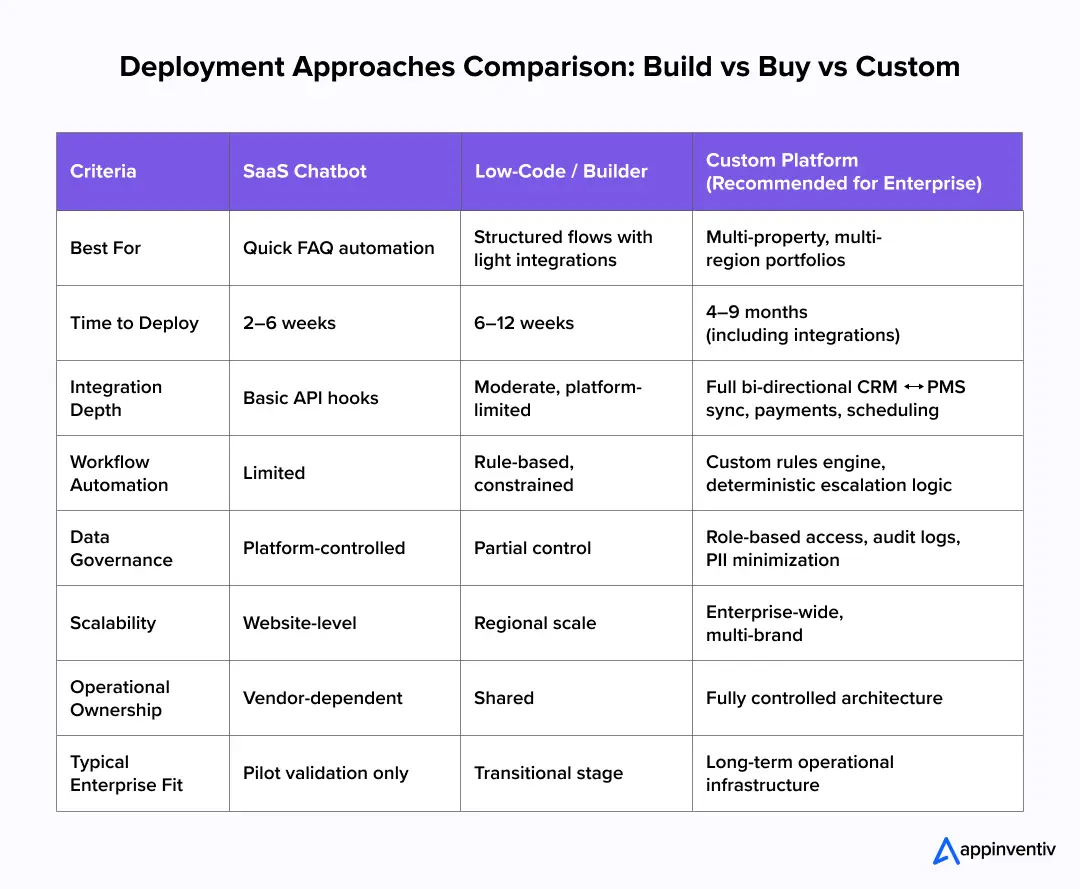
Enterprises need more than a chat window. They require bi-directional CRM ↔ PMS sync, deterministic business rules, audit trails, and SRE-grade reliability. Off-the-shelf products are useful for quick validation, but they typically fall short on governance, scale, and control. A custom platform gives you those things — and keeps them under your rules and SLAs.
Clear Decision Checklist (Pick One)
Choose the option that aligns with your operational complexity, not just your timeline.
Use SaaS when:
- You need a surface-level presence fast (<6 weeks).
- Use case = FAQ deflection or basic lead capture only.
- Integrations are shallow and data sensitivity is low.
Use Low-code when:
- You want more control over flows but can accept platform limits.
- A small ops team will maintain the bot.
- Scope = single region or a few properties.
Build a custom platform (recommended for enterprise) when any apply:
- You run multi-region, multi-brand portfolios.
- You require ticket creation, payments, and bidirectional sync with CRM/PMS.
- Compliance, auditability, and data governance matter.
- You expect the chatbot to function as an operational interface, not just a marketing widget.
What to Expect — Enterprise Comparison
The real difference emerges in integration depth, governance control, and long-term ownership.
Pragmatic Rollout: Pilot → Core → Scale
Enterprises that treat this as platform engineering rather than feature deployment see fewer re-platforming cycles later.
- Pilot (8–10 weeks): pick 1–2 properties, integrate CRM write + PMS read, run live traffic (20–30% of inquiries). Measure containment, ticket accuracy, lead-to-tour time.
- Design the core (8–14 weeks): build middleware (API gateway, message queue), rules engine, RAG index, audit logs, and RBAC. Treat this as platform engineering.
- Migrate & scale (ongoing): roll connectors, harden monitoring/SLOs, expand locales and languages, add governance workflows.
KPIs to Track (Pilot and Scale)
These indicators determine whether the chatbot is reducing workload or simply shifting it elsewhere.
- First response time: target <10 seconds.
- Containment (no human required): 40–60% in pilot; 60–75% at scale.
- Ticket metadata accuracy: ≥92%.
- Lead qualification accuracy: ≥80% (pilot) → ≥90% (scale).
- Escalation false positives: <5%.
Measure model confidence distributions, hallucination incidents per 10k queries, and integration success rate (API write/read success).
Key Risks and Mitigations (Short)
Addressing these early prevents operational friction as adoption expands.
- Data fragmentation: define a single source of truth before you build.
- Misrouted leads/duplicate records: implement idempotent write patterns and territory rules.
- Compliance gaps: redact PII in indices, keep raw PII in a secure vault, enforce per-field access.
- Trust loss from poor handoff: use deterministic handoff rules and always-visible “speak to agent” option.
How Appinventiv Helps (Practical Capabilities)
The objective is not deployment speed, but building a stable, compliant system that supports portfolio growth over time.
- Map systems of record and produce a 2–3 week integration audit (deliverable: cost pilot scope).
- Build middleware: API gateway, pub/sub, schema translation, audit logging.
- Implement RAG responsibly: vector DB with TTL, provenance snippets, and PII minimization.
- Create a deterministic rule engine for escalations and eligibility (non-ML overlays).
- Deliver SRE and governance: SLOs, dashboards, per-field encryption, and content approval workflows.
If you run an enterprise portfolio, start with an integration audit (2–3 weeks) to map systems of record and produce a cost pilot scope — the clearest, lowest-risk path to a custom operational platform.
Implementation Roadmap for a Production-Ready Property Management Chatbot
A working demo is easy to ship. A chatbot that can handle real tenant traffic, integrate with core systems, and stay reliable over time needs a phased rollout.
The roadmap below is designed for an AI chatbot for property management initiatives where accuracy, handoffs, and operational continuity matter.
Phase 1: Use Case Selection and Workflow Mapping
Start by choosing use cases with measurable impact: lead qualification, tour scheduling, maintenance triage, rent queries, and renewal reminders. Then map the workflow end-to-end.
What this phase should produce:
- A clear definition of “done” for each use case (response time targets, handoff rules, and resolution outcomes)
- Conversation flows tied to actions: ticket creation, lead creation, scheduling, and notifications
- Escalation paths for high-risk requests (safety concerns, disputes, payment issues)
This is where many real estate chatbot use cases fail in practice: the bot answers correctly, but nothing happens next.
Phase 2: Data and Integration Readiness
Chatbots fail when they are forced to guess. Data access and integration design decide whether the bot can provide accurate answers and take action.
Key technical work:
- Identify systems of record (CRM, property management system, listing database, work order system, calendars, payments)
- Define read vs write permissions (what the bot can view, create, or update)
- Standardize data fields (unit identifiers, resident IDs, property codes, ticket categories)
- Set up integration patterns: API gateway, webhooks, message queues, or middleware
If real estate CRM integration is required, define routing logic early: territory rules, agent assignment, lead status updates, and duplicate handling.
Phase 3: Conversation Design, Training Data, and Guardrails
This phase is about making the bot behave like a reliable front desk, not a guessing machine.
What matters here:
- Intent library design that reflects real conversations (maintenance, leasing, billing, policies)
- Entity extraction rules for unit number, dates, budgets, amenities, and issue categories
- Multilingual chatbot handling where relevant
- Response guardrails: approved phrasing for policies and lease-related queries
- Human handoff logic that triggers based on confidence score, user frustration signals, or regulated topics
Response guardrail:
If the model returns an answer that references a price, lease term, or eligibility, show a provenance snippet and include “Please confirm with leasing” where applicable.
For a tenant management chatbot, adopt a strict approach to PII handling: avoid exposing sensitive data in chat transcripts and enforce role-based access controls.
Phase 4: Pilot Deployment with Measurement and Stress Testing
A pilot should be limited in scope but realistic in conditions. Pick a property group or a region where volumes are high enough to learn quickly.
Run the pilot with:
- Load testing for peak inquiry windows (after-hours spikes, rent due dates, outage events)
- Resilience testing for integration failures (CRM downtime, PMS API latency, listing feed delays)
- Monitoring for response accuracy and escalation rates
- Clear KPIs: first response time, containment rate, resolution time, scheduling completion rate, ticket accuracy, and tenant satisfaction signals
This phase determines whether real estate automation with AI chatbots is reducing workload or simply moving it downstream.
Pilot Plan (8 weeks): Suggested Scope
- Audit & scope (Weeks 0–1): Identify systems of record, legal constraints, and test property (1–2 buildings).
- Connectors (Weeks 2–3): Build minimal CRM write, PMS ticket create, and listing read connectors.
- Conversation & RAG tuning (Weeks 4–5): Create intents, entity rules, retrieval index (availability + lease clauses).
- Controlled pilot (Week 6): Route 20–30% of inbound inquiries through the bot; measure containment & accuracy.
- Stress & failover (Week 7): Simulate PMS downtime, high-volume spikes, and test human-handoff flows.
- Review & scale decision (Week 8): Deliver KPI report (containment, lead conversion delta, time saved) and next-step roadmap.
- Deliverable: 4-page pilot report summarizing KPIs, risks, and scale recommendation.
Pilot KPI Example:
| KPI | Pilot Target | Scale Target |
|---|---|---|
| First response time | < 10 seconds | < 10 seconds |
| Containment rate (no human needed) | 40–60% | 60–75% |
| Ticket accuracy (correct metadata) | ≥ 92% | ≥ 95% |
| Lead qualification accuracy | ≥ 80% | ≥ 90% |
| Escalation false positives | < 5% | < 3% |
| Time saved (staff hours/month) | measurable by pilot | scale with portfolio |
Phase 5: Scale-out, Governance, and Continuous Improvement
Once the system proves stable, scale-out is mostly about consistency: version control, content governance, and ongoing tuning.
Operational controls to implement:
- A content update workflow with approvals for policy, pricing, and lease content
- Audit logs for sensitive actions (ticket updates, resident data access, payment links)
- Analytics for drift detection (new intent patterns, seasonal issues, property-specific anomalies)
- Structured feedback loops between property teams and the chatbot team
A well-governed rollout turns an AI chatbot for real estate into a dependable communication layer that improves over time, rather than a one-time feature launch.
How Much Does a Real Estate Chatbot Service Cost
Enterprise leaders rarely ask, “How much does a chatbot cost?” The better question is, “What level of operational capability are we funding, and what returns should we expect?”
Typical Investment Bands
While exact figures vary by integration depth and portfolio size, most enterprise deployments fall within the following ranges:
| Deployment Type | Cost Range |
|---|---|
| Pilot Deployment | $35,000–$75,000+ |
| Production-Ready Platform | $80,000–$180,000+ |
| Enterprise-Scale Implementation | $200,000–$400,000+ |
1. Focused Pilot Deployment ($35,000–$75,000+)
Designed to validate value in a controlled environment. Typically includes:
- Website or WhatsApp chatbot
- Basic lead capture
- Limited CRM write integration
- Predefined conversation flows
- Performance tracking dashboards
This phase helps quantify containment rates, lead qualification improvements, and response time reductions before scaling.
2. Production-Ready Platform ($80,000–$180,000+)
Built for operational reliability. Often includes:
- Bi-directional CRM integration
- PMS ticket creation and status sync
- Structured leasing and maintenance workflows
- Retrieval-based response accuracy for property data
- Role-based access controls
- Monitoring and analytics
At this stage, the chatbot shifts from a marketing tool to an operational interface.
3. Enterprise-Scale Implementation ($200,000–$400,000+)
For multi-region or multi-brand portfolios requiring governance and scale.
Typically includes:
- Deep integrations across CRM, PMS, listing systems, payments
- Custom workflow engines
- Multilingual and omnichannel orchestration
- Compliance architecture and audit logging
- SLA-backed reliability and monitoring
The higher range reflects integration complexity and enterprise governance – not simply “more features.”
What Drives Cost?
Several factors influence total investment:
- Integration Depth: Number of systems connected and whether sync is read-only or bi-directional
- Workflow Complexity: Renewal automation, ticket routing rules, escalation logic
- Data Governance Requirements: PII handling, audit logs, compliance controls
- Portfolio Scale: Number of properties, regions, and concurrent users
- Reliability Expectations: Monitoring, redundancy, uptime guarantees
- Multilingual and Omnichannel Requirements
In practice, integration effort and workflow logic account for a significant share of total development effort.
ROI: How Enterprises Evaluate Returns
Enterprise decision-makers typically assess chatbot ROI across three measurable dimensions:
- Labor Efficiency
- 30–60% containment of routine inquiries during pilot stages
- Reduction in repetitive administrative workload
- Reallocation of 100–200+ staff hours per month in mid-size portfolios
- Revenue Impact
- Faster lead response (often under 10 seconds)
- Reduction in lead-to-tour time
- Improved lead qualification quality before agent engagement
Even small improvements in tour booking rates can materially influence occupancy and revenue performance.
- Service Reliability and Retention
- Immediate acknowledgment of maintenance requests
- Fewer missed inquiries
- Improved tenant satisfaction indicators
While retention gains are gradual, consistency in communication often correlates with lower churn over time.
KPIs to Monitor Post-Deployment
Enterprises typically track:
- First response time
- Containment rate
- Ticket accuracy
- Lead qualification accuracy
- Escalation rate
- Resolution time
- Renewal engagement rate
Tracking these metrics early determines whether automation is reducing workload or merely shifting it elsewhere.
A Practical Planning Approach
Rather than committing immediately to a full enterprise build, many organizations begin with a structured integration audit (2–3 weeks). This clarifies:
- System dependencies
- Data access requirements
- Workflow mapping
- Pilot KPIs
- Cost rollout roadmap
The audit output becomes the foundation for budgeting and phased implementation.
In enterprise environments, the real cost driver is not the chat interface. It is integration depth, governance rigor, and long-term scalability. When those elements are addressed correctly, conversational systems evolve into stable operational assets that support leasing, tenant services, and portfolio performance.
Operational Risks and Adoption Challenges in Real Estate Chatbot Implementation
Rolling out a real estate chatbot is rarely just a technical exercise. The technology may work on day one, but adoption, compliance, and integration determine whether it survives beyond the pilot phase.
Property operations are relationship-heavy and compliance-sensitive. A chatbot that ignores those realities can create friction instead of relief. Below are common risk areas teams encounter, along with grounded ways to address them.
1. Workflow Adoption and Change Management
Leasing agents and property managers often have a reasonable concern:
- “Will this replace my interaction with tenants?”
- “Will it make service feel impersonal?”
If the chatbot is introduced as a cost-cutting tool, resistance builds quietly. Workarounds appear, and staff bypasses them.
What tends to work better:
- Position the chatbot as a triage layer, not a substitute for human interaction.
- Define explicit handoff points: negotiations, disputes, sensitive complaints.
- Show teams how repetitive inquiries decrease once automation is active.
- Run a contained pilot (one property, one workflow) and share the results internally.
When agents experience fewer routine calls and receive better-qualified leads through real estate CRM integration, skepticism usually declines. Adoption improves when the value is visible.
2. Data Privacy, Compliance, and Fair Housing Considerations
Real estate conversations often involve personal information: income details, lease terms, contact records, and payment references. In regulated environments, even minor data-handling mistakes can have consequences.
An AI chatbot for property management must be designed with governance from the outset, not retrofitted later.
Operational safeguards typically include:
- Role-based access controls for tenant and prospect data
- Encryption in transit and at rest
- Audit logs for ticket creation, data access, and status changes
- Enterprise AI guardrails preventing automated eligibility decisions
- Approved language templates for lease policies and fees
- Regular compliance reviews of conversation flows
Fair housing considerations are particularly sensitive. Automated responses should not inadvertently filter, bias, or misrepresent eligibility criteria. A structured governance model protects both residents and operators.
3. Integration Complexity with Existing Systems
Many property teams operate on a patchwork of systems: a legacy PMS, a CRM, listing portals, and payment gateways. Without integration, a chatbot becomes little more than a digital receptionist.
When disconnected, it cannot:
- Create structured maintenance tickets
- Update tenant records
- Sync lead data
- Reflect real-time availability
Fragmentation undermines trust quickly. Practical mitigation steps include:
- Mapping system dependencies before development begins
- Identifying a single source of truth for leads, tenants, and tickets
- Using middleware or API gateways to standardize data exchange
- Designing fallback workflows when external systems fail
Early attention to the architecture for property operations automation prevents costly rework later.
4. Maintaining Trust Through Human Handoff
A chatbot that traps users in circular responses damages credibility. In property management, unresolved complaints escalate quickly.
Tenants and prospects should never feel blocked from human assistance.
Effective escalation design includes:
- Automatic handoff when confidence scores drop
- Clear messaging when escalation occurs (“A leasing specialist will contact you shortly”)
- Always-visible option to request a human
- Ongoing review of unresolved or repeated conversations
When human support remains accessible, a real estate chatbot enhances service rather than replacing it.
5. Content Accuracy and Operational Consistency
Property details change frequently: pricing, availability, policies, and amenities. Static chatbot responses can become outdated within weeks.
An inaccurate answer about pet policies or fees can create confusion and potential reputational risk.
To maintain reliability:
- Connect responses to live data sources wherever possible
- Establish approval workflows for policy and pricing updates
- Assign clear ownership for chatbot knowledge management
- Conduct periodic audits of conversation content
Consistency across properties is equally important. A centralized conversational logic layer ensures standardized messaging even as portfolios expand.
Bringing Risk Under Control
None of these challenges is unusual; in fact, they are predictable. The difference between a short-lived pilot and a stable operational layer lies in planning.
When workflow alignment, governance, integration depth, and escalation design are addressed early, conversational systems transition from experimental tools to dependable infrastructure.
Organizations that treat real estate automation with AI chatbots as part of their operating model rather than a standalone feature are far more likely to achieve sustainable adoption and measurable operational gains.
Future Trends in Conversational AI for Property Management (2026 and Beyond)
If the last few years were about answering questions faster, the next phase is about making conversational systems operationally intelligent.
A real estate chatbot is gradually shifting from a front-desk responder to a connected assistant that understands leasing cycles, tenant behavior, and portfolio-level patterns. As property operations become more data-driven, conversational interfaces are being embedded deeper into day-to-day workflows.
Here’s where the momentum is heading.
AI Leasing Assistants and Voice-Based Interactions
Text chat has only one interface. However, in this mobile-first era, prospects expect to ask their questions using their mobile devices.
Voice-enabled AI chatbots for real estate systems are emerging as guided leasing assistants. A renter can ask, “Show me two-bedroom units under $2,000 available next month,” and receive structured options instantly. Tours can be scheduled without switching apps. Comparisons between units can happen conversationally.
For property teams, this expands coverage without expanding headcount. A single conversational layer can operate across website chat, messaging apps, and voice interfaces.
As natural language capabilities mature, the line between a chatbot and a real estate virtual assistant chatbot will blur. The interaction will feel less scripted and more consultative.
Also Read: Chatbot Development Using Deep NLP
Predictive Tenant Engagement and Proactive Communication
Most property operations are reactive. A tenant reports a problem, and the team responds.
The next step is anticipation.
By analyzing maintenance logs, seasonal trends, and recurring service patterns, conversational systems can proactively reach out. For example:
- Reminding tenants about HVAC servicing before peak summer demand
- Checking in after repeated plumbing issues
- Prompting renewal conversations months in advance
This form of tenant engagement automation reduces surprise issues and builds consistency. Instead of waiting for dissatisfaction to surface, property managers gain earlier signals.
It also shifts the AI chatbot’s role in property management from responder to monitor; quietly observing patterns and triggering structured follow-ups.
Generative AI for Listings, Responses, and Marketing Support
Leasing teams spend more time than expected drafting responses, updating property descriptions, and replying to similar inquiries.
Conversational systems are increasingly supporting that workload. An AI chatbot for property listings can dynamically summarize amenities, draft contextual responses based on availability, and assist with content updates across multiple listings.
Used responsibly, this reduces manual effort while maintaining message consistency. Guardrails remain important, especially around pricing, eligibility, and compliance, but structured generation can significantly reduce repetitive communication.
For growing portfolios, this capability supports scalable content management without increasing administrative burden.
Conversational Interfaces Integrated with Smart Buildings
As IoT infrastructure becomes more common in residential and commercial properties, chat interfaces are extending beyond information.
Tenants may use a chatbot to:
- Request access credentials
- Book amenities
- Report temperature irregularities
- Check shared facility availability
In such cases, the property management chatbot becomes a control layer for smart systems. This tightens the link between conversational AI and property operations automation.
The experience becomes practical: fewer app downloads, fewer logins, fewer disjointed systems.
Unified Communication Across the Property Lifecycle
Historically, leasing, maintenance, and portfolio management operated in separate silos. Communication followed the same pattern.
Future conversational AI platforms will serve as a unified interaction layer, from initial inquiry to renewal. Instead of disconnected threads, property teams will see consolidated engagement data:
- Lead conversations
- Maintenance patterns
- Renewal intent signals
- Service escalation trends
This strengthens AI-driven real estate workflows by connecting customer interaction data directly to operational dashboards.
The chatbot becomes less of a feature and more of an operating surface.
Governance and Compliance as Core Design Requirements
As conversational systems handle financial discussions, tenant histories, and policy clarifications, governance becomes foundational.
Audit trails, role-based access, controlled phrasing for regulated topics, and clear human escalation rules will move from “recommended” to mandatory design components.
Organizations investing in long-term real estate chatbot development are increasingly prioritizing compliance architecture alongside conversational intelligence. Trust, especially in regulated markets, will define adoption.
What This Means for Property Teams
The trajectory is clear. Conversational AI in property management is evolving from reactive support to operational orchestration.
Teams that design for integration, data consistency, and governance today will be better positioned as capabilities expand. Those who treat chatbots as isolated tools may find themselves rebuilding in a few years.
The opportunity is not just improved response time. It is building a connected communication layer that simultaneously supports leasing performance, tenant satisfaction, and portfolio insight.
Ready to Reduce Your Manual Workload and Unify Your Property Communication?
An intelligent conversational system helps unify interactions and maintain consistent service delivery.
How Does Appinventiv Develop Chatbots for Real Estate Enterprises?
A chatbot only delivers value when it fits the way your property business actually runs.
At Appinventiv, we approach real estate AI chatbot development services as an operational initiative rather than just a UI feature. The focus is on building systems that connect with your CRM, PMS, and listing infrastructure so conversations translate into actions: leads are routed, tickets are created, and renewals are triggered.
As a real estate app development company with experience in scalable digital platforms, we design conversational systems that support leasing, tenant services, and portfolio oversight in a single, connected layer.
What We Bring to Real Estate Chatbots
- Conversational AI design aligned with real leasing and tenant workflows
- Secure integration with CRM, PMS, and property databases
- Omnichannel engagement across web, mobile, and messaging platforms
- Workflow automation for maintenance, renewals, and service requests
- Role-based access controls and compliance-ready architecture
- Analytics dashboards that surface response patterns and operational trends
The goal is simple: make your chatbot a part of your operating model, not a disconnected tool.
Proven Capability in AI and PropTech
Our experience spans AI-driven platforms and property-focused systems, including:
These projects reflect our ability to design intelligent systems that do more than answer questions; they manage workflows and integrate with business-critical platforms. We prioritize SOC2 compliance and data governance to protect your PII.
For property organizations evaluating conversational automation, early architectural clarity matters. Aligning design, integration depth, and governance from the outset ensures your solution scales as your portfolio grows.
If you’re considering conversational AI for leasing, tenant services, or broader property operations, a structured discussion can help determine the right path forward.
FAQs
Q. What are the benefits of chatbots for property management?
A. The benefits extend beyond answering FAQs.
A well-implemented AI chatbot for property management improves:
- Response speed: Tenants and prospects receive instant acknowledgment.
- Operational efficiency: Routine inquiries and service requests are structured and routed automatically.
- Lead qualification: A chatbot for real estate lead generation captures and filters prospects before human follow-up.
- Service consistency: Policies and updates are communicated uniformly across properties.
- Visibility: Interaction data reveals recurring maintenance patterns, inquiry trends, and renewal signals.
Over time, real estate automation with AI chatbots reduces repetitive workload while strengthening tenant engagement, automation and communication clarity.
Q. What use cases drive ROI for real estate chatbots?
A. ROI typically comes from workflow impact, not just engagement metrics.
High-impact real estate chatbot use cases include:
- Maintenance request automation: Faster ticket logging and reduced manual triage.
- Lead intake and qualification: Immediate capture and routing through real estate CRM integration.
- After-hours inquiry handling: 24/7 support without expanding headcount.
- Lease renewal reminders and follow-ups: Supporting lease management automation.
- Property listing guidance: An AI chatbot for property listings that helps prospects compare units and schedule tours.
When conversational AI is connected to operational systems rather than operating in isolation, it directly contributes to reduced response times, improved conversion readiness, and measurable efficiency gains.
In practice, the highest ROI is achieved where communication volume is high, and workflows are already structured but manually handled.
Q. How does Appinventiv develop chatbots for real estate enterprises?
A. Appinventiv develops real estate chatbots through a structured, enterprise-focused approach starting with requirement analysis and use case mapping (leasing, tenant support, lead qualification), followed by AI model selection (NLP/LLM), CRM & property management system integration, and secure deployment. We also ensure scalability, compliance, and continuous optimization based on user behavior and performance insights.
Q. How can I make my real estate chatbot conversations feel more human?
A. Create personalized welcome messages, keep responses concise, use quick replies for complex answers, and tailor responses to address common client needs. Regularly update the chatbot with current property details, market trends, and interest rates for more relevant interactions.
Q. Can real estate chatbots integrate with my existing CRM and scheduling tools?
A. Yes, most advanced real estate chatbots can integrate with popular CRM systems like Salesforce and HubSpot, as well as calendar tools like Google Calendar and Calendly. This integration allows for automatic lead creation, contact updates, and streamlined appointment scheduling.