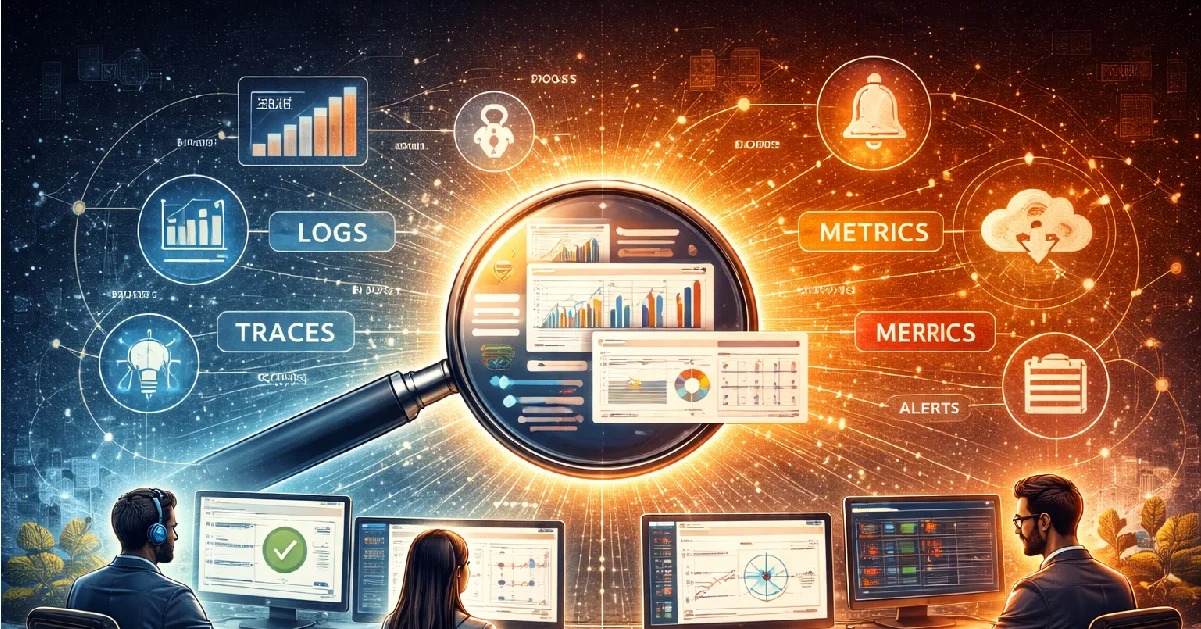
Software testing is no longer just about pass or fail. That mindset is outdated. Modern systems break in quiet ways. And tests often don’t explain why. This is where test observability enters. Not a buzzword. A real gap-filler. Test observability means seeing inside your tests. Not just results. But signals. Logs. Metrics. Context. You don’t guess. You know.
Teams today run thousands of tests. Pipelines move fast. Failures show up late. Or worse, they show up flaky. Debugging then becomes slow. Annoying. Expensive.
Test observability helps you understand what actually happened during a test run. Which step failed? What the system was doing. Why did it fail this time and not yesterday?.
It sits between testing and monitoring. But it’s not the same. And no, better reports alone won’t fix this. If you care about faster feedback, stable releases, and less time wasted on re-runs, this matters. A lot. This guide breaks it down. Simply. Practically. No fluff.
What is observability in software testing?
Observability in software testing is about visibility. Real visibility. Not assumptions. It means understanding what is happening inside the system while tests are running. Not after. During. You don’t just see that a test failed. You see why it failed.
Traditional testing gives outputs. Pass. Fail. Sometimes a stack trace. Observability goes deeper. It connects logs, metrics, traces, and test data into one picture.
When a test breaks, observability helps you answer basic questions fast. What changed? Where it broke. What the system state was at that moment. This is not monitoring. Monitoring tells you something is wrong. Observability helps you figure out what went wrong.
In modern apps, failures are rarely obvious. Microservices talk too much. Dependencies fail quietly. Without observability, tests become blind. So observability in software testing is about reducing guesswork. Less noise. More clarity. Faster decisions. It turns tests from simple checks into learning tools. And that shift matters.
How does observability impact software testing?
Observability changes how testing actually works. Not just how it reports. First, failures become understandable. Tests fail, but now they explain themselves. Logs, traces, and metrics show what the system was doing. No more staring at red builds with no clue.
Second, debugging gets faster. You don’t rerun the same test five times. You inspect the signals once. The root cause shows up early, not after hours of guessing. Third, flaky tests get exposed. Observability helps you see patterns. Timing issues. Dependency delays. Environmental noise. Flakiness stops being random; it becomes visible. It also improves test coverage quality. Not more tests. Better tests. You see which paths are actually exercised and which are just assumed to work.
Feedback loops shrink. Developers don’t wait for long reports. They get context immediately. That changes behavior. Bugs get fixed sooner. Finally, testing becomes proactive.
Instead of reacting to failures, teams spot weak signals early. Before they turn into production issues. So the impact is simple. Less guesswork. Less waste. More trust in your tests.
What’s the difference between Observability and Monitoring?
| Features | Monitoring | Observability |
| Core focus | Watching known issues | Exploring unknown issues |
| Main question | Is something broken | Why did it break |
| Setup style | Predefined checks | Flexible signals |
| Data used | Metrics mostly | Logs, metrics, traces |
| Nature | Reactive | Investigative |
| In testing | The test failed | Shows how and where it failed |
| Failure handling | Alerts you | Explains you |
| Depth | Surface level | Deep system context |
| Use case | Stable systems | Complex modern systems |
What are the benefits of observability in software testing?

Faster root cause analysis
When a test fails, time matters. Without observability, teams scroll logs blindly. Or rerun tests, hoping it fails again. With observability, the failure tells a story. You see which service responded late. Which API returned bad data? What changed since the last run? Root cause moves closer to the failure point. Not buried under noise. Debug time drops a lot.
Reduced flaky tests
Flaky tests waste trust. One run passes. Next run fails. No code change. Observability exposes patterns behind this. Slow dependencies. Race conditions. Resource limits. Once visible, flakiness becomes fixable. Not ignored. Not retired forever.
Better feedback for developers
Developers hate vague failures. “Test failed” means nothing. Observability adds context. Logs. Traces. Timing data. All are attached to the test result. This shortens the feedback loop. Developers act faster. And with more confidence.
Higher test reliability
Reliable tests fail only for real reasons. Observability helps enforce that. You can tell if a failure is a product bug or a test issue. That clarity builds trust in the test suite. Over time, teams stop bypassing failures. Because failures start making sense.
Improved test design
Observability shows how tests interact with the system. Which paths they hit. Which they miss. This reveals weak assertions. Over-mocked tests. Or tests that don’t validate behavior deeply. Design improves naturally. Based on data. Not assumptions.
Faster CI/CD pipelines
Pipelines slow down due to investigation, not execution. Most time is lost after failure. Observability reduces this gap. Failures get diagnosed in one go. Fewer reruns. Fewer rollbacks. Overall flow becomes smoother.
Stronger confidence before release
Before release, doubt is expensive. Teams second-guess results. Observability provides evidence. System behavior under test is clear and traceable. Releases become informed decisions. Not blind leaps.
How long does it take to implement test observability?
It depends. But it’s not instant magic. Basic test observability can start fast. A few days to a week. Add structured logs. Capture test context. Store signals properly. Real value takes longer. A few sprints usually. Because teams need to wire traces, align test data, and clean noisy signals. The slow part is not the tools. It’s discipline.
Tests need better metadata. Environments must be consistent. Logs must actually mean something. Small teams move more quickly. Monoliths are simpler. Microservices take more time. No surprise there. If you expect full observability in a weekend, that’s unrealistic. But if you invest steadily, you’ll see wins early. First clarity comes fast. Maturity comes with usage.
Conclusion
Test observability is a game-changer. Tests stop being blind. Failures start making sense. Debugging gets faster. Flaky tests show up. Releases feel safer. If you want to implement it right, guidance helps.
A top software development company in Bangalore can set it up clean. Even small teams benefit from a software development company in Bangalore that knows modern testing pipelines. Start now. Save time. Reduce errors. Make testing smarter.