[ad_1]
In this article, you will learn a practical, question-driven workflow for reading machine learning research papers efficiently, so you finish with answers — not fatigue.
Topics we will cover include:
- Why purpose-first reading beats linear, start-to-finish reading.
- A lightweight triage: title + abstract + five-minute skim.
- How to target sections to answer your questions and retain what matters.
Let’s not waste any more time.
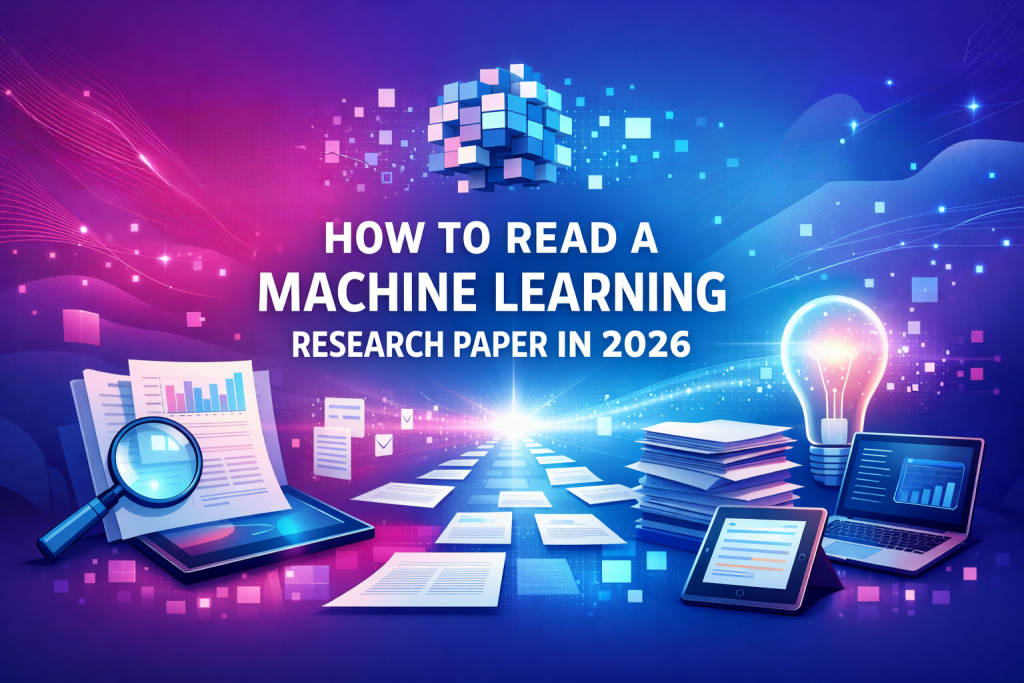
How to Read a Machine Learning Research Paper in 2026
Image by Author
Introduction
When I first started reading machine learning research papers, I honestly thought something was wrong with me. I would open a paper, read the first few pages carefully, and then slowly lose focus. By the time I reached the middle, I felt tired, confused, and unsure what I had actually learned. During literature reviews, this feeling became even worse. Reading multiple long papers in a row drained my energy, and I often felt frustrated instead of confident.
At first, I assumed this was just my lack of experience. But after talking to others in my research community, I realized this struggle is extremely common. Many beginners feel overwhelmed when reading papers, especially in machine learning where ideas, terminology, and assumptions move fast. Over time, and after spending more than two years around research, I realized the issue was not me. The issue was how I was reading papers.
One Idea That Changed Everything for Me
Most beginners approach research papers the same way they approach textbooks or articles: start from the beginning and read until the end. The problem is that research papers are not written to be read that way. They are written for people who already have questions in mind. If you read without knowing what you are looking for, your brain has no anchor. That is why everything starts to blur together after a few pages.
Once I understood this, my entire approach changed. The biggest shift I made was simple:
Never read a paper without a reason.
A paper is not something you read just to finish it. You read it to answer questions. If you do not have questions, the paper will feel meaningless and exhausting. This idea really clicked for me after taking a course on Adaptive AI by Evan Shelhamer (formerly at Google DeepMind). I will not get into who originally proposed the technique, but the mindset behind it completely changed how I read papers. Since then, reading papers has felt lighter and much more manageable. And I will share the strategy in this article.
Starting With Only the Title and Abstract
Whenever I open a new paper now, I do not jump into the introduction. I only read two things:
- The title
- The abstract
I spend no more than one or two minutes here. At this point, I am only trying to understand three things in a very rough way:
- What problem is this paper trying to solve?
- What kind of solution are they proposing?
- Do I care about this problem right now?
If the answer to the last question is no, I skip the paper. And that is completely okay. You do not need to read every paper you open.
Writing Down What Confuses You
After reading the abstract, I stop.
Before reading anything else, I write down what I did not understand or what made me curious. This step sounds small, but it makes a huge difference.
For example, when I read the abstract of the paper “Test-Time Training with Self-Supervision for Generalization under Distribution Shifts”, I was confused at one point and wrote this question in my notes.
What exactly do they mean by “turning a single unlabeled test sample into a self-supervised learning problem”?
I knew what self-supervised learning was, but I could not picture how that would work for the problem being discussed in the paper. So I wrote that question down.
That question gave me a reason to continue reading. I was no longer reading blindly. I was reading to find an answer. If you understand the problem statement reasonably well, pause for a moment and ask yourself:
- How would I approach this problem?
- What naive or baseline solution would I try?
- What assumptions would I make?
This part is optional, but it helps you actively compare your thinking with the authors’ decisions.
Doing a Quick Skim Instead of Deep Reading
Once I have my questions, I do a quick skim of the paper. This usually takes around five minutes. I do not read every line. Instead, I focus on:
- The introduction, to see how the authors explain the problem—only if I am not aware of the background knowledge of that paper.
- Figures and diagrams, because they often explain more than text.
- A high-level look at the method section, just to see what is happening overall.
- The results, to understand what actually improved.
At this stage, I am not trying to fully understand the method. I am just building a rough picture.
Asking Better Questions
After skimming, I usually end up with more questions than I started with. And that is a good thing.
These questions are more specific now. They might be about why certain design choices were made, why some results look better than others, or what assumptions the method relies on.
This is the point where reading starts to feel interesting instead of exhausting.
Reading Only What Helps Answer Your Questions
Now I finally read more carefully, but still not from start to end.
I jump to the parts of the paper that help answer my questions. I search for keywords using Ctrl + F / Cmd + F, check the appendix, and sometimes skim related work that the authors say they are closely building on.
My goal is not to understand everything. My goal is to understand what I care about.
By the time I reach the end, I usually feel satisfied instead of tired, because my questions have been answered. I also start to see gaps, limitations, and opportunities much more clearly, because I am no longer just consuming the paper but actively analyzing it.
A Few Small Things That Help a Lot
- One thing I learned is that reading papers back to back without breaks does not work. Short, focused sessions are much better.
- Another helpful habit is writing a short summary after finishing a paper, even just a few sentences. This makes literature reviews much easier later.
- It is also completely fine if you do not understand all the math. Many experienced researchers skip equations on the first few reads.
- Most importantly, do not compare yourself to senior researchers. They also struggled at the beginning. You just do not see that part.
Final Thoughts
Reading machine learning papers is a skill. It is not something you are born knowing how to do. Once you stop treating papers like something you must read from beginning to end, and start treating them as tools to answer questions, everything becomes easier.
If you are struggling, you are not alone. And you are not bad at research.
You just need a better way to read 🙂
[ad_2]
Source_link