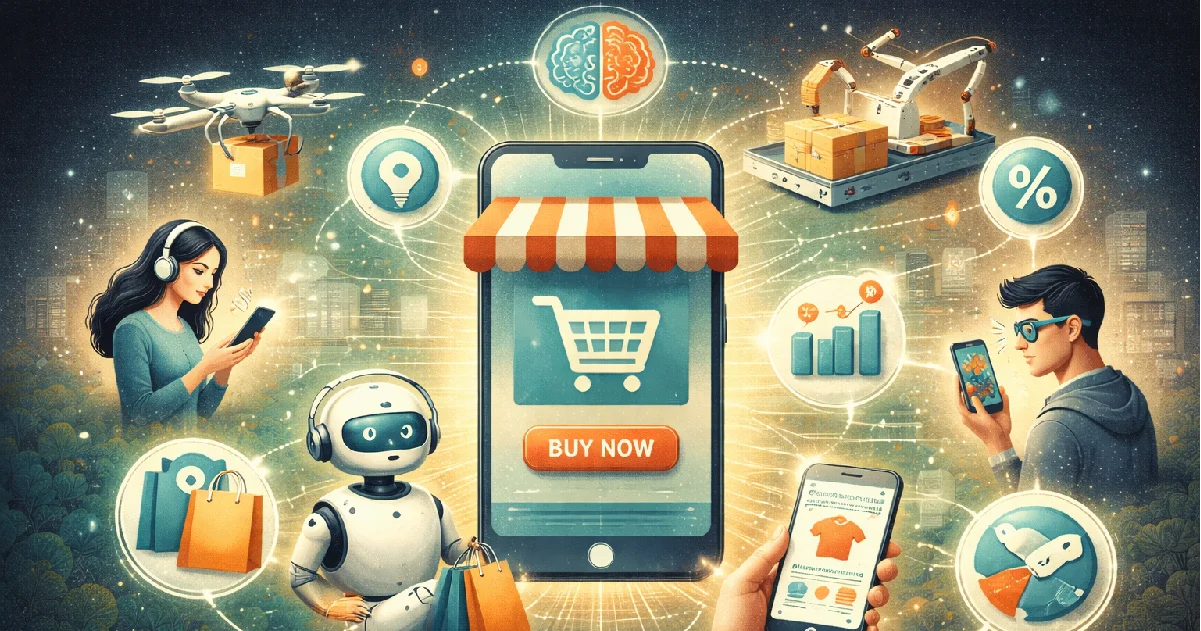
Before we start, imagine this: It’s 2026. A customer opens an app. Doesn’t search. Doesn’t scroll. But the product finds them instead. It knows their size. Their budget. Their mood. Checkout happens in one tap. Delivery arrives the same evening. No cart. No friction. No second thought. That’s where e-commerce is heading. Fast. Let’s break it down.
1. AI-Powered Product Search & Discovery
Search is changing. And typing is becoming optional. In 2026, customers won’t look for products. Products will surface themselves. AI-powered search will understand intent, not keywords. It will not be “Black running shoes under 5k,” but “Something like what I bought last summer,” or “Shoes for daily walking, not gym.” AI will combine browsing history, past purchases, context, and behavior. Then show fewer results. Better ones.
Discovery will happen through:
- voice prompts
- images
- past behaviour
- real-time context
This is not just a UI change. It’s a backend shift. Basic search bars won’t survive this phase.
Brands investing in serious e-commerce web development are already rebuilding search engines from scratch. Especially teams working on advanced custom commerce development projects, where AI-first commerce is becoming the baseline. If your search still depends on filters alone, you’re already late.
2. Agentic Payment Protocols (The First Step Toward Agentic Commerce)
Payments will stop being an action. They’ll become a decision system. In 2026, customers won’t always “pay.” Their agents will.
Agentic payment protocols will allow AI systems to:
- Choose the best payment method
- Apply offers automatically
- Decide when to buy, not just how
A customer approves rules once. Budget limits. Preferences. Frequency. After that, payments happen in the background. This is the first real step toward agentic commerce. Then, with time, checkout pages will shrink. Manual inputs will disappear. But this only works if systems are secure, compliant, and deeply integrated. Patchy payment plugins won’t survive. This again pushes e-commerce web development into a more serious, infrastructure-driven space. Design alone won’t save broken flows.
3. Shopping Will Become Invisible
In 2026, customers won’t “shop” the way they do today. They’ll approve decisions. That’s it. AI-driven commerce is moving from recommendation to automation. There is a very thin line between recommendation and automation and technology is crossing it faster than most brands realize.
Your platform will predict:
- What the user needs
- When they need it
- How much they’re willing to pay
And then it will act accordingly. Subscriptions were just the warm-up. Next comes predictive purchasing. Milk is reordered before it finishes. Shoes are suggested when wear-and-tear data crosses a limit. Skincare is refilled based on climate & skin data. Does it sound convenient to you? It is. But all these things are possible only if your tech stack can handle it.
This is where serious e-commerce web development comes in. Especially for brands scaling fast. Cities like Bangalore are already seeing a demand spike for advanced online retail systems firms that understand AI integrations, not just pretty UIs. If your store still relies on “related products” logic, you’re already behind.
4. Supply Chain Transparency
Customers don’t trust labels anymore. They want proof. In 2026, Digital Product Passports will become common.
Each product will carry verifiable data:
- Origin
- Materials
- Manufacturing process
- Repairability
- Recycling information
Scan once. Know everything. This will matter most in fashion, electronics, and luxury.
But it won’t stay limited there. Transparency won’t be hidden in PDFs. It will be built into product pages. This changes e-commerce website design. More clarity. Less marketing fluff.
Brands that fake sustainability will get exposed faster. Brands that are honest will win slowly but permanently. The tech behind this looks simple to users. It’s not. Complex systems will power very clean interfaces. That irony stays.
5. In-Store Automation and Frictionless Shopping
Online and offline will stop behaving like separate worlds. In 2026, physical stores will borrow speed from e-commerce. And e-commerce will borrow confidence from physical stores.
In-store automation will rise:
- Cashier-less checkouts
- Smart shelves
- Automated inventory tracking
- App-based exits
Just walk in. Pick up. Walk out. No scanning. No waiting. For brands, this means one thing.
Unified systems. Inventory, pricing, customer data, everything must sync in real time. This is where weak e-commerce platforms collapse. Omnichannel is not a buzzword anymore. It’s survival. Backend stability will matter more than storefront beauty.
6. Sustainability and Circular Retail
Sustainability won’t be a section anymore. It will be a filter. In 2026, customers will actively choose:
- Refurbished over new
- Resale over replacement
- Repair over discard
Circular retail models will grow:
- Buy-back programs
- Resale marketplaces
- Rental options
- Repair credits
And this won’t be driven by emotion alone. It will be driven by cost, transparency, and ease. E-commerce platforms will need to support:
- Multi-lifecycle products
- Dynamic pricing
- Condition-based listings
This adds complexity. But customers will reward brands that make it simple. Design will shift again. Clear language. Clear choices. No guilt marketing.
7. Speed Will Decide Winners and Losers
Not delivery speed. Decision speed. In 2026:
- Pages must load instantly
- Search results must feel “right.”
- Payments must feel invisible
- Support must appear before problems do
Every extra second creates doubt. Every doubt kills conversion. Speed will come from:
- Better architecture
- Cleaner flows
- Fewer unnecessary steps
This is where a long-term tech mindset matters. Quick fixes won’t scale. Pretty interfaces won’t compensate. Brands that invest early will move faster later. Others will keep redesigning while losing users quietly.
What This Means For Businesses
Let’s be clear. Templates won’t save you. Cheap plugins won’t scale. Copy-paste strategies will fail. If you’re planning to enter or expand in e-commerce by 2026, you need:
- Solid architecture
- Adaptable design
- Data-driven decisions
- And a long-term tech mindset
Whether you work with a team in Bangalore or anywhere else is secondary. But yes, many brands are looking for e-commerce website developers in Bangalore because of the depth of technical talent there. Just don’t confuse talent with buzzwords.
Conclusion
Shopping in 2026 won’t feel like shopping. It’ll feel like life. Quiet. Fast. Predictive. The brands that win won’t scream louder. They’ll understand better. Whether you are working with an e-commerce web development Bangalore team or operating globally, the principles remain the same. Adapt early. Build smart. Keep it simple. And if you’re still planning your e-commerce journey like it’s 2018, stop. Rethink. Rebuild. Because customers won’t wait for you to catch up. They never do.











![The best time to post on LinkedIn [2025 data]](https://mgrowtech.com/wp-content/uploads/2025/11/DRAFT-The-best-time-to-post-on-LinkedIn-2025-data-350x250.png)