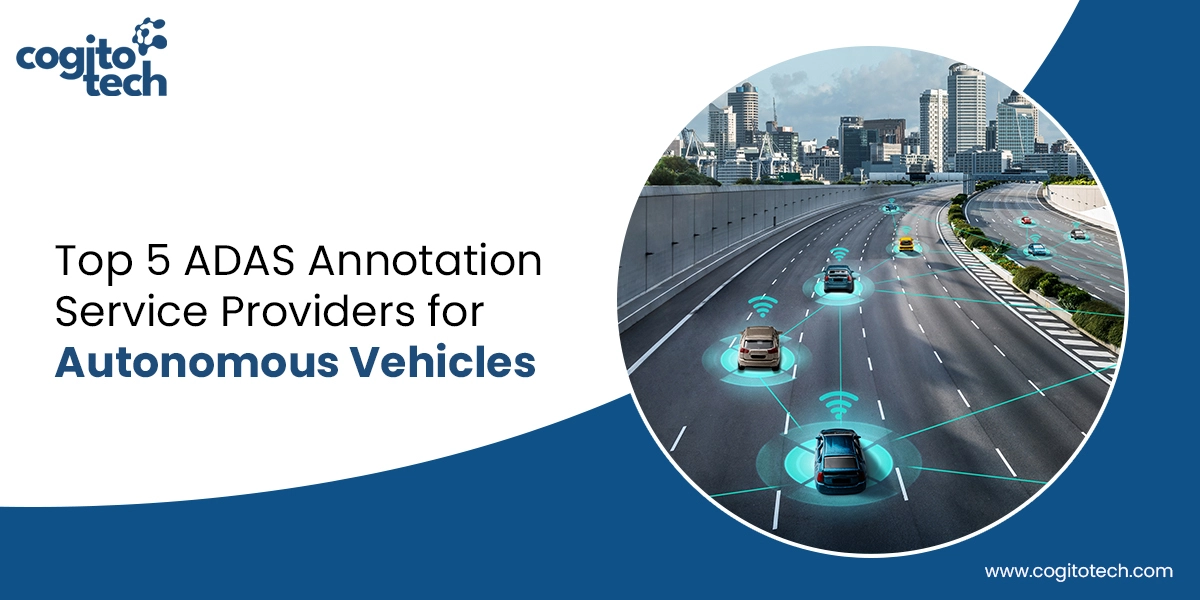
In the automotive domain, ADAS annotation enables the integration of multiple levels of autonomy, ranging from basic features such as lane-keeping and adaptive cruise control to fully autonomous cars. It involves labeling images, videos, LiDAR, and sensor data collected from vehicles, offering multiple levels of autonomy that range from basic features.
This blog explains how sensor data is annotated using techniques like 3D cuboids, polygons, semantic segmentation, and splines to help vehicles understand their surroundings. We will also explore the top five ADAS annotation service providers to outsource such complicated tasks.
How ADAS Annotation Builds a Vehicle’s Perception
To develop accurate and reliable AI models, raw sensor data must be carefully annotated to accurately reflect the real-world conditions that a vehicle typically encounters, such as object type, position, or movement. It’s here that the labeled sensor data allows machines to obtain a multidimensional view of the environment.
For instance, radar bounces radio waves off nearby objects to determine their position and size, while LiDAR does the same using laser beams instead of radio waves. Knowing the expected movement patterns and size can help these cars predict future actions. For example, radar/LiDAR systems can identify other cars and encourage certain maneuvers. Such information from LidAR system is important when it comes to car safety.
The same is true of thermal cameras mounted on these vehicles. Thermal data introduces a new dimension to the types of annotations required. The best course of action for a vehicle to take depends on the feedback from this data. The ability to identify the unique thermal profile of different objects enables more precise actions.
GPS data, as well as data about the speed and direction of the car, is another aspect of data annotation needed for self-driving cars. Knowing precisely what a back-and-forth navigational trip should look like requires diverse data, including vehicle speed and location information. With a proper training dataset, mistakes can be identified sooner. This also applies to events such as road closures and other potential disruptions.
Types of Annotation Used in Autonomous Vehicles
The following section describes how different annotation types contribute uniquely:
1. 3D Cuboids
3D cuboid annotation captures the 3D structure of cars, people, and obstacles. They play a crucial role in autonomous driving and ADAS systems, enabling the avoidance of collisions with other road users and objects. This data annotation method requires annotators to draw cube-like boxes around each object, as well as their depth, orientation, and volume in real-world coordinates.
2. Polygons
As the name suggests, it is the process of drawing polygonal forms so that models detect edges, recognize small or overlapping objects, and understand cluttered scenes more accurately. It captures the margins of irregular objects, such as people or the edges of roads, more accurately than bounding boxes.
3. Semantic Segmentation
Semantic segmentation is the process of assigning a class name to each pixel in an image that matches it. These are used in AVs to identify lanes, recognize drivable zones, and determine where objects end. In complex spaces, such as crossroads or areas with high traffic, pixel-level annotation provides detailed information. It classifies every pixel, enabling AI to distinguish roads, vehicles, sidewalks, and sky for contextual awareness.
4. Splines
Line and spline annotations are helpful in AVs because they are used to mark lane boundaries, road edges, and path guidelines by marking linear or curved paths that reflect the actual road. They are used to understand road geometry for trajectory planning so that the model can maintain correct lane positioning. Unlike straight lines or bounding boxes, splines can model curvature with high precision. It is vital for tasks like lane detection and path planning. For example, in a highway curve or roundabout, splines help the AI system understand how the lane bends and where it merges or diverges.
In essence, camera images use bounding boxes for vehicles, pedestrians, and traffic signs; LiDAR point clouds are marked with 3D cuboids for spatial awareness; and radar data is annotated with velocity vectors or object IDs to track motion over time.
List of Top 5 Companies in ADAS Annotation
1. Cogito Tech
Cogito Tech is a leading player in the annotation and training-data space for AI and computer vision. The company offers specialized ADAS services for autonomous vehicles and multi-sensor data projects. Their infrastructure supports large-scale annotation of camera, LiDAR, radar data, and sensor-fusion datasets, which are essential for ADAS module development.
Key Strengths:
- The infrastructure is designed for large-scale, enterprise-level annotation pipelines that are suitable for autonomous driving datasets.
- Utilizes AI-assisted labeling and quality assurance to expedite multi-sensor annotation.
- Handles image, LiDAR, radar, and video fusion data within a unified platform.
- Trusted by top OEMs and autonomous vehicle developers.
- Rigorous quality control workflows for safety-critical perception data.
2. Anolytics
Anolytics offers data annotation, collection, and curation services with a vertical for “ADAS and Autonomous Vehicles”. They specifically mention ADAS sensor fusion annotation, full-scene labeling (including traffic signs, road markings, and objects), which are key for the perception stack in ADAS.
Key Strengths:
- Dedicated ADAS and autonomous vehicle vertical offering sensor fusion, trajectory, and semantic scene labeling.
- Offers high-quality services at competitive costs for global clients.
- Tailors annotation tools and QC processes to project-specific needs.
- Skilled at handling LiDAR + camera data synchronization for perception tasks.
- Ensures precise, reliable data for complex road environments.
3. DataVLab
DataVLab offers image/video annotation, 3D point-cloud labeling, scenario analysis for autonomous vehicles, and driver assistance systems. The company is notable for ADAS as their services include “Driver assistance technologies” and full scene annotation supporting perceptual understanding — crucial for ADAS.
Key strengths:
- Provides 2D, 3D, and video annotations for complex road scenes.
- Specializes in perception and decision datasets, including lane markings, pedestrians, and drivable areas.
- Multi-step verification processes for safety-critical applications.
- Adaptable workforce and custom tooling for high-volume annotation tasks.
4. Yazaki Corporation
Although Yazaki is known for its automotive supplier services, it also offers high-quality annotation services under the “Image Annotation Service” for AI learning, particularly in the mobility/automotive sectors. They specifically mention mobility/automotive annotation, dealing with high-complexity cases, and highlight a three-stage quality approach that suits safety-critical ADAS data.
Key strengths:
- Deep understanding of vehicle systems and sensor integration from decades in the automotive industry.
- Annotated data undergoes multi-level review for precision and reliability.
- Focused on automotive and mobility annotation use cases rather than generic datasets.
- Trained teams for lane, object, and road-feature labeling using proprietary workflows.
- Emphasizes accuracy, consistency, and reliability — key for ADAS model safety.
5. BasicAI
BasicAI provides complex data annotation services for the automotive industry — including ADAS and autonomous vehicles; covering 2D & 3D bounding boxes, segmentation, sensor fusion. Notably, the annotation types they support (2D/3D, sensor fusion) align exactly with what ADAS systems require (cameras + LiDAR + radar).
Key Strengths:
- Supports 2D bounding boxes, 3D cuboids, polygons, segmentation, and sensor fusion for ADAS.
- Cloud-based platform for team-based annotation and QC across geographies.
- Offers APIs and toolkits compatible with automotive AI training workflows.
- Built-in AI-assisted annotation for faster labeling of repetitive driving scenarios.
- Works with international automotive and robotics clients, ensuring scalable delivery.
How Cogito Tech Applies Various Data Annotation Methods for Autonomous Driving Applications
The development of fully autonomous (Level 5) cars requires service providers to apply the correct technique for data labeling. At Cogito Tech, we first collect data from multiple sensors, including cameras, LiDAR, and radar, to understand their surroundings. A step-wise approach to AVs annotation looks like this:
Step 1: Each sensor captures different types of information, and each requires a corresponding annotation method to enable accurate AI learning. For example, when a car is driving down a street. The camera captures an image showing a pedestrian crossing the road.
Step 2: To help the AI recognize the pedestrian, our data annotators draw a rectangle (bounding box) around the person. It’s quick and effective for identifying objects like cars, people, or bicycles, but not very precise around the edges. As the car continues, the same camera captures a stop sign with an octagonal shape.
Step 3: Instead of drawing a rectangle around it (which would include a lot of background), we use a polygon annotation to trace the exact edges of the stop sign. This provides the AI with a much more accurate understanding of the shape, which is especially helpful for identifying road signs or accurately shaped objects.
Step 4: Meanwhile, the LiDAR sensor captures the depth and structure of the environment using 3D point clouds. To annotate these, we use 3D cuboids to show the position and size of other vehicles, cyclists, or obstacles in three-dimensional space. For mapping lane lines or road boundaries, lines and splines are drawn, helping the vehicle stay in its lane or plan paths.
Step 5: If the goal is to identify every detail, like separating the drivable road from sidewalks or barriers, semantic segmentation is used to label each pixel in the image.
All the mentioned annotation types are chosen according to project priorities, design, security level, and real-world driving scenarios (such as urban streets or highways), ensuring the vehicle understands its surroundings correctly.
Conclusion
The requirement of ADAS in autonomous driving systems would be highly constrained in the absence of annotated data, making it more difficult for them to function safely and effectively on public roads.
Cogito Tech’s ADAS annotation services for autonomous vehicles are a boon for developers, as we provide contextual data labeling for machine learning models, thereby improving the vehicle’s perception and decision-making capabilities.