• About Us
  • Disclaimer
  • Contact Us
  • Privacy Policy
Wednesday, April 29, 2026
mGrowTech
No Result
View All Result
  • Technology And Software
    • Account Based Marketing
    • Channel Marketing
    • Marketing Automation
      • Al, Analytics and Automation
      • Ad Management
  • Digital Marketing
    • Social Media Management
    • Google Marketing
  • Direct Marketing
    • Brand Management
    • Marketing Attribution and Consulting
  • Mobile Marketing
  • Event Management
  • PR Solutions
  • Technology And Software
    • Account Based Marketing
    • Channel Marketing
    • Marketing Automation
      • Al, Analytics and Automation
      • Ad Management
  • Digital Marketing
    • Social Media Management
    • Google Marketing
  • Direct Marketing
    • Brand Management
    • Marketing Attribution and Consulting
  • Mobile Marketing
  • Event Management
  • PR Solutions
No Result
View All Result
mGrowTech
No Result
View All Result
Home Al, Analytics and Automation

Can a Small Language Model Predict Kernel Latency, Memory, and Model Accuracy from Code? A New Regression Language Model (RLM) Says Yes

Josh by Josh
October 4, 2025
in Al, Analytics and Automation
0


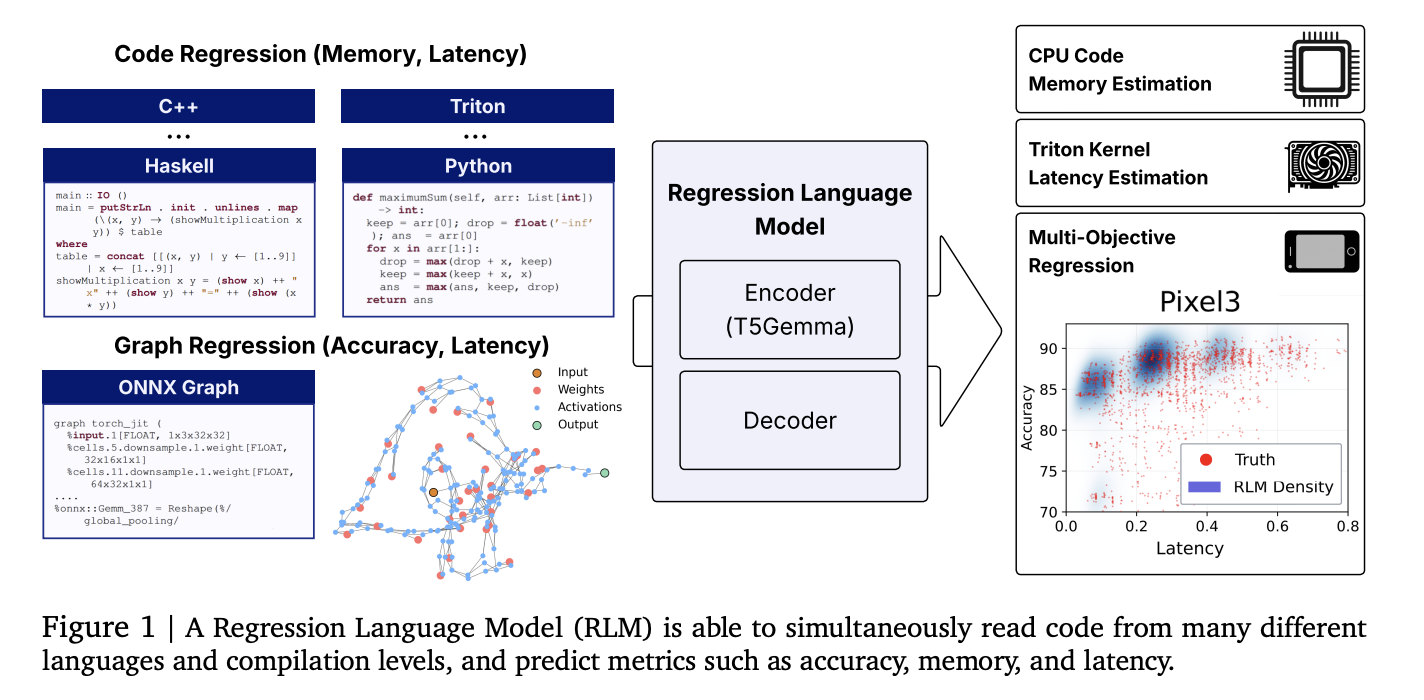
Researchers from Cornell and Google introduce a unified Regression Language Model (RLM) that predicts numeric outcomes directly from code strings—covering GPU kernel latency, program memory usage, and even neural network accuracy and latency—without hand-engineered features. A 300M-parameter encoder–decoder initialized from T5-Gemma achieves strong rank correlations across heterogeneous tasks and languages, using a single text-to-number decoder that emits digits with constrained decoding.

What exactly is new?

  • Unified code-to-metric regression: One RLM predicts (i) peak memory from high-level code (Python/C/C++ and more), (ii) latency for Triton GPU kernels, and (iii) accuracy and hardware-specific latency from ONNX graphs—by reading raw text representations and decoding numeric outputs. No feature engineering, graph encoders, or zero-cost proxies are required.
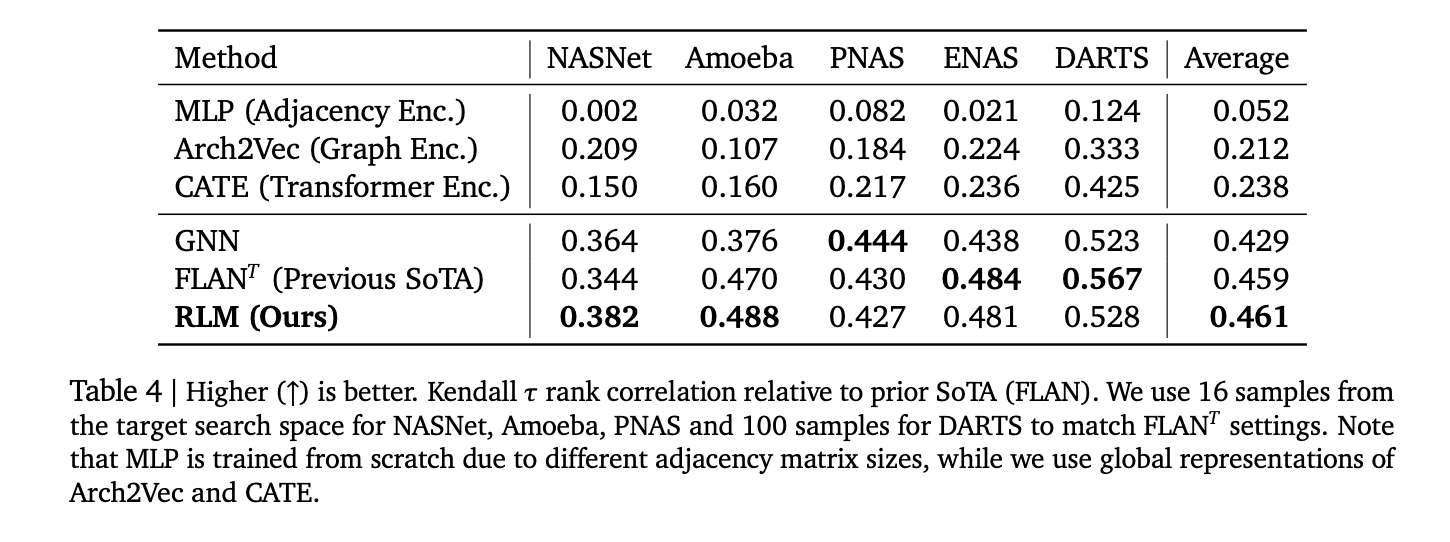
  • Concrete results: Reported correlations include Spearman ρ ≈ 0.93 on APPS LeetCode memory, ρ ≈ 0.52 for Triton kernel latency, ρ > 0.5 average across 17 CodeNet languages, and Kendall τ ≈ 0.46 across five classic NAS spaces—competitive with and in some cases surpassing graph-based predictors.
  • Multi-objective decoding: Because the decoder is autoregressive, the model conditions later metrics on earlier ones (e.g., accuracy → per-device latencies), capturing realistic trade-offs along Pareto fronts.
https://arxiv.org/abs/2509.26476

Why is this important?

Performance prediction pipelines in compilers, GPU kernel selection, and NAS typically rely on bespoke features, syntax trees, or GNN encoders that are brittle to new ops/languages. Treating regression as next-token prediction over numbers standardizes the stack: tokenize inputs as plain text (source code, Triton IR, ONNX), then decode calibrated numeric strings digit-by-digit with constrained sampling. This reduces maintenance cost and improves transfer to new tasks via fine-tuning.

Data and benchmarks

  • Code-Regression dataset (HF): Curated to support code-to-metric tasks spanning APPS/LeetCode runs, Triton kernel latencies (KernelBook-derived), and CodeNet memory footprints.
  • NAS/ONNX suite: Architectures from NASBench-101/201, FBNet, Once-for-All (MB/PN/RN), Twopath, Hiaml, Inception, and NDS are exported to ONNX text to predict accuracy and device-specific latency.
How does it work?

  • Backbone: Encoder–decoder with a T5-Gemma encoder initialization (~300M params). Inputs are raw strings (code or ONNX). Outputs are numbers emitted as sign/exponent/mantissa digit tokens; constrained decoding enforces valid numerals and supports uncertainty via sampling.
  • Ablations: (i) Language pretraining accelerates convergence and improves Triton latency prediction; (ii) decoder-only numeric emission outperforms MSE regression heads even with y-normalization; (iii) learned tokenizers specialized for ONNX operators increase effective context; (iv) longer contexts help; (v) scaling to a larger Gemma encoder further improves correlation with adequate tuning.
  • Training code. The regress-lm library provides text-to-text regression utilities, constrained decoding, and multi-task pretraining/fine-tuning recipes.

Stats that matters

  • APPS (Python) memory: Spearman ρ > 0.9.
  • CodeNet (17 languages) memory: average ρ > 0.5; strongest languages include C/C++ (~0.74–0.75).
  • Triton kernels (A6000) latency: ρ ≈ 0.52.
  • NAS ranking: average Kendall τ ≈ 0.46 across NASNet, Amoeba, PNAS, ENAS, DARTS; competitive with FLAN and GNN baselines.

Key Takeaways

  1. Unified code-to-metric regression works. A single ~300M-parameter T5Gemma-initialized model (“RLM”) predicts: (a) memory from high-level code, (b) Triton GPU kernel latency, and (c) model accuracy + device latency from ONNX—directly from text, no hand-engineered features.
  2. The research shows Spearman ρ > 0.9 on APPS memory, ≈0.52 on Triton latency, >0.5 average across 17 CodeNet languages, and Kendall-τ ≈ 0.46 on five NAS spaces.
  3. Numbers are decoded as text with constraints. Instead of a regression head, RLM emits numeric tokens with constrained decoding, enabling multi-metric, autoregressive outputs (e.g., accuracy followed by multi-device latencies) and uncertainty via sampling.
  4. The Code-Regression dataset unifies APPS/LeetCode memory, Triton kernel latency, and CodeNet memory; the regress-lm library provides the training/decoding stack.

It is very interesting how this work reframes performance prediction as text-to-number generation: a compact T5Gemma-initialized RLM reads source (Python/C++), Triton kernels, or ONNX graphs and emits calibrated numerics via constrained decoding. The reported correlations—APPS memory (ρ>0.9), Triton latency on RTX A6000 (~0.52), and NAS Kendall-τ ≈0.46—are strong enough to matter for compiler heuristics, kernel pruning, and multi-objective NAS triage without bespoke features or GNNs. The open dataset and library make replication straightforward and lower the barrier to fine-tuning on new hardware or languages.

🚨 [Recommended Read] ViPE (Video Pose Engine): A Powerful and Versatile 3D Video Annotation Tool for Spatial AI

Check out the Paper, GitHub Page and Dataset Card. Feel free to check out our GitHub Page for Tutorials, Codes and Notebooks. Also, feel free to follow us on Twitter and don’t forget to join our 100k+ ML SubReddit and Subscribe to our Newsletter. Wait! are you on telegram? now you can join us on telegram as well.


Asif Razzaq is the CEO of Marktechpost Media Inc.. As a visionary entrepreneur and engineer, Asif is committed to harnessing the potential of Artificial Intelligence for social good. His most recent endeavor is the launch of an Artificial Intelligence Media Platform, Marktechpost, which stands out for its in-depth coverage of machine learning and deep learning news that is both technically sound and easily understandable by a wide audience. The platform boasts of over 2 million monthly views, illustrating its popularity among audiences.

🙌 Follow MARKTECHPOST: Add us as a preferred source on Google.


READ ALSO

The MIT-IBM Computing Research Lab launches to shape the future of AI and quantum computing | MIT News

Meta FAIR Releases NeuralSet: A Python Package for Neuro-AI That Supports fMRI, M/EEG, Spikes, and HuggingFace Embeddings


Previous articleA Coding Guide to Build an Autonomous Agentic AI for Time Series Forecasting with Darts and Hugging Face


Source_link

Related Posts

The MIT-IBM Computing Research Lab launches to shape the future of AI and quantum computing | MIT News
Al, Analytics and Automation

The MIT-IBM Computing Research Lab launches to shape the future of AI and quantum computing | MIT News

April 29, 2026
Meta FAIR Releases NeuralSet: A Python Package for Neuro-AI That Supports fMRI, M/EEG, Spikes, and HuggingFace Embeddings
Al, Analytics and Automation

Meta FAIR Releases NeuralSet: A Python Package for Neuro-AI That Supports fMRI, M/EEG, Spikes, and HuggingFace Embeddings

April 29, 2026
Enabling privacy-preserving AI training on everyday devices | MIT News
Al, Analytics and Automation

Enabling privacy-preserving AI training on everyday devices | MIT News

April 29, 2026
OpenAI Releases Privacy Filter: A 1.5B-Parameter Open-Source PII Redaction Model with 50M Active Parameters
Al, Analytics and Automation

OpenAI Releases Privacy Filter: A 1.5B-Parameter Open-Source PII Redaction Model with 50M Active Parameters

April 29, 2026
Top 10 Physical AI Models Powering Real-World Robots in 2026
Al, Analytics and Automation

Top 10 Physical AI Models Powering Real-World Robots in 2026

April 28, 2026
Build a Reinforcement Learning Powered Agent that Learns to Retrieve Relevant Long-Term Memories for Accurate LLM Question Answering
Al, Analytics and Automation

Build a Reinforcement Learning Powered Agent that Learns to Retrieve Relevant Long-Term Memories for Accurate LLM Question Answering

April 28, 2026
Next Post
Is AI-generated actress Tilly Norwood the next Scarlett Johansson?

Is AI-generated actress Tilly Norwood the next Scarlett Johansson?

POPULAR NEWS

Trump ends trade talks with Canada over a digital services tax

Trump ends trade talks with Canada over a digital services tax

June 28, 2025
Communication Effectiveness Skills For Business Leaders

Communication Effectiveness Skills For Business Leaders

June 10, 2025
15 Trending Songs on TikTok in 2025 (+ How to Use Them)

15 Trending Songs on TikTok in 2025 (+ How to Use Them)

June 18, 2025
App Development Cost in Singapore: Pricing Breakdown & Insights

App Development Cost in Singapore: Pricing Breakdown & Insights

June 22, 2025
Comparing the Top 7 Large Language Models LLMs/Systems for Coding in 2025

Comparing the Top 7 Large Language Models LLMs/Systems for Coding in 2025

November 4, 2025

EDITOR'S PICK

Google brings its AI-powered photo-to-video capability to more apps

Google brings its AI-powered photo-to-video capability to more apps

July 24, 2025
Grow a Garden Spaghetti Recipe

Grow a Garden Spaghetti Recipe

August 11, 2025
Does Your Manufacturing Business Really Need Social Media?

Does Your Manufacturing Business Really Need Social Media?

October 25, 2025
How we’re making data centers more flexible to benefit power grids

How we’re making data centers more flexible to benefit power grids

August 4, 2025

About

We bring you the best Premium WordPress Themes that perfect for news, magazine, personal blog, etc. Check our landing page for details.

Follow us

Categories

  • Account Based Marketing
  • Ad Management
  • Al, Analytics and Automation
  • Brand Management
  • Channel Marketing
  • Digital Marketing
  • Direct Marketing
  • Event Management
  • Google Marketing
  • Marketing Attribution and Consulting
  • Marketing Automation
  • Mobile Marketing
  • PR Solutions
  • Social Media Management
  • Technology And Software
  • Uncategorized

Recent Posts

  • Moburst’s Monthly Marketing Roundup #30
  • BrandSmart 2026: How to Market Better, not faster, in the Age of Acceleration
  • The retrieval rebuild: Why hybrid retrieval intent tripled as enterprise RAG programs hit the scale wall
  • The MIT-IBM Computing Research Lab launches to shape the future of AI and quantum computing | MIT News
  • About Us
  • Disclaimer
  • Contact Us
  • Privacy Policy
No Result
View All Result
  • Technology And Software
    • Account Based Marketing
    • Channel Marketing
    • Marketing Automation
      • Al, Analytics and Automation
      • Ad Management
  • Digital Marketing
    • Social Media Management
    • Google Marketing
  • Direct Marketing
    • Brand Management
    • Marketing Attribution and Consulting
  • Mobile Marketing
  • Event Management
  • PR Solutions