If you’re here for email marketing automation examples, you’re probably stuck in the same loop most enterprise teams are: packed calendars, messy segments, and big sends doing less every quarter. Meanwhile, high-intent signals, like product views, onboarding friction, and renewal risk, expire faster than your team can act on them.
Email marketing automation is how top companies fix that disconnect. It lets you use event-driven workflows, rules engines, and behavioral data to trigger personalized emails across the lifecycle at scale.
Email automation consistently outperforms batch blasts because it pursues users when interest is fresh. Automated email campaigns generate 320% more revenue than non-automated sends, and, as privacy changes make open rates less reliable, marketers can no longer optimize for vanity metrics. What matters now is when a message is sent and what the user does next: clicks, conversions, retention.
Below, we break down nine email marketing automation examples from top brands to help you capture intent, reduce lag, and drive predictable revenue.
What is email marketing automation and why does it work for B2C brands?
Email marketing automation is a system of event-triggered workflows that automatically send emails based on customer actions, using rules, segmentation, and behavioral data from your email service provider or customer data platform. It offers:
- Real-time intent capture: For most brands, customer intent is spiky and short-lived. With nearly 1 out of 5 customers abandoning their carts, you’re losing buyers when you rely on scheduled sends. Automated email marketing campaigns, like abandoned cart flows, react within minutes to what the customer just did before their interest fades.
- Higher revenue efficiency: Automated messages drive disproportionate revenue by responding to customer actions. Industry benchmarks show that automated emails outperform one-off campaigns by a wide margin and account for a large share of total email ROI. That’s why top customer engagement and marketing teams center their email programs on automation flows and use campaigns mainly to amplify major revenue moments.
- Scalable personalization: Buyers don’t care about name-only personalization. They expect messages that match their priorities: offers, reminders, and recommendations based on their real behavior and preferences. Personalized email messages increase click-through rates by about 14% and conversion rates by around 10%. Segmented, personalized strategies generate a large share of total email revenue, proving relevance directly impacts performance.
- Privacy-resilient measurement: Open rates have become increasingly unreliable as privacy protections limit visibility into when, where, and whether emails are actually read. As a result, optimizing for opens alone no longer reflects real performance. Email automation shifts focus to downstream actions, likes, clicks, conversions, repeat purchases, and churn signals. This shift brings sharper attribution and far better decision-making.
- Lifecycle conversion lift: High-performing brand programs go beyond welcome emails and promo blasts. They use a CDP like Insider One to unify behavioral, transactional, and lifecycle data, then trigger the next best message based on real customer signals. Because a CDP resolves identity across channels and updates profiles in real time, automations fire when intent peaks. That’s why CDP-powered email automation flows, like welcome, abandoned cart, and post-purchase, consistently outperform broadcast campaigns. The payoff is compounding lifecycle revenue driven by timing and data quality.
Now, let’s break down how top brands use email marketing automation in practice.
9 email marketing automation examples that drive real results
If you’ve made it this far, you’re past the theory. What you want now is to see how brands actually use email automation workflows to influence timing, relevance, and conversion in real buying moments. Brands use these workflows to automate around intent signals like seasonality, location, consumption patterns, inventory, and post-purchase behavior so that they feel timely, contextual, and commercially effective.
1. Puma’s seasonal product drop: Prioritize seasonal buying cycles
PUMA triggers its football boot emails at the start of pre-season, when player replacement and upgrade intent naturally spike. Instead of sending a generic new-arrivals campaign, the automation fires around key season moments like league restarts and training ramps, promoting product packs aligned to player needs like speed, control, and creativity.
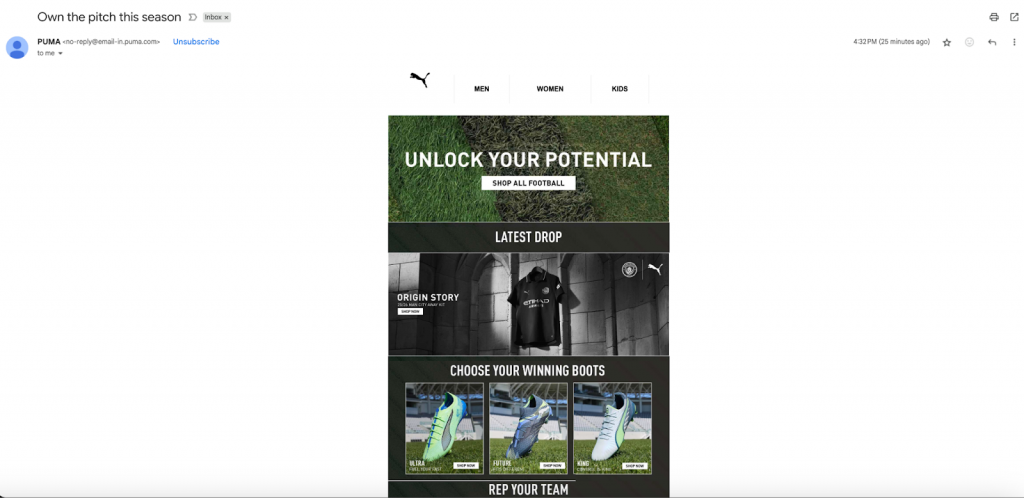
Each email follows a consistent structure: a clear product drop, a single hero story, and personalized recommendations using recent browsing, last-season purchases, or product-line affinity. Urgency comes from time-boxed access rather than discounts, giving customers a reason to act without eroding value.
Behind the scenes, this runs as a simple rules-driven flow: season start signal, football interest segment, and pack-specific merchandising. The result is higher engagement and faster conversion because the message arrives when demand already exists.
Key takeaway: Sync automated email marketing campaigns with seasonal buying cycles that matter to your customers. Brands see higher click-through and faster conversion when timing matches real buying windows.
2. Amazon Music: Benefit-Driven Feature Activation
Amazon uses email automation to activate an underused Prime benefit. They send an automated email to Prime members who show low engagement, highlighting the value of Amazon Music, already included in their subscription.
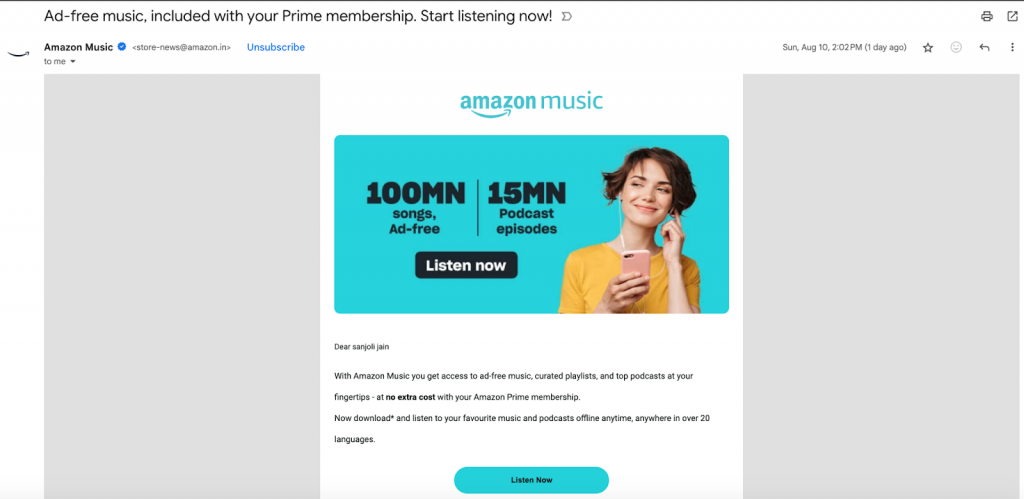
The message leads with zero additional cost and then grounds that value in everyday use cases, such as ad-free music, curated playlists, offline playback, and broad language support. This approach works when you need to remind users to do something they already pay for.
From a lifecycle standpoint, this type of email campaign increases feature adoption, strengthens habit formation, and raises the perceived value of your product, which directly supports retention.
Key takeaway: Reframe unused features as benefits customers already have access to, rather than add-ons they need to evaluate or pay for. This removes price objections upfront and nudges users to try the feature, which increases adoption and long-term value.
3: Starbucks’ new cherry blossom-themed beverages: Geo-based event tie-ins
Starbucks Japan uses local cultural moments as a trigger for highly contextual email campaigns, with sakura season as a standout example. Every spring, Starbucks marks cherry blossom season with limited-time sakura drinks, merchandise, and in-store digital experiences.
Emails during this period tap into a nationally shared moment, highlighting time-bound drinks, free sakura toppings, and immersive AR experiences available only during the promotion window. The automation works because timing is anchored to a real-world event customers already anticipate. Starbucks makes the email feel relevant the moment it lands by aligning messaging, products, and experience to a local cultural calendar.
Key takeaway: Trigger email automation around local events and cultural moments your audience already anticipates. Emails feel relevant by default and drive engagement without discounts when timing aligns with real-world context.
4. IndiGo’s Sight Seeing campaign: Add-on cross-sell after booking
IndiGo triggers its Sight Seeing emails immediately after a flight booking, when travelers are still planning their trip, and decision friction is low. Their automated email campaigns promote destination-specific tours and activities linked to the booked route, using booking data the airline already has. The offer reduces objections upfront by highlighting perks like free 24-hour cancellation and loyalty rewards, making the add-on feel easy and low risk.
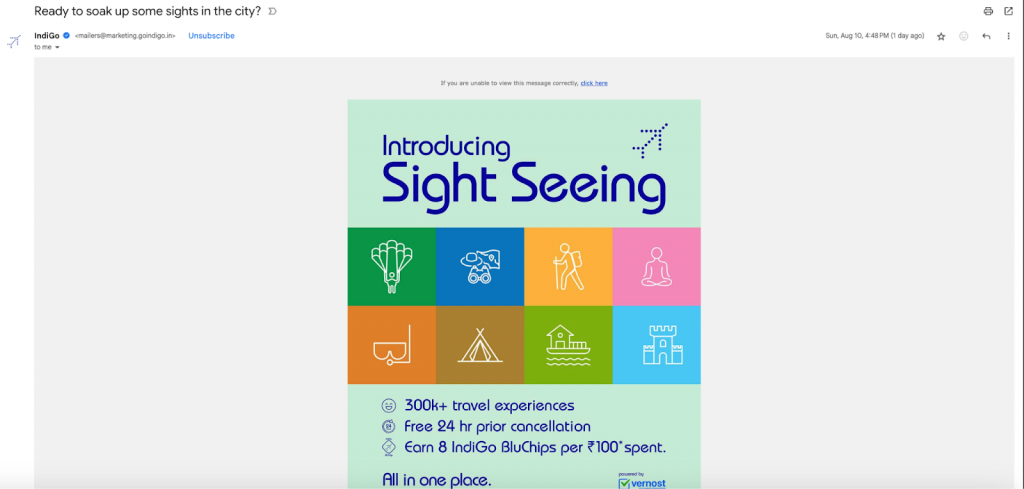
Ancillary purchases convert best right after checkout, when customers are mentally assembling the full trip. By embedding experiences into the post-booking flow, IndiGo captures incremental revenue without disrupting the primary purchase or relying on discounts.
Key takeaway: Trigger cross-sell automations immediately after checkout, when customers are still in planning mode, and intent is highest. Contextual, low-friction add-ons tied to the original purchase convert better at this stage than delayed or generic offers.
5. Netflix’s tailored series recommendation: Post-binge follow-ups
Netflix uses binge behavior as a trigger. When a viewer finishes a series in a short span, it sends a follow-up email with recommendations closely tied to what they just watched. The goal is to reduce the effort of choosing what to watch next while interest is still high.
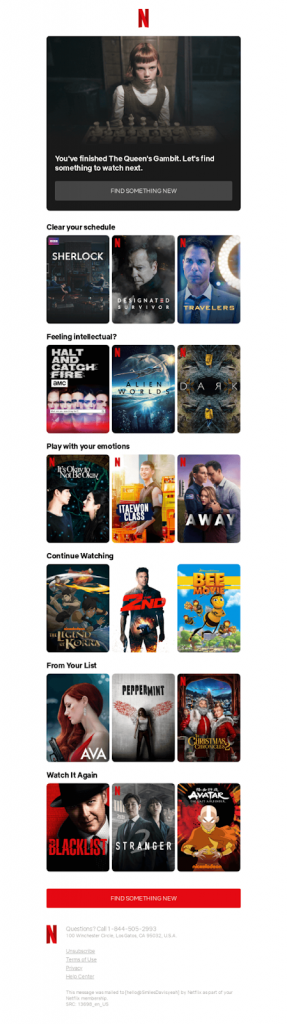
This email automation works because Netflix’s product is designed around next-choice discovery. Using signals like completion, binge speed, and recent viewing, the system surfaces a short list of highly relevant titles. By timing the email while the viewer is still in the same mindset, Netflix reduces choice overload and makes the next play feel like a natural continuation.
Key takeaway: Turn content consumption into a trigger for personalized recommendations and deeper engagement. Act while momentum is high, so the next action feels effortless rather than forced.
6. Linkin Park’s collaboration with Johnny Cupcakes: Limited-time collab countdown emails
Limited-time collaboration drops work best when email automation makes the deadline feel real. In the Linkin Park and Johnny Cupcakes collaboration, the brand runs a fixed, 48-hour pre-order window and sends a last-chance reminder as the close approaches.
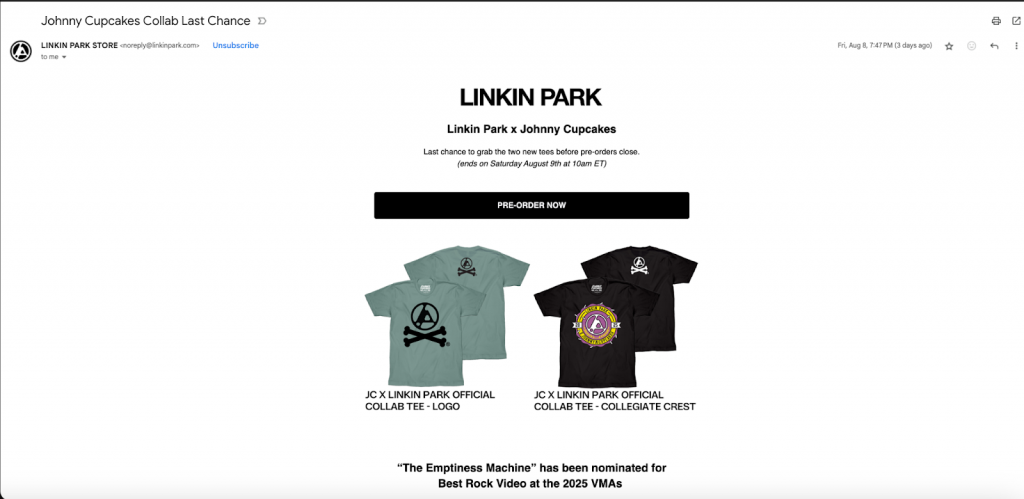
Time-based scarcity increases purchase intent when buyers believe the cutoff is genuine. The automation follows a clear sequence:
- Remind fans that they opted into something exclusive
- Show the products clearly to simplify the decision, and
- Restate the exact end time to push action
Using a real deadline also protects trust, since audiences quickly tune out urgency that feels artificial.
Key takeaway: Use countdown emails with real, fixed deadlines to convert customers who delay decisions until the last moment. Scarcity only works when the cutoff is genuine, so clarity and trust matter as much as urgency.
7. Freaks of Nature’s low-stock alert: Inventory-based urgency sequences
Inventory-driven urgency works when scarcity is real and tightly tied to customer intent. Travel booking aggregators show this with messages like “only 2 rooms left at this price,” shown exactly when availability drops for a hotel a traveler is already considering. The pressure doesn’t feel forced because the loss is clear and immediate: wait, and the option may disappear.
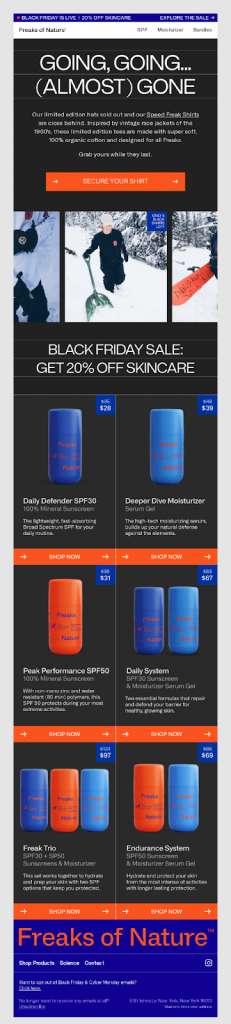
You see the same pattern in e-commerce emails. Low-stock alerts focus on a single product the customer browsed, show what’s left, and point to one clear action. AI email marketing makes this process scalable and trustworthy. It monitors inventory in real time, triggers alerts only when stock crosses a threshold, and suppresses messages if availability rebounds.
Key takeaway: Let real inventory changes trigger urgency for items customers already want.
8. Zoës Kitchen: Thank you with surprise offer
This Zoës Kitchen email shows how brands can use surprise offers to reward loyal or exclusive customers in a way that feels genuine. The message targets ZK Rewards members and places a free item directly into their account, framing it as appreciation rather than a promotion. Because redemption is built into the existing loyalty flow, the reward feels easy to use and reinforces the value of membership.
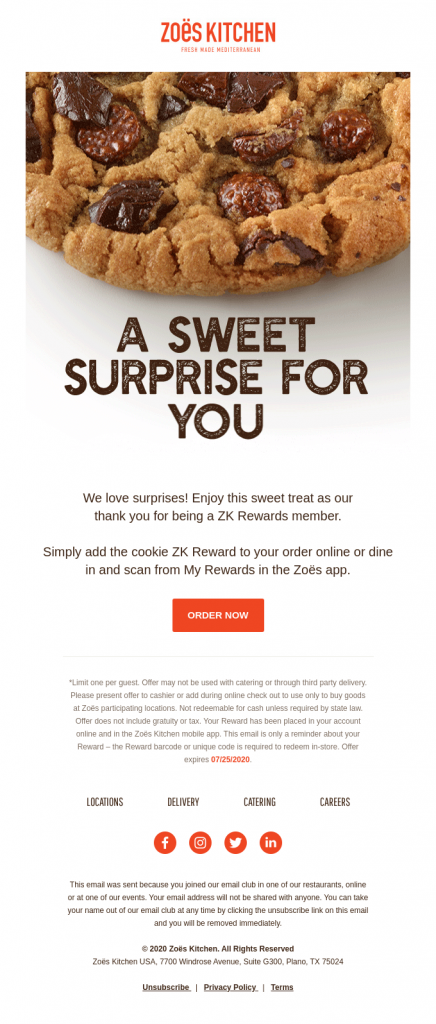
This works because surprise rewards arrive when customers are already positively inclined toward the brand, strengthening emotional loyalty and encouraging repeat visits without relying on discounts.
Key takeaway: Use unexpected rewards to recognize loyal customers and deepen long-term engagement without sales pressure.
9. Theater’s “Seen On Them” campaign: Social trend to product curation
This email marketing automation example turns social attention into a buying path. Instead of asking shoppers to jump from a TikTok look to five open tabs, the brand curates the ‘seen on’ moment inside the email and makes it shoppable in one click.
Campaigns like Theater’s “Seen On Them” work by pulling from what’s already trending (celebrity outfits, influencer fits, viral aesthetics), and then restyling those looks using the brand’s own catalog. The email doesn’t explain the trend. It assumes familiarity, shows the products, and removes the friction of finding them elsewhere to buy.
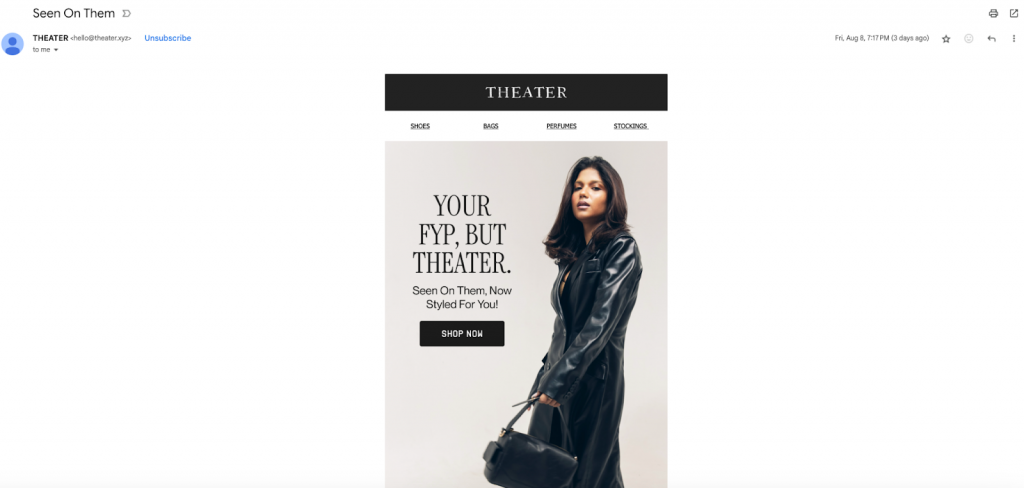
Why this works is simple. Social proof lowers hesitation, and cultural timing creates urgency. When the email lands while the trend is still circulating, customers feel like they’re acting in the moment. Operationally, this is a repeatable flow: monitor social trends, map them to products, and send curated drops to subscribers who’ve shown interest in similar styles.
Key takeaway: Turn trending social moments into curated, shoppable emails so customers can buy what they just saw, without leaving their inbox.
Build these automations faster with Insider One
Insider One gives brands a deeply AI-powered foundation for running campaigns similar to the email marketing automation examples you explored above. At its core is a unified customer data platform that consolidates behavior, profile, and preference data so every automated email can be precisely targeted and timed.
Insider One’s AI capabilities, including generative and predictive models, let you automate not just sends but also content and timing. It can generate subject lines and email copy, predict the best send times based on individual engagement patterns, and power real-time personalization so the message adapts even after it lands in the inbox. The platform also supports advanced experimentation like A/B testing, where the highest-performing variant is served automatically.
Because the CDP and AI work together, brands can turn almost any customer action (browsing, purchasing, reviewing, content consumption, or location signals) into an automated email trigger. The result is messaging that responds to real behavior in real time instead of generic campaigns tied to a fixed calendar. Sign up for a demo today to see how these email automations work in practice.
FAQs
Automated email marketing uses software to send emails automatically based on customer behavior, timing, or predefined rules. Instead of manual campaigns, messages trigger when someone browses a product, abandons a cart, makes a purchase, or reaches a lifecycle milestone. Email marketing automation allows brands to deliver timely, relevant emails to customers based on their intent.
A common example is an abandoned cart email triggered when a shopper adds items to their cart but leaves without checking out. The email automatically reminds them of the product, often with images or availability cues. It sends while interest is still high, increasing the chance of recovery.
Marketing automation refers to using technology to automate customer communications across channels based on behavior and data. Examples include welcome email series after signup, post-purchase follow-ups, low-stock alerts, and renewal reminders. These workflows run continuously without manual intervention. Each message is triggered by a specific customer event.
An auto-generated email is sent automatically when a predefined action occurs. A typical example is a purchase confirmation email sent immediately after checkout. Others include password resets, review requests, or post-booking confirmations. These emails deliver essential information without needing a marketer to send them manually.