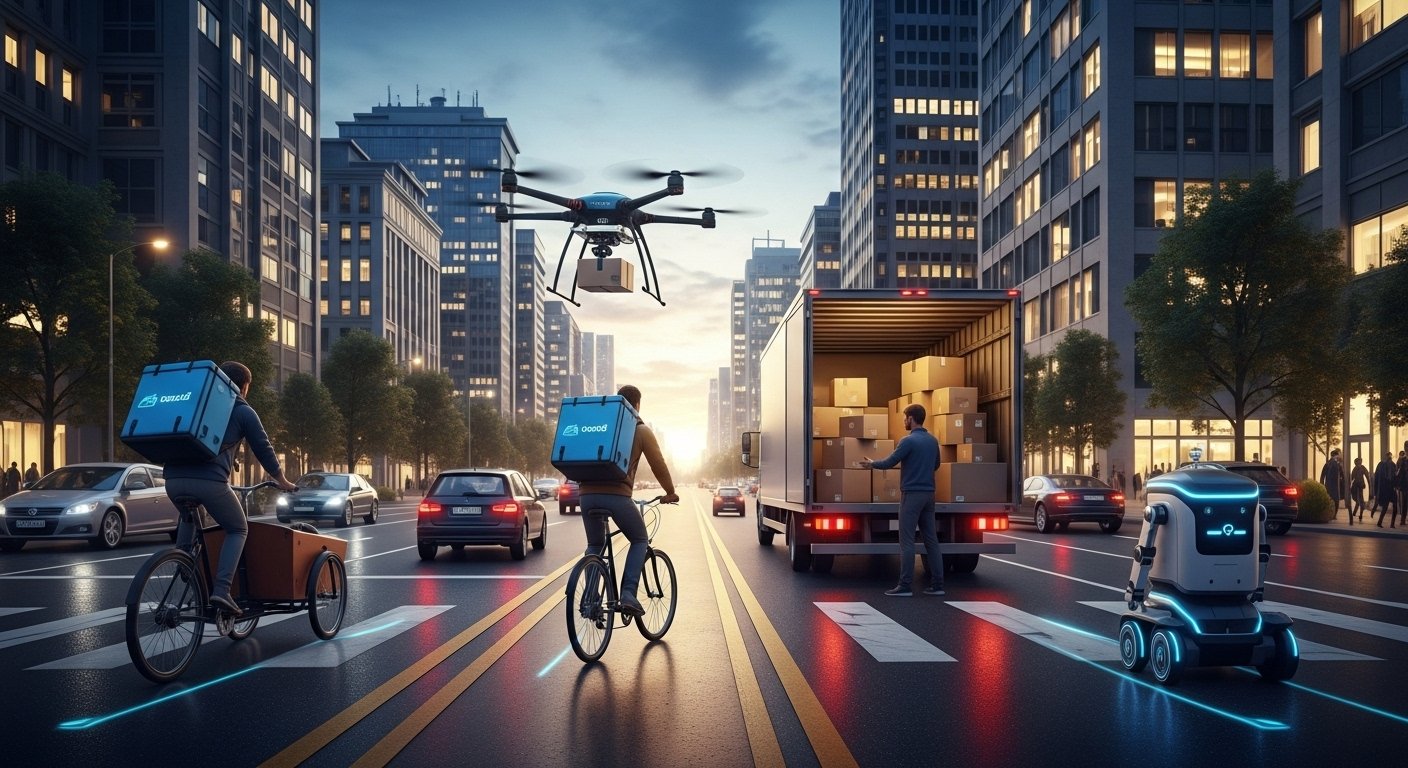
Urban logistics is entering a new era where practical technology drives meaningful results. Today, more than 55% of people live in cities, and urbanization is expected to rise to 68% by 2050, placing intense pressure on delivery networks to keep up with growing demand. U.S. e-commerce is projected to reach $1.1 trillion in sales by 2026, heightening expectations for faster and more reliable last-mile service.
Decision-makers now view the final mile as a unified system where software, stations, drivers, and customers share a single source of truth, thereby improving cost, speed, and sustainability. Investment is shifting to last mile technology that converts real-time conditions into actionable plans, as tighter streets and higher expectations redefine the final mile. Let us take a look at the top ten technology trends transforming last mile urban logistics in 2025.
10 Fields Where Last Mile Technology is Moving Fastest in 2025
Urban delivery is shifting from manual coordination to software-defined operations. Leaders favor platforms that turn live signals into decisions teams can trust. The ten trends listed below demonstrate how investment now yields measurable gains in speed, cost, and reliability.
- AI Route Optimization With Micro-refresh ETAs
AI models learn local speeds, historical data, service times, and access constraints, then refresh routes and ETAs at short intervals rather than once per day. This raises stop density, reduces reattempts, and keeps delivery windows aligned with current conditions.
As a result, last mile technology links planning and execution in a single, adaptive loop. Planners compare scenario outcomes side by side and lock the best plan for the next refresh cycle.
- Open Out-of-home (OOH) Networks and Locker-first Journeys
Carrier-agnostic lockers and pick-up points are moving from add-ons to core network assets. They consolidate handoffs, lower failed attempts, and offer flexible collection windows.
With open APIs and partner apps, this last mile technology scales quickly and integrates seamlessly into existing workflows. Data on locker uptake and dwell informs where to expand nodes for the highest operational and customer impact.
- Urban Micro-fulfillment and Resilient Infrastructure Shorten The Loop
Inventory positioned near demand reduces distance and variability. Micro-fulfillment sites and building-level locker banks absorb volume, enabling round-the-clock pickup. Paired with routing, this last mile technology reduces miles per parcel and sustains service during outages with localized buffers and redundant power. Resilient network design also reduces single-point failures and stabilizes SLA performance during peak conditions.
- IoT and Edge Telemetry for Condition, Safety, and Compliance
Sensors capture temperature, humidity, shock, idling, and energy use across vehicles and parcels. Geofences and access cues guide compliant arrivals and departures. When integrated with predictive analytics, this last mile technology converts raw device events into timely actions that safeguard product integrity and service levels. Exception playbooks trigger holds, redirects, or reschedules based on trusted thresholds, rather than relying on manual judgment.
- Sustainability Metrics Embedded in Every Choice
Operational views now place emissions alongside time and cost. EV-aware routing considers charge levels and dwell opportunities, while bikes and lockers reduce grams per stop in dense zones. With measurement and optimization on one screen, sustainability becomes a practical routing rule. Teams can simulate alternatives and choose routes that meet both service targets and emissions budgets.
- Predictive Exception Management That Flags Risk Early
Machine-learning models assess late-arrival risk by analyzing speed profiles, access history, dwell patterns, weather conditions, and scan behavior. Alerts carry owners and timers so teams act before promises slip.
This last mile technology curbs overtime, prevents reattempts, and supports consistent playbook responses. Historical resolution data improves recommendations, translating alerts into actions that consistently protect OTIF.
- API-first Orchestration Across Carriers, Systems, And Sites
Open APIs and event streams synchronize OMS, TMS, WMS, CRM, carrier networks, and fleet systems. When the plan, driver app, and customer link draw from a single event backbone, ETAs align, and audit trails remain intact.
This integration layer removes rekeying and the blind spots that create preventable exceptions. Versioned contracts and monitoring ensure integrations remain reliable as partners evolve and volumes increase.
- Cybersecurity And Data Governance Move To The Forefront
Broader data sharing increases risk alongside benefit. Encryption, role-based access, secure telemetry, and privacy-by-design now influence selection as much as features. Providers that embed protection into last mile technology earn trust at an enterprise scale. Audit trails and automated retention policies satisfy compliance requirements across regions and sectors.
- Autonomy and Robotics Advance Through Focused Pilots
Robots, drones, and autonomous couriers are transitioning from demonstrations to focused deployments, where workflow fit and economics are strong. Economics improve when autonomy pairs with micro-hubs, refrigerated lockers, and specialist lanes.
In this context, automation complements broader last mile technology roadmaps rather than replacing them. Operational data guides where autonomy is economically viable, ensuring investments focus on repeatable, high-yield corridors.
- Customer Experience (CX) Becomes a Product, Not Just a Metric
Experience is designed end-to-end, not measured after the fact. Self-service scheduling, live tracking, preferred pickup points, and smart redirections reduce calls and missed attempts.
Accessibility features, such as voice prompts and large-type ETAs, widen the reach, while a single event stream ensures customers see credible promises instead of apologies. Clear post-delivery feedback loops capture issues early and feed continuous improvement across routes and markets.
What This Means for Planners, Dispatch, and Customer Teams
Operational gains materialize when planning, station workflows, curb execution, and customer communication operate on a single timeline with shared identifiers. A unified control tower integrated with routing intelligence resequences stops, republishes ETAs at short intervals, and propagates the same update to driver apps and customer links.
Teams no longer reconcile conflicting systems; they address the few exceptions that truly affect service. Governance improves as well. Clear ownership models, standard operating procedures, and compact KPI scorecards align daily actions with service targets. Data quality routines sustain a single source of truth, while audit trails support compliance reviews and commercial claims.
Training becomes targeted because event histories reveal where guidance is most needed. In practice, last mile technology creates a predictable way of working that reduces variability, improves first-attempt success rates, and shortens resolution times.
How to Get Started, Fast?
Begin with a small, well-instrumented scope, prove value with clear metrics, then expand deliberately. Consistency and shared facts matter more than breadth on day one.
- Choose One Source of ETA Truth
Unify ETAs across the control tower, driver app, and customer link so everyone sees the same promise. This anchors every other last mile technology decision.
- Instrument the station
Scan arrivals, sort, load, and gate-out, then link events to route plans. Clean upstream data reduces downstream exceptions and enables accurate training of AI.
- Pilot Locker-first in the Right Neighborhoods
Use footfall, distance to door, and hour-of-day analysis to select zones. Expect fewer reattempts and lower grams per stop.
- Adopt AI Routing With Governance
Compare the cost per stop and first-attempt success to baseline, review exceptions weekly, and document what works before scaling.
- Design CX Like a Product
Offer live tracking, smart redirections, and accessible pickup flows. Treat app journeys and locker UX as core areas of last mile technology, not extras.
Make Urban Delivery Predictable Now
Urban delivery will not get simpler, yet it can become more predictable when decisions move at the speed of events. OOH consolidation can reduce trips and emissions when lockers and pick-up points operate as a unified ecosystem with advanced last mile delivery software.
IoT signals will continue to power analytics that keep product condition, energy use, and curb moves within the standards customers and cities expect. Taken together, these shifts push last mile technology from pilot to standard practice.
With technology partners such as FarEye, you can align planning, visibility, exceptions, and customer communication without disrupting core systems. Choose modular tools, wire clean data, and provide every stakeholder with the same ETA so operations remain steady, costs decrease, and service improves. Ready to act? Select a corridor, connect the signals, and turn last mile technology into measurable results.