10 Critical Mistakes that Silently Ruin Machine Learning Projects
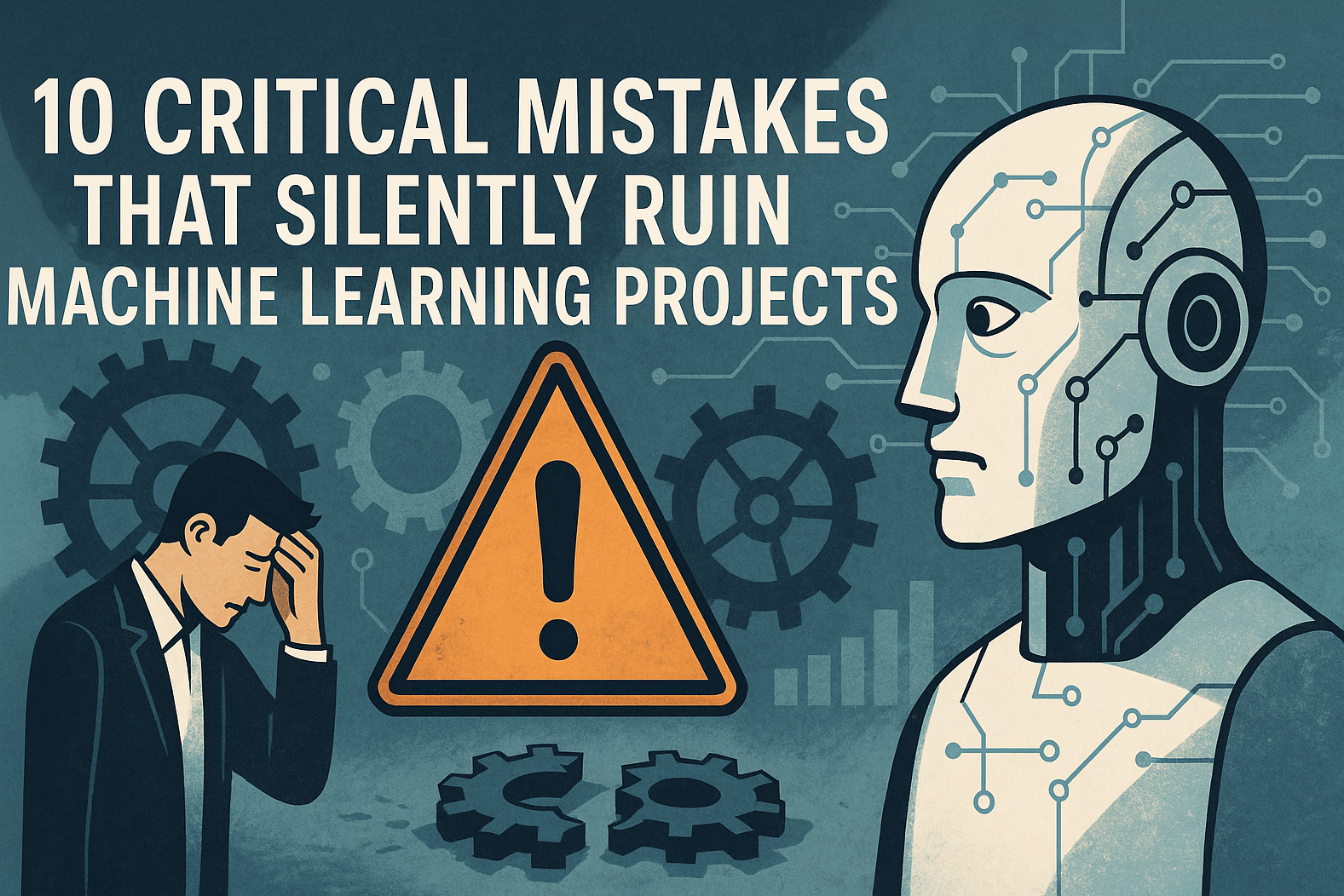
Image by Editor | ChatGPT
Introduction
Machine learning projects can be as exciting as they are challenging. From data collection and preparation to model deployment and monitoring, many aspects require careful attention to avoid costly setbacks, inaccurate models, or wasted resources. This article outlines 10 critical mistakes that, if not identified and addressed properly, could derail machine learning projects — sometimes in subtle and hard-to-detect ways. The list spans the different stages of a machine learning lifecycle, from goal setting to deployed system maintenance.
10 Machine Learning Project Mistakes Across Its Lifecycle
1. Misaligned or Vague Project Goals
Whether you want to build a predictive model to estimate supermarket sales in the next 30 days or a real-time action recognition system in video for sports tracking, the project objectives must be clear and measurable. Without clearly defined and measurable goals, evaluating success or aligning stakeholders becomes infeasible. Poorly defined objectives often lead to wasted resources or building machine learning solutions that address the wrong problems.
2. Poor Data Quality
As critically important and valuable as it is, raw data is, more often than not, far from perfect in terms of quality. Real-world data often contains missing values, noisy instances, and inconsistencies, and it might not be representative of all possible situations or groups relevant to the application scenario. Training a model on such “imperfect data” will, overwhelmingly, yield machine learning models that produce unreliable outcomes. This illustrates a central, foundational principle in the machine learning landscape: “garbage in, garbage out”. If you train a model for personalized product recommendations with historical customer data full of errors and inconsistencies, the product recommendations (predictions) for any target user once the system is deployed are almost certainly condemned to fail.
3. Inappropriate Data Preprocessing
Data preprocessing is the process applied to improve raw data quality before building a machine learning model. However, in the spirit of Murphy’s Law, if something can go wrong during this stage, it often will. It is crucial that the necessary preprocessing steps are correctly identified and undertaken, depending on the specific issues found in the data. Typical preprocessing steps include normalizing numeric features, encoding categorical features, and handling imbalanced data. Skipping these steps could severely impact the model’s performance. Issues like data leakage during preprocessing—for example, by using information from the test set during training or inadvertently including the target variable in feature engineering—are particularly risky, as they usually go unnoticed.
4. Choosing the Wrong Machine Learning Technique or Model Type
Machine learning models vary greatly in complexity. While a simple linear regression model might suffice for predicting exam scores based on hours of study, a more challenging problem like predicting future flight prices based on numerous and diverse factors will logically require a more sophisticated model, like a random forest or XGBoost ensemble. The bottom line: using overly simple models for complex problems can lead to underfitting, where the model fails to learn important patterns from the training data. Meanwhile, using unnecessarily complex models for simple tasks is not a good idea either, as it could lead to overfitting: memorizing the training data so excessively that the model is unable to generalize to new, unseen data. Also be aware that blindly opting for trendy architectures without considering the problem context might lead to unnecessarily wasted resources: do not use a sledgehammer to crack a nut!
5. Poor Hyperparameter Tuning
Hyperparameter tuning is a critical step in training machine learning models, especially those of intermediate to high complexity with plenty of “design choices” to be made before initiating the training process. Adopting arbitrary or default hyperparameter values without applying a structured approach to find the best configuration — like grid search or Bayesian optimization — can result in suboptimal models, even if the chosen technique is the most suitable for the problem and goal at hand.
6. Incomplete or Insufficient Model Evaluation
It’s tempting to rely solely on a single evaluation metric that reports positive results, but this approach often ignores other metrics that can capture different nuances of a model’s performance. Likewise, not using proper evaluation mechanisms like cross-validation, or testing your model only on a single data split, can often give a false sense of good performance. Robustness must be an integral part of the evaluation; to test it, you need to ensure the model is exposed to a wide variety of situations it might have to address in the real world, even the least likely ones.
7. Opaque Models: Lack of Interpretability or Transparency
In high-stakes domains, it is important that the model’s behavior, inputs, and limitations when making predictions can be explained to stakeholders; otherwise, trust in the solution might be compromised. This is typically the case in domains like finance, law, and healthcare.
8. Inappropriate Deployment Strategy
Our model has been trained, properly evaluated, and validated, and it has the desired level of interpretability: it’s time to deploy it to production! But there are still issues that could be encountered at this late stage of the project. Real-world integration is an engineering process that requires not only technical expertise but also careful planning for integration with the system(s) the model will become part of. Aspects to consider in deployment planning include model prediction latency, infrastructure, and retraining pipelines. Even well-performing models could be rendered useless in production environments if the deployment process is not conducted properly.
9. Ignored User Adoption and Feedback
Once deployed, end users become the main point of interaction with the model. If users don’t understand the model’s predictions or they simply don’t trust them, they won’t keep using it. End users should therefore be involved in the earlier stages of the project, particularly in the design process. Making the outputs actionable is a key indicator of success, and user feedback on the deployed model can help continuously improve it and detect areas needing revision or improvement.
10. No Ongoing Maintenance or Monitoring
Imagine tending to a garden meticulously, only to abandon it once the first flowers bloom. Something similar often happens with machine learning models once deployed: they are no longer monitored or maintained. This can nullify all the effort from the previous nine steps. Real-world data evolves, and since machine learning models are fueled by data, their performance can (and often will) decay over time due to data drift or changes in the environment. Monitoring, setting alerts, and establishing retraining pipelines are essential to combat performance degradation. Otherwise, by the time the team notices something is wrong, the damage may already be done, typically from delivering misleading predictions over a period of time.
Wrapping Up
This article has explored the lifecycle of machine learning system development, highlighting 10 critical (and sometimes subtle) mistakes that can derail a project and outlining effective approaches to avoid them.