Email marketing has entered a new era, and the platforms built for the last one are showing their limits. Subscribers expect timely, relevant, personalised messages, and delivering that at scale requires more than a smarter ESP. It requires AI that runs across every touchpoint: email, SMS, WhatsApp, web, and app, all sharing the same data, the same logic, and the same view of each customer. That’s the shift driving AI adoption in email marketing in 2026, and the gap between platforms that were built this way and platforms that weren’t is widening fast.
The AI-enabled email marketing market is projected to reach $6.74 billion by 2030, growing at a 25.4% CAGR . This rapid growth highlights the increasing reliance on AI for real-time insights, automated optimization, and smarter audience targeting.
Marketers who adopt AI-driven email tools gain the agility and insight needed to stay ahead in a crowded inbox. With AI, campaigns can adapt dynamically, send the right message to the right subscriber at the right time, and turn raw data into actionable insights that drive measurable results.
The growing importance of AI in email marketing
The role of AI-powered email marketing has moved far beyond buzz; it’s now a core part of how brands engage subscribers and drive results. Rapidly evolving consumer expectations and the complexity of modern marketing technology stacks are pushing marketers to adopt smarter tools that deliver personalized experiences at scale.
In simple terms, AI in email marketing uses machine learning and automation to analyze data, predict patterns, and optimize campaigns, from segmentation and personalization to send-time optimization and performance analysis. These capabilities help teams deliver the right message to the right audience at the right moment, without manual intervention.
Consumers increasingly expect personalization: 71% of people now say they want tailored interactions from brands, and many become frustrated when emails feel generic or irrelevant. This shift in expectation is a major driver behind AI adoption in email marketing platforms.
At the same time, demand for AI‑enabled email marketing solutions is projected to grow as more businesses embrace AI‑driven insights and automation.
Why AI adoption is accelerating
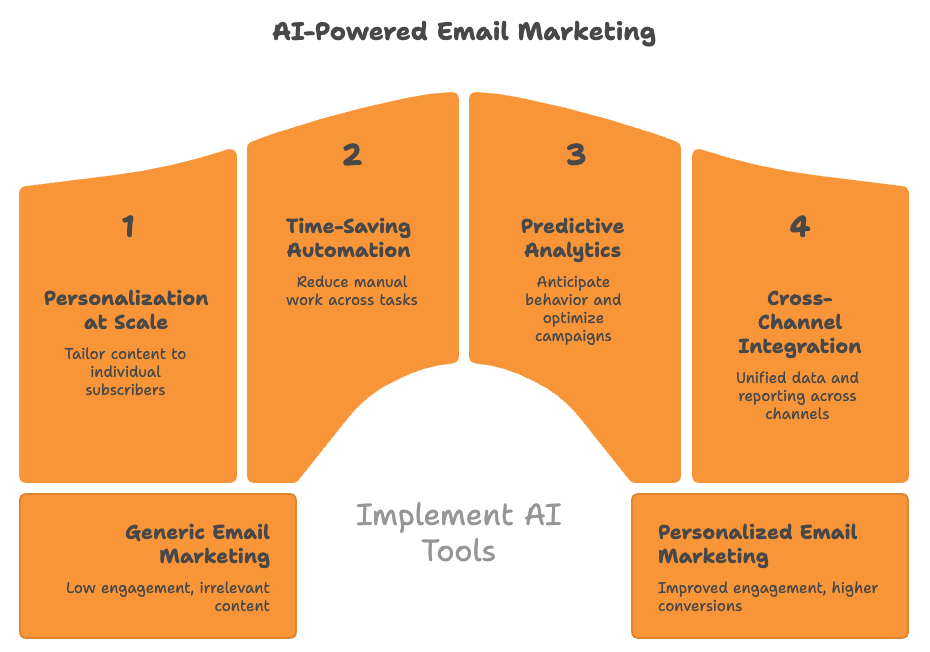
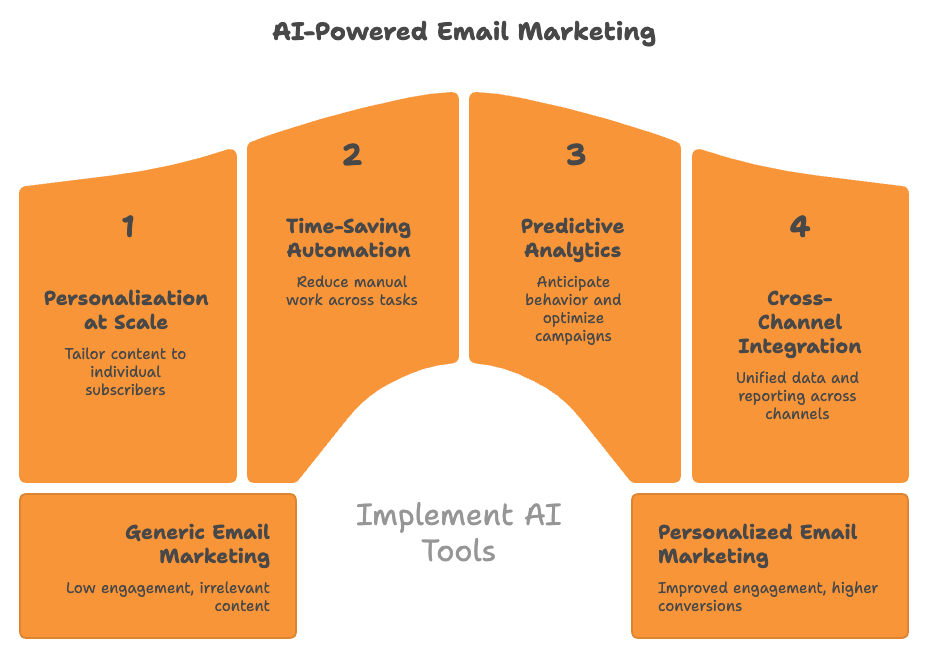
AI tools are being adopted for several core reasons that directly impact campaign performance:
- Personalization at scale — AI analyzes individual behaviors and preferences to tailor email content down to the recipient level.
- Time‑saving automation — Tasks like segmentation, content generation, and campaign optimization that once took hours can now be completed in a fraction of the time.
- Predictive analytics — Machine learning models forecast user behavior, optimize timing, and improve relevance without manual guesswork.
- Cross‑channel integration — Modern platforms link email data with CRM, ecommerce, and advertising systems for unified reporting and consistent experiences.
- Unified architecture advantage — Platforms built as a single AI-native system, where email, SMS, web, and app share one CDP and one orchestration engine, outperform stacks assembled from separate tools, because every message is informed by everything a customer has done everywhere, not just in email
Here’s a quick summary of these benefits:
| Core Benefit | What It Enables |
| Personalization at Scale | Tailor content and offers to individual subscribers |
| Automation Efficiency | Reduce manual work across segmentation, scheduling, and optimization |
| Predictive Insights | Anticipate behavior and optimize campaigns proactively |
| Seamless Integration | Unified data and reporting across channels |
| Unified Architecture | Enhanced learning and 1:1 personalization |
These capabilities help marketers keep up with customer expectations and improve open rates, engagement, and conversions, results that traditional email tools often find difficult to match at scale.
How AI enhances personalization and customer engagement
AI‑powered email marketing does much more than insert a name at the top of a message. At its core, AI‑powered personalization uses machine learning and real‑time data to tailor content, offers, and recommendations specifically to each subscriber’s behavior, preferences, and purchase history, then deliver them automatically once the workflows are set up.
This isn’t just smart; it aligns with what customers actually want. 71% of consumers expect personalized interactions, and 76% express frustration when experiences aren’t tailored to them, a clear signal that relevance has become table stakes in digital engagement.
Personalization, strengthened with Sirius AI™, Smart Recommender, AMP
Traditional vs. AI‑powered personalization
Here’s a quick contrast between old‑school tactics and AI‑driven experiences:
| Personalization type | How it works | Typical impact |
| Static/rule‑based | Same content for broad segments | Limited relevance, slower optimization |
| AI‑powered dynamic | Content adapts per individual in real time | Higher engagement, better conversions |
Traditional methods rely on broad segments and manual rules (“send offer A to group X”), while AI tools can tailor content in real time to each user’s profile and behavior, a much deeper level of relevance.
Platforms with advanced segmentation and journey orchestration use predictive insights to determine not just who should receive a message, but what that message should contain for each recipient.
This level of AI personalization directly supports stronger customer engagement, deeper loyalty, and better overall campaign performance, because messages feel relevant, timely, and tailored to individual needs.
What AI‑powered automation means in email marketing
AI‑powered automation refers to systems that use machine learning and data signals to trigger email actions, such as sending a message when a user abandons a cart or visits certain pages, without needing manual setup for each user. This includes:
- Automated triggers: Real-time, behavior-based emails sent when users take or do not take specific actions, such as abandoning a cart, making a first purchase, or becoming inactive. This ensures timely and highly relevant communication.
- Drip campaigns: Pre-defined, multi-step sequences that nurture subscribers over time. These campaigns adapt based on engagement such as opens, clicks, and conversions, guiding users from awareness to purchase.
- Smart workflows: End-to-end, AI-powered journeys that continuously evaluate user behavior to determine the next best message, channel, and timing, removing the need for manual campaign planning.
- Replenishment campaigns: For consumable products like skincare, supplements, coffee, and pet food, emails are triggered based on predicted usage cycles. Customers receive reminders when they are likely running low, often with AMP-powered one-click reorder functionality.
- VIP tier escalation: Automatically detects when a customer crosses a lifetime spend threshold and triggers a personalized email acknowledging their VIP status, unlocking perks like exclusive offers or early access, strengthening loyalty at a key moment.
- Win-back campaigns: Instead of waiting for full inactivity, churn prediction identifies early disengagement signals and launches adaptive win-back journeys. Messaging evolves based on user response, with escalation to other channels if needed.
- Post-purchase cross-sell: After a purchase, the system tracks browsing behavior and sends timely recommendations for complementary products, aligned with the customer’s discovery phase rather than fixed schedules.
- Interactive launches (AMP): Product launch emails become interactive experiences that allow users to browse collections, select variants, and add to cart directly inside the email, reducing friction and improving conversion rates.
- Browse abandonment: Goes beyond cart abandonment by targeting users who viewed products but did not add to cart. Emails are tailored with relevant content, social proof, or comparisons to move them closer to purchase.
- Peak season campaigns: Designed to handle high-volume moments like Black Friday without performance drops. Campaigns remain personalized at scale by using send-time optimization and preferred channels to deliver individually timed interactions.
These automated flows make it feasible to deliver relevant, timely, and personalized messaging at scale, which is difficult to maintain with purely manual systems.
How AI automation improves efficiency
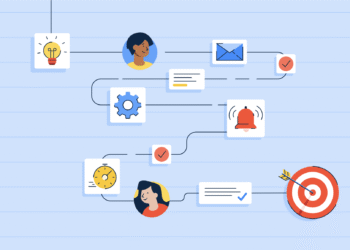
Here’s a simple step‑by‑step flow showing how an AI‑driven automation workflow handles a user journey:
- Trigger Event: A user abandons a shopping cart or browses a product category.
- AI Evaluation: The system analyzes behavior and predicts optimal content and timing based on past data.
- Automated Delivery: The appropriate email sequence is sent automatically (e.g., reminder, offer, product recommendations).
- Adaptive Optimization: AI adjusts content, timing, and follow‑ups based on real‑time engagement signals.
Because AI handles much of the routine decision‑making and execution, teams can scale efforts quickly across large subscriber lists, reducing manual bottlenecks and improving consistency.
Why time‑saving automation is a business advantage
- Faster execution: Campaigns launch rapidly without manual setup.
- Improved consistency: Workflows run reliably around the clock.
- Better personalization: Triggered emails feel more relevant than mass broadcasts.
- Higher productivity: Teams spend less time on repetitive tasks and more on strategy.
Overall, AI‑powered automation streamlines execution, enables scalable personalization, and reduces the manual workload that often limits email marketing effectiveness.
How Insider One’s Architect turns behavioral data into revenue
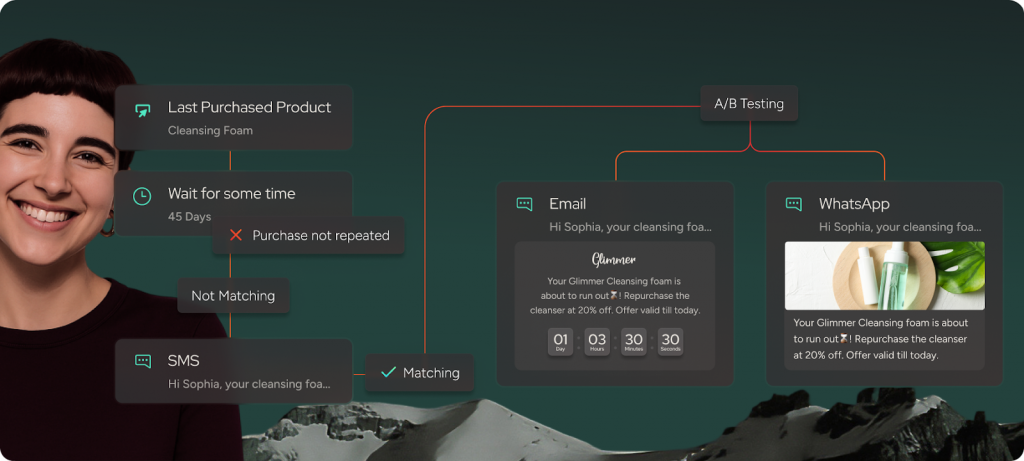
The automation capability that separates Insider One from standard email platforms is Architect, its AI-native journey orchestration engine. Architect does not just trigger emails based on predefined rules. It builds multi-step, adaptive journeys that respond to what customers actually do in real time, selecting the next best message, channel, and timing based on live behavioral signals.
Here is how an Architect-powered journey handles a real customer scenario:
A customer adds a pair of trainers to their cart and leaves without purchasing.
Architect detects the abandonment signal and queries the customer’s CDP profile, purchase history, channel preferences, discount affinity, time of day engagement patterns. It determines this customer has a low discount affinity and typically engages with email in the evening. It sends a personalized email at the optimal hour with a product recommendation that updates at open based on any additional browsing the customer has done since abandonment.
The customer opens the email but does not click. Architect registers the open without conversion and automatically queues a WhatsApp follow-up the following morning, not a copy of the email, but a shorter, more direct message referencing the specific product. The customer clicks through and purchases.
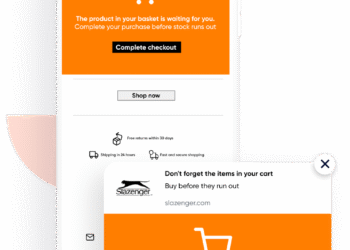
The entire sequence, detection, CDP query, channel selection, timing optimization, follow-up escalation, happens without any manual intervention. This is what Slazenger experienced when it used Architect and Sirius AI™ to build behavior-driven cart recovery journeys, achieving 30% productivity gains while significantly improving recovery rates.
Leveraging predictive analytics to optimize email campaigns
Predictive analytics in email marketing uses AI algorithms to analyze historical behavior, identify patterns, and forecast future subscriber actions. This enables marketers to anticipate engagement, optimize send times, and recommend personalized content sequences, creating more relevant and effective campaigns.
For example, AI can predict when individual subscribers are most likely to open an email, suggest subject lines, or sequence content in automated workflows to maintain ongoing engagement. By applying these insights, brands can increase open rates, drive conversions, and maximize ROI.
Manual vs. AI-powered predictive analytics
| Approach | How It Works | Key Outcome |
| Manual Analysis | Relies on historical data and assumptions | Slower, less accurate, limited scalability |
| AI-Powered Predictive | Uses machine learning to forecast behavior and optimize campaigns in real time | Faster, highly precise, scalable, improved engagement |
Integrating predictive analytics into email marketing allows marketers to shift from reactive decision-making to AI‑driven campaign optimization, improving both efficiency and results.
How Insider One applies predictive analytics across the email journey
Insider One‘s predictive capabilities go significantly beyond send time optimization. Sirius AI™ applies machine learning models across the full email lifecycle to predict and act on signals that standard platforms cannot detect:
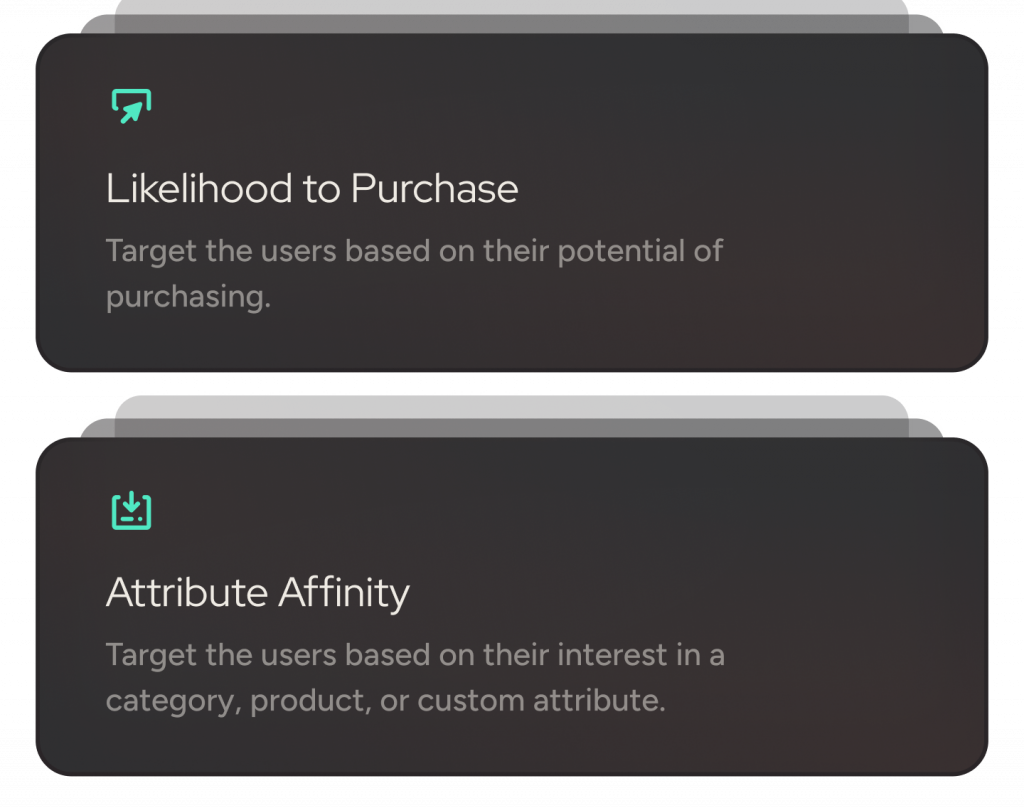
- Likelihood to purchase: Insider One scores each subscriber’s likelihood to purchase in the next session, enabling marketers to suppress high-intent subscribers from discount campaigns, protecting margin, while targeting price-sensitive subscribers with precisely calibrated offers.
- Churn risk scoring: Predictive models identify subscribers who are beginning to disengage before they unsubscribe, flagging the window in which a well-timed re-engagement campaign can recover them. A subscriber who has moved from weekly opens to monthly opens triggers a churn risk score that automatically activates a win-back journey.
- Discount affinity modeling: Not every subscriber needs a discount to convert. Insider One models each subscriber’s sensitivity to promotional offers, ensuring that discounts are reserved for subscribers who genuinely need the incentive, rather than being applied universally, which trains customers to wait for sales.
- 120+ micro-segments for surgical targeting: Insider One supports over 120 segmentation attributes combining purchase history, browsing behavior, lifecycle stage, channel reachability, and predicted future actions. This level of granularity means campaigns can be targeted to audiences like “high-value subscribers who have not purchased in 45 days, have a high likelihood to purchase, and engage primarily on mobile in the evening”, without requiring a data team to build the segment manually.
- Next-Best Channel, predictive channel selection at scale: When a subscriber does not engage with an email, Insider One does not simply send a follow-up email. Its Next-Best Channel capability predicts which channel the subscriber is most likely to respond to SMS, WhatsApp, push notification, or email, and automatically routes the next message accordingly. This means email campaigns are not siloed; they are the starting point of an intelligent multi-channel conversation.
- Insights Agent, autonomous email performance monitoring: Most email platforms tell you what happened after a campaign has run its course. Insider One’s Insights Agent monitors campaign performance in real time and acts on problems before they escalate into revenue loss.
When an email campaign begins underperforming, open rates drop, click-through rates fall below baseline, or engagement declines in a specific segment or region, the Insights Agent detects the anomaly automatically, performs root cause analysis, and either alerts the marketing team with a specific recommendation or triggers a corrective action autonomously.
For example, if open rates drop significantly in a particular region during a weekend campaign, the Insights Agent identifies whether the cause is subject line fatigue, a suboptimal send time, or a content issue by comparing performance across segments and regions in real time. It can automatically pause underperforming sends, queue refreshed variants, and notify the team via their preferred channel, all without waiting for a marketer to review a dashboard on Monday morning.
For email marketers managing high-frequency campaigns across large subscriber bases, this capability alone can recover significant revenue that would otherwise be lost to campaigns that run to completion before anyone notices they are failing.
Seamless integration: AI across your marketing channels
AI reaches its full potential when it connects across email, SMS, web, ads, and social media, allowing marketers to deliver a consistent, unified customer experience. Cross-channel AI integration ensures that customer data, automation, and messaging work together, so every touchpoint feels personalized and relevant.
For example, AI-driven platforms can sync customer behavior across channels, trigger follow-up emails based on actions in other systems, and maintain consistent messaging across campaigns. Integration examples include:
- Automated follow-ups triggered from chatbot or support interactions in your existing tech stack
- Ecommerce platforms sending SMS or email messages after cart activity
- Social media campaigns adjusting retargeting based on email engagement
Solutions like Insider One’s unified customer data platform (CDP) combined with 100+ plug‑and‑play integrations, make it easy to orchestrate campaigns across channels, enabling real-time personalization and connected journeys that enhance engagement and conversions.
Democratizing AI: access for businesses of all sizes
AI-powered email marketing is no longer limited to enterprises, but that doesn’t mean all platforms are equally accessible. The real barrier to adoption has never been cost; it’s been implementation complexity. Platforms that require months of technical setup, dedicated IT resource, or a professional services investment before a campaign goes live effectively exclude the majority of marketing teams,a regardless of budget.
Insider One is built so that the same capabilities used by global enterprise brands, predictive segmentation, cross-channel journey orchestration, and real-time personalization, are available to teams of any size, without IT dependency and with first campaigns typically live within days of onboarding. The differentiator isn’t a stripped-down SMB tier; it’s an architecture that doesn’t require technical resources to operate at full capability.
By making AI-powered email marketing accessible to all, brands can create more relevant, engaging, and impactful campaigns, bridging the gap between strategy and execution while driving measurable results.
To stay competitive in 2026, marketers need a clear roadmap for adopting AI-driven email marketing. The goal is not just implementing AI, but using it to enhance personalization, automate workflows, integrate platforms, and optimize campaigns continuously.
4 foundational steps
- Adopt AI Tools for Personalization and Analytics – Leverage predictive analytics, AI-powered segmentation, and dynamic content to deliver relevant experiences at scale.
- Automate Workflows – Implement AI-driven triggers, drip campaigns, and smart sequences to save time and ensure consistent engagement.
- Integrate Platforms – Connect email, CRM, ecommerce, SMS, and social platforms to unify customer data and maintain consistent messaging.
- Monitor Trends and Optimize – Track performance metrics in real time, adjust campaigns based on insights, and stay ahead of emerging consumer expectations.
AI adoption checklist
- Define campaign goals and KPIs for AI implementation
- Evaluate vendors for personalization, automation, and analytics capabilities
- Launch pilot projects to test AI-driven workflows and engagement
- Scale successful campaigns while auditing processes for additional automation opportunities
- Choose solutions that are quick to implement, effective across channels, and strong on localization support.
Insider One: The AI-native platform built for email that actually converts
The distinction matters because the alternatives each carry a structural cost that compounds over time.
Dedicated email platforms, ESPs built around email first, require brands to integrate a separate CDP for behavioral data, separate tools for SMS and WhatsApp, and separate recommendation engines for product personalization. Each integration introduces data latency, reconciliation risk, and vendor management overhead. The result is campaigns that are personalized in email but disconnected from what a customer did on the website five minutes ago.
Broader CRM-suite platforms offer deep data connectivity but typically require months of implementation, dedicated technical administration, and significant professional services investment before a single campaign goes live. For most marketing teams, the time-to-value gap alone is disqualifying.
Insider One eliminates both trade-offs. It is a single AI-native platform where email, SMS, WhatsApp, web, app, and search all share the same CDP, the same journey orchestration engine, and the same AI intelligence layer — available in weeks, operated by marketing teams without IT dependency. This isn’t a positioning claim; it’s an architectural difference that shows up in campaign performance, because every email Insider One sends is informed by everything a customer has done across every other touchpoint.
Here is what that looks like in practice across Insider One’s core email capabilities:
Sirius AI™: Patent-pending generative and predictive AI for email. Sirius AI™ is Insider One’s AI engine, combining generative and predictive intelligence to automate the tasks that slow email teams down. It generates subject lines and email body copy from a short text prompt, predicts which subscribers are most likely to purchase or churn, selects A/B test winners automatically without waiting for manual review, and translates and localizes campaigns in a single click based on each recipient’s language. For global brands managing campaigns across multiple markets, this alone eliminates weeks of manual localization work per campaign cycle.
Architect: Journey orchestration that runs on behavioral intelligence Architect is Insider One’s AI-native journey builder, and it is what separates Insider One from platforms that treat email as an isolated channel. Architect builds multi-step, cross-channel journeys that respond to what customers actually do in real time, not what a marketer predicted they would do when the flow was set up. A customer who ignores a cart abandonment email can automatically receive a WhatsApp message. A customer who opens but does not click can receive a follow-up with a different subject line and product angle. Slazenger used Architect and Sirius AI™ to build behavior-driven journeys that delivered 30% productivity gains and significantly improved cart recovery rates, without adding headcount.
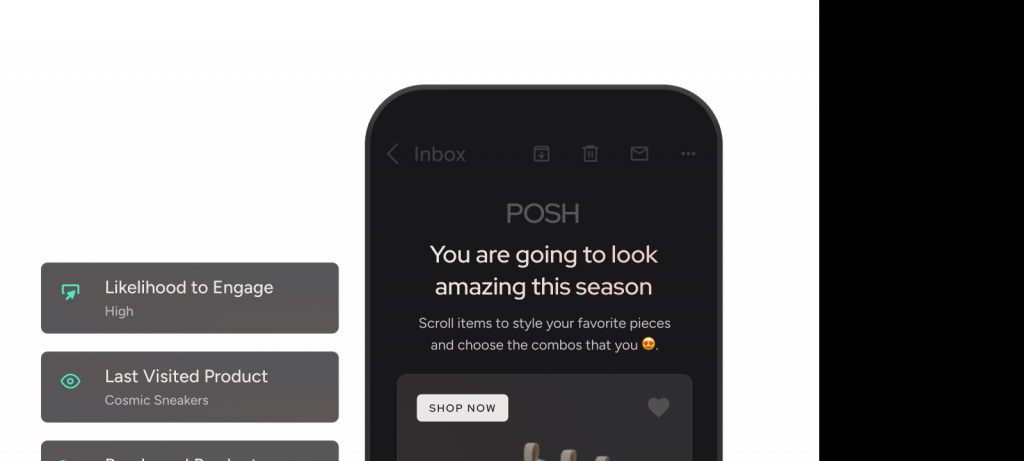
Smart Recommender: Product recommendations that update at the moment of open Most email platforms embed product recommendations at send time and leave them static. Insider One’s Smart Recommender updates recommendations in real time based on each subscriber’s most recent behavior at the precise moment they open the email. A subscriber who browsed running shoes this morning will see running shoes when they open the email this afternoon — even if the email was sent last night. This eliminates the stale recommendation problem that costs ecommerce brands significant revenue from emails that feel out of date.
AMP for Email: Let customers transact inside the inbox. AMP emails are one of Insider One’s most powerful and most underutilized capabilities. Rather than sending a customer to a landing page to complete an action, AMP emails embed interactive elements, product carousels, survey forms, appointment booking, cart additions directly inside the email itself. Customers can browse, respond, and even add items to the and cart without leaving their inbox. This removes a significant friction point from the email journey and has been shown to materially improve conversion rates compared to standard click-through campaigns. It is also an effective tool for collecting zero-party data, as customers can provide preferences and feedback with a single tap inside the email itself.
Next-Best Channel: Let AI decide which channel each message should use Insider One’s Next-Best Channel capability analyzes each subscriber’s engagement history across all touchpoints and automatically routes messages to the channel where they are most likely to respond. A marketer can set up a campaign once, add multiple channel options, and let Insider One determine whether each recipient receives an email, an SMS, a WhatsApp message, or a push notification, based on their actual behavior. This means email campaigns are no longer limited by the assumption that every subscriber prefers email.
Send Time Optimization: Per-subscriber, per-hour precision Insider One’s Send Time Optimization does not simply estimate a good send window. It logs each subscriber’s engagement history across 24 one-hour slots every day and triggers each email at the specific hour that the subscriber is most likely to engage. At scale, this means a campaign to one million subscribers goes out at one million different times, each one calibrated to the individual.
Email deliverability, built into the platform, not bolted on: Personalization and automation only drive results if emails actually reach the inbox. Insider One’s platform is built with deliverability as a foundational concern rather than an afterthought. It supports proper authentication standards, maintains list hygiene through suppression of inactive and invalid addresses, and provides real-time deliverability monitoring alongside campaign analytics. Brands migrating from other platforms benefit from a dedicated onboarding and migration support team that manages IP warming and list transition to protect sender reputation from day one. For enterprise brands sending at high volume, deliverability is not a secondary consideration, it is the prerequisite for everything else in this article to work.
Launch faster with pre-built templates and a no-code journey builder: One of the most practical barriers to AI adoption in email marketing is the assumption that advanced personalization and automation require technical resources to implement. Insider One removes this barrier with a library of proven, pre-built email templates covering every major use case, welcome sequences, cart abandonment, post-purchase follow-up, replenishment, re-engagement, and VIP escalation, all customizable without a single line of code.
Architect, Insider One’s visual journey builder, allows marketing teams to design, launch, and optimize multi-step cross-channel journeys directly from a drag-and-drop interface. There is no IT dependency, no waiting for developer resource, and no requirement to rebuild journeys when adding new channels. Brands consistently cite this as one of the primary drivers of fast time to value , with first campaigns typically live within days of onboarding rather than weeks.
Take the next step:
- Request a demo to explore Insider One’s AI personalization, predictive analytics, and automated workflows.
- Take a platform tour to see dashboards, cross-channel integrations, and real-time optimization in action.
By integrating Insider One, your email strategy becomes smarter, faster, and more results-driven, helping your 2026 campaigns deliver meaningful engagement and measurable business outcomes.