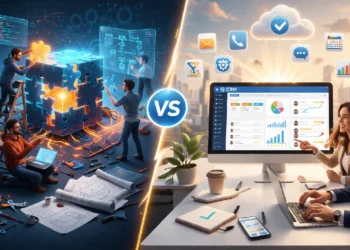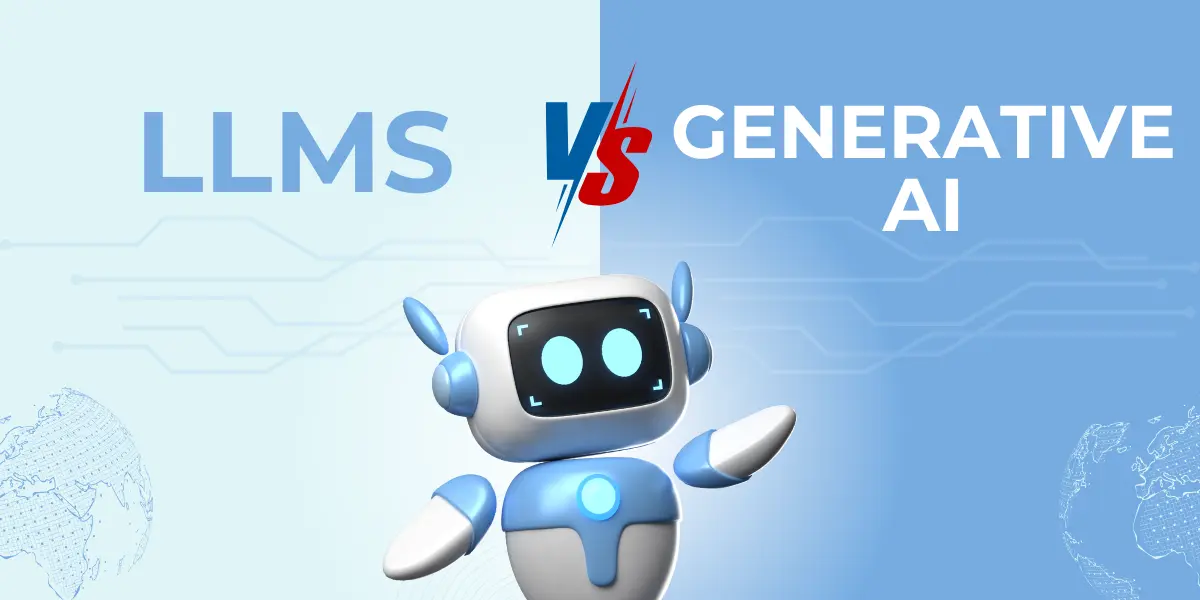
Is there any difference between Generative AI vs LLMs?
Are marketing terms that can be used interchangeably?
Well, they are very similar yet very different, and that’s what I would be explaining in this blog.
The short answer is yises, LLM and GenAI are different. In simpler terms, GenAI is the next evolution of LLMs, just as AGI will be the next evolution of GenAI.
Let’s now talk about what LLMs & GenAI models are.
LLMs (Large Language Models): Precursor To GenAI
As the name suggests, LLMs are large language models that can analyse large set of data and respond in text format. LLMs are essentially very large, scaled-up versions of transformer-based neural networks trained specifically on language data.
Neural networks are the core, transformers are a type of neural network optimized for sequences like text, and LLMs result from training massive ML transformer models on huge datasets.
Applications of LLMs:
- Text completion
- Translation
- Summarization
- Question answering
- Conversational agents (chatbots)
Standard Process of Creating LLMs
As one of the leading Gen AI development company in India, we have created plenty of AI models for our clients. Timeline to develop LLM can range from months to years, it requires massing resources including thousands of GPUs, petabytes of data, engineers, researchers, and more.
Here is what LLM development process looks like:
- LLM Scoping and Planning: First, decide the model’s purpose (e.g., chat, translation), set parameters like size (billions of parameters), capabilities (multimodal), and next finalize the constraints (ethical guidelines).
- Data Collection and Filtering: The next step is to gather the data set from various sources and filter it to remove bias or toxicity.
- Model Architecture Design: Choose or design a neural network architecture, almost always based on transformers for LLMs. Define layers, attention mechanisms, and scale (e.g., 7B to 1T parameters).
- Pre-Training: Train the model from scratch on unlabeled data to learn general patterns (e.g., predicting next words). This uses unsupervised learning and takes most of the compute time.
- Fine-Tuning: Adapt the pre-trained model for specific tasks (e.g., instruction-following) using labeled data. Techniques like RLHF (Reinforcement Learning from Human Feedback) align it with human preferences.
- Evaluation and Iteration: Test for accuracy, biases, hallucinations, and benchmark LLM to improve performance.
- Deployment and Post-Training: Next, launch your LLM and optimize for inference (e.g., quantisation to reduce size), deploy via APIs, and monitor/update (with new data LLM models with feedback).
Examples of LLM Models
- BERT (Base Uncased): BERT is a classic Bidirectional encoder with the capability to understand sentiments, relations, and context between words.
- GPT-3.5: It’s a legacy text generator trained and tuned for chat, built by OpenAI.
- o3/o3-mini: Reasoning focused LLM from OpenAI, it’s excellent in math/code. This model is also a successor to the ChatGPT o1 model, emphasising analytical thinking without multimodality.
- Claude Haiku 4.5/3.5: Model from Antropic, strong in writing and safety, ideal for quick tasks.
- Llama 3.1/3.3: Dense transformer text models optimized for chat and data analysis.
Generative AI
Development in computing technology has led the analyst to assume we are miles away from making Moore’s law dead. It has also led to a massive revolution in custom AI development, where LLMs or AIs have moved from just analysis to originality and generative models.
Generative AIs are systems that can create new content, such as text, images, audio, or video, based on the learning patterns from data.
Applications of Generative AI:
- Text generation (stories, articles, code)
- Image synthesis (creating realistic images or art)
- Music composition
- Video generation
- Data augmentation
Read also: Understanding the History of AI and its Updated Features
Here is what the GenAi development process looks like:
- GenAI Scope and Planning: Before any AI development company starts working on Generative AI, it should define the end goal of the model. Next, they should choose modality, architecture (e.g., GAN for images, transformer for text), scale (parameters), and ethical considerations to reduce bias.
- Data Collection and Filtering: Next, prepare datasets that you need to train Gen AI for your respective goals (e.g., LAION-5B for images, AudioSet for sound). Next Clean and label (if needed) datasets, and preprocess (e.g., resize images, tokenize text). If you are preparing multimodal GenAI, then align data across types (e.g., image-text pairs).
- Model Architecture Selection & Design: Next, you select or invent a neural network-based architecture suited to the task. For text-based GenAI, go with transformers. For images/video-based Gen AIs, select GANs, VAEs, or diffusion models works the best. In case of hybrid GenAI, go for multimodal (e.g. CLIP for text-image alignment).
- Pre-Training: Now, start feeding labelled or weakly labelled data to learn patterns (Feed images to train the model on how to reconstruct or predict pixels).
- Fine-Tuning and Specialization: Next, refine Gen AI with task-specific data and controls like prompts for user-guided generation.
- Evaluation and Improvement: Test your GenAI for quality (e.g., FID score for images and perceptual metrics for audio to improve performance), safety (e.g., no harmful content), and biases. Use benchmarks like MS-COCO for images. If required improve your GenAI model by adjusting hyperparameters or retraining.
- Deployment and Optimization: Finally, you can now compress and deploy your model (e.g., via APIs). Monitor the performance and update it with new data or feedback if required.
For open-source models like Stable Diffusion, steps 3-7 often build on pre-existing checkpoints to accelerate development.
Examples of GenAI Models
- DALL-E series (e.g., DALL-E 4): Text-to-image generator from OpenAI, creating high-resolution visuals from descriptions with advanced editing and style customization capabilities.
- Sora series (e.g., Sora 3): Text-to-video model built by OpenAI, generating realistic clips with temporal consistency, improved for longer sequences and physics simulation.
- Stable Diffusion (e.g., Stable Diffusion 3): Open-source diffusion-based image generator from Stability AI, customizable for various artistic styles and widely used for creative visual content.
- Midjourney (v6 or later): AI art generator accessible via Discord, specializing in high-quality, imaginative images from text prompts, with strong community-driven features.
- Imagen series (e.g., Imagen 3): Text-to-image model from Google, producing photorealistic or stylized visuals, integrated into tools like Gemini for enhanced multimodal applications.
- Veo series (e.g., Veo 2): Text-to-video generator developed by Google, creating dynamic scenes with advanced narrative and temporal logic for applications in media and simulations.
Generative AI vs LLM Head-to Head Comparison
| Parameter | Generative AI (GenAI) | Large Language Models (LLMs) |
| Definition | A broad category of AI systems that create new, original content (e.g., text, images, audio, video, code) by learning patterns from data and generating outputs that mimic or extend human creativity. | A specialized subset of GenAI focused on processing and generating human-like text/language. LLMs are trained on vast text datasets to understand context, grammar, and semantics. |
| Why Use It | To automate creative tasks, enhance productivity in media/design, simulate scenarios, or generate diverse content quickly and at scale. Ideal for innovation where originality across modalities is needed. | To handle language-specific tasks like writing, translation, or conversation efficiently. Used for knowledge retrieval, automation of text-based workflows, and reasoning without needing multimodal inputs. |
| Who Uses It | Artists, designers, marketers, filmmakers, musicians, developers, researchers, and industries like entertainment, advertising, healthcare (e.g., drug design), and gaming. | Writers, programmers, customer support teams, educators, businesses for chatbots, legal professionals for document analysis, and researchers in NLP. |
| Technical Differences | Supports multiple modalities and architectures (e.g., diffusion for images, GANs for synthesis). Can be multimodal, handling cross-data types. Often probabilistic for varied outputs. | Primarily text-focused, using sequential processing. Relies on token prediction; less emphasis on visual/audio synthesis unless extended (e.g., multimodal LLMs). |
| Differences in Development Process | Involves modality-specific data prep (e.g., image augmentation), diverse architectures, and evaluation metrics (e.g., FID for images). Pre-training on mixed data; fine-tuning for creative control. More hardware-intensive for non-text. | Focuses on text tokenization, transformer scaling, and RLHF for alignment. Pre-training on corpora; fine-tuning for tasks like chat. Iterative with benchmarks like perplexity. |
| What Kind of Prompt Each Can Take | Flexible: Text descriptions, images, audio clips, or combinations (e.g., “generate an image of a cat playing piano”). Supports conditional generation based on user inputs. | Mainly natural language text prompts (e.g., “Write a story about a robot”). Some advanced LLMs accept structured prompts or code, but core is textual. |
| Text Only or Text + Images (Input Modalities) | Multimodal: Can take text, images, video, audio, or hybrids (e.g., text-to-image models accept text + reference images). | Primarily text-only, though some (e.g., GPT-4o) extend to text + images/audio, but traditional LLMs are text-centric. |
| What Kind of Training Data Each Requires | Vast, modality-specific datasets: Text corpora, image libraries (e.g., LAION), audio banks, video clips. Often unlabeled or paired (e.g., image-caption pairs). | Primarily massive text datasets (e.g., books, web pages, code repos). Can include structured data like dialogues; focuses on linguistic variety. |
| Output Type | Diverse: Text, images, videos, audio, 3D models, code, or simulations. Outputs are creative and variable. | Mainly text: Sentences, paragraphs, code, translations, or structured responses like JSON. |
| Key Challenges in Developing | Ethical issues (e.g., deepfakes, copyright), high compute for multimodality, ensuring quality/consistency across outputs, and avoiding biases in visual/audio data. | Hallucinations (false info), bias amplification from text data, enormous energy costs for training, and alignment to human values without toxicity. |
| Core Technology | Varied architectures: GANs, VAEs, diffusion models, transformers (for text/multimodal), and hybrids. Relies on probabilistic sampling. | Transformer neural networks with attention mechanisms; scaled with billions of parameters and autoregressive prediction core. |
| Use Cases | Art generation (e.g., DALL-E for images), video editing (Sora), music composition (MusicGen), drug molecule design, virtual worlds in gaming. | Chatbots (ChatGPT), content writing, code assistance (Copilot), translation, summarization, question-answering in education/business. |
When to Use Generative AI?
Generative AI is ideal for businesses that need to create diverse content or solve complex problems. Here are three use cases of AI in business operations that will help you to think and then decide your type of AI Application Development Services:
1. Marketing and Creative Campaigns:
You can use Generative AI to create engaging content for marketing campaigns. It can be images, videos, and audio.
Examples: A fashion brand uses DALL·E or MidJourney to generate unique visuals for social media ads. A music streaming service uses AI to create personalized jingles for users.
2. Product Design and Prototyping:
Businesses can use Generative AI to accelerate product design and prototyping. You can generate 3D models, synthetic images, or simulations.
Example: An automotive company uses Generative AI to design car parts or create virtual prototypes for testing.
3. Data Augmentation and Synthetic Data Generation:
Businesses can use Generative AI to create synthetic data for training machine learning models. It is highly useful in industries where real world data is hard to find.
Example: A healthcare company uses GANs to generate synthetic medical images for training diagnostic AI systems.
When to Use LLMs?
LLMs are best for businesses that rely heavily on text-based processes. It can be customer interactions or content creation. Here are three key scenarios:
1. Customer Support and Engagement:
Use LLMs to automate customer support and handle FAQs. Also, you can provide personalized responses through chatbots or virtual assistants.
Example: An ecommerce company uses ChatGPT to power its customer service chatbot. This reduces response times and improves customer satisfaction.
2. Content Creation and Copywriting:
Use LLMs to generate high quality text content. It can be blogs, emails, product descriptions, and social media posts.
Example: A marketing agency uses GPT-4 to draft blog posts, ad copy, and email campaigns. This can save them time and resources.
3. Data Analysis and Insights:
Use LLMs to analyze large volumes of text data and generate reports. It can help you in summarizing customer feedback or analyzing market trends.
Example: A financial services firm uses an LLM to analyze earnings reports and social media sentiment to inform investment decisions.
Final Thoughts on Generative AI vs LLM
LLM and AI’s role in business strategy has only been rising. Before you hire an AI developer to build your next GenAI or LLM project, it’s important to audit which model works the best for you.
Generative AI powers content creation across various formats. LLMs specialize in text-based applications. They are important for tasks like AI prompt engineering and customer engagement.
In digital transformation, AI is revolutionizing how businesses operate. It is enhancing automation and customer experiences.
Meanwhile, AI in cybersecurity is strengthening threat detection and response mechanisms. Emerging technologies like Quantum AI are also pushing the boundaries further.
FAQs
Is Generative AI the Same as LLMs?
No, Generative AI and LLM are not the same. GenAI can create content in a variety of media formats, and LLM, on the other hand, focuses exclusively on language processing. LLMs are a subset of Gen AI, but not all GenAIs are LLMs; for example, image generators like DALL-E are GenAI but not LLMs.
What is ChatGPT full form?
ChatGPT stands for “Chat Generative Pre-trained Transformer.” The “Chat” refers to its conversational interface, “Generative” indicates its ability to create new text, “Pre-trained” means it’s initially trained on vast datasets before fine-tuning, and “Transformer” is the underlying neural network architecture that powers it.
Is ChatGPT LLM or NLP?
ChatGPT is primarily an LLM (Large Language Model), as it’s a scaled-up model trained on massive text data to generate and understand language. However, it relies on NLP (Natural Language Processing) techniques. Still, ChatGPT is an LLM that uses NLP methods to function.
What are the top 3 generative AI?
Gemini, GPT, and Claude are the top 3 generative AI models based on the benchmarks, reasoning, versatility, and market share.
Is ChatGPT a generative AI?
Yes, ChatGPT is a generative AI. It generates a response in text, images, videos, and various other formats.
Who are the big 5 in Generative AI vs LLM debate?
Alphabet, xAi, OpenAI, Anthropic, and Meta are the big 5 in AI.
Which AI is not generative?
Non-generative AI focuses on analysing, classifying, and interpreting existing data to make predictions or decisions rather than creating new content.
Which company is leading in generative AI?
As of 2026, OpenAI is widely regarded as the leading company in generative AI, thanks to its GPT series (e.g., GPT-5.2), ChatGPT’s massive adoption, and innovations in multimodal tools like DALL-E and Sora.
What is the difference between prompt engineering for generative AI vs prompt engineering for LLMs?
Prompt engineering involves crafting inputs to guide AI outputs effectively. The differences stem from scope: For Generative AI (GenAI) prompts can include text, images, audio, or combinations (e.g., “Generate a video of a cat dancing based on this image”). On the other hand, LLMs use text-centric prompts, emphasizing chain-of-thought reasoning, role-playing, or structured formats (e.g., “Step-by-step, explain quantum physics”).
Is LLM the same as generative AI?
No. LLMs are a subset of generative AI. Generative AI includes any AI that creates content. While LLMs specifically focus on generating and understanding text.
What is the difference between generative AI and reinforcement learning?
Generative AI creates new content. Reinforcement learning trains models to make decisions by rewarding desired behaviors. Teaching a robot to walk is a perfect example of reinforcement learning.
Does generative AI use deep learning?
Yes. Most generative AI systems use deep learning techniques such as neural networks to learn patterns and generate new content.