With so many brands competing for attention, it’s no longer enough to offer products or services. Brands need to find ways to quickly stand out from the crowd and be truly memorable.
This is the essence of brand positioning: how you want people to perceive your brand and what makes it different from the competition. It’s the mental space your brand occupies, and a key part of building a strong brand strategy.
In a previous article, we introduced a simple method called the 3C’s to help you craft a clear brand positioning statement. Today, we’re taking it a step further: we’ll introduce a framework to visualize the five main brand positioning types, helping you complement the 3C’s method and create a sharper, more powerful brand strategy.
Proven Systems for Business Owners, Marketers, and Agencies
→ Our mini-course helps you audit and refine an existing brand in 15 days, just 15 minutes a day.
→ The Ultimate Brand Building System is your step-by-step blueprint to building and scaling powerful brands from scratch.
The Foundations of Brand Positioning
A simple definition
Brand positioning is how you want your brand to be perceived by customers and how it differs from competitors. Kotler has defined it as “the act of designing the company’s offering and image to occupy a distinctive place in the mind of the target market”.
A brand positioning strategy, therefore, involves creating brand associations in customers’ minds to make them perceive the brand in a specific way. It often takes the form of a simple sentence or a few words that summarize how you want the brand to be perceived, and what makes it unique.
The 3C’s method
The 3C’s method, which stands for Consumers, Company, and Competitors, is a simple yet effective tool for crafting a clear brand positioning statement. It helps you understand your target audience, your company’s capabilities, and your competitive landscape.
Your brand positioning statement should do three things:
- Resonate with your consumers. It should feel relevant and meaningful to your target audience.
- Be deliverable by your company. It has to match your capabilities and resources.
- Set you apart from your competitors. You need to stand out in the market.
An easy way to summarize your brand positioning is with three words. For example: “vegan, traditional, feminine.” Each of these words must be carefully chosen to meet all three requirements above. Try to avoid using vague terms like “quality, unique, successful.” Every brand wants those, and they won’t help you stand out.
While the 3C’s provide the foundation, it’s equally important to understand the different types of brand positioning that exist in the marketplace. Doing so gives your strategy clarity and direction.
The Five Brand Positioning Types
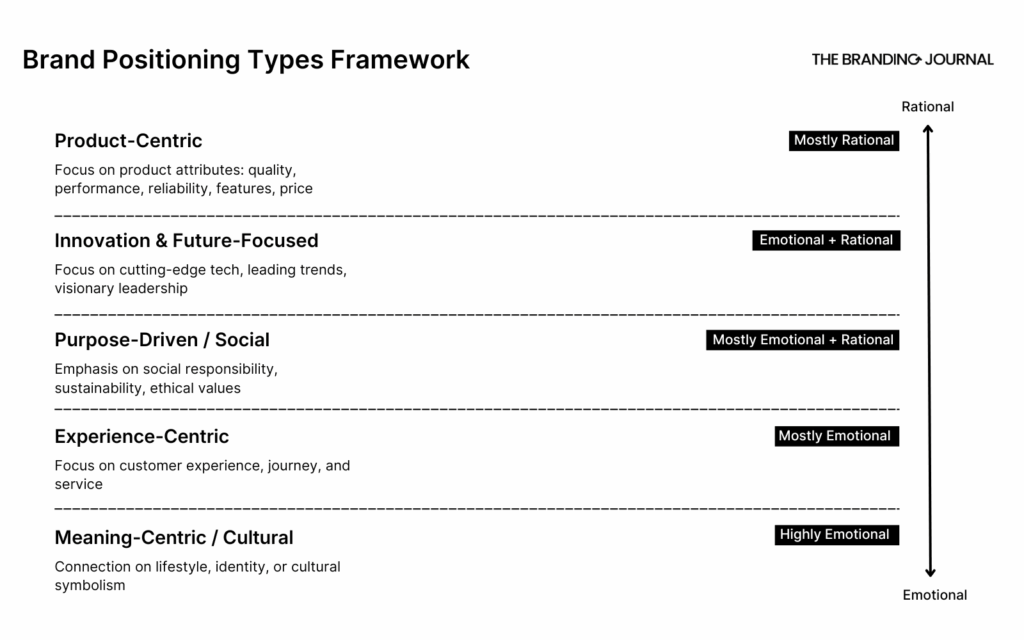
This framework is not exhaustive, but it’s highly practical for visualizing where your brand sits, where competitors are, and where opportunities lie. Each type emphasizes a different approach to connecting with your audiences, whether rational, emotional, or both.
1. Product-Centric
Product-centric brands differentiate primarily through tangible product benefits, such as product or service quality, reliability, performance, or value for money. Here, what you sell matters more than the story you tell. Customers choose these brands because they are confident the products themselves will deliver superior results or experiences.
The strength of this positioning lies in concrete product benefits that give customers confidence.
Examples:
- Swatch: Affordable, colorful, reliable, Swiss-made watches.
- Gillette: Precision and performance in every razor.
2. Innovation & Future-Focused
Innovation-driven brands position themselves around cutting-edge technology and a unique vision for the present and future. They inspire excitement and curiosity and appeal to both the desire to own the latest innovation and the emotional excitement of being part of something groundbreaking.
This positioning type only works if you can brand can deliver innovative solutions, leadership, progress, and a pioneering mindset.
Examples:
- Dyson: Reinventing engineering standards in home appliances.
- Apple: Pioneering design and technology that shape future trends.
3. Purpose-Driven / Social-Centric
These brands are guided by values such as sustainability, social responsibility, or community impact. The product itself becomes secondary; what matters is the cause or movement the brand represents. If you opt for this type of positioning strategy, it is essential to be 100% aligned with the cause you chose for your brand. Consumers can see through messaging that lacks real proof or commitment.
Purpose-driven positioning works well for a socially conscious audience and should balance emotional appeal with rational credibility.
Examples:
- Tony Chocolonely: Advocates for social justice and fair trade in chocolate.
- Patagonia: Environmental activism as a core identity.
4. Experience-Centric
Experience-centric brands focus on how they make customers feel through every interaction, from purchase to post-sale service. The product itself may be functional, but the differentiator is the experience, whether it’s delightful, immersive, or seamless.
Here, the emotional connection comes from the journey and interaction, not just the product itself.
Examples:
- Disney: Magical experiences for the whole family.
- Ritz-Carlton: Legendary customer service that feels personal.
5. Meaning-Centric / Cultural Focus
Meaning-centric brands resonate deeply with identity, lifestyle, or cultural symbolism. Through the use of their products or services, these brands become symbols of belonging. Owning or wearing the brand signals values, beliefs, or being part of a specific community.
When choosing this type of positioning, your focus should be on building emotional resonance tied to who the customer is or aspires to be, rather than what they buy.
Examples:
- Harley-Davidson: Symbol of freedom, rebellion, and adventure.
- Supreme: Signals identity, street culture, exclusivity, and community.
The Brand Positioning Types Map
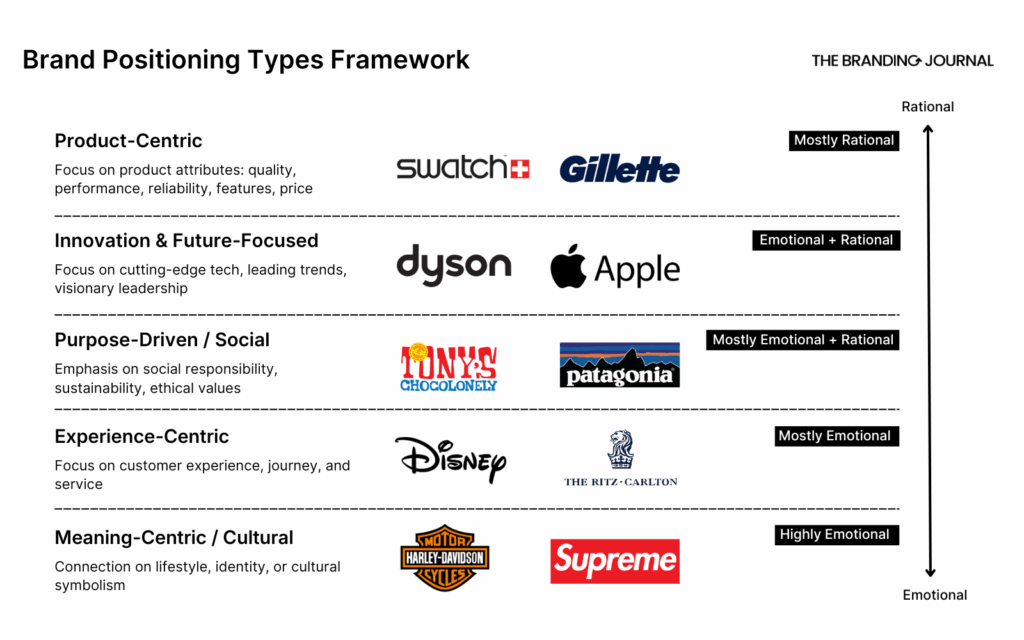
This map, or proposed framework, is a visual representation of the five types of brand positioning. Using this tool can be a quick, easy-to-read way to map your brand and see where your competitors sit, helping you choose the direction that best fits your brand.
Here is the tool, for you to use in your work:
Here is the tool again with the examples mentioned above:
How to Define Your Brand Positioning Type, Step-By-Step
Here’s a step-by-step guide to leveraging this framework alongside the 3C’s method:
Step 1: Map your competitors’ positioning types
Start by identifying your brand’s competitors and assigning them to one of the five types. This mapping allows you to determine where crowded areas are versus where there are opportunities for differentiation.
Step 2: Analyze market opportunities
Once you’ve mapped out all your competitors, look for underserved positioning types. For this step, it is also important to consider where the future is headed in terms of customer values, preferences, and emerging trends such as sustainability and innovation. This will allow you to spot the gaps that your brand might, or might not, choose to fill.
Step 3: Assess your brand’s strengths and identity
While it’s important to differ from competitors, it’s even more crucial to ensure that your positioning is fully aligned with your brand’s essence, identity, and capabilities. Reflect on your brand’s core capabilities, identity, and vision. Your positioning type should feel authentic, avoiding forced positioning that misaligns with your brand’s story.
Step 4: Choose your primary positioning type
Select one type as your brand’s main focus: your “home base.” This clarity will help you be more focused as a brand and inform all your future decisions regarding brand and marketing strategy.
Step 5 (Optional): Consider supporting positioning dimensions
We recommend sticking to a single positioning type to keep your messaging and strategy as focused as possible. However, in some cases, it can be interesting to add secondary positioning types to enrich your brand and give it more depth. If this applies to your brand, choose one or two secondary types to complement the first one.
For example, a Product-Centric brand could add Purpose-Driven elements to enhance emotional appeal. Or, if we consider one of the examples mentioned earlier, Dyson could fit into both the Product-Centric and Innovation & Future-Focused categories. However, the brand is best known for its focus on innovation and the future, which truly sets Dyson apart.
But remember, your primary type should be your number one direction.
Step 6: Craft Your Brand Positioning Statement
Apply the 3C’s method, taking into consideration your chosen positioning type(s). Create a simple brand positioning statement that is clear, authentic, and unique.
Step 7: Implement brand messaging and experience
With a clear positioning type and positioning statement, you can now ensure your messaging, visuals, and customer interactions consistently reflect your positioning. Alignment across all touchpoints is essential.
Step 8: Monitor and evolve
Track market changes, competitor moves, and customer expectations. Feel free to refine or expand your positioning over time to stay relevant and resilient.
| Steps | Key Question | Outcome |
|---|---|---|
| 1. Map competitors | Where do competitors position themselves? | Competitive landscape |
| 2. Analyze opportunities | Which positions are underserved? | Market gap insights |
| 3. Assess your brand | What fits our identity and strengths? | Authentic positioning |
| 4. Choose primary type | What is our main focus? | Clear, strategic positioning |
| 5. Add secondary types | How can we enrich? | Multi-dimensional strategy |
| 6. Implement messaging | How to communicate consistently? | Cohesive brand experience |
| 7. Monitor & evolve | Are we staying relevant? | Sustainable growth |
Conclusion
With brand positioning, you want to avoid being everything to everyone. Your objective is to choose a clear path where your brand can shine, stand out, and stay relevant. Whether you lead with innovation, meaning, or purpose, the key is authenticity and consistency.
The Brand Positioning Types framework is a powerful tool to bring clarity and focus to your strategy. While most brands will fall predominantly into one type, many benefit from blending elements of several. Remember to combine this approach with the 3C’s method to create a simple positioning statement that will guide all your future branding decisions.
At the end of the day, a strong brand is recognized, but also remembered, felt, and chosen. Knowing what type of brand you are is the first step to building that lasting impact.
Proven Systems for Business Owners, Marketers, and Agencies
→ Our mini-course helps you audit and refine an existing brand in 15 days, just 15 minutes a day.
→ The Ultimate Brand Building System is your step-by-step blueprint to building and scaling powerful brands from scratch.