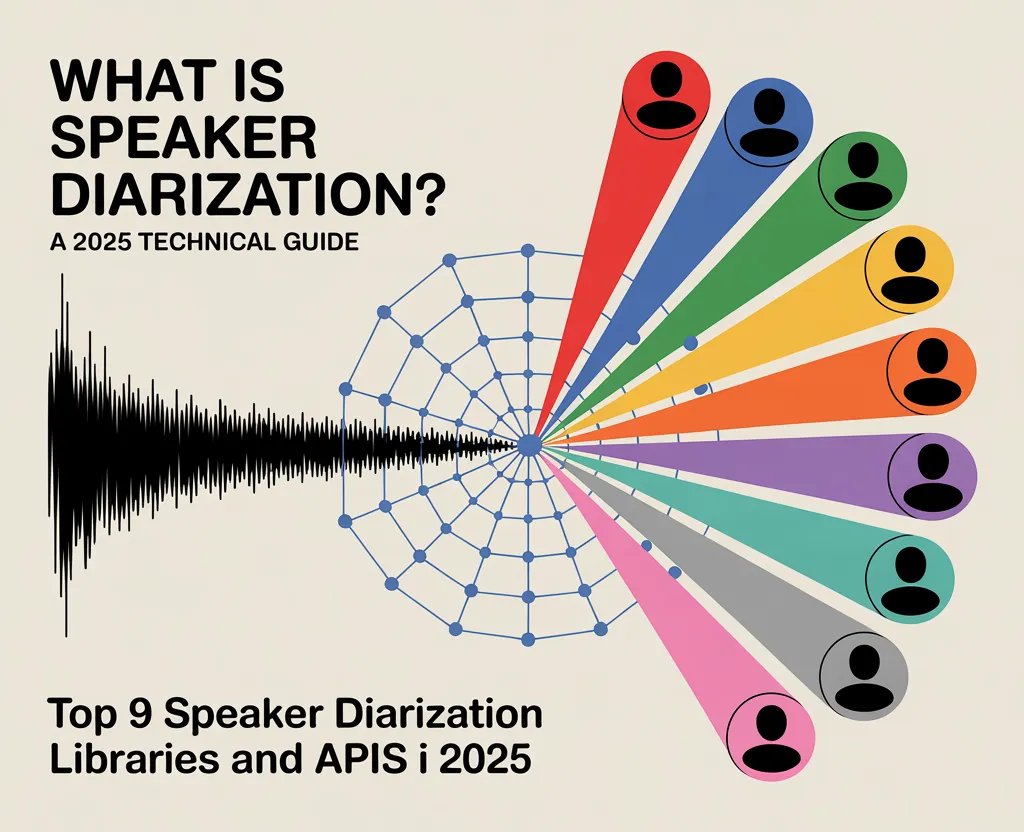
Speaker diarization is the process of answering “who spoke when” by separating an audio stream into segments and consistently labeling each segment by speaker identity (e.g., Speaker A, Speaker B), thereby making transcripts clearer, searchable, and useful for analytics across domains like call centers, legal, healthcare, media, and conversational AI. As of 2025, modern systems rely on deep neural networks to learn robust speaker embeddings that generalize across environments, and many no longer require prior knowledge of the number of speakers—enabling practical real-time scenarios such as debates, podcasts, and multi-speaker meetings.
How Speaker Diarization Works
Modern diarization pipelines comprise several coordinated components; weakness in one stage (e.g., VAD quality) cascades to others.
- Voice Activity Detection (VAD): Filters out silence and noise to pass speech to later stages; high-quality VADs trained on diverse data sustain strong accuracy in noisy conditions.
- Segmentation: Splits continuous audio into utterances (commonly 0.5–10 seconds) or at learned change points; deep models increasingly detect speaker turns dynamically instead of fixed windows, reducing fragmentation.
- Speaker Embeddings: Converts segments into fixed-length vectors (e.g., x-vectors, d-vectors) capturing vocal timbre and idiosyncrasies; state-of-the-art systems train on large, multilingual corpora to improve generalization to unseen speakers and accents.
- Speaker Count Estimation: Some systems estimate how many unique speakers are present before clustering, while others cluster adaptively without a preset count.
- Clustering and Assignment: Groups embeddings by likely speaker using methods such as spectral clustering or agglomerative hierarchical clustering; tuning is pivotal for borderline cases, accent variation, and similar voices.
Accuracy, Metrics, and Current Challenges
- Industry practice views real-world diarization below roughly 10% total error as reliable enough for production use, though thresholds vary by domain.
- Key metrics include Diarization Error Rate (DER), which aggregates missed speech, false alarms, and speaker confusion; boundary errors (turn-change placement) also matter for readability and timestamp fidelity.
- Persistent challenges include overlapping speech (simultaneous speakers), noisy or far-field microphones, highly similar voices, and robustness across accents and languages; cutting-edge systems mitigate these with better VADs, multi-condition training, and refined clustering, but difficult audio still degrades performance.
Technical Insights and 2025 Trends
- Deep embeddings trained on large-scale, multilingual data are now the norm, improving robustness across accents and environments.
- Many APIs bundle diarization with transcription, but standalone engines and open-source stacks remain popular for custom pipelines and cost control.
- Audio-visual diarization is an active research area to resolve overlaps and improve turn detection using visual cues when available.
- Real-time diarization is increasingly feasible with optimized inference and clustering, though latency and stability constraints remain in noisy multi-party settings.
Top 9 Speaker Diarization Libraries and APIs in 2025
- NVIDIA Streaming Sortformer: Real-time speaker diarization that instantly identifies and labels participants in meetings, calls, and voice-enabled applications—even in noisy, multi-speaker environments
- AssemblyAI (API): Cloud Speech-to-Text with built‑in diarization; include lower DER, stronger short‑segment handling (~250 ms), and improved robustness in noisy and overlapped speech, enabled via a simple speaker_labels parameter at no extra cost. Integrates with a broader audio intelligence stack (sentiment, topics, summarization) and publishes practical guidance and examples for production use
- Deepgram (API): Language‑agnostic diarization trained on 100k+ speakers and 80+ languages; vendor benchmarks highlight ~53% accuracy gains vs. prior version and 10× faster processing vs. the next fastest vendor, with no fixed limit on number of speakers. Designed to pair speed with clustering‑based precision for real‑world, multi‑speaker audio.
- Speechmatics (API): Enterprise‑focused STT with diarization available through Flow; offers both cloud and on‑prem deployment, configurable max speakers, and claims competitive accuracy with punctuation‑aware refinements for readability. Suitable where compliance and infrastructure control are priorities.
- Gladia (API): Combines Whisper transcription with pyannote diarization and offers an “enhanced” mode for tougher audio; supports streaming and speaker hints, making it a fit for teams standardizing on Whisper who need integrated diarization without stitching multiple.
- SpeechBrain (Library): PyTorch toolkit with recipes spanning 20+ speech tasks, including diarization; supports training/fine‑tuning, dynamic batching, mixed precision, and multi‑GPU, balancing research flexibility with production‑oriented patterns. Good fit for PyTorch‑native teams building bespoke diarization stacks.
- FastPix (API): Developer‑centric API emphasizing quick integration and real‑time pipelines; positions diarization alongside adjacent features like audio normalization, STT, and language detection to streamline production workflows. A pragmatic choice when teams want API simplicity over managing open‑source stacks.
- NVIDIA NeMo (Toolkit): GPU‑optimized speech toolkit including diarization pipelines (VAD, embedding extraction, clustering) and research directions like Sortformer/MSDD for end‑to‑end diarization; supports both oracle and system VAD for flexible experimentation. Best for teams with CUDA/GPU workflows seeking custom multi‑speaker ASR systems
- pyannote‑audio (Library): Widely used PyTorch toolkit with pretrained models for segmentation, embeddings, and end‑to‑end diarization; active research community and frequent updates, with reports of strong DER on benchmarks under optimized configs. Ideal for teams wanting open‑source control and the ability to fine‑tune on domain data
FAQs
What is speaker diarization? Speaker diarization is the process of determining “who spoke when” in an audio stream by segmenting speech and assigning consistent speaker labels (e.g., Speaker A, Speaker B). It improves transcript readability and enables analytics like speaker-specific insights.
How is diarization different from speaker recognition? Diarization separates and labels distinct speakers without knowing their identities, while speaker recognition matches a voice to a known identity (e.g., verifying a specific person). Diarization answers “who spoke when,” recognition answers “who is speaking.”
What factors most affect diarization accuracy? Audio quality, overlapping speech, microphone distance, background noise, number of speakers, and very short utterances all impact accuracy. Clean, well-mic’d audio with clearer turn-taking and sufficient speech per speaker generally yields better results.

Michal Sutter is a data science professional with a Master of Science in Data Science from the University of Padova. With a solid foundation in statistical analysis, machine learning, and data engineering, Michal excels at transforming complex datasets into actionable insights.