
Ranking for a few keywords doesn’t mean you’re visible.
You might be on page one. You might even be getting traffic. But if competitors show up more often, in more places, for more searches, they’re the ones people remember.
That’s what Share of Voice measures. Not whether you rank, but how much of the conversation you actually own.
It’s a critical voice metric for understanding your brand’s true market position and brand visibility across digital marketing channels.
In this article, I’ll explain what exactly Share of Voice is, how to calculate it, and how to get more of it.

Link building cheat sheet
Gain access to the 3-step strategy we use to earn over 86 high-quality backlinks each month.
What is Share of Voice?
Share of Voice, or SOV, is a measure of how visible your brand is compared to competitors.
In general, it can apply to a lot of channels:
- Paid ads
- Social media
- PR
- Even email!
Anywhere multiple brands are competing for attention, you can talk about Share of Voice.
Understanding why Share of Voice is important helps you gauge whether your marketing efforts are cutting through the noise.
In SEO, Share of Voice measures how much traffic you get from a defined set of keywords compared to your competitors.
It takes into account where you rank for each keyword and how much search volume those keywords have.
A #1 ranking on a high-volume keyword matters far more than a low ranking on a small one.
Instead of looking at individual rankings, Share of Voice shows how big your slice of the total available clicks actually is.
This makes it more valuable than tracking isolated metrics because it reveals your overall visibility and market share in search results.
Which Metrics Make up Share of Voice?
At its core, Share of Voice is a percentage. It answers one simple question:
Out of all the possible attention in a market, how much of it do you get?
How that’s calculated depends on the marketing channel, but the logic is always the same.
Share of Voice in Google (SEO)
In organic search, Share of Voice is usually based on:
- The keywords you rank for (including branded keywords)
- Your ranking positions for those keywords
- The search volume behind them
- The estimated click-through rate of each position
Each ranking position is assigned an expected CTR. Ranking #1 captures far more clicks than ranking #8. That CTR is multiplied by the keyword’s search volume to estimate traffic.
Once you do that for all tracked keywords and all competitors, SOV is calculated like this:
Your estimated organic traffic ÷ Total estimated organic traffic for all tracked sites × 100
That’s why improving a single page from position 6 to position 3 on a high-volume keyword can move your SEO Share of Voice more than publishing multiple new articles.
Higher SOV in search results directly correlates with increased brand visibility and your target audience’s exposure to your content.
Share of Voice in Paid Search
In paid channels, Share of Voice is usually based on impression share.
The formula is simpler:
Your impressions ÷ Total impressions available for your target keywords × 100
Here, the biggest drivers are bid competitiveness, budget (ad spend), ad relevance, and Quality Score.
Your PPC Share of Voice depends heavily on how you allocate resources across campaigns. You don’t need to rank organically at all to own a large Share of Voice in paid search.
Share of Voice in Social Media
On social media platforms, Share of Voice is typically measured by mentions.
This can include:
The basic formula looks like:
Your brand mentions ÷ Total mentions across all competitors × 100
Some teams also weigh this by engagement and sentiment, so a mention with reach or interaction counts more than a passive one.
Many brands use social listening tools like Sprout Social to track their social media SOV.
These social media analytics platforms help you monitor online mentions, media mentions, and even media coverage across different social media marketing channels.
How to Check Your Share of Voice in Ahrefs
Ahrefs is one of several Share of Voice tools available for tracking your position.
To see Share of Voice in Ahrefs, you first need to set up a project in Rank Tracker. That’s where SOV is calculated.
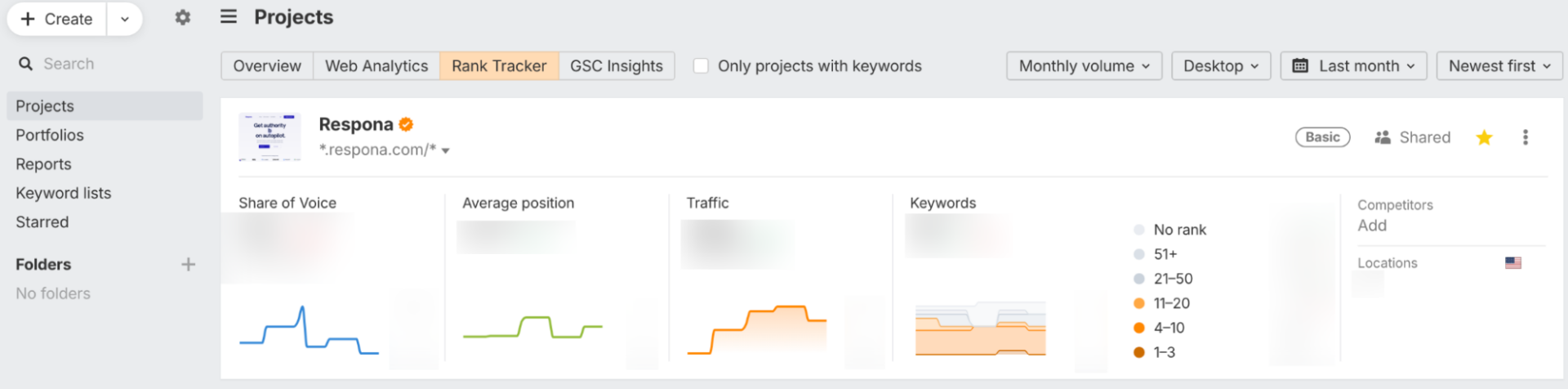
Once the project is created, you have two main options for keyword tracking.
The first option is tracking a specific keyword set. This is usually the better approach. You add the keywords you actually care about, like product terms, core topics, or pages tied to revenue.
Your Share of Voice will then reflect how visible you are for that defined space.
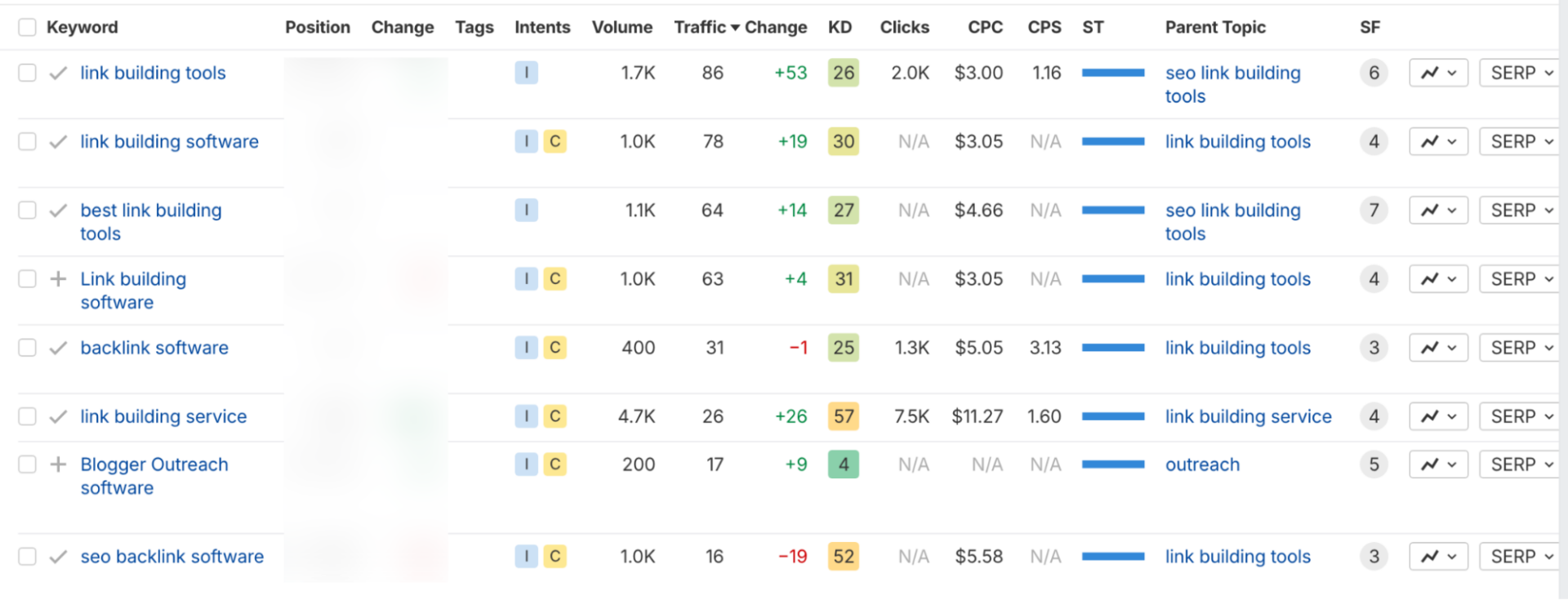
The second option is tracking all the keywords you already rank for.
This gives you a broader view of overall visibility, but it can get noisy. You’ll often need to clean the list so irrelevant or one-off queries don’t skew the metric.
After adding keywords, you should add competitors. Share of Voice only makes sense when you’re comparing yourself to other sites ranking for the same searches.
Comparing your brands share against competitors reveals whether you’re gaining or losing ground.
From there, Ahrefs shows Share of Voice in the project overview and competitor views.
The number represents your estimated share of clicks across the tracked keywords, weighted by ranking position and search volume.
It essentially shows your Voice percentage of the available search market.
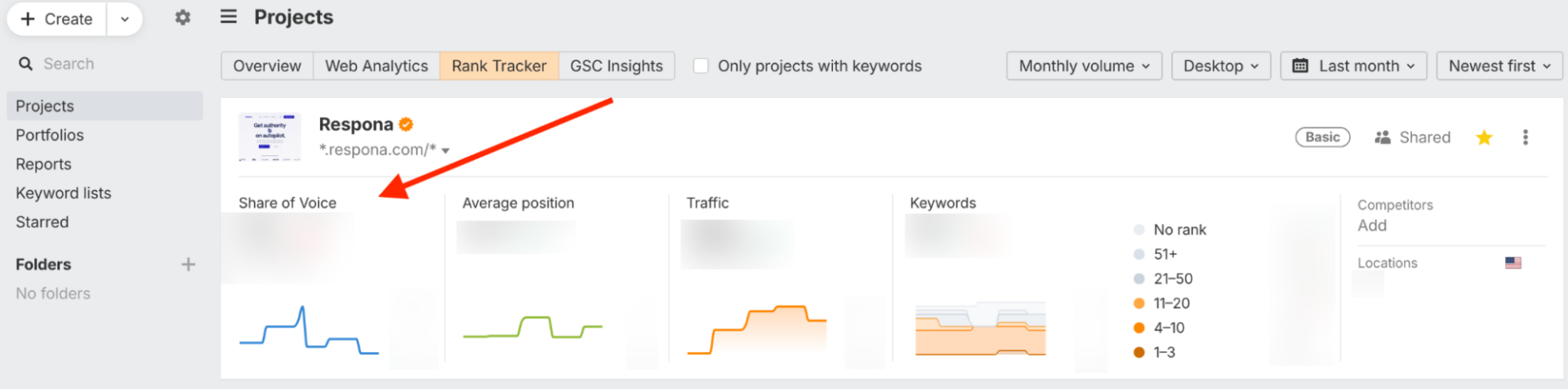
The key thing to remember is that your Share of Voice is only as good as the keywords you track. Pick them carefully, and the metric becomes incredibly useful.
How to Increase Your Share of Voice (Besides Just Publishing Content)
Publishing more content helps, but it’s rarely what moves Share of Voice in a meaningful way.
Most gains come from improving visibility on keywords you already rank for.
Moving a page from position 8 to position 4 on a high-intent keyword will usually increase your Share of Voice more than publishing a brand-new article that lands on page two.
That’s why optimization and links matter so much.
Refreshing existing pages, tightening their focus, and expanding coverage around keywords where you’re already close can produce quick wins. But to actually move those pages up, you usually need external signals.
This is where links and listicle placements do the heavy lifting.
Links help existing pages climb into stronger positions. Listicles put your brand in front of audiences and platforms that Google and AI systems already crawl and reuse. Both directly increase how often you show up across competitive searches, boosting your overall brand visibility.
If you’re already creating solid content, link building is often the fastest way to increase Share of Voice without doubling your publishing output.
That’s exactly what our done-for-you link building service is built for.
We secure contextual links and listicle placements on real, relevant sites so your pages move up and take more space in search results. You keep publishing. We focus on getting your content mentioned and linked where it counts.
If your goal is high SoV, this is how you get it.
Link building cheat sheet
Gain access to the 3-step strategy we use to earn over 86 high-quality backlinks each month.
Now Over To You
Share of Voice is one of those metrics that changes how you think about SEO once you start paying attention to it.
It shifts the goal from “ranking for keywords” to “owning visibility.”
If you’re serious about increasing that visibility, content alone won’t get you there. Strategic links and listicle placements are what help you move up, stay there, and crowd out competitors.
That’s exactly what our done-for-you link building service is built for.
You focus on publishing solid content. We focus on getting it placed where it actually counts.
Frequently Asked Questions (FAQ)
Is Share of Voice better than tracking keyword rankings?
It’s more useful at a high level. Rankings show individual wins and losses, while Share of Voice shows overall visibility across an entire topic or keyword set. It gives you insight into your actual market position.
Can Share of Voice go down even if traffic goes up?
Yes. If competitors grow faster than you or enter your keyword space aggressively, your relative share can shrink even while your own numbers improve. This is why Voice matters—it’s about your position relative to the competition.
How often should I check Share of Voice?
Monthly is usually enough. It’s a trend metric, not something that needs daily monitoring. Regular checks give you valuable insights without overwhelming you with data.
Does Share of Voice include AI overviews or featured snippets?
Indirectly. If your rankings improve or your content is pulled into prominent SERP features, your estimated visibility increases, which can boost SOV.
What’s the fastest way to increase Share of Voice?
Improving rankings for keywords you already sit near the top for, and building links to those pages. It’s usually faster than trying to rank brand-new content from scratch.