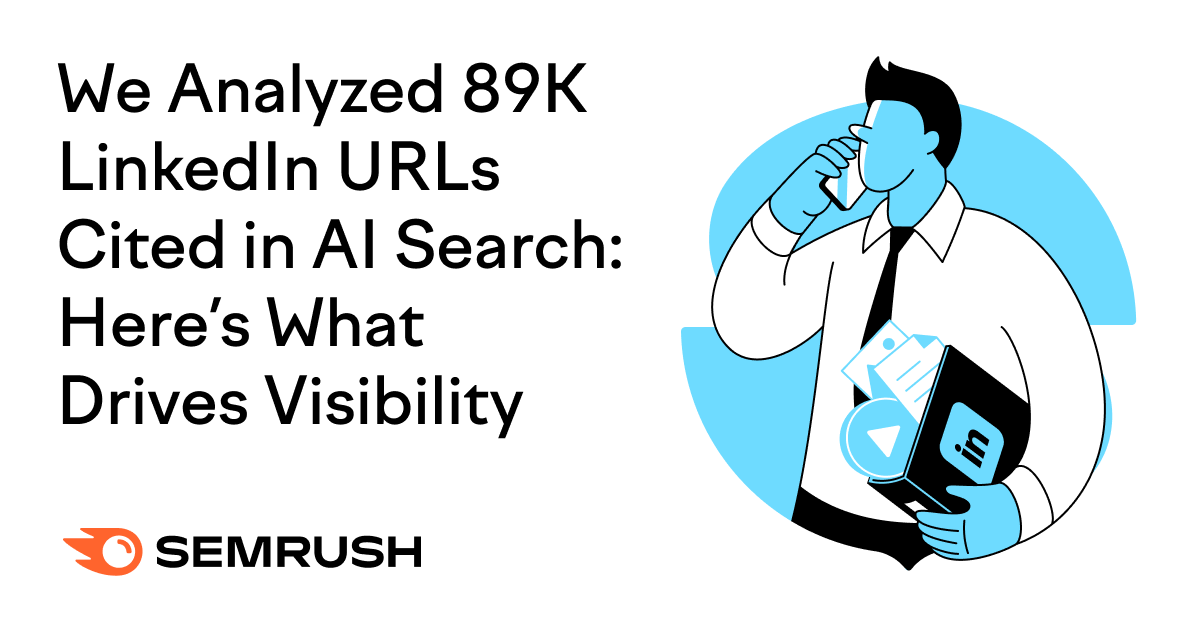
AI search engines like ChatGPT are actively shaping how your brand gets discovered, described, and evaluated—and LinkedIn is one of their primary sources.
But it’s not just about how often your content is cited by AI. What’s more important is understanding why AI models trust certain kinds of LinkedIn content and not others, and how brands can win that trust.
We analyzed 89,000 unique LinkedIn URLs cited by ChatGPT Search, Google AI Mode, and Perplexity, and put together a practical playbook to help you increase your AI visibility.
At a Glance: 5 Key Takeaways for Your AI Visibility Strategy
- LinkedIn is one of the most cited domains across AI models. It ranks #2 in citations in our dataset, appearing in 11% of AI responses on average across ChatGPT Search, Perplexity, and Google AI Mode.
- Your LinkedIn content can directly shape how AI explains your brand. LinkedIn shows relatively high semantic similarity scores in our dataset (0.57–0.60), meaning AI responses often mirror the meaning of the original content.
- Educational, original content is cited most often. Long-form articles (500–2,000 words) and mid-length posts (50–299 words) account for the largest share of AI citations, and 54–64% of cited posts focus on sharing knowledge or practical advice, while reshares are rarely referenced.
- AI citations reward relevance and consistency more than virality. Most cited posts have moderate engagement (15–25 reactions), while about 75% of cited authors post frequently (5+ posts in four weeks) and nearly half have over 2,000 followers.
- You need both Company Page content and individual thought leadership. For example, Perplexity cites Company Pages most often (59%), while ChatGPT Search and Google AI Mode more often cite individual creators (59%).
To sum it all up: AI search engines tend to cite original LinkedIn posts and articles that clearly explain a topic, provide value, and come from active, credible authors.

Deep Dive on Methodology
In January-February 2026, we analyzed 325,000 unique prompts across three AI search tools: ChatGPT Search, Google AI Mode, and Perplexity. The prompt sample spanned topics across 12 major industry categories, including professional and business topics relevant to LinkedIn, among others.
We then identified 89,000 unique LinkedIn URLs cited in AI-generated responses and collaborated with LinkedIn to obtain deeper insights. For each URL, we measured:
- Citation frequency and position: How often and where it was cited in the response
- Content type: Long-form articles, posts, Company Pages, job listings, or others
- Author signals: The follower count, posting frequency, and creator type of the author
- Engagement signals: the median number of reactions and comments
- Content signals: The length, media format, intent, and originality level of the content
We also measured how closely AI responses matched the source, using a semantic similarity ratio (0–1), where 0 indicates no shared context, and 1 means the phrasing is nearly identical.
1. LinkedIn Is the Second Most Cited Domain Across ChatGPT Search, Perplexity, and Google AI Mode
LinkedIn is second in citations on ChatGPT Search, Google AI Mode, and Perplexity for our dataset—ahead of Wikipedia, YouTube, and every major news publisher.

On average, 11% of AI responses reference LinkedIn. However, this varies by model and industry. Perplexity cites LinkedIn in just 5.3% of responses, compared to 13.5% on Google AI Mode and 14.3% on ChatGPT Search.

What This Means for You
Your potential customers are asking questions of AI tools right now, and LinkedIn content is showing up in the answers.
If your brand isn’t consistently publishing on LinkedIn, someone else’s content will fill that space and shape what AI tells customers about your products or services.
This is especially true if you are in professional or B2B categories. The majority of prompts in our analysis came from technology, business services, finance, and industrial sectors.
2. AI Responses Have Significant Semantic Overlap with Cited LinkedIn Content
AI search doesn’t just cite LinkedIn; it echoes it.
With semantic similarity scores between 0.57 and 0.60, AI responses tend to mirror the meaning of the original LinkedIn content. That means your brand message is more likely to be represented accurately.

By comparison, similarity scores were lower for other platforms we analyzed in previous studies. They averaged 0.53–0.54 for Reddit posts and 0.435 for Quora answers, indicating that AI paraphrases those sources more heavily.
What This Means for You
When your LinkedIn content is cited in AI search, it isn’t just linked: it actively influences how the topic is explained.
To benefit from this:
- Clearly define key concepts and brand/product-related terms in your content
- State your core message explicitly in the first few lines
- Use precise, consistent terminology for your category and use cases
- Avoid vague positioning that could be misinterpreted when paraphrased
3. Original Posts and Articles Dominate AI Citations
Our analysis shows that LinkedIn articles dominate AI citations across all three models. They account for 50–66% of cited LinkedIn content, while feed posts make up 15–28%, depending on the platform.
This likely reflects how AI retrieval works. LinkedIn articles are longer, structured, and indexable, making them easier for AI tools to parse, extract key ideas from, and reference in answers.
At the same time, internal data from LinkedIn reveals that—increasingly—shorter feed posts appear regularly in citations, showing that both formats can contribute to AI visibility.

Our data on the length of cited articles points to the sweet spot.
Articles of 500–2,000 words are cited the most. These are attractive to AI tools as they are comprehensive enough to answer a detailed question, yet focused enough to stay useful throughout.

For LinkedIn feed posts, the pattern scales down accordingly: mid-length posts of 50–299 words account for the largest share of AI citations.

We also noticed that originality matters just as much as length.
Approximately 95% of cited posts across all three models are original. Reshares barely register at just 5% of citations.

What This Means for You
The key takeaway is that all content presents an opportunity. To maximize your visibility in AI-powered search, you need a smart strategy that leverages both long-form articles and short, impactful posts.
- Build a dedicated article calendar around the topics your audience searches for
- Structure those articles like a good blog post: clear headline, direct answer early, logical flow throughout
- Aim for originality, depth, and value when creating both LinkedIn posts and articles
4. The Most Cited Posts Share Knowledge
AI models overwhelmingly cite educational and advice-driven content.
Our analysis found that well over half of the cited LinkedIn content is knowledge or advice-driven. In fact, for Google AI Mode, this makes up almost two-thirds of citations.
Content promoting a product or service has the second-largest share of citations, albeit less.

This suggests that AI tools act like good editors: cut through the noise and surface the most helpful content that actually helps the person asking.
What This Means for You
If you want LinkedIn visibility in AI search, publish posts that clearly explain how something works, share first-hand experience, or document specific results.
5. Perplexity Favors Company Accounts. ChatGPT Search and Google AI Mode Favor People
Not all AI models treat LinkedIn content equally—and the company vs. individual split is stark.
Company Pages dominate on Perplexity, accounting for 59% of its LinkedIn citations. On ChatGPT Search and Google AI Mode, it’s the very opposite: individual members make up 59% of citations on each.

What This Means for You
To boost your LinkedIn visibility in AI answers and beyond, focus on two key strategies: branded company content and individual creators discussing your brand. This includes thought leadership from employees as well as content from customers, users, and industry influencers.
- Invest in your Company Page: Publish regularly, keep your positioning current, and treat it as a content hub.
- Build employee advocacy: Encourage employees, customers, users, and industry leaders to share content consistently. Support them in building their personal brands by creating content that highlights your company.
A strong approach is to create unique, research-driven content and distribute it across both company and employee accounts. For example, this LinkedIn post promoting one company’s data report is being cited in at least 26 ChatGPT search prompts:

6. Frequency and Credibility Outperform Fame in AI Search
AI citations don’t just go to the biggest names: they also go to frequent posters with real expertise and a moderate, established following.
Around three-quarters of cited LinkedIn post authors are frequent posters (users who created over 5 posts in the previous four weeks).
Occasional contributors are cited far less frequently. Our theory: The more you post, the more content opportunities there are for an LLM to pick up and cite.

For long-form articles, frequency also matters, though slightly less so. Across all three models, around 60% of cited authors are frequent posters.

The balance between popularity and authority reveals some interesting trends.
For posts, an author’s follower count shows a similar impact on citations. Nearly half of the cited LinkedIn post authors in our analysis have 2,000+ followers.

Interestingly, across all models, individuals with less than 500 followers (beyond their connections) are just as likely to be cited—if not more so—than individuals with more than 500 followers.
This suggests that while an established following increases the likelihood of citation, authoritative content from creators with smaller audiences still consistently breaks through.

What This Means for You
AI visibility on LinkedIn is driven most by consistency and expertise—not follower count or influencer status. To increase your visibility:
- Create a structured content program that enables multiple subject matter experts (SMEs) to publish regularly — with editorial guidelines, ghostwriting, or internal content support.
- Provide writing support, templates, and clear topic ownership so your team can publish expertise at scale without slowing down operations.
- Operationalize thought leadership by giving SMEs defined topics, publishing schedules, and content assistance so they can maintain consistent output.
7. Engagement Helps, But You Don’t Need to Go Viral
The most-cited LinkedIn content has just modest engagement. This reinforces the fact that AI retrieval is about relevance and is not a popularity contest.
To illustrate this, we found that the median cited LinkedIn post has 15–25 reactions and no more than 1 comment.

We saw the same pattern in our Reddit study: the threads AI tools cited most weren’t the ones with thousands of upvotes. They were often older, quieter discussions with clear, direct answers.
What This Means for You
Relevance wins out over reach. AI search does not reward the most-liked posts. It rewards the most relevant answers.
Focus on publishing content that answers specific, high-intent questions your customers actually search for.
For example, this article is one of the top-cited URLs from our analysis. The author draws on his firsthand experience to rank the best SEO newsletters and explain each recommendation. It’s relevant and authoritative, and that’s why it’s being resurfaced.

Track Your LinkedIn AI Visibility with Semrush
Understanding how to get your brand’s LinkedIn content cited by AI starts with monitoring your visibility.
Semrush’s AI Visibility Toolkit shows you where AI-generated responses cite LinkedIn content relevant to your niche and brand.
For example, enter a topic of your choice in the Prompt Research tool, check the AI-generated responses, filter by LinkedIn, and review the posts and articles being surfaced.
.gif)
This will help you understand which types of LinkedIn content AI models trust, so you can adapt and refine your content to match what works.
The Toolkit also includes the Narrative Drivers tool to identify LinkedIn citations alongside other sources, to analyze sentiment, and uncover broader strategic recommendations.

![How To Write With AI Without Sounding Like a Machine [Free AI Workflows & Prompts]](https://mgrowtech.com/wp-content/uploads/2026/03/How-To-Write-With-AI-Without-Sounding-Like-a-Machine-OG-Image-2-350x250.png)