Key Takeaways
- AR/VR in fitness is transforming exercise with engaging, interactive, and custom workouts that enhance engagement and retention.
- It is estimated that the global AR/VR market will reach $589 billion by 2035.
- AR/VR helps companies to go international with online classes and personalized distance training.
- AR/VR contributes to better outcomes and user satisfaction in fitness programs by providing real-time feedback and improving performance.
- Virtual membership, in-app purchases, and premium content are new revenue streams that businesses can tap into using AR/VR.
The idea of innovation is not new to the fitness industry. Still, in recent years, significant technological changes driven by the development of augmented reality (AR) and virtual reality (VR) were not anticipated. Fitness companies are integrating these technologies to offer customers innovative, interactive, convenient, and tailored virtual reality fitness experiences.
AR in fitness is not about whether it will transform the industry, but how AR fitness integration is redefining exercise participation, training engagement, and user interaction with immersive fitness experiences.
AR and VR in fitness are altering how people exercise. The technologies offer interactive augmented reality workout experiences that go beyond the boundaries of traditional training applications and physical training. It may be the creation of physical virtual backgrounds or real-time information on the condition of a certain mid-workout. The advantages are obvious.
In the case of fitness companies, it is not an improvement in user experience. One way is to find new markets, retain clients, and stand out in a saturated industry. When used effectively, AR/VR can help the business grow quickly, deliver experiences never seen before, and stay ahead of the competition.
In this blog, we will describe 10 notable use cases of AR/VR in the fitness industry and how they can be helpful. We will also discuss market insights, advantages, challenges, and new trends in the AR/VR fitness market. These are not only changing workouts, but also changing how fitness companies interact with their customers, generate value, and grow.
AR/VR Fitness Market Set to Reach $693B by 2035
Turn this growth into a real business outcome with AR/VR fitness apps tailored to your customers and revenue goals.

What Makes AR/VR in Fitness a Business Growth Opportunity?
The AR/VR market is expected to grow to over $693 billion by the year 2035, meaning that it is going to grow tremendously in the future.
For the AR/VR in the fitness industry, this will present new opportunities to reach and keep customers through immersive experiences.
AR/VR is being adapted by the fitness companies to offer remote training via virtual reality, fitness, and custom workouts. These technologies make fitness simpler and offer alternative means of revenue, such as virtual membership and the sales of equipment.
Key Trends:
- Remote Workouts: Virtual reality fitness classes can bring fitness to users anywhere they go.
- Personalization: AR/VR can be fitted into a workout plan led by performance data in real time.
- Global Presence: Fitness brands can target users anywhere in the world, and it is not necessary to focus on physical location.
The integration of AR/VR in the fitness industry is becoming more critical to attract businesses interested in staying competitive and delivering and improving their services.
How to Implement AR/VR in Your Fitness Offerings Step by Step?
The use of VR and AR technology in your fitness company can make it more interesting and open up sources of revenue that you might not have thought of.
The way to do it is by:
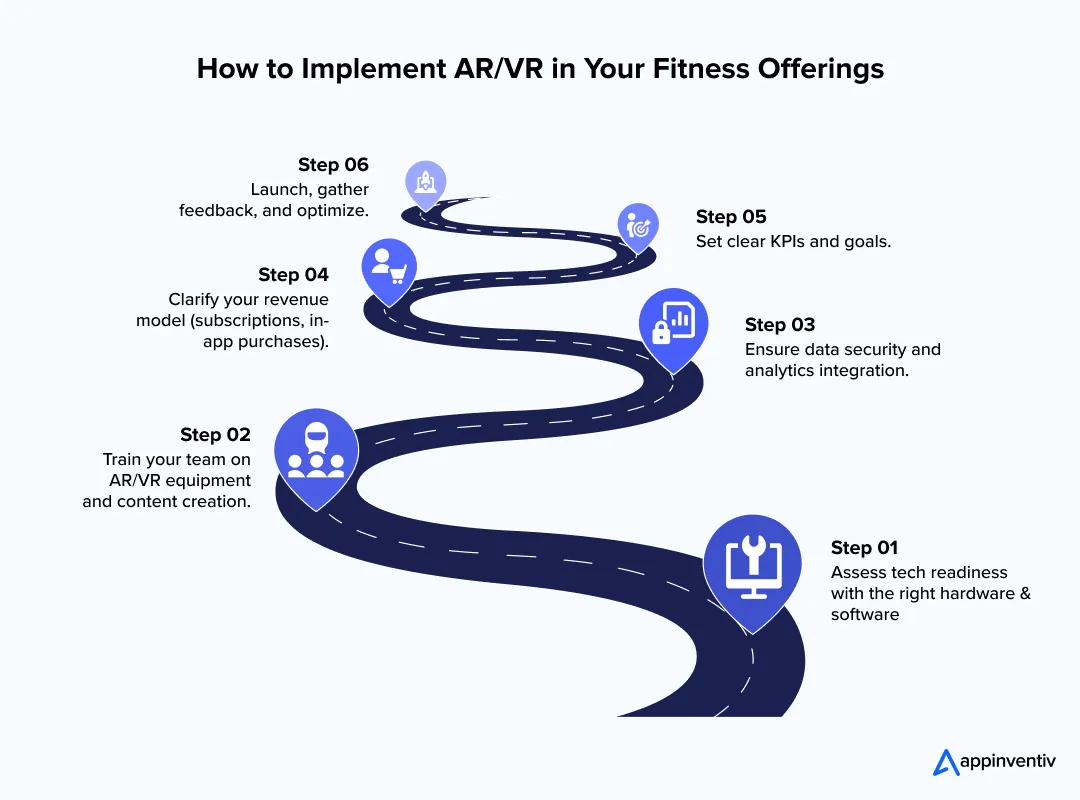
Step 1: Technology Readiness Assessment
- Hardware: Spend on VR glasses hardware, including the Oculus Rift or the HTC Vive, motion trackers, and intelligent gym equipment.
- Software: Build the worlds of the future with software packages like Unity3D or Unreal Engine, and make them work with your existing systems.
Step 2: Train Your Team
- Staff Training: You need to make your trainers comfortable with using AR/VR machines and provide real-time feedback to your clients.
- Creation of Content: Decision on whether you’ll handle AR fitness app development internally or work with programmers. Design compelling AR/VR workout routines and interactions.
Step 3: Ensure Data Security
- Privacy Compliance: Sensitive health data must be strongly encrypted and comply with GDPR or HIPAA standards.
- Analytics: Tailor exercises using IoT data analytics sensors, monitor the performance, and get insights.
Step 4: Clarify Your Business Model
- Revenue Streams: You can think of virtual classes, subscriptions, or even the sale of AR/VR-ready equipment.
- Partners: Join forces with technologists and content developers to develop at a faster rate.
Step 5: Setting KPIs and Goals
- Measures: Keep track of the user activity, frequency of platform use, and retention.
- Pilot Program: Start small with a test first to get user response, and then scale down, and then go large.
How AR/VR in the Fitness Industry Is Driving High-Impact Use Cases?
AR in fitness and VR are revolutionizing the sector through the provision of interactive, personalized, and more complex experiences.
Such technologies and their use cases for augmented and virtual reality fitness apps are overshadowing the traditional models of fitness, allowing companies to grow, work with customers better, and provide newer services.
The applications of AR VR fitness technology are really making a significant impact, as evidenced by 10 of the following use cases, which also provide real-life examples of AR/VR fitness apps and how the technologies are being applied by businesses.
1. Individualized Virtual Training
Behind personalized AR and VR fitness training sits a real-time skeletal tracking system that reads body movement through device cameras and IMUs in smart wearables. This sensor-fusion pipeline feeds AI inference models running on edge nodes, enabling AR fitness integration to adjust workout intensity within milliseconds.
The result is training that feels instantly responsive rather than algorithmic, showing how AR/VR in the fitness industry is enabling adaptive virtual coaching at scale.
Example
Peloton is a company that offers smart equipment and an integrated app that adjusts training intensity in real time based on metrics such as heart rate and cadence. With this personalization, user satisfaction increases because the experience is tailored to their needs.
Business Impact
Individual experiences drive increased engagement and retention, enabling businesses to build a loyal customer base more easily. It is also capable of tiered pricing models in which upgraded users will have access to more customized services.
2. Gamified Workouts
Gamified AR/VR fitness experiences are built on real-time engines like Unity and Unreal, where physics simulations translate user movement into interactive environments. Multiplayer challenges inside immersive training modules use WebRTC and low-latency event streaming to keep participants synchronized. This transforms exercise into engaging AR/VR workouts and socially connected fitness experiences.
Example
Supernatural is a virtual reality fitness app that lets people play on mountains or beaches, making fitness feel like a game. Users can punch targets, dodge obstacles, and monitor their scores as they work out.
Business Impact
AR fitness app development with gamification will promote long-term adherence to exercise because it’s enjoyable. They deliver an audience that is younger and more technologically inclined, enabling businesses to enjoy greater subscription and user interest.
3. Live Feedback and Metrics of Performance
AR/VR fitness programs rely on sensor fusion architectures combining camera-based pose tracking, IMUs, and Bluetooth Low Energy heart rate monitors to deliver accurate real-time feedback.
To keep motion natural, motion-to-photon latency is maintained below 20ms with 90Hz–120Hz refresh rates. Asynchronous Timewarp stabilizes rendering, ensuring AR/VR features for workout apps remain smooth even during high-intensity movement.
Example
Zwift provides real-time metrics—speed, cadence, and heart rate—to cyclists and runners, and offers virtual worlds to make training more engaging. The platform is also dynamically adapted to the user’s performance.
Business Impact
The ability to provide real-time feedback through VR fitness app development would be a major value-add for businesses offering fitness services, helping them justify a higher-tier subscription model. It also provides an opportunity to upsell by offering specialized features such as form correction and detailed performance tracking.
4. Virtual Fitness Group and Social Interaction
Virtual group workouts inside immersive training modules depend on real-time avatar synchronization and spatial audio streaming. WebRTC pipelines handle live voice and video, while edge servers replicate motion data between participants to reduce geographic latency.
This has become one of the most adopted use cases for augmented and virtual reality fitness apps, making remote group training feel close to in-studio sessions.
Example
FitXR is a virtual fitness environment that lets users join group classes, compete, and communicate with others through their avatars. Such social factors make fitness more entertaining and inspiring.
Business Impact
Virtual communities create a higher user loyalty and customer retention. Businesses can monetize these communities through exclusive access to classes or events, and the sense of belonging that will keep users active.
5. Rehabilitation Therapeutic Fitness
AR and VR for fitness rehabilitation integrate depth-sensing cameras and biomechanical safety models to detect improper joint movement in real time. These augmented and virtual reality fitness apps encrypt recovery data under HIPAA and GDPR frameworks, enabling secure collaboration with clinical partners. Patients receive guided therapy that feels personal, safe, and clinically reliable.
Example
VRHealth is an XRHealth solution that uses virtual reality to help patients follow physical therapy exercises. The system will provide feedback on their movement, and patients will be assisted in healing their injuries under the instruction of a virtual therapist.
Business Impact
The medical care and recovery programs offer a business opportunity for fitness firms, as they can expand their services to rehabilitation centers, hospitals, and long-term care facilities, given the growing healthcare market.
6. Distanced Workouts Consultations / Hybrid Models
Remote coaching through AR/VR fitness apps combines low-latency WebRTC video with live skeletal tracking dashboards for trainers. AI-driven rep counting and fatigue detection run in real time, allowing trainers to adapt sessions instantly. This reflects emerging AR/VR trends in the fitness industry, where immersive remote coaching is becoming a standard service layer.
Example
Mirror offers real-time and remote consultations by connecting clients with fitness trainers. It is also used to provide live feedback, allowing trainers to guide a person through a workout while evaluating their technique.
Business Impact
This hybrid model is very affordable and enables fitness businesses to reach clients worldwide without a physical location. It also offers a certain degree of customization that is attractive to the modern-day customer on the move.
7. Distance Group Distributed User Virtual Group Classes
Large-scale virtual classes are powered by microservices-based session orchestration that automatically scales during peak workout hours. Adaptive streaming pipelines balance video quality and bandwidth across global users. This app engineering approach supports the future of VR and AR in fitness, enabling location-independent training at enterprise scale.
Example
Black Box VR is a corporation that provides group VR experiences in which individuals share experiences. Despite the distance between them, the participants will be able to see one another and talk in a shared virtual space.
Business Impact
Online group classes will help the fitness companies expand and reach their customers throughout the world. Such courses are also more interactive and promote a community feeling and attendance.
8. Enhanced Product and Equipment Interaction in AR in Fitness
Augmented reality and virtual reality fitness apps development uses ARKit and ARCore spatial mapping to place 3D fitness equipment accurately inside real-world environments. Cloud-rendered models stream on demand, removing heavy device storage requirements. This approach has become a core part of AR/VR app development strategies, helping brands deliver interactive product exploration experiences.
Example
Nike Fit is an AR application that allows users to scan their feet and choose a shoe from a 3D model. It also allows users to view the boots on their feet before buying.
Business Impact
Through AR fitness app development, this will be an interactive shopping experience that leads to more conversions and fewer returns, as customers will better understand how the products will benefit them. It also makes the purchasing process more involving, thus resulting in higher customer satisfaction.
9. Workout Immersion in Addictive Workouts
Immersive training modules in virtual reality fitness demand motion-to-photon latency below 20ms to prevent dizziness during high-movement sessions. Rendering pipelines apply foveated rendering and Asynchronous Spacewarp to sustain stable 90Hz frame rates. The result is next-generation virtual reality fitness experiences built on advanced VR and AR technology.
Example
ICAROS is a type of fitness equipment that combines with immersive VR to enable users to train in virtual worlds, such as a mountain trail or a beach. It is a virtual reality that makes exercises interesting and motivating.
Business Impact
VRs help make workouts more regular and can keep users motivated to work out. This will increase long-term engagement, customer retention, and the likelihood that users renew their subscriptions.
10. More Complex Analytics and Trainer Ecosystem Facilitating
Trainer dashboards inside AR/VR fitness platforms ingest motion and biometric telemetry through real-time event-streaming architectures. Machine learning models transform this data into performance insights and predictive fatigue scoring. This completes enterprise app ecosystems and directly addresses key challenges of developing AR/VR fitness applications through data-driven coaching intelligence.
Example
Trainerize integrates with fitness trackers to provide trainers with data on their clients’ workouts. The trainers will observe clients’ behavior in 3D and provide real-time feedback and guidance.
Business Impact
This technological solution will deliver significant value to personal training services, enabling businesses to charge higher prices through advanced coaching. It also provides trainers with information-based knowledge to enhance client outcomes.
Also Read: 15 Use Cases on How AI Is Transforming Virtual Reality: The Future of Immersive Experiences
What Are the Benefits of Using Virtual and Augmented Reality in Fitness?
Augmented reality for business and virtual reality fitness apps offer concrete advantages that directly affect business development. These technologies are transforming the operations of fitness businesses by increasing user engagement, streamlining business processes, and opening new revenue streams.
The following are some of the advantages:
- Immersion and Retention: AR/VR fitness app solutions offer better immersion and interaction, thereby retaining the users. Online training, personalized activities, and virtual workouts assist in retaining the end users.
- New Revenue streams: VR and AR technology are facilitating innovation in monetization (e.g., virtual subscriptions, in-app purchases, exclusive content, e.g., VR workout classes).
- Flexibility and Connectivity: AR/VR allows increasing the fitness service without physically increasing the space. Users can find virtual workouts and services anywhere.
- Competitive Differentiation: Adopting AR/VR first will make the business stand out among competitors and become an innovative pioneer in the sphere of fitness.
- Individualization via Data: AR/VR platforms collect helpful user data, such as metrics, interests, and habits. This data can be applied to offer personalized exercise programs and suggestions.
All these business benefits demonstrate that AR/VR is no longer a new tendency but a helpful tool that may also help to expand, increase customer satisfaction, and make fitness organizations more profitable.
What Are the Hard Engineering Challenges in AR/VR Fitness Integration?
AR/VR fitness integration presents technical and operational challenges that enterprises must solve to scale immersive digital training successfully.
Key challenges of developing an AR/VR fitness application include hardware and cost barriers, the complexity of developing augmented reality and virtual reality fitness apps, constraints on app development, legacy system integration, biometric data security, and user safety.
Addressing these early ensures stable deployment, measurable ROI, and consistent user experience.
1. Hardware and Cost Barriers
AR/VR hardware such as headsets, motion sensors, and smart fitness equipment can require high upfront investment, slowing AR/VR adoption in fitness businesses.
Organizations can reduce cost barriers by enabling BYOD (Bring Your Own Device) models, prioritizing mobile-based AR fitness integration, and negotiating bundled hardware partnerships.
2. AR/VR App Development and Content Creation Complexity
Augmented reality and virtual reality fitness apps development demands specialized 3D content creation, real-time interaction design, and engine expertise using platforms such as Unity and Unreal Engine.
Poor content design directly impacts user engagement and retention. Enterprises can adopt modular AR/VR content pipelines, reusable immersive training modules, and third-party content frameworks to accelerate development cycles while ensuring a consistent user experience.
3. Measuring and Proving ROI of AR/VR Programs
Many fitness enterprises struggle to measure tangible ROI from AR/VR fitness initiatives, especially when linking immersive experiences to business outcomes.
Organizations should track key performance indicators (KPIs), including user engagement, session frequency, subscription rates, free-to-paid conversion, customer retention, churn reduction, and customer lifetime value (CLV).
4. Linkage to Legacy Systems
Integrating AR/VR fitness platforms with existing membership management systems, workout databases, payment systems, and wearable data platforms can create interoperability constraints. Adopting API-driven integration layers and middleware ensures AR/VR solutions connect seamlessly with current software ecosystems without disrupting ongoing operations.
5. Biometric and Health Data Privacy
Real-time performance analytics in AR and VR for fitness rely on sensitive biometric and health data, subject to GDPR and HIPAA compliance requirements. Implementing encrypted data pipelines, anonymized processing, and controlled access frameworks ensures regulatory compliance while protecting user trust.
6. Safety, Accessibility, and Motion Comfort
Immersive AR/VR workout and fitness experiences may cause motion sickness or limit accessibility for diverse user groups. Adaptive intensity controls, comfort-mode locomotion, accessibility-first interface design, and guided onboarding flows ensure inclusive AR/VR fitness experiences.
By addressing hardware cost barriers, app development complexity, ROI measurement, legacy linkage, biometric data security, and accessibility early, fitness enterprises can deploy scalable AR/VR solutions that deliver consistent performance, improved user engagement, and long-term retention.
Ready to Launch Your AR/VR Fitness App?
Work with a product team that understands wearables, AI, and large-scale fitness platforms from day one.

How Is an AR/VR Fitness App Engineering Blueprint Designed for Enterprise Scale?
Picture a fitness brand preparing to launch its first immersive workout experience. The success of that rollout depends on more than creative content. AR fitness app development for real-world overlays, virtual reality fitness app development for fully immersive training modules, real-time performance analytics, and cloud-based content orchestration must work together.
When done right, AR/VR technology delivers scalable AR/VR fitness solutions that stay stable across devices, networks, and global user demand.
What Does the Core AR/VR Technology Architecture Look Like?
This is the foundation that keeps immersive fitness platforms reliable when real users, real devices, and real data come into play.
| Architecture Layer | Recommended Technology Stack | Enterprise Function |
|---|---|---|
| AR Fitness Integration Layer | ARKit, ARCore, WebXR | Mobile-based augmented reality workout overlays |
| Immersive Training Modules (VR) | Unity, Unreal Engine | High-fidelity fitness environments |
| Motion & Skeletal Tracking | OpenXR, MediaPipe, Depth APIs | Real-time posture and movement analysis |
| Wearable & Smart Equipment Integration | Apple HealthKit, Google Fit, BLE SDKs | Biometric and performance data capture |
| Real-Time Performance Analytics | Kafka, Redis Streams, BigQuery | Sub-second adaptive workout feedback |
| Cloud Backend Orchestration | AWS, Azure, GCP + Kubernetes | Scalable session and content management |
| Streaming & Edge Delivery | 5G and emerging 6G networks + Edge CDN | Low-latency immersive experience delivery |
| Security & Compliance | HIPAA and GDPR encryption, Zero Trust Architecture | Health and biometric data protection |
Hardware & Device Ecosystem Strategy
Choosing the right hardware ecosystem determines how quickly AR/VR fitness offerings reach real customers.
VR Hardware Selection
High-end VR headsets such as Meta Quest and HTC Vive make fully immersive virtual reality fitness training possible without external tracking setups. This is where premium digital fitness experiences come to life.
AR Hardware Deployment
Mobile AR through smartphones and tablets lowers adoption barriers. AR glasses like Microsoft HoloLens and Magic Leap add advanced augmented reality workout overlays for enterprise-grade training environments.
Smart Fitness Equipment Connectivity
Smart bikes, treadmills, and wearable fitness trackers feed real-time performance data into AR/VR systems. The result is workouts that adapt as the user moves, not after the session ends.
Software & Content Development Framework
This is where AR fitness app development and virtual reality fitness app development turn ideas into usable experiences.
- Unity and Unreal Engine power interactive 3D workout environments
- Modular immersive training modules speed up content production
- Cloud-based content storage keeps workouts accessible across devices
- SDK and API integrations connect wearables, payments, and user accounts
This structure keeps content pipelines fast without compromising experience quality.
Partner & Platform Ecosystem Enablement
No AR/VR fitness solution scales alone. The ecosystem around it matters just as much as the code.
- VR hardware partnerships improve device optimization
- Apple HealthKit and Google Fit integrations enable personalized workout tracking
- Content studio collaborations accelerate interactive virtual fitness production
Together, these partnerships reduce development risk and time-to-market.
Cross-Device Compatibility & Interoperability
AR/VR fitness solutions must operate across smartphones, VR headsets, AR glasses, and smart fitness equipment. API-driven interoperability and cloud-synced user states allow workouts to continue seamlessly, whether a user switches from phone to headset or from gym equipment to home training.
How Can Enterprises Future-Proof AR/VR Fitness Technology?
Technology shifts fast. Fitness platforms must be ready before users expect them.
- AI-driven performance coaching personalizes every session
- 5G and upcoming 6G networks enable smooth immersive workout streaming
- Continuous wearable integration supports all-day biometric tracking
- Cloud-native infrastructure keeps global expansion frictionless
This keeps AR VR fitness solutions relevant as networks, devices, and user expectations evolve.
A well-designed AR/VR technology ecosystem built on Unity, Unreal, ARKit, ARCore, cloud orchestration, wearables, and next-generation networks gives fitness enterprises something valuable. A platform that scales. A user experience that stays smooth. And an immersive training environment that keeps customers coming back.
How Do ROI, KPIs, and Business Impact Metrics Justify AR/VR Fitness Integration?
AR and VR for fitness deliver measurable financial and operational impact by improving customer lifetime value (CLV), reducing churn, and increasing virtual subscription revenue. A well-executed AR/VR fitness app strategy allows enterprises to scale globally, lower infrastructure costs, and unlock new monetization models through immersive training modules, in-app purchases, and data-driven performance optimization.
Measuring Return on Investment (ROI)
To measure ROI, enterprises evaluate initial investment across hardware, software, and AR/VR content development, then track incremental revenue from virtual subscriptions, premium immersive content, and in-app purchases. Additional ROI drivers include cost savings on physical infrastructure, global digital expansion, and higher equipment utilization through connected smart fitness devices.
Key Performance Indicators (KPIs)
Key metrics to track include:
| Business Metric | Typical Impact Range | Value Driver |
|---|---|---|
| Customer Lifetime Value (CLV) | 20–35% increase | Premium immersive content subscriptions |
| Churn Reduction | 18–30% decrease | Higher user engagement consistency |
| User Engagement | 22–40% longer sessions | Immersive training retention |
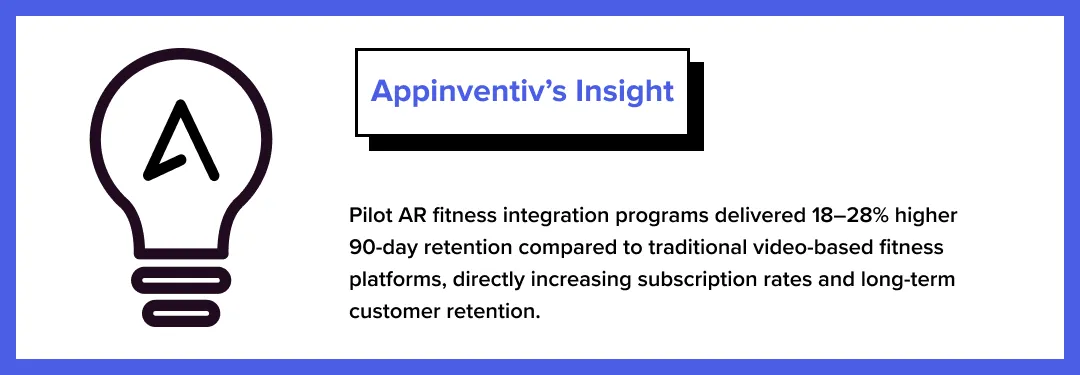
| Subscription Rates | 15–28% uplift | Free-to-paid conversion via AR coaching |
| Virtual Subscription Revenue | New recurring stream | On-demand VR classes and upgrades |
| Equipment Utilization | Higher smart device usage | Connected AR/VR workout experiences |
| Global Expansion Reach | 3–5× growth | Borderless AR/VR fitness delivery |
| Break-Even Acceleration | Faster ROI realization | Reduced infrastructure costs |
Strategic Enterprise Advantages
- Increase user engagement through immersive AR and VR fitness experiences
- Improve customer retention and reduce churn with real-time performance feedback
- Unlock virtual subscriptions and in-app purchases as recurring revenue streams
- Lower infrastructure costs by scaling digital-first fitness offerings
- Accelerate break-even timelines on AR/VR investment
- Maximize smart equipment utilization through connected workout ecosystems
Also Read: 15 Use Cases and Examples of How AI Is Transforming the Fitness Industry
What Is the Future of VR and AR in Fitness?
AR and VR technologies are also changing rapidly, and several AR/VR trends in the fitness industry are defining the future. Here’s what to watch:
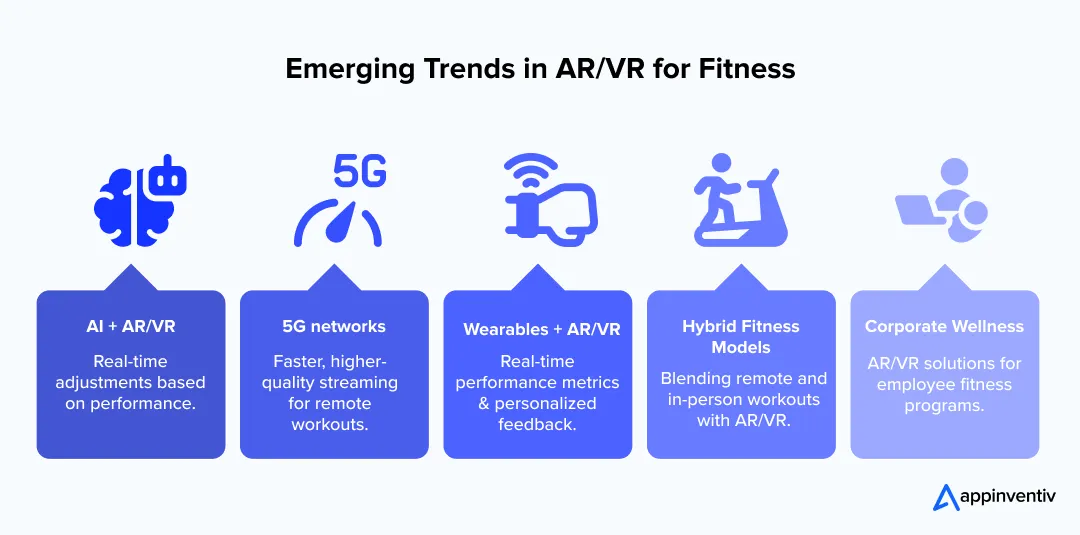
- AI Integration with AR/VR: Integrating AI with AR/VR enables real-time adjustments to exercises based on how the user is performing, providing an even more customized exercise experience.
- AR/VR Streaming and 5G Networks: With the advent of 5G, fitness businesses will have the opportunity to provide high-quality, low-latency real-time streaming of virtual classes and immersive workouts, enhancing the overall user experience.
- Wearables + AR/VR Synergy: AR/VR will be integrated with wearables (e.g., smartwatches, fitness trackers) to provide users with real-time performance metrics, improving personalization and feedback during workouts.
- Hybrid Fitness Models: Hybrid fitness models will be driven by AR/VR, providing remote and in-person fitness workouts. Augmented and virtual reality fitness training can be accessed by users anywhere.
- Corporate Wellness Programs: AR/VR will be used more by businesses, with companies providing employees with immersive virtual fitness programs to enhance their well-being and productivity.
Also Read: AR/VR Trends and Predictions For The Upcoming Years
Looking For a Reliable AR/VR Tech Partner?
From pilot to global rollout, we design and build secure AR and VR fitness apps that plug into your existing products.
How Appinventiv Can Empower Your Fitness Business with AR/VR Innovation
At Appinventiv, we specialize in changing the businesses of fitness using VR and AR technology, and through our professional fitness app development services and tailored fitness applications.
Having completed 120+ wearable apps projects and a portfolio satisfaction of 95%, we offer comprehensive AR VR app development services to assist you with AR/VR fitness app development and VR apps in fitness that will increase user engagement, retention, and generate new revenue opportunities.
We present 300+ AI-powered solutions to the table to make sure your fitness application incorporates real-time data analytics and custom training. Through VR fitness app development, you can create augmented reality workouts, provide virtual reality workouts, or add new functionality to workout apps (gamified training and real-time feedback). We can help you make your vision a reality.
We manage the process, from conceptualization to deployment, and make sure that your application will be scalable and will integrate smoothly with smart fitness equipment and wearables. We can collaborate with businesses to ensure that they remain ahead of the curve and offer users a personalized experience of being immersed in the world of fitness with our knowledge and expertise in AI, wearable technology, and AR/VR app development.
Let’s connect and collaborate to develop an AR/VR fitness application that changes your business and makes the users keep coming back to the app.
Frequently Asked Questions
Q. Why Businesses Should Build an AR/VR Fitness App?
A. The development of an AR/VR fitness application can enable enterprises to provide immersive and engaging experiences that will help them stand out in the competitive fitness industry. The personalized workouts, real-time feedback, and virtual classes are possible with the help of these technologies, which make fitness more interactive.
The AR/VR also makes a business reach further all over the world, churn reduces, and generates new income sources by means of subscriptions or in-app purchases. Embracing AR/VR, the companies will be able to remain on top of trends and offer groundbreaking solutions that would appeal to tech-oriented users.
Q. What Motivates Companies to Adopt AR/VR Fitness Solutions?
A. The use of AR/VR fitness solutions in companies is the reason that customer engagement is improved, resulting in increased retention and increased length of stay. The technologies also provide the business with the ability to expand across the whole world through virtual and on-demand services.
Moreover, AR/VR can be used to create individualized experiences that can delight more people. It also makes business leaders in the innovation, allowing them to charge high prices and assist in creating a difference from the competitors.
Q. How Can Augmented Reality Transform the Fitness Industry?
A. AR changes the concept of fitness by providing interactive and real-time feedback. It takes people through workouts, provides on-screen guidance, monitors progress, and makes the whole experience more pleasant.
AR is also able to superimpose workout data, e.g., muscle engagement, onto the surroundings of a user. This enables fitness to be more individual and participatory, enhances retention and output, and gives businesses useful information on how to improve their services.
Q. How is AR Used in Fitness?
A. AR in fitness helps to increase user interaction by placing interactive content over the real-world space. It offers real-time responses in form and performance tracking, and can teach through exercises. AR also builds virtual trainers and virtual workout environments, which make the exercise routines feel new and exciting. The technology is an incentive to users and will stimulate regularity in the workouts.