Most enterprises already use AI tools. But most of them behave like assistants waiting for instructions. Humans still have to connect the dots, move insights between tools, and trigger the next action. This manual orchestration becomes the bottleneck when you scale campaigns across customer journeys and channels.
That’s why enterprise teams are increasingly exploring the use cases of agentic AI.
Today, enterprises are deploying autonomous AI agents that can plan goals, execute multi-step workflows, and coordinate across systems. In practice, agentic AI turns traditional AI tools into systems that launch campaigns, analyze performance signals, personalize engagement, and optimize outcomes while keeping humans in control of goals and guardrails..
Currently, 23% of organizations have started AI agent pilot projects, while 14% have progressed to partial or full-scale implementation. Meanwhile, Gartner predicts 40% of enterprise applications will embed task-specific AI agents by 2026, up from less than 5% today.
In this guide, we explore 10 high-impact use cases of agentic AI for enterprises and how autonomous agents drive campaigns, engagement, and performance at enterprise scale.
10 agentic AI use cases for enterprise and D2C marketers
1. Autonomous campaign creation and real-time optimization
Agentic AI allows campaigns to operate as continuous experimentation systems instead of one-time launches, solving two major problems marketing teams face:
- Teams must produce more content across more channels. 43% of retailers say content demand across channels is rising.
- Teams also must improve engagement and conversion. 47% of retailers face pressure to lift performance.
Agentic AI addresses both problems within a single operating loop. AI agents can:
- Turn a brief into campaign assets
- Build audience segments
- Launch tests across email, paid, site, and social
- Optimize campaigns based on CTR, conversion rate, suppression triggers, and on-site behavior
Salesforce’s 2025 marketing research also found 75% of marketers are already implementing or experimenting with AI, and high performers are 2.5x more likely to have fully implemented it. This means campaigns are moving away from manual coordination toward systems that continuously test and optimize performance.
2. Multi-channel customer engagement
Multi-channel engagement becomes difficult to manage as customer conversations spread across email, SMS, chat, push notifications, and social messaging. Most teams handling these manually struggle to deliver a consistent experience and engagement across channels.
- Customers expect consistent experiences across channels. 73% of customers expect companies to understand their unique needs and expectations, regardless of where the interaction happens.
- Customer journeys are becoming increasingly fragmented. 80% of consumers say the experience a company provides is as important as its products or services.
Agentic AI helps you manage these complexities by orchestrating engagement across email, SMS, chat, push notifications, and social in real time. AI agents track behavioral signals, like browsing activity, purchase intent, and past interactions, and decide the next best action. An agent might trigger an email after a product view, send an SMS if a cart remains inactive, or initiate a chatbot conversation during a return visit.
Instead of teams stitching together journeys manually, AI agents maintain continuous, context-aware conversations across channels.
3. Dynamic creative and content generation
Brands now need hundreds of creative variations across audiences, channels, and formats, yet most teams still build assets manually and reuse them across segments. Several industry signals highlight the pressure:
- 87% of marketers already use AI to assist with content creation, showing how quickly creative workflows are shifting toward automation.
- 93% or marketers rely on AI to generate content faster, and 90% to make faster marketing decisions.
Instead of producing a fixed set of assets, agentic AI helps you:
- Generate dozens of ad variations for different audience segments
- Assemble landing pages dynamically based on traffic source or intent
- Write product descriptions from catalog data in real time
As engagement signals (dwell time, conversions, and click-through rates) arrive, The agent refines messaging and scales the best-performing creative automatically once engagement signals (dwell time, conversions, and click-through rates) arrive.
4. Predictive churn and retention agents
Customer churn rarely happens suddenly. In most cases, signals like declining engagement, fewer purchases, or reduced product usage appear weeks or months earlier. The challenge for marketing and growth teams is detecting those signals early enough to intervene. Research shows that acquiring a new customer can cost 5-25 times more than retaining an existing one. At the same time, increasing customer retention by 5% can boost profits by up to 95%.
Agentic AI helps brand marketing teams act on these signals before customers leave. AI agents can monitor:
- Behavioral patterns such as declining usage
- Reduced purchase frequency
- Support interactions
- Negative sentiment
Once risk signals appear, the agent can trigger personalized interventions like targeted offers, loyalty rewards, re-engagement emails, or proactive customer support outreach. Instead of reacting after customers churn, enterprises can use always-on retention systems that detect risk early and trigger interventions to protect revenue and customer lifetime value.
5. Lead scoring and nurture automation
Marketing teams usually generate more leads than sales teams can pursue. However, 79% of marketing leads never convert into sales, often because they are not properly nurtured. The challenge lies in identifying which prospects are ready to buy and nurturing the rest without overwhelming them with follow-ups.
Agentic AI improves this lead scoring process by turning lead qualification and nurturing into an adaptive system. AI agents continuously analyze behavioral signals like page visits, email engagement, product interest, and buying intent. Instead of relying on static scoring rules, the agent adjusts lead scores dynamically based on new signals. Then the system automatically triggers tailored nurture sequences to move prospects toward conversion.
This adaptive lead scoring evolves with buyer behavior instead of relying on fixed drip campaigns and manual qualification. As a result, marketing teams can identify high-intent prospects earlier and move them to sales at the right moment.
6. Real-time customer insights analysis
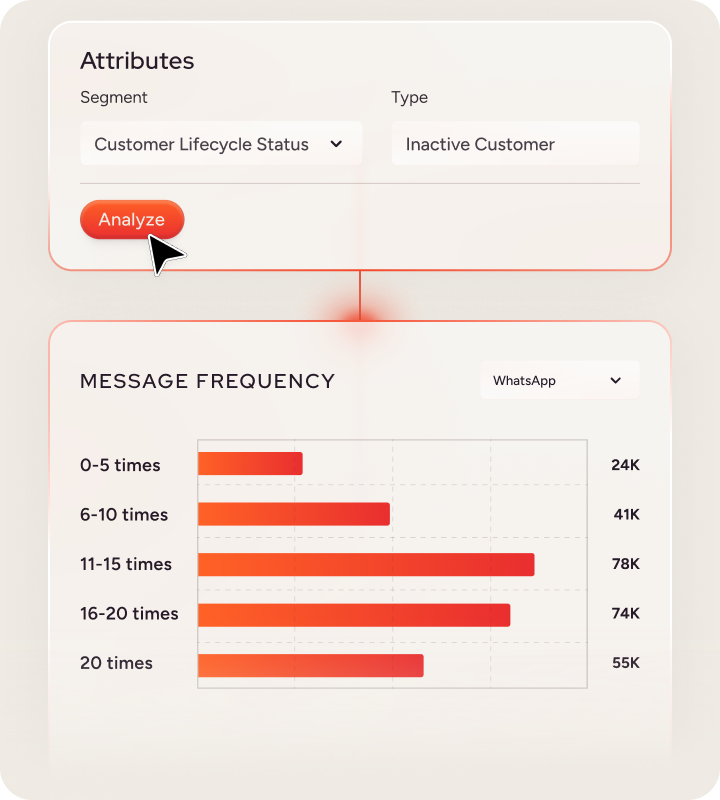
Marketing teams now collect a massive amount of data, including campaign metrics, CRM activity, product usage signals, social conversations, and support interactions. The real challenge lies in turning those signals into insights quickly enough to act. Data from recent studies shows how valuable that capability can be:
- Companies extensively using customer analytics report 115% higher ROI and 93% higher profits than organizations that rely less on data-driven decision making.
- 75% of marketers already use AI to analyze marketing data or generate content, signaling a broader shift toward AI-assisted insight generation.
Agentic AI helps marketing teams close this insight gap. AI agents continuously monitor signals across campaign platforms, CRM systems, product usage data, and social channels. The agent detects patterns like rising product interest, shifts in audience sentiment, declining engagement in a segment, or emerging demand signals.
The system then automatically surfaces actionable insights based on those signals. For example, you can see which messaging resonates or which segments show early buying intent.
Instead of relying on periodic reports or manual analysis, you get continuous insights that you can use to optimize campaign performance and support decisions.
7. AI-powered social listening and engagement
Social platforms generate a constant stream of customer signals. The opportunity for enterprise marketing teams lies in spotting those signals early and responding while conversations are still active. Here’s why it matters:
- 76% of consumers notice and appreciate when companies prioritize customer support on social media.
- More than 500 million tweets are posted every day, showing the scale of real-time conversation brands must monitor.
Agentic AI helps teams manage that volume. Autonomous agents continuously scan social platforms, forums, and community channels to spot patterns like:
- Rising mentions of a product
- Changes in sentiment, or
- Conversations indicating buying intent
The agent surfaces actionable insights and triggers engagement when relevant signals appear. For example, the system might flag a growing conversation about a product feature, highlight influencers discussing the brand, or respond to customer questions through approved messaging guidelines. With AI-powered social listening, enterprise marketing teams can monitor conversations and engage with users without manually tracking social chatter.
8. Customer journey mapping and orchestration
Customer journeys rarely follow a linear path.
A buyer might discover a brand through social, compare options through search, read reviews, interact with email campaigns, and only convert after multiple touchpoints. The challenge for enterprises lies in understanding those journeys and delivering the right message at the right moment.
Agentic AI helps teams manage that complexity by analyzing behavioral signals across CRM systems, marketing platforms, website interactions, and purchase history. The agent adjusts messaging and touchpoints automatically when customer behavior changes.
For example, the system might trigger educational content during early research, send comparison guides during consideration, and deliver personalized offers when buying intent strengthens.
9. Autonomous experimentation and testing
Running tests consistently is tough, no matter how much your marketing team values experimentation. As a result, many teams run only a handful of tests each quarter instead of continuously optimizing messaging, offers, and user flows. When testing becomes a consistent practice, conversion rate optimization programs can increase website conversions by an average of 49%.
Agentic AI helps marketing teams operationalize experimentation. AI agents can:
- Generate multiple variations of offers, messaging, landing pages, and customer journeys
- Launch tests across campaigns and channels simultaneously
- Monitor engagement signals like click-through rates, conversions, bounce rates, and revenue impact
As results come in, the agent scales high-performing variations and removes underperforming ones. Instead of occasional A/B tests, agentic AI lets marketing teams run continuous experimentation where campaigns improve through ongoing testing.
10. Synthetic cohorts and scenario simulation
Marketing teams often face a difficult trade-off when testing campaigns. Running experiments on real audiences generates useful insights, but failed tests can waste budget or damage customer experience. The challenge is finding ways to evaluate campaign ideas before exposing them to real users. That’s where agentic AI can help you with campaign testing through synthetic cohorts.
Instead of running early tests on live audiences, AI agents can:
- Generate simulated customer groups based on behavioral data, demographics, and historical campaign responses
- Model how these cohorts might respond to different offers, messaging variations, or pricing strategies
For example, an agent might simulate how a new promotion performs across different segments, estimate conversion outcomes, and identify which scenarios are most promising. This means enterprise marketing teams can test and refine strategies with synthetic cohorts before committing full budget to live campaigns.
How enterprises should approach agentic AI adoption
Agentic AI moves AI from assistance to execution.
Instead of generating ideas or reports, AI agents now analyze signals, make decisions, and carry out actions across marketing workflows. Enterprises already run hundreds of campaigns, channels, and experiments simultaneously. Human teams struggle to coordinate that scale manually.
The agentic AI use cases above show where agents deliver immediate value:
- Continuous campaign optimization
- Adaptive lead scoring
- Real-time insight discovery
- Social listening
- Churn prevention
- Automated experimentation
Each use case removes a manual coordination layer and replaces it with systems that monitor signals and act.
Early adoption should focus on narrow, high-impact workflows. Start with experimentation, customer engagement, or analytics where real-time signals already exist. Connect agents to CRM, campaign platforms, and product data. Measure outcomes through conversion lift, retention improvements, and campaign velocity. As agentic AI reshapes how marketing teams operate, marketers who treat agents as operational partners will move and learn faster.
FAQs
Traditional AI provides insights, predictions, or single-task automation that requires human direction to turn outputs into action. Agentic AI goes further by executing multi-step workflows on its own. It can plan actions, interact with tools or systems, and adjust decisions based on results.
The biggest benefit is the ability to run large parts of the marketing and retention engine with minimal manual coordination. Agentic systems can monitor customer signals, launch campaigns, test variations, and optimize performance continuously. This allows D2C marketers to focus on strategy while the system manages execution. The result is faster experimentation, better personalization, and improved ROI, retention, and customer lifetime value.
No, agentic AI is not limited to marketing or customer engagement. While those areas show early adoption, the same approach applies to many enterprise functions. Organizations are already exploring agentic systems for operations, IT support, HR workflows, cybersecurity monitoring, and financial analysis. Many workflows that involve data signals, decisions, and repeated actions can be automated or augmented through agentic AI.