Insights into the future of the comms function from Ragan and HarrisX.
AI is now an accepted part of the workplace in 95% of communications departments, according to new data from Ragan Communications and HarrisX. The full results were revealed live Thursday during Ragan’s Future of Communications Conference.
AI use in comms is far more than just a toe in the water. Of the 400 senior-level communicators and CEOs who answered the survey, 30% said that more than half of communications work is currently being done by AI. Fifty-five percent of communicators and CEOs expected AI would do the bulk of comms work by 2030.
But despite the almost universal adoption of AI, communications is still seen as a valuable asset. Among surveyed CEOs, 83% said they value the communications function “very much.” They especially turn to communicators for their expertise in employee communications, executive communications and employee wellness, the survey found.
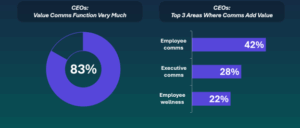
More externally facing tasks still hold value to top brass, such as social media (18%), reputation management (17%) and crisis management, but the logic tracks that CEOs value communicators most for the areas in which they directly collaborate most.
But CEOs painted a sometimes-contradictory picture of the skills they think communicators most need to succeed in the workplace today. Nearly half (49%) said they believe traditional communications profession skills will soon be replaced by prompt engineering and data fluency proficiency – a logical conclusion given the amount of comms work now done by AI. While the survey didn’t ask specifically what traditional comms skills are, the classics are writing, speaking and research.
At the same time, however, when asked what skills are most important to communicators, AI ranked far down the list, behind strategic thinking, creative problem-solving and calm under pressure.

Further muddying the picture, 57% of CEOs said they’d choose to have an important speech written by a custom AI trained on every speech they’d ever given and every article they’d ever written over a “top-tier communicator” who wasn’t using AI.
Yikes.
So here we have CEOs who overwhelmingly value the work of communicators and say the most important skills for communicators are the most human: strategy, creativity and grace under pressure. At the same time, they prefer a robot to write their speech and they say prompt engineering will become more important than communications skills.
What does it all mean?
First, take a deep breath. These numbers may seem scary on the surface, but there’s plenty of brightness too: 42% of CEOs think AI will actually create more jobs in communications. Only 24% think it will lead to a net job loss. Communicators broadly agree, with only 13% fearing AI will threaten their jobs.
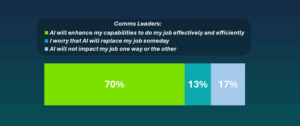
But reading between the lines, we can see that what CEOs value in communicators versus what they see as core communications skills are different. They mostly aren’t looking for writing skills, media savvy or executive coaching skills. Those are increasingly things that can be replaced with a well-trained robot. No, what they want from communicators are the things that AI can’t do – and never will be able to do: the ability to apply strategy to unique situations, the creativity to see new solutions and the ability to deliver even under difficult circumstances.
The data shows that communicators who continue to evolve and grow their high-level skills – skills that can be used to direct AI assistants – will succeed. It’s those who only focus on their tactical abilities who may be at risk.
Key areas of disagreement
In many areas, communicators and CEOs were on the same page. But there were two key areas of divergence worth exploring.
The first is on who actually leads the communications function. By and large, CEOs said they were the head honchos, with 74% claiming they led comms in their company and that they should lead comms in the company. But comms leaders strongly disagreed – only 20% agreed that CEOs head the department and only 31% said they should. There was divergence of opinions among communications leaders on who should head communications, with CCO (37%) and chief people officer (13%) two popular choices.
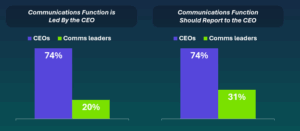
What accounts for this divide? CCO remains a relatively new position in the C-suite and not all companies have yet adopted it. Additionally, because communications are so visible – and often have the CEO’s name attached – many may believe that the buck stops with them and they need to maintain ultimate control.
Of course, the CEO is the ultimate arbiter of most things in an organization. But this clear division of opinion could cause problems, especially when it comes to respecting the opinions of the head of communications, whatever their title may be. Frank discussions may be necessary.
The other major area of disagreement was around when companies should speak up on major issues of the day.
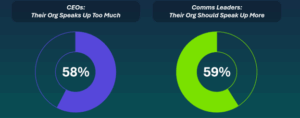
Perhaps not surprisingly, CEOs, who must think of the bottom line, think their company is too vocal on issues. Comms leaders, who often value transparency, think companies should take a more active role.
The answer, as it so often does, may lie between the two extremes. Even with a volatile political climate, companies must stand for something or they’ll stand for nothing. They also must protect their interests, even if it may cause pushback. At the same time, companies must carefully decide where their voice can add value and where it only adds noise.
Click here to download more results from the survey.
Allison Carter is editorial director of PR Daily and Ragan.com. Follow her on LinkedIn.
The post This is how CEOs view communicators as AI use becomes near universal appeared first on PR Daily.