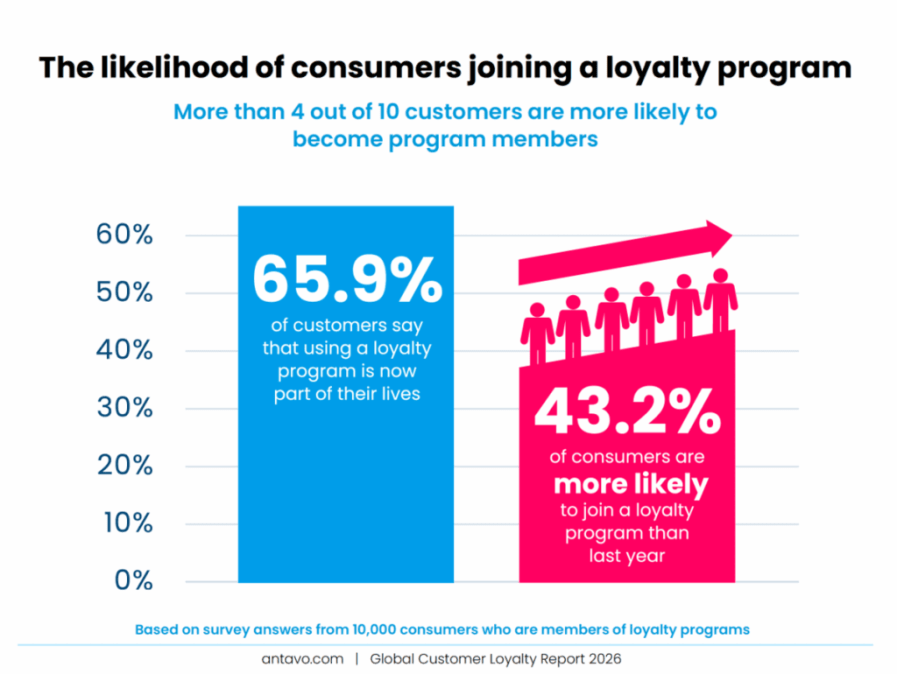
Loyalty programs are entering what many would call a golden age. Satisfaction and ROI are at record highs, and 89.4% of program owners are confident that loyalty drives value they would not get otherwise. On the consumer side, interest is rising too: 43.2% of customers say they are more likely to join a loyalty program than last year, and 65.9% say loyalty is now part of their everyday lives. At first glance, this sounds like alignment. Brands are investing more. Consumers are joining more. Everyone wins. But beneath these strong topline metrics lies a critical issue that marketers cannot afford to ignore: the loyalty perception gap.
All the statistics in this article are from Antavo’s Global Customer Loyalty Report 2026. Make sure to download it for more regions, global and industry-based findings on loyalty and AI.
Marketers think they deliver value, but customers disagree
When marketers and consumers were asked the same question, the results revealed a striking disconnect. 82.6% of marketers believe their loyalty program makes customers feel valued. Only 56.2% of customers agree. That 26-point gap is not a rounding error. It is a strategic warning sign.
The same overestimation appears elsewhere. 51.0% of marketers believe customers only shop with brands that offer loyalty programs, but just 29.7% of consumers say that is true. In other words, brands may see loyalty as a differentiator, while customers see it as a hygiene factor. The implication for marketing leaders is clear: delivering value is not the same as being perceived as valuable.
The root cause: transactional thinking
Consumers are explicit about what motivates them to join and engage. The top driver is still financial value. 70.8% join for money-saving benefits such as coupons, vouchers, or cashback. Free products and services come next at 46.3%, followed by personalized offers at 41.6%. Saving money gets customers in the door. But it does not automatically make them feel valued.
The biggest disappointments tell the real story. 49.1% of consumers say it takes too long to earn rewards. 41.1% are frustrated by rewards expiring before they can use them. 38.9% find rewards unattractive.
From a behavioral perspective, this is critical. When rewards feel unattainable, loyalty shifts from motivation to frustration. Unused points are not just an accounting metric. They are a signal of disengagement. In 2025, 27% of earned points were left unspent, and 12% expired. If value is promised but not realized, customers do not feel rewarded. They feel misled.
The silent churn problem
Perhaps the most concerning insight is not about enrollment but retention. Data from 500 million member interactions shows that 74% of members quietly quit within two months, meaning they stop engaging while remaining enrolled. Only 3.4% actively opt out. This is the paradox of modern loyalty. Membership is high. Opt-out is low. Engagement is fragile.

For marketers enrollment metrics can create a false sense of security. A growing member base does not equal a growing relationship. Repeat purchases may reflect habit, not attachment. And habits are easy to break when a competitor offers a better deal or more seamless experience.
Why the gap exists
There are three likely reasons behind the perception gap.
- Bbrands focus on what they can measure. Engagement rates, redemption rates, incremental sales. These are essential KPIs. But customers judge value emotionally, not just economically.
- Complexity erodes perceived value. Lengthy earning cycles, expiring points, and unclear rules create friction. Even small frictions accumulate into dissatisfaction.
- Loyalty has become normalized. As more brands launch programs, customers expect one by default. The bar has risen. What once felt special now feels standard.
In short, marketers are operating in a competitive loyalty economy where differentiation requires more than points.
Closing the gap: what marketers should do next
For CMOs and CRM leaders, the path forward is not about abandoning transactional benefits. It is about building on them.
- Make rewards feel achievable.
Shorten earning cycles. Introduce micro-rewards. Offer early wins within the first 30 days. Momentum matters more than theoretical lifetime value. - Rethink expiration policies.
Expiring points may protect liability on the balance sheet, but they damage emotional equity. If expiration is necessary, pair it with proactive reminders and easy redemption options. - Shift from enrollment KPIs to engagement KPIs.
Track early inactivity signals. Measure time-to-second-action. Monitor the first 60 days closely, where most quiet quitting happens. - Balance transactional and emotional loyalty.
Financial incentives attract. Recognition, personalization, and convenience retain. Feeling known and understood often outweighs another 10% discount. - Use data to listen, not just to optimize.
Loyalty programs generate rich behavioral signals. Use them to identify frustration points, redemption bottlenecks, and dormant segments. Perception improves when friction declines.
The strategic takeaway
Loyalty programs are stronger than ever, and consumers are more open to joining them. But the real competitive edge lies in perception. The brands that will win in the Value Age are not those that simply offer rewards. They are the ones that consistently prove, in small and frequent ways, that membership is worth it.If you’re exploring how ways to launch or revamp a loyalty program with a next-gen loyalty technology, book a call with Antavo’s loyalty experts. And don’t forget to download our report!