A year ago, SEO success meant asking: “Do you rank for your target keywords?”
Today, the question is entirely different: “When someone asks an answer engine about your category, does your brand show up in the answer?”
If not, and you’re absent from the responses generated by ChatGPT, Perplexity, Gemini, and Copilot, then you’re invisible where it matters most. You might technically “rank” on traditional search results, but you’re missing from the conversations that are actually shaping buying decisions.
Today, marketers need to rethink visibility. Showing up in AI-generated answers requires a new type of authority: being cited, not just indexed; being referenced, not just ranked. AI challenges marketers to expand beyond traditional SEO mechanics into a world where credibility, consensus, and reputation matter far more than keyword density.
As Kevin Indig, Growth Advisor at G2, puts it: “Even though we’re talking about synthetic knowledge, that knowledge is actually built on human intelligence.” AI isn’t creating answers from nothing — it’s deciding which human sources deserve to be cited. And right now, it might not be choosing yours.
To understand this shift, we first need to examine what it truly means for marketers to transition from a click-driven world to a citation-driven world.
TL;DR
- SEO has shifted from ranking for keywords to being cited in AI-generated answers, making citations the new measure of visibility.
- Answer engines (ChatGPT, Perplexity, Gemini, Copilot) pull from multi-source human intelligence, favoring brands with consistent, structured, and trustworthy information across the web.
- A new KPI stack includes citation frequency, AI answer inclusion rate, source diversity, sentiment-weighted authority, snippet ownership, and hallucination rate.
- Brands winning AI visibility today succeed across Reddit, G2, documentation, and answer-first content, creating clarity and consensus for LLMs to reference.
- The future of SEO is about being referenced, not clicked, as AI agents increasingly evaluate brands, synthesize recommendations, and shape buying decisions.
What does the shift from clicks to citations mean for marketers?
Shifting from clicks to citations means that visibility is no longer measured by traffic, but by how often AI tools pull from and reference your brand across the web. The core purpose of a search engine was to index the web and present a list of links for a user to click. The core purpose of an answer engine, however, is to synthesize information from the web and present a single, definitive answer. This fundamental difference has reshaped the entire marketing funnel.
Buyers are increasingly relying on AI-generated answers for everything from product comparisons and troubleshooting to vendor evaluation. This shift demands a new kind of digital presence — one distributed across communities, reviews, forums, technical documentation, and expert-led content. AI favors ecosystems rich in perspective, diversity, and authenticity.
For marketers, this shift in buyer behavior fundamentally changes where influence is earned. If buyers are getting their answers directly from AI tools, then the traditional strategy of optimizing only for your own website is no longer enough. Visibility now depends on whether AI systems recognize your brand as part of the conversation. That means marketers must ensure their information is consistent, trusted, and present across the wider ecosystem — not just on their blogs, but in reviews, community discussions, documentation, and third-party content.
To see why citations have become the new currency of discoverability, we need to understand what’s happening behind the scenes as AI shifts from search engines to answer engines.
Why citations now matter more than ever?
The fundamental shift in how users discover information has transformed what matters for digital visibility. Search engines retrieve links; answer engines retrieve context — synthesizing information from multiple sources to construct complete answers.
The decline in click-through rates (CTR) is well-documented. When an AI overview appears in search results, the CTR for even the top organic result can drop precipitously. The logic is simple: if a user’s question is answered directly within the AI interface, there’s no compelling reason to visit your website.
This elevates citations into the most valuable currency in digital visibility.
Here’s what’s changed for SEO today:
Visibility over traffic
Even without generating a single click, earning a citation in an AI answer establishes your brand as the definitive expert on a topic. You become part of the answer itself.
Trust and authority
AI models are engineered to prioritize factual accuracy, credibility, and authoritative sourcing. When your content is cited, it means the systems have identified you as a trusted source worth referencing.
Brand authority over click volume
Consistent citation across key industry topics fundamentally shifts market dynamics. We’re moving from a “click economy” to one centered on brand authority and expert visibility, where being recognized matters more than being visited.
But if visibility is no longer measured by rankings or clicks, the natural question becomes: what should marketers measure instead? That’s where the new key performance indicator (KPI) stack for AI search emerges.
Want to dig deeper into how you can help your brand appear in AI-generated answers? Watch this webinar.
What is the new KPI stack for AI search?
Traditional SEO KPIs, such as organic traffic and rankings, no longer tell the full story of visibility. AI discovery requires a new KPI framework focused on citations, authority, and multi-surface influence, not just clicks.
Citation frequency
Citation frequency is the primary metric that measures how often your brand or content is referenced across major AI platforms (like ChatGPT, Gemini, etc.). Also known as citation share of voice (C-SOV), it is the #1 metric for AI visibility — the closest equivalent to ranking #1 in a traditional SERP environment.
How to measure: Build a list of your top 25–50 category questions (e.g., “best CRM for SMBs). Run these prompts weekly across multiple LLMs and document every instance where your brand is mentioned or cited. Tools like Profound, BrightEdge Copilot, or Perplexity dashboards can automate this.
Pro tip: C-SOV = (Your brand citations ÷ Total citations across competitors) × 100
AI answer inclusion rate
This metric tracks how often your brand appears within the body of AI-generated answers for your target prompts. While citation frequency measures all mentions, AI answer inclusion rate (AAIR) measures whether your brand is actually part of the synthesized narrative. A high inclusion rate means the model understands your positioning and considers you a key entity in the category.
How to measure: Build a recurring LLM answer report with your target prompts. For each answer, score whether the model includes your brand as a recommended solution, a comparison point, a referenced case study, or a knowledge source.
Source diversity score
Source diversity score (SDS) measures the breadth of authoritative surfaces where your brand appears. AI models usually trust brands with a “wide footprint” across forums, review platforms, expert blogs, documentation, Reddit threads, niche communities, and third-party editorial content. A brand with presence on only its own website will struggle to appear in AI answers, even if it ranks well traditionally.
How to measure: Create a main list of the top surfaces influencing your category, such as Reddit, G2, TrustRadius, Quora, StackExchange, GitHub, YouTube explainers, analyst reports, and LinkedIn expert posts. Track where your brand appears, how often, and with what depth. SDS improves as you increase both volume and variety of sources referencing your brand.
Sentiment-weighted authority
Sentiment-weighted authority (SWA) measures not only how often your brand is mentioned across the internet, but how positively it is discussed. AI models interpret sentiment as a trust signal. They are more likely to cite brands associated with positive user experiences, constructive reviews, technical accuracy, and strong community feedback. SWA is one of the emerging KPIs that blends reputation management with SEO and community influence.
How to measure: Use sentiment analysis tools to evaluate sentiment across key surfaces: reviews, community posts, technical threads, and social commentary. Multiply your total mentions against sentiment polarity (positive, neutral, negative). High positive sentiment dramatically increases AI citation likelihood, while even a small amount of negative sentiment in technical communities (e.g., GitHub issues, Reddit critiques) can suppress your authority in LLM outputs.
Snippet ownership score
This metric measures how often your brand controls the core explanatory segments that AI models extract to construct their answers. While C-SOV measures mentions, snippet ownership score measures who owns the explanation. If your phrasing, definitions, frameworks, or methodologies appear inside the body of an AI-generated answer, even without explicit brand attribution, you have snippet ownership.
How to measure: Regularly run prompts across major AI platforms and compare the generated phrasing against your own website content, documentation, and thought leadership. Look for similarities in definitions, step-by-step instructions, feature explanations, or frameworks. Tools like Profound or manual semantic similarity checks can help identify high overlap.
Hallucination rate
Hallucination rate measures how often AI models generate incorrect, fabricated, outdated, or misleading information about your brand. As LLMs attempt to “fill gaps” when data is incomplete or inconsistent, hallucinations become increasingly common — especially for brands with a limited footprint or ambiguous entity signals.
How to measure: Evaluate hallucination rate by running structured brand-truth prompts across AI platforms. Test critical questions such as: “What does [Brand] do?” or “Who are [Brand]’s competitors?”. Document discrepancies between the AI-generated responses and your verified brand truth.
Some brands are already operationalizing this new KPI stack — and their tactics reveal what winning looks like in the citation-first era.
How leading brands are winning with citation-first SEO?
Most brands assume AI visibility is won through sharper optimization or better-written blogs. But the brands that show up on answer engines are the ones that have mastered two things: distributed trust signals and answer-first content.
Some of the biggest visibility gains are happening on platforms marketers once overlooked, like Reddit. When users describe real experiences, present strong points of view, and edge cases in long-form threads, they create the kind of human truth that AI systems gravitate toward.
Brands that show up organically in Reddit discussions often find themselves appearing in AI answers ahead of larger, better-funded competitors.
“To do Reddit right, you literally just have to act like a human.”
Rob Gaige
Global Head of Insights at Reddit
At the same time, review ecosystems like G2 have become critical “proof layers” for AI systems. LLMs look for consistent, cross-validated information, and G2 provides exactly that: verified reviews, detailed feature descriptions, competitive comparisons, and data-rich category positioning. When your brand’s information is coherent across G2, your website, and third-party sources, AI models encounter fewer contradictions — and cite you more frequently.
Recent Semrush research of 230K prompts confirms that LLMs overwhelmingly cite community-driven and expert-led platforms over traditional websites.
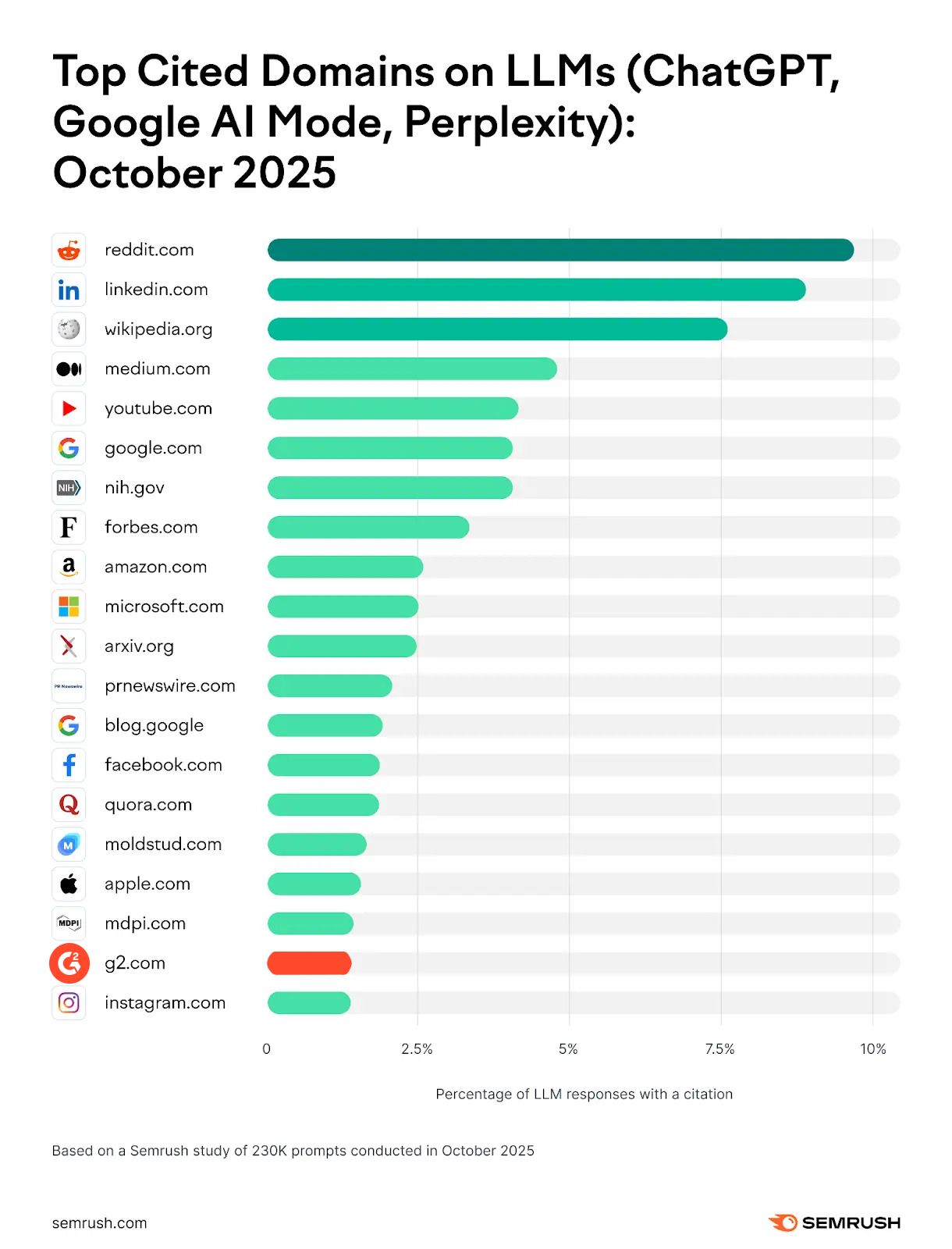
As search has drastically changed, answer first content is the key to cite on LLMs. Leading brands, such as Semrush, Zapier, HubSpot, and even smaller SaaS tools, are internalizing this shift. They are not writing for clicks; they are writing for retrieval, clarity, and extractability. So it’s safe to say that AI models lean toward content that’s easy to retrieve, clearly written, and straightforward for them to interpret and quote.
What will the future of SEO metrics look like?
We’re entering an era where digital visibility no longer starts with a search bar — it starts with an answer. And as AI agents become central to how people evaluate tools, compare vendors, and make decisions, the brands that win the SEO game will be the ones that invest in the accuracy, consistency, and clarity those systems depend on.
According to G2’s AI Agents Report, “Nearly half of global organizations believe that by 2030, SaaS products and AI agents will operate in coordinated orchestration roles”. This means AI will increasingly evaluate content, interpret brand positioning, and synthesize recommendations without human prompting.
As AI models read and reinterpret content every day, they reward brands that maintain coherence across every surface — G2 profiles, documentation, community-building platforms, partner content, and answer-first resources. Those who invest early in this ecosystem are already seeing a rise in citation frequency, accelerated discovery, and more accurate representation in AI outputs.
“You need to invest equally in SEO and AEO visibility… we’re in an in-between era.”
Sydney Sloan
CMO Advisor at G2
So, I guess it’s safe to say that SEO is not dying; it is simply evolving into a much more nuanced, content-quality-driven discipline. The challenge for modern marketers is to embrace the age of AI and transform their mindset from clicks to citations.
FAQS
- What is citation-first SEO?
Citation-first SEO is an approach that optimizes your brand so that AI systems can easily understand, trust, and cite your information in generated answers, rather than just ranking your pages on SERPs.
- How can brands increase their chances of being cited by AI models?
Brands improve citations by building a clear, consistent, and multi-surface digital footprint. This includes maintaining accurate profiles on G2, cultivating real discussions on Reddit and communities, publishing answer-first content built for extraction, and removing contradictions across the web.
- What is the difference between SEO and AEO?
Search engine optimization (SEO) focuses on helping your content rank in traditional SERPs. Its goal is to drive clicks by optimizing for keywords, backlinks, and on-page relevance so Google can index and rank your pages.
Whereas answer engine optimization (AEO) focuses on helping your brand appear inside AI-generated answers from systems like ChatGPT, Gemini, Perplexity, and Copilot. AEO ensures AI models understand your brand clearly enough to cite it in responses.
Want a deeper breakdown of how AI reshapes discovery and demand? Watch G2’s full webinar on capturing demand in the LLM ecosystem.
Edited by Supanna Das