Not every trend needs your brand’s voice and jumping into all of them can backfire.
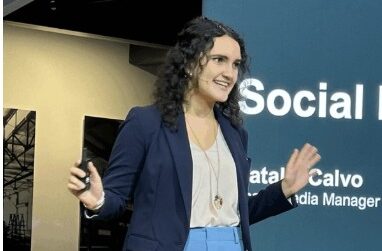
Natalie Calvo, head of social media at Prologis, has built a path into social media that was shaped by curiosity. Torn between interests like economics and chemistry, Calvo chose communications as a way to explore both, building a career rooted in continuous learning. That mindset has carried her from agency work at Burson to leading social strategy at Prologis, where she now navigates complex topics like electrification and energy. But her approach to communication was also shaped much earlier at home.
Calvo grew up in a Cuban-American household where Spanish was spoken at home to preserve her family’s culture. While she was fluent conversationally, her professional training was in English and AP style, creating a gap in how she could communicate professionally in Spanish. That influenced her decision to start her career in Chicago instead of Miami, where it was home to Spanglish. Today, she uses Spanish daily with a Peruvian direct report living in France, strengthening both her fluency and confidence in a global role.
What originally drew you to communications and eventually social media?
When I was in school, I was really interested in everything. So when I was trying to decide my major before I started college, I was between economics and chemistry and a couple of other things.
I decided that if I went into communications, then I could communicate about economics, or I could communicate about chemistry, or I could communicate about anything I was interested in. In my mind, it was a way to have my career be focused on education for myself while still doing something that I cared about and having the ability to switch between one thing and another.
My mom was a teacher, so the concept of learning was really fun for me. I feel like to be able to communicate about any subject, you have to become knowledgeable enough — almost more knowledgeable than the people who are actually doing the thing — to then be able to speak on it. So I got to work with the American Chemistry Council when I was at Burson, and now I work in industrial real estate, which is something I knew absolutely nothing about before I joined this company. Through it, I get to learn about EVs, electrification and energy worldwide.
Social media specifically came from trying to get experience. Every job description asked for experience, even in unpaid roles. So I got a job at an SEO firm, where I wrote content for different organizations’ websites and pitched stories to get published. I was 19, writing about diabetes and mortgage advice, which is why you should never take advice you read on the internet. But it got my foot in the door in digital, and when I interviewed at Burson-Marsteller, they placed me in a digital internship. Since digital was largely social media, that’s how I ended up in the social media niche.
How would you describe your social media strategy today?
I would say that my social strategy is very people-first versus company-first.
Even though I’m in charge of my company’s pages, the time I dedicate to those pages is the smallest part of what I do. We might post three to four times a week, and in the in-between time, I focus on supporting employees and making sure they’re telling their own stories, because people care a lot more about what a person has to say than what a company has to say.
That depends on the company, of course. Everyone cares what Disney has to say, or what Oreo has to say. But when it comes to something more niche — like industrial real estate or plastics manufacturing — no one is going out of their way to follow a company. They want to follow the people who are talking about it.
There are no influencers who are passionate about industrial real estate, so the people telling the story are employees, brokers or competitors. The best way to tell the story is through employee channels, where we can share details that matter to us, not just what drives a sale. To me, it’s not about making sales via social media — it’s about telling a brand’s story, and the most credible place for that is when it’s coming from not the brand.
What’s one social media trend companies are overthinking right now?
I think there are a lot of videos on TikTok or Instagram Reels that every brand wants to comment on. They want to add their own funny comment just to show that the brand exists.
But when negative stories happen, everyone is in the comments saying, “Where’s the brand with their cute comment now?”
So when you establish yourself as a chronically online brand, and then a moment happens where you need more time to think, people assume you’re choosing to ignore them.
That’s not the case. The brand is trying to be strategic and develop a response that works for customers and the business. But that’s not the reputation they’ve built. So commenting on everything right away is probably a trend that’s overhyped.
What’s a lesson from working with clients that still sticks with you?
In the social media space, everyone thinks they know how things should work.
Early in my career, I’d get asked to do things I didn’t know how to do, and I would panic. I had a manager, Matt Kelly, who told me to stop and think about it. None of the people on that call did social media for a living — they did it as a hobby.
He said, if you don’t know how to do the thing they’re asking, do you think it’s actually possible, or did they make up a feature? That gave me confidence to say, no, I know what I know, and I’ll correct myself later if needed.
As someone who lives and breathes the space, I can say the thing you’re asking for doesn’t exist yet. It’s a great idea, but it’s not something I can deploy. Instead, here’s something that will have a similar effect.
The takeaway is everyone thinks they know a lot about social media, but you’re the one who knows the most, because it’s your job, not theirs.
How are you thinking about generative AI when it comes to social content now?
Reddit is the No. 1 feeder, LinkedIn is No. 2, based on Perplexity, Gemini and ChatGPT responses. So the work I do needs to feed back into those sources and give people accurate information about my company.
I look at what questions come up naturally on X that people are asking Grok, where I’m tagged or my company is mentioned. Then I check if we have content that answers those questions in a way that reflects how we want to be represented.
If we don’t, I think about how to incorporate that information into future social posts without deviating from our strategy or voice.
And if it doesn’t belong on social, I work with our communications team. That might turn into a blog, podcast, case study or another format. They’re not seeing these questions the way I am. As someone who lives and breathes social media, I have a front-row seat to it and can pull others in to help fill those gaps.
What kind of content do you enjoy most personally?
Every day for the last 84 or 85 days, when I’m getting ready to go to sleep, my husband and I pull up the Daily Duck on TikTok.
There’s a woman whose dad was going to throw away an old painting, and she decided to keep it. Every day this year, she’s adding a new duck to it. What started as a generic ocean scene now has more than 80 ducks.
There’s a duck hot air balloon, a duck version of Moira Rose, a duck lifeguard and even a Titanic scene with Jack and Rose. She did a whole pirate week with a duck Jack Sparrow and a duck kraken.
That’s the post I stay awake for every night. Everything else I might enjoy, but the duck is the consistent part of my day.
What’s something you learned recently that surprised you?
On Outlook, there’s a time zone feature I didn’t know about. When you’re scheduling meetings, you can add multiple time zones so you can see them all at once.
Now, when I look at 9 a.m., I know that’s 6 a.m. in California and 2 p.m. in France. I used to do the math, but now it’s just there.
That matters because my boss is in California, I’m in Florida and my direct report is in France. I only overlap with my direct report for about three hours a day, and daylight saving time changes don’t always line up globally. So having that visibility has been pretty revolutionary for me.
Isis Simpson-Mersha is a conference producer/ reporter for Ragan. Follow her on LinkedIn.
The post Prologis’ head of social on why people-first beats brand-first appeared first on PR Daily.