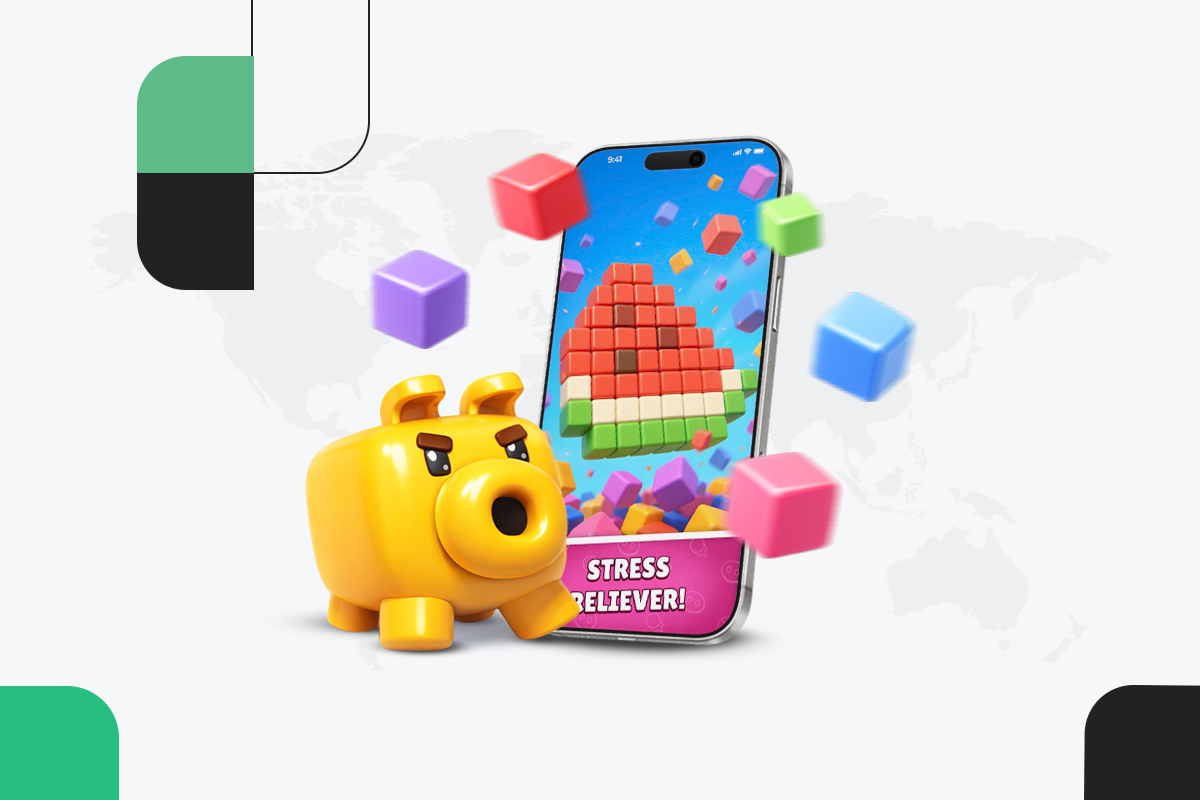
Pixel Flow launched in August 2025 with no publisher and a team of about ten people. A few months later it was making over half a million dollars a day. Here’s what they got right.
Quick facts:
- Genre: Color Shooter / Sort hybrid
- Developer: Loom Games (~20 people, Turkey)
- Launch: August 17, 2025
- Peak daily revenue: ~$550K (IAP + ads)
- Daily active users: ~1M by December 2025
The Core Loop: Simple Idea, Smart Constraints
The basic concept is easy to explain: colored shooters clear matching pixel blocks to reveal an image underneath. You get it in the first thirty seconds.
What actually makes it interesting is everything built around that concept. Slot limits, a conveyor belt, a rotating tray, a recovery bench. Each one adds a layer of pressure. Take any of them away and the game becomes trivial.
There’s also a mechanic called slinging — if you’re fast enough, you can chain inputs and temporarily push past your limits, recovering boards that looked unsalvageable. It rewards players who pay attention, which is less common in this genre than you’d think.
What this produces:
- Longer sessions than most sort games
- Better mid-term retention among engaged players
- Players who keep coming back to get better, not just to pass time
The downside is that it’s not for everyone. Casual or distracted players tend to drop off earlier than they would in a more forgiving game. But the ones who stick around play for close to an hour a day — and that makes the monetization math work.
Visuals: Familiar on Purpose
The art style isn’t trying to be original. Cartoon characters, cute animals, recognizable proportions. It deliberately stays close to what already works without copying any specific IP.
That choice pays off in two ways:
- In-game: clean, high-contrast visuals that are easy to read when things get hectic on the board
- In ads: watching a pixelated image come together as blocks disappear is immediately satisfying to watch, even if you’ve never played, which makes for strong marketing creatives
Getting both out of the same art direction is an efficient use of resources, and the download numbers suggest it’s working.

Monetization: Protecting the Difficulty
The IAP setup is straightforward, and that’s intentional.
How it works:
- Boards are fully deterministic, no random reshuffles to bail you out
- Rewarded ads don’t let you skip the hard parts
- Interstitials run on failure and after wins
- No airplane mode workaround
When you fail in Pixel Flow, it’s your fault. That keeps frustration intact as a reason to spend. The ads create enough friction that the Remove Ads purchase feels worth it. It’s a system where ads and IAP reinforce each other rather than compete.
By December 2025, IAP was bringing in over $300K per day, with ads adding another 30–40% on top, around $550K total daily.
On the geographic side, the US makes up about 9% of revenue and the UK around 5%. That spread across markets means lower average user acquisition costs, which keeps the whole operation more sustainable.

What Comes Next
Clones are already here. A Vietnamese studio launched a close copy that scaled to around $140K per day pretty quickly. More will follow, and as the category gets crowded, user acquisition gets more expensive for everyone.
The pressure points:
- Rising costs as more studios compete for the same players
- Needing to ship content faster than competitors can copy it
- Keeping acquisition costs below what players are actually worth
The game has real structural advantages; high session time, a difficulty curve that sustains spending, a monetization setup that doesn’t cannibalise its own engagement. Whether that’s enough to stay ahead of a crowded category is the question worth watching.