Lior Eldan
24 December 2025
As both Apple’s App Store and the Google Play Store have grown, it has become increasingly important to stand out and ensure you are doing everything within your power to maximize your engagement opportunities in both stores.
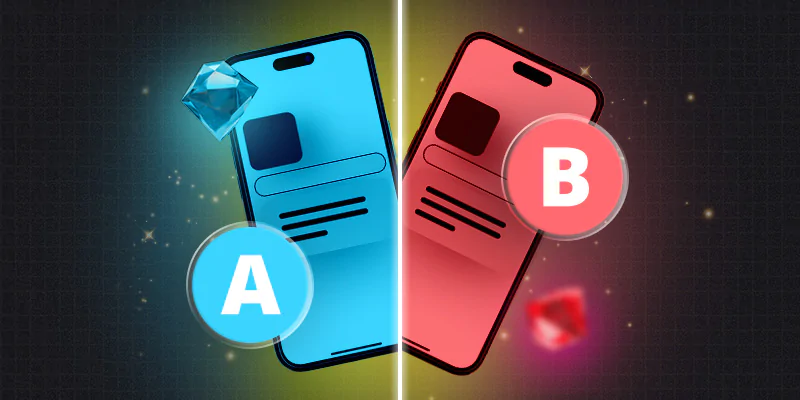
A great way to do so is through conducting mobile app A/B testing. It ensures that you’re constantly improving, and it’s a very tangible and methodical way to improve conversion rates and increase results generally.
What is Mobile A/B testing?
A/B testing simply means that you create two versions of something where each one is slightly different and test them against each other with an audience sample. In the mobile marketing world, it can refer to testing two versions of an ad, app store screenshots, or in-app experience, to name just a few. From the test results, you can determine which performs best according to your KPIs.
The easiest way to test versions against each other is by ensuring there’s only one single difference between each, so you can attribute any change in results to that aspect. Just to give you an amuse bouche, a difference can be in the text (body or headline), banner image, target audience, and more.
Each version is displayed to a different audience, and their results help us determine which ad works better. Some sort of a digital focus group, if you will. Just to make sure it’s clear, we’ll give an example:
You have an ad; however, you’re not sure what the CTA button should say. You and your colleagues are debating between two versions. So what do you do? Make both, of course. Then you divide your audience in half and send a different ad to each, and see which version is more engaging and comes up with better results.
Mobile App A/B Testing Best Practice in 2026
A strong test starts with a hypothesis, not a hunch.
Instead of “Let’s change the first screenshot and see what happens,” anchor your test in evidence:
-
What do reviews complain about?
-
Where do users drop off in the funnel?
-
Which value props are driving the best quality users?
-
Which competitor patterns repeat across the category?
Then form a clear hypothesis, for example:
“A screenshot showing the app dashboard will convert better than a lifestyle image because it reduces uncertainty and clarifies what the user gets immediately.”
Timing still matters: run tests long enough to cover weekday and weekend behavior. Google explicitly recommends running store listing experiments for at least a week to account for traffic pattern differences.
Also, avoid running tests when outside forces will distort results (major seasonality spikes, big PR moments, product outages, or large acquisition shifts). And do not change other variables mid-test, since it compromises the conclusions.
What is Statistical Significance?
Throughout this article, you’ll find numerous references to statistical significance, so we thought it would be a good idea to introduce you to the concept.
Statistical significance is identifying what the probability of the test results is to be true to the overall population. It shows how likely it is that the difference between your experiment’s control version and test version isn’t due to error or random chance. For example, if you run a test with a 95% significance level, you can be 95% confident that the differences are real.
Statistical significance is used to better understand when tests or variations need to stop running. Tests or variations aren’t usually stopped before they reach significance unless other considerations are at play, e.g. too many variations, time or budget constraints, etc.
The preliminary work to an A/B test involves calculating the amount of samples needed per variation in order to achieve statistical significance. This relates to the experiment’s accuracy. The more samples there are, the more statistically significant the test is likely to be.
If the difference between the best performing and worst performing variations are not statistically significant at the end of the test, that means the test was inconclusive.
How to A/B Test The Right Way in 2026?
There are a few guidelines to do it right, in a way that will bring concrete results, which can give us essential information to guide future mobile app A/B testing strategy as well.
One Variable
The test versions should be completely similar, with only one difference. This is perhaps the most important aspect of the testing. If you test both a different color and text, how will you know which made the difference? Did version A convert better than version B because the text was more persuasive, or because the picture caught attention?
Also, more variations means less clicks per variation (it divides the total amount of traffic we bring to each version more), thus making the experiment harder to conclude. Less traffic to each variation provides less statistical significance.
ABCD Test
Testing only one element at a time could mean that if you want to test screenshots with a different background and different text copy, you must make two variations with the same background and different copy, and two more variations with the same copy and different background.
The first variation is always the reference point, which in many cases when it comes to screenshots, is the currently active store variation. For example:
- Variation A: Current (live on the store)
- Variation B: New Design (same copy as variation A)
- Variation C: New Copy (same design as variation A)
- Variation D: New Design + New Copy
Audience
An audience size of only five people is not sufficient to determine what works and what not. For such a test, you need to reach a large enough audience to achieve good results. However, when doing so, make sure not to overlap with another campaign that might be live. If a person sees two different ads for the same app, the result might be biased.
You need a significant amount of traffic to each version to reach statistical significance, as touched upon above.
Time Frame
The general conception for a test’s time frame is not fewer than seven days, and up to fourteen days. This is enough time to assess the numbers across weekdays and weekends, where traffic differs, and leaves enough time for the test to warm up.
However, remember that this is only a test and not the actual campaign, so you’d want to end it in time so you can get to the real deal.
Budget
Every aspect of such a test on social networks or the app stores comes with its cost. On the one hand, it’s recommended not to spare any expenses to achieve the best results. However, remember it’s just a test. Save money for the real campaign you intend to run after you have the results of your A/B test. The minimum amount for a split test on Facebook is $800, so you can start with that and control your expenses.
Strategies
Almost every single part of your app store presence can be tested and improved upon. Below we’ve highlighted some key areas to look at first when it comes to the ultimate app store testing strategy.
1. Keywords
While keywords pack the least amount of ASO “power” (when compared to factors such as title and subtitle on iOS, or title and short description on Android), they are definitely an area in which ASO performance can be lifted. And when it comes to testing keywords, not only should individual keywords be tested, but also the interplay between keywords and images. Important questions to ask at this stage when testing your keyword strategy are:
- Should we focus on broader keywords or very narrow keywords for specific niches?
- Should we use more provocative keywords?
2. App Title & Subtitle
The app name and description don’t live in isolation. They have to be an integral part of the keyword and creative strategy. The big question is: should you go for the most competitive terms with the most traffic, or go for long-tail keywords that will get you ranked easier for these niches?
3. Icon
The app icon is extra critical because depending on how a user got to your app, it might be the only creative they see before deciding to go ahead and explore further. Testing here should include:
- Colors
- Images vs sketches vs logos
- On Google Play – should the background be round or in another shape?
- Design (e.g. “flat” vs 3D)
4. Creatives
It’s interesting to note that even the biggest apps in the world are testing and changing around their creative assets four to five times every month.
When it comes to testing your creatives, it includes everything from:
- Images vs video (e.g. using just screenshots or screenshots in addition to an app store preview video)
- Aspect ratios (resolutions and sizes like iPhone 6s vs iPhone 12 Pro sizes)
- Which aspect of the app to show first (order of the unique selling propositions)
- Design style and colors
- Captions and call to actions on top of the screenshots
- Layout (portrait vs landscape)
- Look and feel (think “busy” versus “minimalist”)
- Screenshots, specifically individual screenshots or composite images
What to A/B Test?
Now it’s time to get serious!
Which aspects of your campaign do you want to test? Here are a few possibilities:
Test Components
You are going live with an ad or app store screenshot update – should it be red or green? Should the title say “learn more” or “sign up”? These are aspects that can prove crucial, and you can try two versions and see which works best. However – as written before – make sure to only test one component at a time. If you are not sure about several aspects you can run multiple tests, but not simultaneously.
Age groups
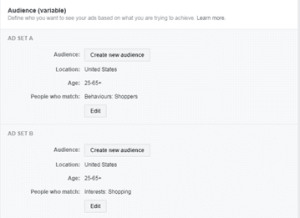
Is your app better for kids, teens, millennials or older adults? You can see which age group reacts better to it through A/B testing. This aspect can also give you deeper insights into your app, and not only to the specific ads, app page or screenshots you’re testing. Don’t forget to find appropriate age groups – don’t advertise an app for baby food to pensioners.
Location – States/ Countries
Who responds better to your app – Americans or Australians? East Coast or Midwest? You can test this simply by targeting two groups who live in different places and see who reacts better. Note: in this scenario you need to send the same exact variations to both groups.
A/B Testing on Meta (Formerly Facebook)
So, you’ve decided what you want to test, how you want to test it, created your ads and everything is ready. Now what? Facebook offers many tools to help with A/B testing, also known as Split Tests. Each tool is flexible and can be used wisely and differently for any app, taking into consideration time, budget and more.
One example can be found in a past campaign we ran, in which we tested the buttons. While the difference between “sign up” vs “learn more” may seem small and insignificant, the results were conclusive – one ad worked better than the other, and by far. Now, that doesn’t mean the other ad was wrong, just that for this specific ad of that exact product – one CTA worked better. That’s the importance of split testing.
Here are a couple of tools we regularly use when A/B testing on Facebook:
Auto/Manual Bid
Ever wondered which method delivers the best results? Facebook bid types allows you to test different methods of optimization. This tool enables you to decide if you want Facebook to run your ads automatically, or if you prefer to manually control them.
Lookalike Audience
With this advanced tool by Facebook, you can target people who are more likely to install your app. Facebook creates a broad list of potential users, based on similar characteristics to current users, and allows you to adjust the exposure percentage, i.e. how wide/narrow your targeted audience will be. You can try different exposure rates and determine which works best for you.
While the concept of A/B testing exists in digital ad marketing for many years, it took longer before Facebook created a simple tool for advertisers to run experiments conveniently with what they call Split Testing.
Testing For Success
Where testing really becomes effective, is when it is done continuously. By making continuous testing part of your ASO strategy’s DNA, you are sure to see results.
For more app store testing strategies, and for improving your app’s performance in general, get in touch with us. We’re the experts trusted by global brands to deliver the highest performance for their mobile apps, and we’d love to help you too.
Google Play Experiments
Google Play Console’s Store Listing Experiments lets you run free A/B tests on store listing graphics and localized text, and it reports outcomes like acquisition performance and even 1-day retention for variants.
Google’s own best-practice guidance is to:
-
Test high-impact assets like icons, video, and screenshots
-
Test one asset at a time for clearer learnings
-
Run tests for at least a week to cover weekday/weekend differences
iOS A/B Testing
A/B testing on iOS is no longer “unavailable.”
Apple’s Product Page Optimization (inside App Store Connect) allows you to test different app icons, screenshots, and preview videos, comparing up to three variants against your original product page, and then apply the winning variant broadly.
FAQs
Mobile A/B testing is when you create two (or more) versions of an asset or experience, show each version to different audience segments, and compare performance against a clear KPI (like install rate, conversion rate, or retention
Yes. Apple offers Product Page Optimization in App Store Connect, which lets you test different icons, screenshots, and preview videos. You can test up to three variants against your original product page and apply the best-performing option.
A common best practice is at least one full week, so results include weekday and weekend behavior. Longer tests may be needed if traffic is low or results are close.
Statistical significance estimates whether the observed performance difference is likely real or could be random chance. It helps you avoid calling “winners” too early, especially with limited traffic.
An inconclusive test is still useful. It often means either (1) the change was too subtle, (2) you need more traffic or time, or (3) the tested hypothesis did not meaningfully affect user decisions. Take the learning, refine the hypothesis, and test again.
Lior Eldan
Lior Eldan is the Co-Founder & COO of Moburst. As an ASO and Mobile media expert, Lior mentors and supports startups, helping them develop and execute their mobile marketing strategies.